


 |
市場調查報告書
商品編碼
2101690
汽車罩市場機會、成長要素、產業趨勢分析及2026-2035年預測Car Covers Market Opportunity, Growth Drivers, Industry Trend Analysis, and Forecast 2026 - 2035 |
||||||

全球汽車罩市場預計到 2025 年將達到 9.465 億美元,年複合成長率為 4.2%,到 2035 年將達到 14.2 億美元。
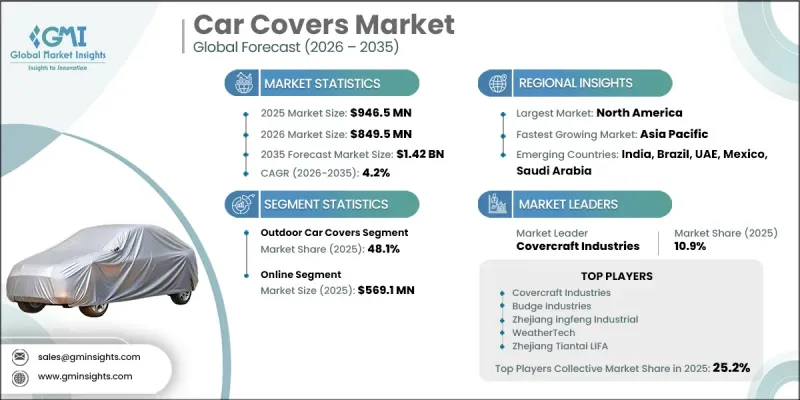
過去三年,該市場規模成長約9,700萬美元,反映穩定持續的成長,而非短期需求波動。市場成長的促進因素包括高階汽車防護配件的日益普及、電子商務滲透率的不斷提高以及人們對天氣造成的車輛損壞日益成長的擔憂。全球車輛數量的持續成長以及汽車擁有率的上升,進一步擴大了汽車防護配件的基本客群。此外,不斷上漲的更換成本促使消費者延長車輛使用年限,從而推動了對有助於保持車輛外觀和整體價值的產品的需求。開發中國家汽車擁有率的提高以及網路購物的便利性也進一步促進了市場擴張。此外,與標準產品相比,消費者對提供更廣泛覆蓋範圍、更高防護等級和更卓越整體性能的高階客製化產品的需求正在成長,這為製造商在預測期內提升產品價值和盈利創造了機會。
| 市場範圍 | |
|---|---|
| 開始年份 | 2025 |
| 預測期 | 2026-2035 |
| 上市時的市場規模 | 9.465億美元 |
| 預測金額 | 14.2億美元 |
| 複合年成長率 | 4.2% |
預計到2025年,戶外車罩市佔率將達到48.1%,銷售額將達4.554億美元。預計到2035年,該細分市場將以4.2%的複合年成長率成長。這一成長主要得益於在戶外停車普遍、車輛經常暴露於可能影響其外觀的環境條件的地區,消費者對車輛保護的需求不斷成長。消費者持續青睞能夠長期抵禦各種天氣變化的耐用產品,也有助於該細分市場主導地位。
預計2025年,線上銷售管道將佔據60.1%的市場佔有率,銷售額將達到5.691億美元,年複合成長率(CAGR)為4.5%。電子商務的持續擴張正在強化這個管道,它為消費者提供了便捷的途徑,讓他們能夠輕鬆比較各種車輛保護產品,並根據車輛的具體情況進行購買。消費者可以根據車輛規格、材質偏好、價格和使用需求有效地瀏覽產品,這進一步鞏固了線上零售在全球市場的主導地位。
預計到2025年,北美汽車罩市場規模將達到4.736億美元,佔50%的市場佔有率,到2035年將達到6.903億美元,年複合成長率(CAGR)為3.9%。成熟的汽車售後市場、高階汽車配件的普及以及消費者對高性能防護產品日益成長的偏好,共同推動了北美市場的成長。除了對客製化和全天候汽車罩的需求不斷成長外,對高階汽車護理產品的持續投資預計也將進一步鞏固北美在預測期內的主導地位。
目錄
第1章:調查方法和範圍
第2章執行摘要
第3章 行業洞察
- 產業生態系分析
- 供應商情況
- 原物料供應商
- 零件供應商
- 製造商
- 服務供應商
- 分銷管道
- 最終用途
- 成本結構
- 利潤率
- 每個階段增加的價值
- 垂直整合趨勢
- 顛覆者
- 供應商情況
- 影響產業的因素
- 市場促進因素
- 全球汽車擁有量增加
- 人們對車輛保護的意識日益增強
- 更多暴露於極端天氣事件中
- 汽車售後市場的擴張
- 對豪華汽車配件的需求日益成長
- 市場限制因素
- 分銷低價仿冒品
- 充足的室內停車設施
- 市場機遇
- 對專為電動車 (EV) 設計的車罩的需求日益成長
- 新興汽車市場的擴張
- 智慧汽車罩的開發
- 擴大與整車廠和經銷商的合作關係
- 環保汽車罩的需求日益成長
- 市場促進因素
- 成長潛力分析
- 價格分析
- 對過去價格趨勢的分析
- 依球員類型分類的定價策略(高級球員、超值球員、成本加成球員)
- 監管指南
- 北美洲
- 美國:遵守《消費品安全改進法案》(CPSIA) 和加州 65 號提案規定的化學品法規。
- 加拿大:《消費品安全法》(CCPSA)和《紡織品標籤法》
- 歐洲
- 德國:歐盟 REACH 法規和通用產品安全法規 (GPSR)
- 英國:英國REACH 法規與通用產品安全法規 (GPSR)
- 法國:歐盟 REACH 法規和生產者延伸責任 (EPR) 包裝法規
- 義大利:歐盟紡織品標籤法規(歐盟第1007/2011號)及REACH化學品合規性
- 亞太地區
- 中國:GB 18401《紡織品安全技術規範》與中國RoHS指令(如適用)
- 印度:印度標準局 (BIS) 的紡織品品質標準和法定計量(包裝商品)法規
- 日本:《家用物品品質標籤法》和工業標準(JIS)紡織品產品品質標準
- 韓國:KC產品安全認證和韓國生態標章標準
- 澳洲:澳洲消費者法 (ACL) 下的產品安全要求和原產地標示標準
- 拉丁美洲
- 巴西:INMETRO紡織品監管和消費者保護法(CDC)
- 墨西哥:NOM-004-SE-2021 紡織品標籤標準與聯邦消費者保護法
- 阿根廷:IRAM紡織品標準與消費者保護法(第24240號法律)
- 中東和非洲
- 阿拉伯聯合大公國:阿拉伯聯合大公國紡織品監管總局 (GSO) 和阿拉伯聯合大公國合格評定體系 (ECAS)
- 沙烏地阿拉伯:SASO紡織品技術法規與SALEEM產品合格評定計劃
- 南非:紡織品基本標準(NRCS)和消費者保護法(CPA)
- 北美洲
- 技術與創新展望
- 最新技術
- 新興技術
- 波特的分析
- PESTLE分析
- 專利分析
- 貿易數據分析
- 進出口量及進口額趨勢
- 主要貿易路線及關稅的影響
- 生產能力和生產情況
- 設備產能:按地區和主要生產商分類
- 運轉率和擴張計劃
- 人工智慧和生成式人工智慧對市場的影響
- 利用人工智慧改造現有經營模式
- 設計自動化最佳化
- 用於需求預測的供應鏈人工智慧
- 按細分市場分類的生成式人工智慧用例和部署藍圖
- 風險、限制和監管考量
- 永續性和環境方面
- 永續計劃
- 減少廢棄物策略
- 生產中的能源效率
- 具有環保意識的舉措
- 考慮碳足跡
- 預測假設和情境分析
- 基本案例:驅動複合年成長率的關鍵宏觀經濟與產業變量
- 樂觀情境:宏觀經濟與產業的順風
- 悲觀情景:宏觀經濟放緩或產業逆風
第4章 競爭情勢
- 介紹
- 企業市佔率分析
- 北美洲
- 歐洲
- 亞太地區
- 拉丁美洲
- 中東和非洲
- 競爭定位矩陣
- 主要進展
- 併購
- 夥伴關係和聯盟
- 新產品發布
- 業務拓展計劃及資金籌措
- 按公司規模進行基準測試
- 排名分類標準與選擇標準
- 按銷售額、地區和創新能力分類的層級定位矩陣。
第5章 市場估計與預測:依材料分類,2022-2035年
- 聚酯纖維
- 聚丙烯(PP)
- 聚乙烯(PE)
- 棉法蘭絨
- 聚氯乙烯/乙烯基
- 其他
第6章 市場估算與預測:依產品分類,2022-2035年
- 室內汽車罩
- 戶外汽車罩
- 全天候汽車罩
第7章 市場估價與預測:依車輛類型分類,2022-2035年
- 搭乘用車
- 掀背車
- 轎車
- SUV
- MPV/跨界車/其他
- 商用車輛
- 輕型商用車(LCV)
- 重型商用車(HCV)
第8章 市場估算與預測:依FIT類型,2022-2035年
- 通用型
- 半訂製款
- 訂製款
第9章 市場估價與預測:依銷售管道分類,2022-2035年
- 主要趨勢
- 線上
- 離線
第10章 市場估價與預測:依最終用戶分類,2022-2035年
- 主要趨勢
- 私家車車主
- 車隊營運商
- 租車公司
- 汽車經銷店
第11章 市場估價與預測:按地區分類,2022-2035年
- 主要趨勢
- 北美洲
- 美國
- 加拿大
- 歐洲
- 英國
- 德國
- 法國
- 義大利
- 西班牙
- 比利時
- 荷蘭
- 瑞典
- 俄羅斯
- 亞太地區
- 中國
- 印度
- 日本
- 澳洲
- 新加坡
- 韓國
- 越南
- 印尼
- 泰國
- 拉丁美洲
- 巴西
- 墨西哥
- 阿根廷
- 中東和非洲
- 南非
- 沙烏地阿拉伯
- UAE
第12章:公司簡介
- 世界公司
- Budge Industries
- CarCovers.com
- Classic Accessories
- Confezioni Andrea Italia
- Covercraft Industries
- Coverking
- OEMCover
- WeatherTech
- Zhejiang Mingfeng Industrial
- Zhejiang Tiantai LIFA Auto Accessories
- 當地公司
- California Car Cover
- Classic Additions
- Dalian RunDe Packing Technology
- JK Cover
- Polco Creations
- Seal Skin Covers
- Specialised Covers
- 新興企業
- Covergo
- Hangzhou Hongda Automotive
- MeetCover
The Global Car Covers Market was valued at USD 946.5 million in 2025 and is estimated to grow at a CAGR of 4.2% to reach USD 1.42 billion by 2035.
The market recorded an increase of approximately USD 97 million over the previous three years, reflecting stable and sustained growth rather than short-term demand fluctuations. Market growth is supported by the increasing adoption of premium vehicle protection accessories, expanding e-commerce penetration, and rising concerns regarding weather-related vehicle damage. Continued growth in the global vehicle population, combined with increasing vehicle ownership, is creating a broader customer base for protective automotive accessories. In addition, consumers are retaining vehicles for longer periods due to higher replacement costs, increasing the demand for products that help preserve exterior appearance and overall vehicle value. Improving access to vehicle ownership across developing economies and the growing convenience of online shopping are further strengthening market expansion. Demand is also shifting toward premium custom-fit products that provide improved coverage, enhanced protection, and better overall performance compared with standard alternatives, creating favorable opportunities for manufacturers to improve product value and profitability throughout the forecast period.
| Market Scope | |
|---|---|
| Start Year | 2025 |
| Forecast Year | 2026-2035 |
| Start Value | $946.5 Million |
| Forecast Value | $1.42 Billion |
| CAGR | 4.2% |
The outdoor car covers segment accounted for 48.1% share in 2025, generating USD 455.4 million, and is projected to grow at a CAGR of 4.2% through 2035. Growth is supported by increasing demand for vehicle protection in regions where outdoor parking is common and automobiles are regularly exposed to environmental conditions that may affect their exterior appearance. Consumers continue to prefer durable products that offer long-term protection against changing weather conditions, contributing to the segment's leading market position.
The online distribution channel represented 60.1% share in 2025, accounting for USD 569.1 million, and is expected to grow at a CAGR of 4.5%. Continued expansion of e-commerce has strengthened this channel by providing consumers with convenient access to a wide range of vehicle protection products, simplified product comparisons, and model-specific purchasing options. The ability to efficiently browse products based on vehicle specifications, material preferences, pricing, and application requirements continues to support the dominance of online retail within the global market.
North America Car Covers Market accounted for 50% share in 2025, reaching USD 473.6 million, and is forecast to attain USD 690.3 million by 2035, registering a CAGR of 3.9%. Regional growth is supported by a mature automotive aftermarket, widespread adoption of premium vehicle accessories, and increasing consumer preference for high-performance protective products. Rising demand for custom-fit and all-weather vehicle covers, along with continued investment in premium automotive care products, is expected to reinforce North America's leading position throughout the forecast period.
Major companies operating in the global car covers market include Budge Industries, CarCovers.com, Classic Accessories, Confezioni Andrea Italia, Covercraft Industries, Coverking, OEMCover, WeatherTech, Zhejiang Mingfeng Industrial, and Zhejiang Tiantai LiFA Auto Accessories. Companies operating in the car covers market are strengthening their competitive position by expanding product portfolios with premium, custom-fit, and all-weather vehicle protection solutions. Manufacturers are investing in advanced materials that improve durability, weather resistance, and overall product performance while enhancing customer satisfaction. Strategic partnerships, expanded e-commerce capabilities, and broader distribution networks are helping companies reach a larger customer base across global markets. Businesses are also focusing on research and development to introduce innovative fabric technologies, improve product customization, and increase manufacturing efficiency.
Table of Contents
Chapter 1 Methodology & Scope
- 1.1 Research approach
- 1.2 Quality Commitments
- 1.2.1 GMI AI policy & data integrity commitment
- 1.2.1.1 Source consistency protocol
- 1.2.1 GMI AI policy & data integrity commitment
- 1.3 Research Trail & Confidence Scoring
- 1.3.1 Research Trail Components
- 1.3.2 Scoring Components
- 1.4 Data Collection
- 1.4.1 Partial list of primary sources
- 1.5 Data mining sources
- 1.5.1 Paid sources
- 1.5.1.1 Sources, by region
- 1.5.1 Paid sources
- 1.6 Base estimates and calculations
- 1.6.1 Base year calculation
- 1.7 Forecast
- 1.7.1 Quantified market impact analysis
- 1.7.1.1 Mathematical impact of growth parameters on forecast
- 1.7.1 Quantified market impact analysis
- 1.8 Research transparency addendum
- 1.8.1 Source attribution framework
- 1.8.2 Quality assurance metrics
- 1.8.3 Our commitment to trust
Chapter 2 Executive Summary
- 2.1 Industry 360° synopsis
- 2.2 Key market trends
- 2.2.1 Regional
- 2.2.2 Material
- 2.2.3 Product
- 2.2.4 Fit Type
- 2.2.5 Vehicle
- 2.2.6 Distribution Channel
- 2.2.7 End User
- 2.3 TAM Analysis, 2026-2035
- 2.4 CXO perspectives: Strategic imperatives
Chapter 3 Industry Insights
- 3.1 Industry ecosystem analysis
- 3.1.1 Supplier landscape
- 3.1.1.1 Raw material suppliers
- 3.1.1.2 Component suppliers
- 3.1.1.3 Manufacturers
- 3.1.1.4 Service providers
- 3.1.1.5 Distribution channel
- 3.1.1.6 End Use
- 3.1.2 Cost structure
- 3.1.3 Profit margin
- 3.1.4 Value addition at each stage
- 3.1.5 Vertical integration trends
- 3.1.6 Disruptors
- 3.1.1 Supplier landscape
- 3.2 Industry impact forces
- 3.2.1 Growth drivers
- 3.2.1.1 Growing global vehicle ownership
- 3.2.1.2 Increasing awareness of vehicle protection
- 3.2.1.3 Rising exposure to extreme weather conditions
- 3.2.1.4 Expansion of the automotive aftermarket
- 3.2.1.5 Growing demand for premium vehicle accessories
- 3.2.2 Market Restraints
- 3.2.2.1 Availability of low-cost counterfeit products
- 3.2.2.2 High availability of covered parking facilities
- 3.2.3 Market Opportunities
- 3.2.3.1 Rising demand for electric vehicle (ev)-specific covers
- 3.2.3.2 Expansion in emerging automotive markets
- 3.2.3.3 Development of smart car covers
- 3.2.3.4 Increasing oem and dealership partnerships
- 3.2.3.5 Growing demand for eco-friendly car covers
- 3.2.1 Growth drivers
- 3.3 Growth potential analysis
- 3.4 Pricing Analysis (Driven by Primary Research)
- 3.4.1 Historical Price Trend Analysis
- 3.4.2 Pricing Strategy by Player Type (Premium / Value / Cost-plus)
- 3.5 Regulatory guideline
- 3.5.1 North America
- 3.5.1.1 U.S.: Consumer Product Safety Improvement Act (CPSIA) & California Proposition 65 Chemical Compliance
- 3.5.1.2 Canada: Canada Consumer Product Safety Act (CCPSA) & Textile Labeling Act
- 3.5.2 Europe
- 3.5.2.1 Germany: EU REACH Regulation & General Product Safety Regulation (GPSR)
- 3.5.2.2 UK: UK REACH Regulation & General Product Safety Regulations (GPSR)
- 3.5.2.3 France: EU REACH Regulation & Extended Producer Responsibility (EPR) Packaging Regulations
- 3.5.2.4 Italy: EU Textile Labeling Regulation (EU No. 1007/2011) & REACH Chemical Compliance
- 3.5.3 Asia Pacific
- 3.5.3.1 China: GB 18401 National General Safety Technical Code for Textile Products & China RoHS (where applicable)
- 3.5.3.2 India: Bureau of Indian Standards (BIS) Textile Quality Standards & Legal Metrology (Packaged Commodities) Rules
- 3.5.3.3 Japan: Household Goods Quality Labeling Act & Industrial Standard (JIS) Textile Quality Standards
- 3.5.3.4 South Korea: KC Product Safety Certification & Korean Eco-Label Standards
- 3.5.3.5 Australia: Australian Consumer Law (ACL) Product Safety Requirements & Country of Origin Labelling Standards
- 3.5.4 Latin America
- 3.5.4.1 Brazil: INMETRO Textile Product Regulations & Consumer Protection Code (CDC)
- 3.5.4.2 Mexico: NOM-004-SE-2021 Textile Labeling Standard & Federal Consumer Protection Law
- 3.5.4.3 Argentina: IRAM Textile Standards & Consumer Defense Law (Law No. 24,240)
- 3.5.5 MEA
- 3.5.5.1 UAE: UAE.S GSO Textile Product Regulations & Emirates Conformity Assessment Scheme (ECAS)
- 3.5.5.2 Saudi Arabia: SASO Textile Product Technical Regulations & SALEEM Product Conformity Program
- 3.5.5.3 South Africa: Compulsory Specification for Textile Products (NRCS) & Consumer Protection Act (CPA)
- 3.5.1 North America
- 3.6 Technology and Innovation landscape
- 3.6.1 Current technologies
- 3.6.2 Emerging technologies
- 3.7 Porter’s analysis
- 3.8 PESTEL analysis
- 3.9 Patent analysis (Driven by Primary Research)
- 3.10 Trade data analysis (Driven by Paid Research)
- 3.10.1 Import/export volume & value trends
- 3.10.2 Key trade corridors & tariff impact
- 3.11 Capacity & production landscape (Driven by Primary Research)
- 3.11.1 Installed capacity by region & key producer
- 3.11.2 Capacity utilization rates & expansion pipelines
- 3.12 Impact of AI & generative AI on the market
- 3.12.1 AI-Driven Disruption of Existing Business Models
- 3.12.2 Automated design optimization
- 3.12.3 Supply chain AI for demand forecasting
- 3.12.4 GenAI use cases & adoption roadmap by segment
- 3.12.5 Risks, Limitations & Regulatory Considerations
- 3.13 Sustainability and environmental aspects
- 3.13.1 Sustainable practices
- 3.13.2 Waste reduction strategies
- 3.13.3 Energy efficiency in production
- 3.13.4 Eco-friendly Initiatives
- 3.13.5 Carbon footprint considerations
- 3.14 Forecast assumptions & scenario analysis (Driven by Primary Research)
- 3.14.1 Base Case - key macro & industry variables driving CAGR
- 3.14.2 Optimistic Scenarios - Favorable Macro and Industry Tailwinds
- 3.14.3 Pessimistic Scenario - Macroeconomic slowdown or industry headwinds
Chapter 4 Competitive Landscape, 2025
- 4.1 Introduction
- 4.2 Company market share analysis
- 4.2.1 North America
- 4.2.2 Europe
- 4.2.3 Asia-Pacific
- 4.2.4 Latin America
- 4.2.5 Middle East & Africa
- 4.3 Competitive positioning matrix
- 4.4 Key developments
- 4.4.1 Mergers & acquisitions
- 4.4.2 Partnerships & collaborations
- 4.4.3 New product launches
- 4.4.4 Expansion plans and funding
- 4.5 Company tier benchmarking
- 4.5.1 Tier classification criteria & qualifying thresholds
- 4.5.2 Tier positioning matrix by revenue, geography & innovation
Chapter 5 Market Estimates & Forecast, By Material, 2022 - 2035 ($Mn, Units)
- 5.1 Key trends
- 5.2 Polyester
- 5.3 Polypropylene (PP)
- 5.4 Polyethylene (PE)
- 5.5 Cotton & Flannel
- 5.6 PVC/Vinyl
- 5.7 Others
Chapter 6 Market Estimates & Forecast, By Product, 2022 - 2035 ($Mn, Units)
- 6.1 Key trends
- 6.2 Indoor Car Covers
- 6.3 Outdoor Car Covers
- 6.4 All-Weather Car Covers
Chapter 7 Market Estimates & Forecast, By Vehicle, 2022 - 2035 ($Mn, Units)
- 7.1 Key trends
- 7.2 Passenger Cars
- 7.2.1 Hatchback
- 7.2.2 Sedan
- 7.2.3 SUV
- 7.2.4 MPV/Crossover/Others
- 7.3 Commercial Vehicles
- 7.3.1 Light Commercial Vehicles (LCV)
- 7.3.2 Heavy Commercial Vehicles (HCV)
Chapter 8 Market Estimates & Forecast, By Fit Type, 2022 - 2035 ($Mn, Units)
- 8.1 Key trends
- 8.2 Universal Fit
- 8.3 Semi-Custom Fit
- 8.4 Custom Fit
Chapter 9 Market Estimates & Forecast, By Distribution Channel, 2022 - 2035 ($Mn, Units)
- 9.1 Key Trends
- 9.2 Online
- 9.3 Offline
Chapter 10 Market Estimates & Forecast, By End User, 2022 - 2035 ($Mn, Units)
- 10.1 Key Trends
- 10.2 Individual Vehicle Owners
- 10.3 Fleet Operators
- 10.4 Car Rental Companies
- 10.5 Automotive Dealerships
Chapter 11 Market Estimates & Forecast, By Region, 2022 - 2035 ($Mn, Units)
- 11.1 Key Trends
- 11.2 North America
- 11.2.1 US
- 11.2.2 Canada
- 11.3 Europe
- 11.3.1 UK
- 11.3.2 Germany
- 11.3.3 France
- 11.3.4 Italy
- 11.3.5 Spain
- 11.3.6 Belgium
- 11.3.7 Netherlands
- 11.3.8 Sweden
- 11.3.9 Russia
- 11.4 Asia Pacific
- 11.4.1 China
- 11.4.2 India
- 11.4.3 Japan
- 11.4.4 Australia
- 11.4.5 Singapore
- 11.4.6 South Korea
- 11.4.7 Vietnam
- 11.4.8 Indonesia
- 11.4.9 Thailand
- 11.5 Latin America
- 11.5.1 Brazil
- 11.5.2 Mexico
- 11.5.3 Argentina
- 11.6 MEA
- 11.6.1 South Africa
- 11.6.2 Saudi Arabia
- 11.6.3 UAE
Chapter 12 Company Profiles
- 12.1 Global Players
- 12.1.1 Budge Industries
- 12.1.2 CarCovers.com
- 12.1.3 Classic Accessories
- 12.1.4 Confezioni Andrea Italia
- 12.1.5 Covercraft Industries
- 12.1.6 Coverking
- 12.1.7 OEMCover
- 12.1.8 WeatherTech
- 12.1.9 Zhejiang Mingfeng Industrial
- 12.1.10 Zhejiang Tiantai LIFA Auto Accessories
- 12.2 Regional Players
- 12.2.1 California Car Cover
- 12.2.2 Classic Additions
- 12.2.3 Dalian RunDe Packing Technology
- 12.2.4 JK Cover
- 12.2.5 Polco Creations
- 12.2.6 Seal Skin Covers
- 12.2.7 Specialised Covers
- 12.3 Emerging Players
- 12.3.1 Covergo
- 12.3.2 Hangzhou Hongda Automotive
- 12.3.3 MeetCover

 汽車車身貼膜PVC薄膜市場:全球市場預測(2026-2032年)
 全球汽車罩市場規模、佔有率、趨勢和成長分析報告(2026-2034)
 汽車罩:市場佔有率分析、產業趨勢與統計、成長預測(2026-2031)汽車覆材市場:依材料、外飾部件、塗層技術和車輛類型分類-2026-2032年全球市場預測汽車罩市場:2026-2032年全球市場預測,依材料、車輛類型、應用、最終用戶和通路分類全球汽車貼膜市場規模、佔有率、趨勢及成長分析報告(2026-2034)智慧電動天窗市場:依車輛類型、應用、技術、通路和組件分類,全球預測,2026-2032年
 2026年全球汽車罩市場報告
 汽車罩市場-全球產業規模、佔有率、趨勢、機會與預測:按車輛類型、銷售管道、地區和競爭格局分類,2021-2031年汽車外飾黏合劑解決方案市場(按車輛類型、技術、黏合劑類型、應用和分銷管道分類)—全球預測,2026-2032年