


 |
市場調查報告書
商品編碼
2101683
衛星推進系統市場機會、成長促進因素、產業趨勢分析及2026-2035年預測。Satellite Propulsion Systems Market Opportunity, Growth Drivers, Industry Trend Analysis, and Forecast 2026 - 2035 |
||||||

全球衛星推進系統市場預計到 2025 年將達到 55 億美元,年複合成長率為 9%,到 2035 年將達到 131 億美元。
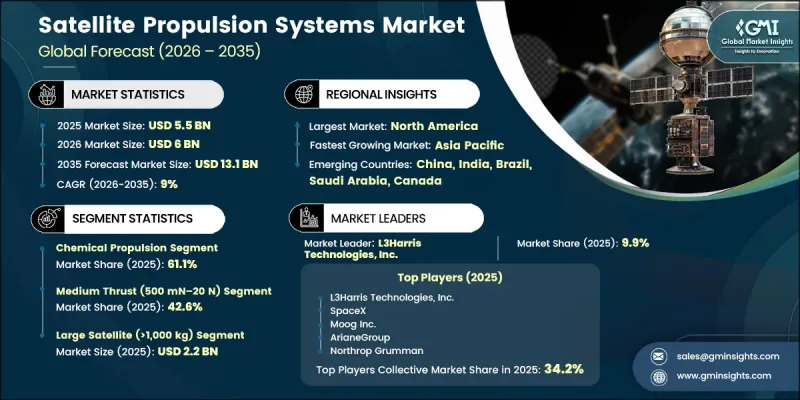
隨著衛星部署在商業、政府和國防領域的持續加速,衛星推進系統市場正在不斷擴張。低地球軌道衛星網路的快速成長、小型衛星的日益普及以及各國對航太計畫投入的增加,都推動了對先進推進技術的需求。推進系統對於衛星入軌、軌道維持、機動、避碰以及在其生命週期末期的脫軌至關重要,使其成為現代衛星任務的關鍵組成部分。電力推進和環保推進技術的持續創新正在提高任務效率、降低推進劑消耗並延長運行壽命。同時,對永續航太運作和衛星維護的日益重視也為先進推進解決方案創造了更多機會。預計對旨在提升商業和政府應用任務表現的下一代推進技術的投資增加,將有助於滿足全球太空產業不斷變化的需求,並促進市場的長期成長。
| 市場範圍 | |
|---|---|
| 開始年份 | 2025 |
| 預測期 | 2026-2035 |
| 起始金額 | 55億美元 |
| 預測金額 | 131億美元 |
| 複合年成長率 | 9% |
預計到2025年,化學推進系統將佔據61.1%的市場佔有率,這主要得益於其在關鍵任務中提供高推力和可靠性能的能力。化學推進系統將繼續廣泛應用於軌道注入、太空船機動、姿態控制和深空任務。其久經考驗的運作可靠性以及對要求嚴苛的政府、國防和商業衛星計畫的適用性,將在整個預測期內持續支撐強勁的市場需求。
預計到2025年,中等推力(500 mN至20 N)的衛星推力將佔42.6%的市場佔有率。此推力範圍是各種衛星衛星星系。此外,此推力範圍相容於化學推進和電推進技術,進一步鞏固了其市場主導地位。
到2025年,北美將佔據衛星推進系統市場45.1%的佔有率。這一區域成長主要得益於政府對太空探勘投入的增加、商業衛星部署的擴大以及國防相關太空舉措的推進。加之其成熟的航太製造生態系統以及對先進推進技術和衛星研發項目的持續投入,北美在全球市場的領先地位將持續鞏固。
目錄
第1章:調查方法和範圍
第2章執行摘要
第3章 行業洞察
- 產業生態系分析
- 供應商情況
- 利潤率
- 成本結構
- 每個階段增加的價值
- 影響價值鏈的因素
- 中斷
- 影響產業的因素
- 成長促進因素
- 擴大小型衛星和低地球衛星群的部署
- 政府對太空探勘和國家衛星計畫的投資
- 電動和環保推動技術的進步
- 人們越來越關注太空永續性和減少軌道碎片的問題
- 對在軌服務和衛星壽命延長的需求日益成長。
- 產業潛在風險與挑戰
- 開發和認證先進推進系統的成本很高。
- 小型衛星的功率、尺寸和推進性能之間的權衡
- 市場機遇
- 擴大電動和環保推動技術的應用
- 在軌服務、延長衛星壽命和擴展太空物流。
- 成長促進因素
- 成長潛力分析
- 價格分析
- 對過去價格趨勢的分析
- 依球員類型分類的定價策略(高級球員、超值球員、成本加成球員)
- 監理情勢
- 波特的分析
- PESTLE分析
- 貿易數據分析
- 進出口量及進口額趨勢
- 主要貿易路線及關稅的影響
- 人工智慧和生成式人工智慧對市場的影響
- 利用人工智慧改造現有經營模式
- 按細分市場分類的生成式人工智慧用例和部署藍圖
- 生產能力和生產情況
- 主要生產商的生產能力
- 運轉率和擴張計劃
第4章 競爭情勢
- 介紹
- 按地區
- 北美洲
- 歐洲
- 亞太地區
- 拉丁美洲
- 中東和非洲
- 市場集中度分析
- 按地區
- 主要市場公司的競爭分析
- 競爭定位矩陣
- 主要進展
- 併購
- 夥伴關係和聯盟
- 新產品發布
- 業務拓展計劃及資金籌措
- 按公司規模進行基準測試
- 排名分類標準與遴選標準
- 按銷售額、地區和創新能力分類的層級定位矩陣。
第5章 市場估算與預測:依驅動技術分類,2022-2035年
- 化學推廣
- 電力推進
- 霍爾效應推進器
- 離子推進器(柵極格式離子引擎)
- 電灑和FEEP系統
- 脈衝等離子推進器(PPT)
- 其他
- 綠色/低毒性推進技術
- 冷氣促銷
- 混合動力推進
第6章 市場估計與預測:依組件分類,2022-2035年
- 推進器
- 推進劑儲存槽和儲存系統
- 供應系統
- 電源處理單元(PPU)
- 推進控制電子設備
- 其他
第7章 市場估計與預測:依衛星質量分類,2022-2035年
- 奈米衛星(小於10公斤)
- 微型衛星(11-100公斤)
- 小型衛星(101-500公斤)
- 中型衛星(501-1000公斤)
- 大型衛星(超過1000公斤)
第8章 市場估算與預測:依推進層級分類,2022-2035年
- 低推力(小於500毫牛)
- 中等推力(500毫牛至20牛)
- 高推力(超過 20 牛頓)
第9章 市場估價與預測:依最終用戶分類,2022-2035年
- 政府/私部門
- 商業的
- 軍事/國防
第10章 市場估價與預測:依地區分類,2022-2035年
- 北美洲
- 美國
- 加拿大
- 歐洲
- 德國
- 英國
- 法國
- 西班牙
- 義大利
- 亞太地區
- 中國
- 印度
- 日本
- 澳洲
- 韓國
- 拉丁美洲
- 巴西
- 墨西哥
- 阿根廷
- 中東和非洲
- 南非
- 沙烏地阿拉伯
- UAE
第11章:公司簡介
- 全球主要公司
- L3Harris Technologies, Inc.
- SpaceX
- Moog Inc.
- ArianeGroup
- Northrop Grumman
- 該地區的主要公司
- 北美洲
- Agile Space Industries
- Benchmark Space Systems
- Busek Co. Inc.
- ExoTerra Resource
- Marotta Controls
- Rocket Lab USA
- 亞太地區
- Aliena Pte Ltd
- Bellatrix Aerospace
- IHI Corporation
- Neumann Space
- Pale Blue Co.
- Xingchen Space
- Yidong Yuhang
- 歐洲
- Airbus CRISA
- Airbus DS(Electric Prop.)
- Dawn Aerospace
- Enpulsion GmbH
- GomSpace
- Safran
- SITAEL SpA
- T4i Srl
- 北美洲
- 小眾玩家/顛覆者
- Aurora Propulsion Technologies
- Bradford Space
- CU Aerospace
- ECAPS AB
- Exotrail SA
- Morpheus Space
- Orbion Space Technology
- Rafael Advanced Defense Systems
- Revolution Space
- Tethers Unlimited
- ThrustMe
- VACCO Industries
The Global Satellite Propulsion Systems Market was valued at USD 5.5 billion in 2025 and is estimated to grow at a CAGR of 9% to reach USD 13.1 billion by 2035.
The satellite propulsion systems market is expanding as satellite deployments continue to accelerate across commercial, government, and defense sectors. Growing demand for advanced propulsion technologies is being driven by the rapid expansion of low Earth orbit satellite networks, increasing adoption of small satellites, and rising investments in national space programs. Propulsion systems have become essential for orbital insertion, station-keeping, maneuvering, collision avoidance, and end-of-life deorbiting, making them a critical component of modern satellite missions. Continuous innovation in electric and environmentally friendly propulsion technologies is improving mission efficiency, lowering propellant consumption, and supporting longer operational lifecycles. At the same time, increasing emphasis on sustainable space operations and satellite servicing is creating additional opportunities for advanced propulsion solutions. Rising investments in next-generation propulsion technologies designed to improve mission performance across both commercial and government applications are expected to strengthen long-term market growth while supporting the evolving requirements of the global space industry.
| Market Scope | |
|---|---|
| Start Year | 2025 |
| Forecast Year | 2026-2035 |
| Start Value | $5.5 Billion |
| Forecast Value | $13.1 Billion |
| CAGR | 9% |
The chemical propulsion segment accounted for 61.1% share in 2025, owing to its ability to deliver high thrust and dependable performance for mission-critical operations. Chemical propulsion systems continue to be widely adopted for orbit insertion, spacecraft maneuvering, attitude control, and deep-space missions. Their proven operational reliability and suitability for demanding government, defense, and commercial satellite programs continue to support strong market demand throughout the forecast period.
The medium thrust (500 mN-20 N) segment held a share of 42.6% in 2025. This thrust range has become the preferred choice for orbit raising, orbital maneuvering, station-keeping, and attitude control across a broad range of satellite platforms. The segment offers an effective balance between propulsion efficiency and maneuverability, making it suitable for medium-sized satellites, geostationary missions, and expanding satellite constellations. Its compatibility with both chemical and electric propulsion technologies further strengthens its market leadership.
North America Satellite Propulsion Systems Market accounted for 45.1% share in 2025. Regional growth is supported by increasing government investment in space exploration, expanding commercial satellite deployment, and rising defense-related space initiatives. A well-established aerospace manufacturing ecosystem, combined with ongoing investments in advanced propulsion technologies and satellite development programs, continues to reinforce North America's leadership in the global market.
Major companies operating in the global satellite propulsion systems market include SpaceX, Northrop Grumman, Rocket Lab USA, Moog Inc., L3Harris Technologies, Inc., Safran, Airbus DS (Electric Prop.), Airbus CRISA, ArianeGroup / OPC Lampoldshausen, Bellatrix Aerospace, Bradford Space, Busek Co. Inc., Dawn Aerospace, Exotrail SA, Aurora Propulsion Technologies, Orbion Space Technology, Benchmark Space Systems, Morpheus Space, VACCO Industries, Tethers Unlimited, SITAEL S.p.A., T4i S.r.l., ThrustMe, Enpulsion GmbH, ECAPS AB, GomSpace, Pale Blue Co., Neumann Space, Agile Space Industries, Aliena Pte Ltd, CU Aerospace, ExoTerra Resource, IHI Corporation, Rafael Advanced Defense, Marotta Controls, Revolution Space, Xingchen Space, and Yidong Yuhang. Companies operating in the satellite propulsion systems market are strengthening their competitive position through continuous investment in advanced propulsion technologies, product innovation, and research and development. Market participants are focusing on improving propulsion efficiency, reducing system weight, extending mission life, and developing environmentally sustainable propulsion solutions to meet evolving customer requirements. Strategic collaborations with satellite manufacturers, launch service providers, government agencies, and defense organizations are expanding commercial opportunities and accelerating technology adoption.
Table of Contents
Chapter 1 Methodology and Scope
- 1.1 Market scope and definition
- 1.2 Research design
- 1.2.1 Research approach
- 1.2.2 Data collection methods
- 1.3 Data mining sources
- 1.3.1 Global
- 1.3.2 Regional/Country
- 1.4 Base estimates and calculations
- 1.4.1 Base year calculation
- 1.4.2 Key trends for market estimation
- 1.5 Primary research and validation
- 1.5.1 Primary sources
- 1.6 Forecast model
- 1.7 Research assumptions and limitations
Chapter 2 Executive Summary
- 2.1 Industry 360° synopsis, 2022 - 2035
- 2.2 Key market trends
- 2.2.1 Propulsion technology trends
- 2.2.2 Component trends
- 2.2.3 Satellite mass trends
- 2.2.4 Thrust class trends
- 2.2.5 End-user trends
- 2.2.6 Regional trends
- 2.3 TAM Analysis, 2026-2035
- 2.4 CXO perspectives: Strategic imperatives
Chapter 3 Industry Insights
- 3.1 Industry ecosystem analysis
- 3.1.1 Supplier Landscape
- 3.1.2 Profit Margin
- 3.1.3 Cost structure
- 3.1.4 Value addition at each stage
- 3.1.5 Factor affecting the value chain
- 3.1.6 Disruptions
- 3.2 Industry impact forces
- 3.2.1 Growth drivers
- 3.2.1.1 Increasing deployment of small satellites and LEO constellations
- 3.2.1.2 Government investments in space exploration and national satellite programs
- 3.2.1.3 Advancements in electric and green propulsion technologies
- 3.2.1.4 Growing emphasis on space sustainability and orbital debris mitigation
- 3.2.1.5 Rising demand for in-orbit servicing and satellite life extension
- 3.2.2 Industry pitfalls and challenges
- 3.2.2.1 High development and qualification costs of advanced propulsion systems
- 3.2.2.2 Power, size, and propulsion performance trade-offs in small satellites
- 3.2.3 Market opportunities
- 3.2.3.1 Growing adoption of electric and green propulsion technologies
- 3.2.3.2 Expansion of in-orbit servicing, satellite life extension, and space logistics
- 3.2.1 Growth drivers
- 3.3 Growth potential analysis
- 3.4 Pricing Analysis (Driven by Primary Research)
- 3.4.1 Historical Price Trend Analysis
- 3.4.2 Pricing Strategy by Player Type (Premium / Value / Cost-plus)
- 3.5 Regulatory landscape
- 3.5.1 North America
- 3.5.2 Europe
- 3.5.3 Asia Pacific
- 3.5.4 Latin America
- 3.5.5 Middle East & Africa
- 3.6 Porter's analysis
- 3.7 PESTEL analysis
- 3.8 Trade Data Analysis (Based on Paid Database)
- 3.8.1 Import/Export Volume & Value Trends
- 3.8.2 Key Trade Corridors & Tariff Impact
- 3.9 Impact of AI & Generative AI on the Market (Driven by Primary Research)
- 3.9.1 AI-Driven Disruption of Existing Business Models
- 3.9.2 GenAI Use Cases & Adoption Roadmap by Segment
- 3.10 Capacity & Production Landscape (Driven by Primary Research)
- 3.10.1 Production Capacity by Key Producer
- 3.10.2 Capacity Utilization Rates & Expansion Pipelines
Chapter 4 Competitive Landscape, 2025
- 4.1 Introduction
- 4.1.1 By Region
- 4.1.1.1 North America
- 4.1.1.2 Europe
- 4.1.1.3 Asia-Pacific
- 4.1.1.4 Latin America
- 4.1.1.5 Middle East and Africa
- 4.1.2 Market Concentration Analysis
- 4.1.1 By Region
- 4.2 Competitive analysis of major market players
- 4.3 Competitive positioning matrix
- 4.4 Key developments
- 4.4.1 Mergers & acquisitions
- 4.4.2 Partnerships & collaborations
- 4.4.3 New product launches
- 4.4.4 Expansion plans and funding
- 4.5 Company tier benchmarking
- 4.5.1 Tier classification criteria & qualifying thresholds
- 4.5.2 Tier positioning matrix by revenue, geography & innovation
Chapter 5 Market Estimates and Forecast, By Propulsion Technology, 2022 - 2035 (USD Million)
- 5.1 Key trends
- 5.2 Chemical propulsion
- 5.3 Electric propulsion
- 5.3.1 Hall-effect thrusters
- 5.3.2 Ion thrusters (gridded ion engines)
- 5.3.3 Electrospray & FEEP systems
- 5.3.4 Pulsed Plasma Thrusters (PPT)
- 5.3.5 Others
- 5.4 Green / low-toxicity propulsion
- 5.5 Cold gas propulsion
- 5.6 Hybrid propulsion
Chapter 6 Market Estimates and Forecast, By Component, 2022 - 2035 (USD Million)
- 6.1 Key trends
- 6.2 Thrusters
- 6.3 Propellant tanks & storage systems
- 6.4 Feed systems
- 6.5 Power processing units (PPUs)
- 6.6 Propulsion control electronics
- 6.7 Others
Chapter 7 Market Estimates and Forecast, By Satellite Mass, 2022 - 2035 (USD Million)
- 7.1 Key trends
- 7.2 Nanosatellite (<10 kg)
- 7.3 Microsatellite (11-100 kg)
- 7.4 Minisatellite (101-500 kg)
- 7.5 Medium satellite (501-1,000 kg)
- 7.6 Large satellite (>1,000 kg)
Chapter 8 Market Estimates and Forecast, By Thrust Class, 2022 - 2035 (USD Million)
- 8.1 Key trends
- 8.2 Low thrust (<500 mN)
- 8.3 Medium thrust (500 mN-20 N)
- 8.4 High thrust (>20 N)
Chapter 9 Market Estimates and Forecast, By End User, 2022 - 2035 (USD Million)
- 9.1 Key trends
- 9.2 Government & civil
- 9.3 Commercial
- 9.4 Military & defense
Chapter 10 Market Estimates and Forecast, By Region, 2022 - 2035 (USD Million)
- 10.1 Key trends
- 10.2 North America
- 10.2.1 U.S.
- 10.2.2 Canada
- 10.3 Europe
- 10.3.1 Germany
- 10.3.2 UK
- 10.3.3 France
- 10.3.4 Spain
- 10.3.5 Italy
- 10.4 Asia Pacific
- 10.4.1 China
- 10.4.2 India
- 10.4.3 Japan
- 10.4.4 Australia
- 10.4.5 South Korea
- 10.5 Latin America
- 10.5.1 Brazil
- 10.5.2 Mexico
- 10.5.3 Argentina
- 10.6 Middle East and Africa
- 10.6.1 South Africa
- 10.6.2 Saudi Arabia
- 10.6.3 UAE
Chapter 11 Company Profiles
- 11.1 Global Key Players
- 11.1.1 L3Harris Technologies, Inc.
- 11.1.2 SpaceX
- 11.1.3 Moog Inc.
- 11.1.4 ArianeGroup
- 11.1.5 Northrop Grumman
- 11.2 Regional key players
- 11.2.1 North America
- 11.2.1.1 Agile Space Industries
- 11.2.1.2 Benchmark Space Systems
- 11.2.1.3 Busek Co. Inc.
- 11.2.1.4 ExoTerra Resource
- 11.2.1.5 Marotta Controls
- 11.2.1.6 Rocket Lab USA
- 11.2.2 Asia Pacific
- 11.2.2.1 Aliena Pte Ltd
- 11.2.2.2 Bellatrix Aerospace
- 11.2.2.3 IHI Corporation
- 11.2.2.4 Neumann Space
- 11.2.2.5 Pale Blue Co.
- 11.2.2.6 Xingchen Space
- 11.2.2.7 Yidong Yuhang
- 11.2.3 Europe
- 11.2.3.1 Airbus CRISA
- 11.2.3.2 Airbus DS (Electric Prop.)
- 11.2.3.3 Dawn Aerospace
- 11.2.3.4 Enpulsion GmbH
- 11.2.3.5 GomSpace
- 11.2.3.6 Safran
- 11.2.3.7 SITAEL S.p.A.
- 11.2.3.8 T4i S.r.l.
- 11.2.1 North America
- 11.3 Niche Players/Disruptors
- 11.3.1 Aurora Propulsion Technologies
- 11.3.2 Bradford Space
- 11.3.3 CU Aerospace
- 11.3.4 ECAPS AB
- 11.3.5 Exotrail SA
- 11.3.6 Morpheus Space
- 11.3.7 Orbion Space Technology
- 11.3.8 Rafael Advanced Defense Systems
- 11.3.9 Revolution Space
- 11.3.10 Tethers Unlimited
- 11.3.11 ThrustMe
- 11.3.12 VACCO Industries

 2026-2030年全球衛星推進系統市場
 衛星推進系統市場報告:趨勢、預測與競爭分析(至2035年)
 2026年全球衛星推進系統市場報告
 低地球軌道衛星推進技術市場:2026-2032年全球市場預測(按衛星尺寸、推進方式、組件類型、應用和最終用戶產業分類)
 全球衛星推進系統市場規模、佔有率、趨勢和成長分析報告(2026-2034年)衛星推進市場按類型、組件、平台、最終用戶、軌道類型和應用分類-2025-2030 年全球預測全球衛星推進系統市場規模:依系統類型、應用、推進類型、地區、預測
 衛星推進系統市場規模、佔有率、成長分析、按平台、推進技術、按組件、按最終用戶、按地區、按細分市場、預測(2025 年至 2032 年)
 衛星推進系統市場 - 全球產業規模、佔有率、趨勢、機會和預測,按系統類型、推進類型、地區和競爭細分,2020-2030F
 衛星推動系統的全球市場:市場規模·佔有率·趨勢,產業分析 (各推動系統·各平台·各零件·各終端用戶·各地區),未來預測 (2025年~2034年)