


 |
市場調查報告書
商品編碼
2101682
從 2026 年到 2035 年,自動化和機器人工業執行器的市場機會、成長促進因素、產業趨勢分析和預測。Industrial Actuators for Automation and Robotics Market Opportunity, Growth Drivers, Industry Trend Analysis, and Forecast 2026 - 2035 |
||||||

2025 年全球自動化和機器人工業執行器市場規模預計為 304 億美元,預計到 2035 年將以 8.5% 的複合年成長率成長至 677 億美元。
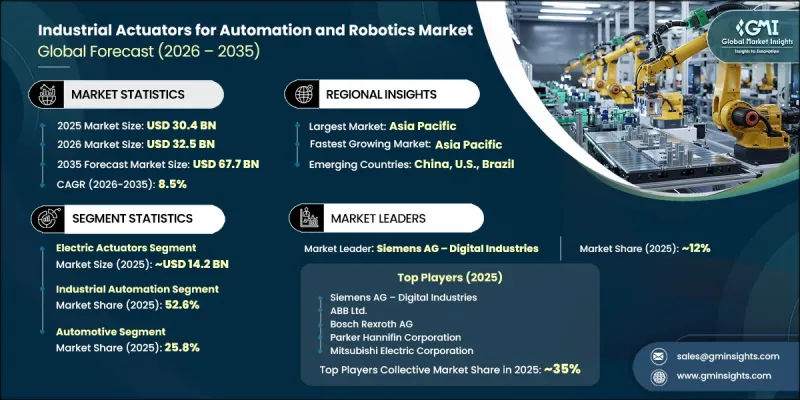
全球自動化和機器人工業執行器市場正因先進製造技術的快速普及而發生變革,這些技術需要高精度、數位化連接的運動控制解決方案。隨著生產設施不斷向智慧製造環境轉型,對高精度、高可靠性、高能源效率且能與自動化控制系統無縫整合的執行器的需求日益成長。機器人技術在整體工業營運中的日益普及進一步推動了市場的長期成長,因為現代自動化越來越依賴智慧執行器技術來提高生產效率和營運一致性。製造商也優先考慮緊湊型、高性能和數位化執行器,以支援先進的機器人系統和自動化設備。製造業現代化、產業數位化以及對生產力提升的持續投資仍然是主要經濟體的關鍵成長驅動力。此外,對營運效率、流程最佳化和高精度製造的日益重視,將在預測期內持續增強對自動化和機器人工業執行器在各種工業應用領域的持續需求。
| 市場範圍 | |
|---|---|
| 開始年份 | 2025 |
| 預測期 | 2026-2035 |
| 起始金額 | 304億美元 |
| 預測金額 | 677億美元 |
| 複合年成長率 | 8.5% |
預計到2025年,電動執行器市場規模將達到142億美元,並在2026年至2035年間以8.2%的複合年成長率成長。與傳統技術相比,電動執行器憑藉其卓越的精度、可靠的運動控制和更高的能源效率,在全球工業執行器市場(尤其是在自動化和機器人領域)中持續佔據主導地位。它們能夠輕鬆整合到數位自動化系統中,並提供精準且可重複的性能,使其成為現代製造工廠的理想選擇。隨著製造商優先考慮提高生產效率、提升操作精度和降低維護需求,以及工業自動化技術的不斷進步,對電動執行器的需求也持續成長。
到2025年,工業自動化應用領域將佔據52.6%的市場。對自動化製造系統、生產線現代化改造、物料輸送設備、包裝流程和製程控制技術的持續投資將繼續推動該領域的成長。工業用戶對執行器提出了更高的要求,包括可靠性能、精確的運動控制以及與先進自動化平台的兼容性。隨著對提高製造效率、確保產品品質穩定和降低營運成本的需求不斷成長,對自動化技術的投資將繼續推動全球各行各業對工業執行器的持續需求。
美國自動化和機器人工業執行器市場預計到2025年將達到52億美元,並在2026年至2035年間以7.8%的複合年成長率成長。市場成長的驅動力包括先進製造技術的廣泛應用、工廠自動化領域的持續投資以及完善的工業機器人生態系統。製造業整體電動和伺服致動器的需求不斷成長,持續創造巨大的成長機會。生產設施的持續現代化、倉庫自動化的擴展以及智慧製造系統的日益普及,進一步強化了美國市場對先進執行器技術的需求。
目錄
第1章:調查方法和範圍
第2章執行摘要
第3章 行業洞察
- 產業生態系分析
- 原料和零件供應商
- 執行器製造商和原始設備製造商
- 系統整合商和分銷商
- 終端用戶產業
- 利潤率
- 每個階段增加的價值
- 影響價值鏈的因素
- 影響產業的因素
- 成長促進因素
- 加快工廠自動化和智慧製造的普及應用。
- 擴大協作機器人(cobot)在中小企業的應用。
- 人形機器人專案的擴展正在創造對執行器的新需求趨勢。
- 潛在風險和挑戰
- 先進的電動和伺服執行器初始成本較高,限制了它們在對成本敏感的市場中的應用。
- 對稀土元素材料和永久磁鐵的依賴導致供應脆弱性。
- 機會
- 在人形機器人和服務機器人領域,對高效能致動器的設計需求日益成長。
- 人工智慧整合的預測性維護正在為售後服務創造新的收入來源。
- 成長促進因素
- 成長潛力分析
- 技術與創新展望
- 新興執行器技術
- 智慧執行器整合
- 小型化和高扭矩密度設計的發展趨勢
- 監理框架
- 工業安全與功能安全標準(IEC 62061、ISO 13849)
- 能源效率與排放氣體法規(歐盟生態設計、能源之星)
- 協作機器人安全標準(ISO/TS 15066、ISO 10218)
- 各地區監管情況(北美、歐洲、亞太地區)
- 價格分析
- 按產品類型分析歷史價格趨勢
- 依球員類型分類的定價策略(高級球員、超值球員、成本加成球員)
- 供應鏈分析
- 重要原料
- 供應鏈脆弱性與地緣政治風險
- 近岸外包和供應商多角化策略
- 貿易數據分析
- 進出口量及進口額趨勢
- 主要貿易路線及關稅的影響
- 人工智慧和生成式人工智慧對市場的影響
- 利用人工智慧改造現有執行器設計與製造模型
- 按細分市場分類的生成式人工智慧用例和部署藍圖
- 人工智慧在運動控制領域的風險、限制與監管考量
- 生產能力和生產情況
- 按地區和主要生產商分類的製造能力
- 運轉率和擴張計劃
第4章 競爭情勢
- 介紹
- 企業市佔率分析
- 按地區
- 企業矩陣分析
- 主要市場公司的競爭分析
- 競爭定位矩陣
- 主要進展
- 併購
- 夥伴關係和聯盟
- 新產品發布
- 業務拓展計劃
第5章 市場估算與預測:依營運類型分類,2022-2035年
- 電動執行器
- 伺服執行器
- 步進馬達執行器
- 線性馬達執行器
- 直接驅動執行器
- 液壓執行器
- 單作用液壓執行器
- 雙作用液壓執行器
- 氣壓執行器
- 單作用氣動執行器
- 雙作用氣動執行器
- 旋轉氣動執行器
- 壓電動器
- 多層壓電致動器
- 彎曲型壓電動器
- 其他(軟致動器、形狀記憶合金致動器、電活性聚合物致動器)
第6章 市場估算與預測:依營運類型分類,2022-2035年
- 線性致動器
- 桿式線性致動器
- 無桿線性致動器
- 伸縮式線性致動器
- 旋轉致動器
- 葉片式旋轉致動器
- 齒輪齒條式旋轉執行器
- 蘇格蘭軛式旋轉執行器
第7章 市場估計與預測:依應用領域分類,2022-2035年
- 工業機器人
- 關節機器人
- SCARA機器人
- Delta/並聯機器人
- 笛卡兒/龍門式機器人
- 協作機器人(cobots)
- 桌上型和輕型協作機器人
- 高承重能力協作機器人
- 流程自動化
- 閥門和流量控制執行器
- CNC工具機驅動
- 用於輸送機和物料輸送的執行器
- 服務機器人
- 自動導引運輸車系統(AMRS)
- 外科手術和醫療機器人
- 野外機器人與外骨骼
- 人形機器人
- 全身人形平台
- 部分人形/上半身系統
第8章 市場估算與預測:依最終用戶產業分類,2022-2035年
- 車
- 車身組裝焊接
- 噴塗自動化
- 電動汽車電池組件
- 電子和半導體
- PCB組裝與SMT
- 晶片處理和晶圓加工
- 航太/國防
- 精密加工和組裝
- MRO(維修、修理和大修)自動化
- 食品/飲料
- 包裝填充線
- 分類和檢測自動化
- 醫療保健
- 手術機器人系統
- 復健及外骨骼裝置
- 化學與材料
- 物流/倉儲業
- 分類、揀選與放置系統
- 履約中心中的自主移動機器人(AMRS)
- 其他(金屬和機械、採礦、石油和天然氣、用水和污水)
第9章 市場估計與預測:依地區分類,2022-2035年
- 北美洲
- 美國
- 加拿大
- 歐洲
- 德國
- 英國
- 法國
- 義大利
- 西班牙
- 亞太地區
- 中國
- 日本
- 印度
- 澳洲
- 韓國
- 拉丁美洲
- 巴西
- 墨西哥
- 阿根廷
- 中東和非洲
- 南非
- 沙烏地阿拉伯
- UAE
第10章:公司簡介
- 世界公司
- SMC Corporation
- Festo SE & Co. KG
- Bosch Rexroth AG
- Parker Hannifin Corporation
- ABB Ltd.
- Yaskawa Electric Corporation
- FANUC Corporation
- 本地公司
- Siemens AG-Digital Industries
- Rockwell Automation, Inc.
- Emerson Electric Co.
- Mitsubishi Electric Corporation
- IAI-Intelligent Actuator Inc.
- Ewellix AB
- IMI Norgren
- 新興企業
- Moog Inc.
- LINAK Group
- Thomson Industries, Inc.
- Tolomatic, Inc.
- Harmonic Drive AG/LLC
- Nidec Corporation
- Omron Corporation
The Global Industrial Actuators for Automation and Robotics Market was valued at USD 30.4 billion in 2025 and is estimated to grow at a CAGR of 8.5% to reach USD 67.7 billion by 2035.
The global industrial actuators for automation and robotics market is transformed by the rapid adoption of advanced manufacturing technologies that require highly accurate and digitally connected motion control solutions. As production facilities continue transitioning toward smart manufacturing environments, demand is rising for actuators capable of delivering precision, reliability, energy efficiency, and seamless integration with automated control systems. The growing adoption of robotics across industrial operations further supports long-term market expansion, as modern automation increasingly depends on intelligent actuator technologies to improve production efficiency and operational consistency. Manufacturers are also prioritizing compact, high-performance, and digitally enabled actuators that support advanced robotic systems and automated equipment. Continuous investment in manufacturing modernization, industrial digitization, and productivity enhancement remains a key growth driver across major economies. In addition, increasing emphasis on operational efficiency, process optimization, and high-precision manufacturing continues to reinforce sustained demand for industrial actuators for automation and robotics across a broad range of industrial applications throughout the forecast period.
| Market Scope | |
|---|---|
| Start Year | 2025 |
| Forecast Year | 2026-2035 |
| Start Value | $30.4 Billion |
| Forecast Value | $67.7 Billion |
| CAGR | 8.5% |
The electric actuators segment generated USD 14.2 billion in 2025 and is projected to grow at a CAGR of 8.2% from 2026 to 2035. Electric actuators continue to dominate the global industrial actuators for automation and robotics market because they offer exceptional precision, reliable motion control, and improved energy efficiency compared to conventional technologies. Their ability to integrate easily with digital automation systems while delivering accurate and repeatable performance makes them the preferred choice across modern manufacturing facilities. Ongoing advancements in industrial automation continue to strengthen demand for electric actuators as manufacturers prioritize higher productivity, greater operational accuracy, and lower maintenance requirements.
The industrial automation application segment accounted for 52.6% share in 2025. Continued investments in automated manufacturing systems, production line modernization, material handling equipment, packaging operations, and process control technologies continue to drive segment growth. Industrial users increasingly require actuators that provide dependable performance, precise motion control, and compatibility with advanced automation platforms. Rising emphasis on improving manufacturing efficiency, maintaining consistent product quality, and reducing operating costs continues to encourage greater investment in automation technologies, supporting sustained demand for industrial actuators across multiple industries worldwide.
U.S. Industrial Actuators for Automation and Robotics Market captured USD 5.2 billion in 2025 and is forecast to grow at a CAGR of 7.8% between 2026 and 2035. Market growth is supported by widespread adoption of advanced manufacturing technologies, continued investment in factory automation, and a well-developed industrial robotics ecosystem. Increasing demand for electric and servo actuators across manufacturing industries continues to create significant growth opportunities. Ongoing modernization of production facilities, expanding warehouse automation, and increasing implementation of intelligent manufacturing systems further strengthen demand for advanced actuator technologies throughout the U.S. market.
Major companies operating in the global industrial actuators for automation and robotics market include SMC Corporation, FANUC Corporation, Bosch Rexroth AG, Siemens AG - Digital Industries, Festo SE & Co. KG, ABB Ltd. - Motion BA, Parker Hannifin Corporation, Yaskawa Electric Corporation, Rockwell Automation, Inc., Emerson Electric Co., Mitsubishi Electric Corporation, IAI - Intelligent Actuator Inc., Ewellix AB (Schaeffler Group), IMI Norgren (IMI plc), Moog Inc., LINAK Group, Thomson Industries, Inc., Tolomatic, Inc., Harmonic Drive AG / LLC, Nidec Corporation, and Omron Corporation. Companies competing in the global industrial actuators for automation and robotics market focus on product innovation, digital integration, and portfolio expansion to strengthen their competitive position. Manufacturers continue investing in research and development to improve actuator precision, energy efficiency, reliability, and compatibility with advanced automation systems. Many companies broaden their offerings by introducing intelligent electric and servo actuator solutions designed to meet evolving industrial automation requirements. Strategic partnerships, technology collaborations, and expansion of distribution networks help companies increase market reach and strengthen customer relationships across key industries.
Table of Contents
Chapter 1 Methodology and Scope
- 1.1 Market scope and definition
- 1.2 Research design
- 1.2.1 Research approach
- 1.2.2 Data collection methods
- 1.3 Data mining sources
- 1.3.1 Global
- 1.3.2 Regional/Country
- 1.4 Base estimates and calculations
- 1.4.1 Base year calculation
- 1.4.2 Key trends for market estimation
- 1.5 Primary research and validation
- 1.5.1 Primary sources
- 1.6 Forecast model
- 1.7 Research assumptions and limitations
Chapter 2 Executive Summary
- 2.1 Industry 360° synopsis
- 2.2 Key market trends
- 2.2.1 Regional
- 2.2.2 Actuation type
- 2.2.3 Motion type
- 2.2.4 Application
- 2.2.5 End user industry
Chapter 3 Industry Insights
- 3.1 Industry ecosystem analysis
- 3.1.1 Raw material & component suppliers
- 3.1.2 Actuator manufacturers & OEMs
- 3.1.3 System integrators & distributors
- 3.1.4 End-user industries
- 3.1.5 Profit margin
- 3.1.6 Value addition at each stage
- 3.1.7 Factor affecting the value chain
- 3.2 Industry impact forces
- 3.2.1 Growth drivers
- 3.2.1.1 Accelerating adoption of factory automation & smart manufacturing
- 3.2.1.2 Rising deployment of collaborative robots (cobots) across SME sector
- 3.2.1.3 Expansion of humanoid robot programs creating new actuator demand vectors
- 3.2.2 Pitfalls & challenges
- 3.2.2.1 High upfront cost of advanced electric & servo actuators limiting adoption in cost-sensitive markets
- 3.2.2.2 Dependency on rare earth materials & permanent magnets creating supply vulnerability
- 3.2.3 Opportunities
- 3.2.3.1 Humanoid & service robotics segment opening premium actuator design demand
- 3.2.3.2 AI-integrated predictive maintenance creating new aftermarket service revenue streams
- 3.2.1 Growth drivers
- 3.3 Growth potential analysis
- 3.4 Technology and innovation landscape
- 3.4.1 Emerging actuator technologies
- 3.4.2 Smart actuator integration
- 3.4.3 Miniaturization & high-torque-density design trends
- 3.5 Regulatory framework
- 3.5.1 Industrial safety & functional safety standards (IEC 62061, ISO 13849)
- 3.5.2 Energy efficiency & emissions regulations (EU Ecodesign, ENERGY STAR)
- 3.5.3 Collaborative robot safety regulations (ISO/TS 15066, ISO 10218)
- 3.5.4 Regional regulatory landscape (North America, Europe, Asia Pacific)
- 3.6 Pricing analysis (driven by primary research)
- 3.6.1 Historical price trend analysis by product category
- 3.6.2 Pricing strategy by player type (premium / value / cost-plus)
- 3.7 Supply chain analysis
- 3.7.1 Critical input materials
- 3.7.2 Supply chain vulnerabilities & geopolitical risks
- 3.7.3 Near-shoring & supplier diversification strategies
- 3.8 Trade data analysis (driven by paid database) (HS code- 8412)
- 3.8.1 Import/export volume & value trends
- 3.8.2 Key trade corridors & tariff impact
- 3.9 Impact of AI & generative AI on the market
- 3.9.1 AI-Driven disruption of existing actuator design & manufacturing models
- 3.9.2 GenAI use cases & adoption roadmap by segment
- 3.9.3 Risks, limitations & regulatory considerations for AI in motion control
- 3.10 Capacity & production landscape (driven by primary research)
- 3.10.1 Installed manufacturing capacity by region & key producer
- 3.10.2 Capacity utilization rates & expansion pipelines (driven by primary research)
Chapter 4 Competitive Landscape, 2025
- 4.1 Introduction
- 4.2 Company market share analysis
- 4.2.1 By region
- 4.2.1.1 North America
- 4.2.1.2 Europe
- 4.2.1.3 Asia Pacific
- 4.2.1.4 Latin America
- 4.2.1.5 Middle East and Africa
- 4.2.1 By region
- 4.3 Company matrix analysis
- 4.4 Competitive analysis of major market players
- 4.5 Competitive positioning matrix
- 4.6 Key developments
- 4.6.1 Mergers & acquisitions
- 4.6.2 Partnerships & collaborations
- 4.6.3 New product launches
- 4.6.4 Expansion plans
Chapter 5 Market Estimates and Forecast, By Actuation Type, 2022 - 2035 (USD Billion) (Thousand Units)
- 5.1 Key trends
- 5.2 Electric actuators
- 5.2.1 Servo actuators
- 5.2.2 Stepper motor actuators
- 5.2.3 Linear motor actuators
- 5.2.4 Direct-drive actuators
- 5.3 Hydraulic actuators
- 5.3.1 Single-acting hydraulic actuators
- 5.3.2 Double-acting hydraulic actuators
- 5.4 Pneumatic actuators
- 5.4.1 Single-acting pneumatic actuators
- 5.4.2 Double-acting pneumatic actuators
- 5.5 Rotary pneumatic actuators
- 5.5.1 Piezoelectric actuators
- 5.5.2 Stack piezoelectric actuators
- 5.5.3 Bending piezoelectric actuators
- 5.6 Others (soft actuators, shape memory alloy actuators, electroactive polymer actuators)
Chapter 6 Market Estimates and Forecast, By Motion Type, 2022 - 2035 (USD Billion) (Thousand Units)
- 6.1 Key trends
- 6.2 Linear actuators
- 6.2.1 Rod-style linear actuators
- 6.2.2 Rodless linear actuators
- 6.2.3 Telescopic linear actuators
- 6.3 Rotary actuators
- 6.3.1 Vane-type rotary actuators
- 6.3.2 Rack & pinion rotary actuators
- 6.3.3 Scotch yoke rotary actuators
Chapter 7 Market Estimates and Forecast, By Application, 2022 - 2035 (USD Billion) (Thousand Units)
- 7.1 Key trends
- 7.2 Industrial robots
- 7.2.1 Articulated robots
- 7.2.2 Scara robots
- 7.2.3 Delta/parallel robots
- 7.2.4 Cartesian/gantry robots
- 7.3 Collaborative robots (cobots)
- 7.3.1 Tabletop & lightweight cobots
- 7.3.2 Heavy-payload cobots
- 7.4 Process automation
- 7.4.1 Valve & flow control actuation
- 7.4.2 CNC & machine tool actuation
- 7.4.3 Conveyor & material handling actuation
- 7.5 Service robots
- 7.5.1 Autonomous guided vehicles (AGVS) & AMRS
- 7.5.2 Surgical & medical robots
- 7.5.3 Field robots & exoskeletons
- 7.6 Humanoid robots
- 7.6.1 Full-body anthropomorphic platforms
- 7.6.2 Partial humanoid / upper-body systems
Chapter 8 Market Estimates and Forecast, By End User Industry, 2022 - 2035 (USD Billion) (Thousand Units)
- 8.1 Key trends
- 8.2 Automotive
- 8.2.1 Body assembly & welding
- 8.2.2 Painting & coating automation
- 8.2.3 EV battery assembly
- 8.3 Electronics & semiconductor
- 8.3.1 PCB assembly & smt
- 8.3.2 Chip handling & wafer processing
- 8.4 Aerospace & defense
- 8.4.1 Precision machining & assembly
- 8.4.2 MRO automation
- 8.5 Food & beverages
- 8.5.1 Packaging & filling lines
- 8.5.2 Sorting & inspection automation
- 8.6 Healthcare & medical
- 8.6.1 Surgical robotic systems
- 8.6.2 Rehabilitation & exoskeleton devices
- 8.7 Chemicals & materials
- 8.8 Logistics & warehousing
- 8.8.1 Sortation & pick-and-place systems
- 8.8.2 Autonomous mobile robots (AMRS) in fulfillment centers
- 8.9 Others (metal & machinery, mining, oil & gas, water & wastewater)
Chapter 9 Market Estimates and Forecast, By Region, 2022 - 2035 (USD Billion) (Thousand Units)
- 9.1 Key trends
- 9.2 North America
- 9.2.1 U.S.
- 9.2.2 Canada
- 9.3 Europe
- 9.3.1 Germany
- 9.3.2 UK
- 9.3.3 France
- 9.3.4 Italy
- 9.3.5 Spain
- 9.4 Asia Pacific
- 9.4.1 China
- 9.4.2 Japan
- 9.4.3 India
- 9.4.4 Australia
- 9.4.5 South Korea
- 9.5 Latin America
- 9.5.1 Brazil
- 9.5.2 Mexico
- 9.5.3 Argentina
- 9.6 Middle East and Africa
- 9.6.1 South Africa
- 9.6.2 Saudi Arabia
- 9.6.3 UAE
Chapter 10 Company Profiles
- 10.1 Global players
- 10.1.1 SMC Corporation
- 10.1.2 Festo SE & Co. KG
- 10.1.3 Bosch Rexroth AG
- 10.1.4 Parker Hannifin Corporation
- 10.1.5 ABB Ltd.
- 10.1.6 Yaskawa Electric Corporation
- 10.1.7 FANUC Corporation
- 10.2 Regional Players
- 10.2.1 Siemens AG - Digital Industries
- 10.2.2 Rockwell Automation, Inc.
- 10.2.3 Emerson Electric Co.
- 10.2.4 Mitsubishi Electric Corporation
- 10.2.5 IAI - Intelligent Actuator Inc.
- 10.2.6 Ewellix AB
- 10.2.7 IMI Norgren
- 10.3 Emerging Players
- 10.3.1 Moog Inc.
- 10.3.2 LINAK Group
- 10.3.3 Thomson Industries, Inc.
- 10.3.4 Tolomatic, Inc.
- 10.3.5 Harmonic Drive AG / LLC
- 10.3.6 Nidec Corporation
- 10.3.7 Omron Corporation

 航太與國防機器人自動化執行器市場報告:趨勢、預測及競爭分析(至2035年)
 汽車壓電陶瓷元件市場-2026-2032年全球市場預測執行器市場:按類型、運動類型、電壓、系統類型、控制類型、安裝類型、應用和銷售管道- 全球預測,2026-2032 年安全設備市場:2026-2032年全球市場預測(依產品類型、外形規格、監控模式、連接方式、組織規模、通路和最終用戶分類)液壓執行器市場:2026-2032年全球市場預測(依執行器類型、工作模式、系統壓力、安裝方式、行程長度、工作輸出、控制系統、供應模式及最終用途產業分類)
 機器人執行器市場機會、成長要素、產業趨勢分析及2026-2035年預測
 液壓執行器市場:全球產業規模、市場佔有率、趨勢、機會和預測(按產品類型、應用和地區分類)、競爭格局(2021-2031 年)
 執行器市場:按產品、類型、最終用途行業和地區分類,2026-2034 年
 機器人軸承市場規模、佔有率和成長分析:按軸承類型、材質、機器人類型、最終用途產業、銷售管道和地區分類-2026-2033年產業預測
 2026年全球感測器和執行器市場報告