


 |
市場調查報告書
商品編碼
2101677
2026 年至 2035 年黴菌毒素檢測和淨化市場的機會、成長動力、產業趨勢和預測。Mycotoxin Testing and Decontamination Market Opportunity, Growth Drivers, Industry Trend Analysis, and Forecast 2026 - 2035 |
||||||

全球黴菌毒素檢測和淨化市場預計到 2025 年將達到 44 億美元,年複合成長率為 5.8%,到 2035 年將達到 78 億美元。
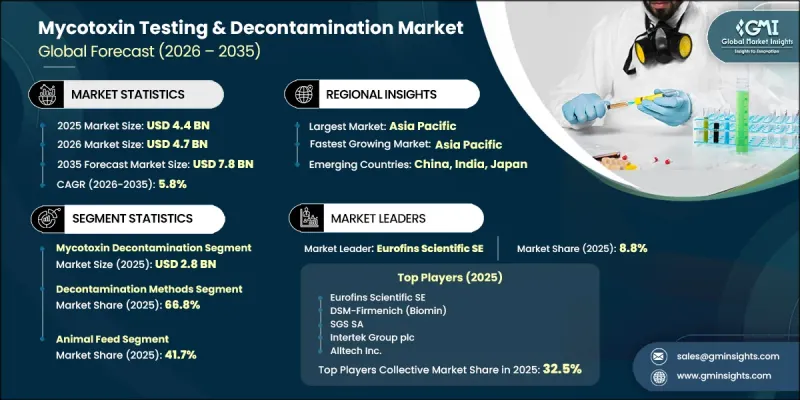
這一成長主要得益於更嚴格的法規結構、國際食品貿易的擴張以及供應鏈中對黴菌毒素風險日益增強的認知。黴菌毒素檢測在識別食品和飼料中的有害化合物(例如黃麴毒素)方面發揮著至關重要的作用,其採用的先進分析技術包括層析法、免疫檢測和快速檢測試劑盒。一個顯著的市場轉變是,市場對將預防、監控和控制功能整合到統一工作流程中的現場快速檢測系統的需求不斷成長。這項轉變正在改善食品安全,減少污染事件造成的經濟損失,加強監管合規性,並提高整個供應鏈的透明度。在飼料產業,消毒解決方案有助於保障牲畜健康和提高生產力;而在食品加工產業,持續監測則確保了消費者安全和出口合格。一個重要的結構性轉變是,在幾個主要司法管轄區,自願檢測做法正轉向經認證的強制性合規體系,這極大地推動了基礎需求的成長。此外,隨著法規的擴展,污染物監測範圍正在擴大,包括新的真菌代謝物,同時敏感食品類別的可接受限度也在收緊,導致全球範圍內的檢測要求更加嚴格。
| 市場範圍 | |
|---|---|
| 開始年份 | 2025 |
| 預測期 | 2026-2035 |
| 起始金額 | 44億美元 |
| 預測金額 | 78億美元 |
| 複合年成長率 | 5.8% |
預計到2025年,黴菌毒素去除劑市場規模將達28億美元。該市場的主要驅動力是飼料添加劑和粘合劑解決方案,包括黏土基材料、活性碳、酵母衍生的細胞壁成分以及水合鈉鋁矽酸鹽。這些解決方案符合全球複合飼料產業大規模、注重成本的營運模式,在該產業中,效率和廣泛的毒素結合能力是至關重要的性能要求。
到2025年,解毒方法將佔據66.8%的市場。該領域的創新日益側重於生物和永續方法,例如基於酶的解毒系統和微生物解決方案,這些方法正逐步取代傳統的化學處理方法。多功能粘合劑和整合式黴菌毒素風險管理平台的應用也日益普及。同時,精密農業工具和收穫後監測技術的整合正在加強預防策略,這反映出整個農業價值鏈正朝著端到端的黴菌毒素風險管理方向發展。
北美黴菌毒素檢測和淨化市場預計到2035年將達到20億美元,這得益於完善的法規環境和成熟的食品安全基礎設施。該地區以FDA和USDA等機構的嚴格監管為特徵,這持續推動先進分析檢測方法的穩定應用。美國仍然是主要市場,由於食品生產商、穀物加工商和飼料製造商的意識不斷提高,整個供應鏈的需求保持穩定。
目錄
第1章:調查方法和範圍
第2章執行摘要
第3章 行業洞察
- 產業生態系分析
- 供應商情況
- 利潤率
- 每個階段增加的價值
- 影響價值鏈的因素
- 中斷
- 影響產業的因素
- 成長促進因素
- 產業潛在風險與挑戰
- 市場機遇
- 成長潛力分析
- 監理情勢
- 波特的分析
- PESTLE分析
- 技術與創新展望
- 最新科技趨勢
- 新興技術
- 價格趨勢
- 按地區
- Tag 的技術
- 未來市場趨勢
- 專利趨勢
- 貿易統計
- 主要進口國
- 主要出口國
- 永續性和環境方面
- 永續計劃
- 減少廢棄物策略
- 生產中的能源效率
- 具有環保意識的舉措
- 考慮碳足跡
第4章 競爭情勢
- 介紹
- 企業市佔率分析
- 按地區
- 北美洲
- 歐洲
- 亞太地區
- 拉丁美洲
- 中東和非洲
- 按地區
- 企業矩陣分析
- 主要市場公司的競爭分析
- 競爭定位矩陣
- 主要進展
- 併購
- 夥伴關係和聯盟
- 新產品發布
- 業務拓展計劃
第5章 市場估算與預測:依產品類型分類,2022-2035年
- 黴菌毒素檢測
- 檢驗產品
- 設備/器材
- 檢測套組和試劑
- 耗材和配件
- 檢查服務
- 內部檢查
- 合約測試服務
- 檢驗產品
- 黴菌毒素去除
- 去污產品
- 飼料添加劑和粘合劑
- 化學解毒劑
- 生物/酵素解毒劑
- 消毒系統和設備
- 物理處理系統
- 工業淨化系統
- 去污產品
第6章 市場估計與預測:依技術與方法論分類,2022-2035年
- 測試技術
- 基於層析法
- HPLC
- LC-MS/MS
- GC-MS
- HRMS
- 基於免疫檢測
- ELISA
- 免疫測量(RIA)
- FPIA
- 基於橫向流動化驗。
- 定量側流免疫分析
- 定性/半定量試紙條檢測
- 基於光譜學
- 近紅外線(NIR)
- FTIR
- 螢光光譜法
- 基於生物感測器的
- 電化學生物感測器
- 光學生物感測器
- 奈米材料增強
- 基於層析法
- 去污方法
- 物理去污方法
- 熱處理
- 紫外線照射
- 臭氧處理
- 伽瑪射線照射
- 化學方法
- 氨處理和鹼處理
- 有機酸處理
- 氧化劑處理
- 生物和酵素法加工方法
- 微生物的生物轉化
- 酵素分解劑
- 利用益生菌進行排毒
- 吸附法
- 黏土礦物
- 活性碳黏合劑
- 酵母細胞壁萃取物
- HSCAS
- 物理去污方法
第7章 市場估算與預測:依黴菌毒素類型分類,2022-2035年
- 黃麴毒素
- 黃麴毒素B1
- 黃麴毒素B2
- 黃麴毒素G1
- 黃麴毒素G2
- 黃麴毒素M1(乳製品)
- 赭曲毒素
- 赭曲毒素A(OTA)
- 赭曲毒素B(OTB)
- Fumonisins
- FumonisinsB1和B2
- FumonisinsB3
- 脫氧核苷和單端孢黴烯族化合物
- Deoxynivalenol(DON/嘔吐毒素)
- T-2 和 HT-2 毒素
- 二乙醯氧基苯酚 (DAS)
- Zearalenone(ZEA)
- 廣藿香
- 麥角生物鹼
- 其他
第8章 市場估算與預測:依最終用途產業分類,2022-2035年
- 食品/飲料
- 穀物、穀類和豆類
- 堅果和乾果
- 香辛料和草藥
- 乳製品和乳製品
- 飲料(啤酒/葡萄酒/果汁)
- 加工食品及包裝食品
- 肉類/家禽
- 動物飼料
- 家禽飼料
- 豬飼料
- 反芻動物飼料
- 水產飼料
- 寵物食品
- 農業和糧食
- 糧倉和收穫後儲存
- 商品貿易與出口檢驗
- 種子和油籽的加工
- 製藥
- 藥物製劑和原料的品管
- 草本和植物來源產品
- 營養保健品和膳食補充劑
- 環境測試
- 土壤和農田監測
- 水質監測
- 室內空氣和職業暴露
第9章 市場估計與預測:依地區分類,2022-2035年
- 北美洲
- 美國
- 加拿大
- 歐洲
- 德國
- 英國
- 法國
- 西班牙
- 義大利
- 其他歐洲國家
- 亞太地區
- 中國
- 印度
- 日本
- 澳洲
- 韓國
- 其他亞太國家
- 拉丁美洲
- 巴西
- 墨西哥
- 阿根廷
- 其他拉丁美洲國家
- 中東和非洲
- 沙烏地阿拉伯
- 南非
- UAE
- 其他中東和非洲國家
第10章:公司簡介
- Alltech Inc.
- ALS Limited
- Bureau Veritas SA
- Charm Sciences Inc.
- DSM-Firmenich(Biomin)
- Eurofins Scientific SE
- Intertek Group plc
- Kemin Industries Inc.
- Merieux NutriSciences
- Neogen Corporation
- Olmix Group SAS
- Romer Labs(ERBER Group)
- SGS SA
The Global Mycotoxin Testing & Decontamination Market was valued at USD 4.4 billion in 2025 and is estimated to grow at a CAGR of 5.8% to reach USD 7.8 billion by 2035.
Growth is shaped by stricter regulatory frameworks, expanding international food trade, and heightened awareness of fungal toxin risks across supply chains. Mycotoxin testing plays a critical role in identifying hazardous compounds such as aflatoxins in food and animal feed, using advanced analytical techniques including chromatography, immunoassays, and rapid detection kits. A notable market shift is the rising preference for on-site and rapid testing systems that integrate prevention, monitoring, and control functions within unified workflows. This transition is improving food safety assurance, reducing financial losses from contamination events, and strengthening regulatory compliance while enhancing transparency across supply networks. In feed applications, decontamination solutions support livestock health and productivity, while in food processing, continuous monitoring safeguards consumer safety and export eligibility. A key structural change is the transition from optional testing practices to mandatory, accredited compliance systems in several major jurisdictions, which is significantly reinforcing baseline demand. Regulatory expansion has also widened contaminant monitoring scopes to include additional fungal metabolites while tightening permissible limits in sensitive food categories, further intensifying testing requirements globally.
| Market Scope | |
|---|---|
| Start Year | 2025 |
| Forecast Year | 2026-2035 |
| Start Value | $4.4 Billion |
| Forecast Value | $7.8 Billion |
| CAGR | 5.8% |
The mycotoxin decontamination segment was valued at USD 2.8 billion in 2025. This segment is largely driven by feed additive and binder solutions that include clay-based materials, activated carbon, yeast-derived cell wall components, and hydrated sodium calcium aluminosilicates. These solutions align with the large-scale, cost-sensitive operational model of the global compound feed industry, where efficiency and broad-spectrum toxin binding capability are essential performance requirements.
The decontamination methods segment accounted for a 66.8% share in 2025. Innovation within this segment is increasingly focused on biological and sustainable approaches, including enzyme-driven detoxification systems and microbial-based solutions that are gradually replacing traditional chemical treatments. The use of multi-functional binders and integrated toxin risk management platforms is becoming more widespread. At the same time, the integration of precision agriculture tools and post-harvest monitoring technologies is strengthening preventive strategies, reflecting a broader shift toward end-to-end mycotoxin risk management across the agricultural value chain.
North America Mycotoxin Testing & Decontamination Market is expected to reach USD 2 billion by 2035, supported by its well-established regulatory environment and mature food safety infrastructure. The region is characterized by stringent oversight from agencies such as the FDA and USDA, which continues to drive consistent adoption of advanced analytical testing methods. The United States remains the primary contributor, with strong awareness among food producers, grain processors, and feed manufacturers ensuring steady demand across the entire supply chain.
Major companies operating in the global mycotoxin testing & decontamination industry include Eurofins Scientific SE, Neogen Corporation, SGS SA, Intertek Group plc, Bureau Veritas SA, ALS Limited, Romer Labs (ERBER Group), Merieux NutriSciences, DSM-Firmenich (Biomin), Alltech Inc., Kemin Industries Inc., Olmix Group SAS, and Charm Sciences Inc. Companies in the mycotoxin testing & decontamination market are prioritizing expansion of rapid and on-site testing solutions that reduce turnaround time and improve supply chain responsiveness. Many players are investing in advanced analytical platforms that integrate chromatography, immunoassay, and digital reporting capabilities for higher accuracy and regulatory compliance. Strategic collaborations with food producers and feed manufacturers are being strengthened to embed testing and decontamination solutions directly into production workflows. Firms are also focusing on biological and enzyme-based detoxification technologies to align with sustainability trends and reduce reliance on chemical treatments.
Table of Contents
Chapter 1 Methodology & Scope
- 1.1 Market scope and definition
- 1.2 Research design
- 1.2.1 Research approach
- 1.2.2 Data collection methods
- 1.3 Data mining sources
- 1.3.1 Global
- 1.3.2 Regional/Country
- 1.4 Base estimates and calculations
- 1.4.1 Base year calculation
- 1.4.2 Key trends for market estimation
- 1.5 Primary research and validation
- 1.5.1 Primary sources
- 1.6 Forecast model
- 1.7 Research assumptions and limitations
Chapter 2 Executive Summary
- 2.1 Industry 360° synopsis
- 2.2 Key market trends
- 2.2.1 Offering type
- 2.2.2 Technology & method
- 2.2.3 Mycotoxin type
- 2.2.4 End use industry
- 2.2.5 Regional
- 2.3 TAM Analysis, 2026-2035
- 2.4 CXO perspectives: Strategic imperatives
- 2.5 Future outlook and strategic recommendations
Chapter 3 Industry Insights
- 3.1 Industry ecosystem analysis
- 3.1.1 Supplier landscape
- 3.1.2 Profit margin
- 3.1.3 Value addition at each stage
- 3.1.4 Factor affecting the value chain
- 3.1.5 Disruptions
- 3.2 Industry impact forces
- 3.2.1 Growth drivers
- 3.2.2 Industry pitfalls and challenges
- 3.2.3 Market opportunities
- 3.3 Growth potential analysis
- 3.4 Regulatory landscape
- 3.4.1 North America
- 3.4.2 Europe
- 3.4.3 Asia Pacific
- 3.4.4 Latin America
- 3.4.5 Middle East & Africa
- 3.5 Porter's analysis
- 3.6 PESTEL analysis
- 3.7 Technology and innovation landscape
- 3.7.1 Current technological trends
- 3.7.2 Emerging technologies
- 3.8 Price trends
- 3.8.1 By region
- 3.8.2 By tag technology
- 3.9 Future market trends
- 3.10 Patent landscape
- 3.11 Trade statistics (HS code)
- 3.11.1 Major importing countries
- 3.11.2 Major exporting countries
- 3.12 Sustainability and environmental aspects
- 3.12.1 Sustainable practices
- 3.12.2 Waste reduction strategies
- 3.12.3 Energy efficiency in production
- 3.12.4 Eco-friendly initiatives
- 3.13 Carbon footprint consideration
Chapter 4 Competitive Landscape, 2025
- 4.1 Introduction
- 4.2 Company market share analysis
- 4.2.1 By region
- 4.2.1.1 North America
- 4.2.1.2 Europe
- 4.2.1.3 Asia Pacific
- 4.2.1.4 LATAM
- 4.2.1.5 MEA
- 4.2.1 By region
- 4.3 Company matrix analysis
- 4.4 Competitive analysis of major market players
- 4.5 Competitive positioning matrix
- 4.6 Key developments
- 4.6.1 Mergers & acquisitions
- 4.6.2 Partnerships & collaborations
- 4.6.3 New product launches
- 4.6.4 Expansion plans
Chapter 5 Market Estimates and Forecast, By Offering Type, 2022-2035 (USD Billion) (Million Test)
- 5.1 Key trends
- 5.2 Mycotoxin testing
- 5.2.1 Testing products
- 5.2.1.1 Instruments & equipment
- 5.2.1.2 Test kits & reagents
- 5.2.1.3 Consumables & accessories
- 5.2.2 Testing services
- 5.2.2.1 In-house laboratory testing
- 5.2.2.2 Contract testing services
- 5.2.1 Testing products
- 5.3 Mycotoxin decontamination
- 5.3.1 Decontamination products
- 5.3.1.1 Feed additives & binders
- 5.3.1.2 Chemical detoxification agents
- 5.3.1.3 Biological/enzymatic detoxifiers
- 5.3.2 Decontamination systems & equipment
- 5.3.2.1 Physical treatment systems
- 5.3.2.2 Industrial decontamination systems
- 5.3.1 Decontamination products
Chapter 6 Market Estimates and Forecast, By Technology & Method, 2022-2035 (USD Billion) (Million Test)
- 6.1 Key trends
- 6.2 Testing Technologies
- 6.2.1 Chromatography-based
- 6.2.1.1 HPLC
- 6.2.1.2 LC-MS/MS
- 6.2.1.3 GC-MS
- 6.2.1.4 HRMS
- 6.2.2 Immunoassay-based
- 6.2.2.1 ELISA
- 6.2.2.2 Radioimmunoassay (RIA)
- 6.2.2.3 FPIA
- 6.2.3 Lateral Flow Assay-based
- 6.2.3.1 Quantitative LFA
- 6.2.3.2 Qualitative/Semi-Quantitative Strip Tests
- 6.2.4 Spectroscopy-based
- 6.2.4.1 Near-Infrared (NIR)
- 6.2.4.2 FTIR
- 6.2.4.3 Fluorescence Spectroscopy
- 6.2.5 Biosensor-based
- 6.2.5.1 Electrochemical Biosensors
- 6.2.5.2 Optical Biosensors
- 6.2.5.3 Nano-Material Enhanced
- 6.2.1 Chromatography-based
- 6.3 Decontamination methods
- 6.3.1 Physical methods
- 6.3.1.1 Thermal treatment
- 6.3.1.2 UV irradiation
- 6.3.1.3 Ozone treatment
- 6.3.1.4 Gamma irradiation
- 6.3.2 Chemical methods
- 6.3.2.1 Ammoniation & alkali treatment
- 6.3.2.2 Organic acid treatment
- 6.3.2.3 Oxidizing agent treatment
- 6.3.3 Biological & enzymatic methods
- 6.3.3.1 Microbial biotransformation
- 6.3.3.2 Enzymatic degradation agents
- 6.3.3.3 Probiotic-based detoxification
- 6.3.4 Adsorption-based methods
- 6.3.4.1 Clay minerals
- 6.3.4.2 Activated carbon binders
- 6.3.4.3 Yeast cell wall extract
- 6.3.4.4 HSCAS
- 6.3.1 Physical methods
Chapter 7 Market Estimates and Forecast, By Mycotoxin Type, 2022-2035 (USD Billion) (Million Test)
- 7.1 Key trends
- 7.2 Aflatoxins
- 7.2.1 Aflatoxin B1
- 7.2.2 Aflatoxin B2
- 7.2.3 Aflatoxin G1
- 7.2.4 Aflatoxin G2
- 7.2.5 Aflatoxin M1 (Dairy)
- 7.3 Ochratoxins
- 7.3.1 Ochratoxin A (OTA)
- 7.3.2 Ochratoxin B (OTB)
- 7.4 Fumonisins
- 7.4.1 Fumonisin B1 & B2
- 7.4.2 Fumonisin B3
- 7.5 DON & Trichothecenes
- 7.5.1 Deoxynivalenol (DON/Vomitoxin)
- 7.5.2 T-2 & HT-2 Toxins
- 7.5.3 Diacetoxyscirpenol (DAS)
- 7.6 Zearalenone (ZEA)
- 7.7 Patulin
- 7.8 Ergot Alkaloids
- 7.9 Others
Chapter 8 Market Estimates and Forecast, By End Use Industry, 2022-2035 (USD Billion) (Million Test)
- 8.1 Key trends
- 8.2 Food & beverages
- 8.2.1 Cereals, grains & pulses
- 8.2.2 Nuts & dried fruits
- 8.2.3 Spices & herbs
- 8.2.4 Dairy & dairy products
- 8.2.5 Beverages (beer/wine/juice)
- 8.2.6 Processed & packaged foods
- 8.2.7 Meat & poultry
- 8.3 Animal feed
- 8.3.1 Poultry feed
- 8.3.2 Swine feed
- 8.3.3 Ruminant feed
- 8.3.4 Aquaculture feed
- 8.3.5 Pet food
- 8.4 Agriculture & grain
- 8.4.1 Grain elevators & post-harvest storage
- 8.4.2 Commodity trading & export inspection
- 8.4.3 Seed & oilseed processing
- 8.5 Pharmaceuticals
- 8.5.1 Drug formulation & raw material qc
- 8.5.2 Herbal & botanical products
- 8.5.3 Nutraceutical & dietary supplement
- 8.6 Environmental testing
- 8.6.1 Soil & agricultural land surveillance
- 8.6.2 Water quality monitoring
- 8.6.3 Indoor air & occupational exposure
Chapter 9 Market Estimates and Forecast, By Region, 2022-2035 (USD Billion) (Million Test)
- 9.1 Key trends
- 9.2 North America
- 9.2.1 U.S.
- 9.2.2 Canada
- 9.3 Europe
- 9.3.1 Germany
- 9.3.2 UK
- 9.3.3 France
- 9.3.4 Spain
- 9.3.5 Italy
- 9.3.6 Rest of Europe
- 9.4 Asia Pacific
- 9.4.1 China
- 9.4.2 India
- 9.4.3 Japan
- 9.4.4 Australia
- 9.4.5 South Korea
- 9.4.6 Rest of Asia Pacific
- 9.5 Latin America
- 9.5.1 Brazil
- 9.5.2 Mexico
- 9.5.3 Argentina
- 9.5.4 Rest of Latin America
- 9.6 Middle East and Africa
- 9.6.1 Saudi Arabia
- 9.6.2 South Africa
- 9.6.3 UAE
- 9.6.4 Rest of Middle East and Africa
Chapter 10 Company Profiles
- 10.1 Alltech Inc.
- 10.2 ALS Limited
- 10.3 Bureau Veritas SA
- 10.4 Charm Sciences Inc.
- 10.5 DSM-Firmenich (Biomin)
- 10.6 Eurofins Scientific SE
- 10.7 Intertek Group plc
- 10.8 Kemin Industries Inc.
- 10.9 Merieux NutriSciences
- 10.10 Neogen Corporation
- 10.11 Olmix Group SAS
- 10.12 Romer Labs (ERBER Group)
- 10.13 SGS SA

 全球黴菌毒素檢測市場規模、佔有率、趨勢和成長分析報告(2026-2034年)
 黴菌毒素檢測市場 - 全球產業規模、佔有率、趨勢、機會及預測(按類型、技術、樣本、最終用戶、地區和競爭格局分類,2021-2031年)