


 |
市場調查報告書
商品編碼
2101662
熔融態鹽類反應爐市場:商業機會、成長要素、產業趨勢分析及2026-2035年預測Molten Salt Reactor Market Opportunity, Growth Drivers, Industry Trend Analysis, and Forecast 2026 - 2035 |
||||||

全球熔融態鹽類反應爐(MSR)市場預計到 2025 年價值 4.952 億美元,並將以 14.1% 的複合年成長率成長,到 2035 年達到 19 億美元。
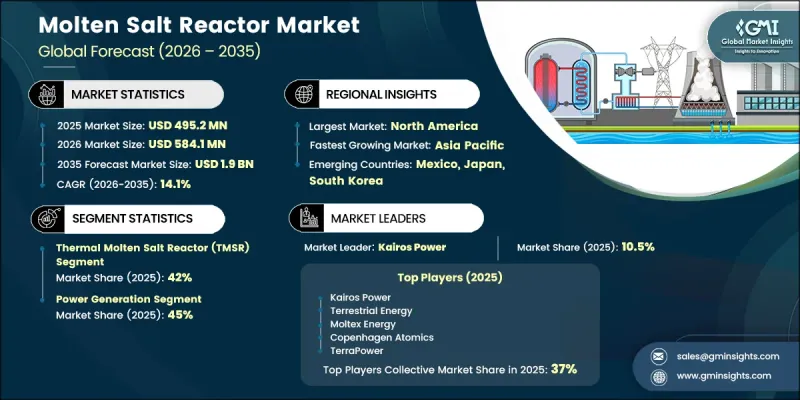
隨著政府和相關人員對先進核能技術的投資不斷增加,熔融態鹽類反應爐(MSR)市場正獲得顯著成長,這些先進技術能夠實現安全、高效和低碳的能源生產。氟化物和氯化物基核子反應爐設計的商業化,以及北美、歐洲和亞太地區支持性政策框架的訂定,正在加速市場發展。由於熔鹽反應器具有高熱效率、增強的被動安全性和高溫供熱供給能力等優勢,工業界正逐步擺脫傳統的熔融態鹽類反應爐反應器技術。這些優勢使熔鹽反應器成為滿足未來電力需求並支持工業脫碳的理想解決方案。政府旨在推廣下一代核能技術的資助計畫和政策舉措也增強了投資者的信心,並促進了長期計畫的發展。對可靠、低碳電力和高溫工業能源日益成長的需求進一步強化了熔融態鹽類反應爐的商業價值,預計這將持續推動全球熔融態鹽類反應爐(MSR)市場在預測期內的成長。
| 市場範圍 | |
|---|---|
| 開始年份 | 2025 |
| 預測期 | 2026-2035 |
| 初始市場規模 | 4.952億美元 |
| 預測金額 | 19億美元 |
| 複合年成長率 | 14.1% |
預計到2025年,熔融態鹽類反應爐市場佔有率將達到42%,並在2035年之前以16.8%的複合年成長率成長,成為成長最快的核子反應爐類型。熔鹽熔融態鹽類反應爐因其高效的運作特性、卓越的安全性以及對高溫能源應用的適用性而持續吸引最大的商業性關注。隨著全球市場商業化的推進,技術的成熟和持續的研發活動正在推動其更廣泛的應用。
預計到2025年,發電領域將佔全球市場佔有率的45%,並在2035年之前維持20.2%的複合年成長率,成為成長最快的應用領域之一。隨著能源供應商尋求可靠、低碳的基本負載電力以滿足不斷成長的電力需求,市場需求也不斷增加。熔融態鹽類反應爐技術正日益被認為是一種極具前景的選擇,它不僅能夠支持長期能源轉型策略,還能在滿足不斷成長的電力需求的同時實現持續發電。
預計到2025年,北美熔鹽反應器(MSR)市佔率將達到50.5%,並在2035年之前以16.1%的複合年成長率成長。該地區持續推動市場發展,這得益於公共和私人對先進核能技術的巨額投資、有利的監管政策以及對核子反應爐創新的強力的製度支持。除了持續的研發活動外,不斷增加的先進核子反應爐商業化資金投入也進一步鞏固了北美在全球市場的主導地位。
目錄
第1章:調查方法和範圍
第2章執行摘要
第3章 行業洞察
- 產業生態系統
- 原物料供應及採購分析
- 生產能力評估
- 供應鏈韌性與風險因素
- 配電網路分析
- 監理情勢
- 北美洲
- 歐洲
- 亞太地區
- 中東和非洲
- 拉丁美洲
- 影響產業的因素
- 促進因素
- 產業潛在風險與挑戰
- 成長潛力分析
- 波特的分析
- PESTLE分析
- 成本結構分析:熔融態鹽類反應爐
- 人工智慧和生成式人工智慧對市場的影響
- 預測性維護和故障檢測
- 電網最佳化和負載預測
- 利用數位孿生進行模擬和測試
- 風險、限制和監管考量
- 新機會和趨勢
- 數位化和物聯網整合
- 進入新興市場
- 整體投資情勢與未來展望
第4章 競爭情勢
- 介紹
- 企業市佔率分析:按地區分類
- 北美洲
- 歐洲
- 亞太地區
- 世界其他地區
- 主要市場公司的競爭分析
- 競爭定位矩陣
- 主要進展
- 併購
- 夥伴關係和聯盟
- 新產品發布
- 業務拓展計劃及資金籌措
- 按公司規模進行基準測試
- 排名分類標準與遴選標準
- 按銷售額、地區和創新能力分類的層級定位矩陣。
第5章 市場規模及預測:依反應器類型分類,2022-2035年
- 熔鹽反應器(TMSR)
- 快堆(FMSR)
- 熔鹽增殖反應器(MSBR)
- 其他
第6章 市場規模與預測:依應用領域分類,2022-2035年
- 發電
- 工業製程熱
- 氫氣生產
- 海水淡化
- 研究與開發
- 船舶和海軍推進系統
- 其他
第7章 市場規模及預測:依燃料類型分類,2022-2035年
- 釷基
- 鈾基
- 鈽/混合氧化物(MOX)
第8章 市場規模及預測:依最終用途分類,2022-2035年
- 公共產業及獨立電力生產商(IPP)
- 政府/國防
- 工業企業
- 研究機構和大學
- 其他
第9章 市場規模及預測:依地區分類,2022-2035年
- 北美洲
- 美國
- 加拿大
- 墨西哥
- 歐洲
- 英國
- 法國
- 德國
- 亞太地區
- 中國
- 印度
- 日本
- 韓國
- 世界其他地區
第10章:公司簡介
- Alpha Tech Research Corp
- China National Nuclear Corporation
- Copenhagen Atomics
- Elysium Industries
- Flibe Energy
- Kairos Power
- Moltex Energy
- Naarea
- Natura Resources
- Orano
- Saltfoss Energy
- Southern Company
- Stellaria
- TerraPower
- Terrestrial Energy
- ThorCon International
- Thorium Tech Solution(TTS)
- Thorizon
- Transatomic Power
- Valar Atomics
The Global Molten Salt Reactor (MSR) Market was valued at USD 495.2 million in 2025 and is estimated to grow at a CAGR of 14.1% to reach USD 1.9 billion by 2035.
The molten salt reactor (MSR) market is gaining significant momentum as governments and industry stakeholders increase investments in advanced nuclear technologies capable of delivering safe, efficient, and low-carbon energy generation. Growing commercialization of fluoride- and chloride-based reactor designs, combined with supportive policy frameworks across North America, Europe, and Asia Pacific, is accelerating market development. The industry is gradually transitioning beyond conventional light-water reactor technologies as molten salt reactors offer advantages including higher thermal efficiency, enhanced passive safety features, and the ability to supply high-temperature heat for industrial applications. These capabilities position MSRs as an attractive solution for meeting future electricity demand while supporting industrial decarbonization. Favorable government funding programs and policy initiatives aimed at advancing next-generation nuclear technologies are also improving investment confidence and encouraging long-term project development. Rising demand for reliable low-carbon electricity and high-temperature industrial energy continues to strengthen the business case for molten salt reactors, reinforcing growth prospects for the global molten salt reactor (MSR) market throughout the forecast period.
| Market Scope | |
|---|---|
| Start Year | 2025 |
| Forecast Year | 2026-2035 |
| Start Value | $495.2 Million |
| Forecast Value | $1.9 Billion |
| CAGR | 14.1% |
The thermal molten salt reactor segment accounted for 42% share in 2025 and is projected to grow at a CAGR of 16.8% through 2035, representing the fastest-growing reactor type. Thermal molten salt reactors continue to attract the greatest commercial interest because of their efficient operating characteristics, favorable safety profile, and suitability for high-temperature energy applications. Their technological maturity and ongoing development activities continue to support wider adoption as commercialization progresses across global markets.
The power generation segment represented 45% share in 2025 and is expected to register a CAGR of 20.2% through 2035, making it one of the fastest-growing application categories. Demand is increasing as energy providers seek dependable low-carbon baseload generation capable of supporting rising electricity consumption. Molten salt reactor technology is increasingly recognized as a promising option for delivering continuous power generation while supporting long-term energy transition strategies and expanding electricity requirements.
North America Molten Salt Reactor (MSR) Market accounted for 50.5% share in 2025 and is projected to grow at a CAGR of 16.1% through 2035. The region continues to lead market development through substantial public and private investment in advanced nuclear technologies, favorable regulatory progress, and strong institutional support for reactor innovation. Ongoing development activities, combined with increasing funding for advanced reactor commercialization, continue to reinforce North America's leadership position within the global market.
Major companies operating in the global molten salt reactor (MSR) market include TerraPower, Kairos Power, Terrestrial Energy, ThorCon International, Moltex Energy, China National Nuclear Corporation, Orano, Southern Company, Copenhagen Atomics, Flibe Energy, Alpha Tech Research Corp, Elysium Industries, Saltfoss Energy, Natura Resources, Naarea, Stellaria, Thorium Tech Solution (TTS), Thorizon, Transatomic Power, and Valar Atomics. Companies operating in the molten salt reactor (MSR) market are strengthening their competitive position through continuous investment in advanced reactor research, technology development, and commercialization initiatives. Industry participants are expanding strategic partnerships with government agencies, research organizations, utilities, and industrial energy users to accelerate project deployment and regulatory approvals. Companies are focusing on improving reactor efficiency, safety systems, fuel utilization, and modular construction methods to reduce project costs and shorten development timelines. Investments in demonstration projects, manufacturing capabilities, and advanced engineering expertise are supporting technology validation and market readiness.
Table of Contents
Chapter 1 Methodology & Scope
- 1.1 Research design
- 1.2 Quality commitment
- 1.2.1 GMI AI policy & data integrity commitment
- 1.2.1.1 Source consistency protocol
- 1.2.1 GMI AI policy & data integrity commitment
- 1.3 Research Trail & Confidence Scoring
- 1.3.1 Research Trail Components
- 1.3.2 Scoring Components
- 1.4 Data Collection
- 1.4.1 Partial list of primary sources
- 1.5 Data mining sources
- 1.5.1 Paid sources
- 1.5.1.1 Sources, by region
- 1.5.1 Paid sources
- 1.6 Base estimates and calculations
- 1.6.1 Base year calculation for any one approach
- 1.7 Forecast model
- 1.8 Research transparency addendum
- 1.8.1 Source attribution framework
- 1.8.2 Quality assurance metrics
- 1.8.3 Our commitment to trust
- 1.9 Market definitions
Chapter 2 Executive Summary
- 2.1 Industry synopsis, 2022 - 2035
- 2.2 Business trends
- 2.3 Reactor type trends
- 2.4 Application trends
- 2.5 Fuel trends
- 2.6 End use trends
- 2.7 Regional trends
Chapter 3 Industry Insights
- 3.1 Industry ecosystem
- 3.1.1 Raw material availability & sourcing analysis
- 3.1.2 Manufacturing capacity assessment
- 3.1.3 Supply chain resilience & risk factors
- 3.1.4 Distribution network analysis
- 3.2 Regulatory landscape
- 3.2.1 North America
- 3.2.2 Europe
- 3.2.3 Asia Pacific
- 3.2.4 Middle East & Africa
- 3.2.5 Latin America
- 3.3 Industry impact forces
- 3.3.1 Growth drivers
- 3.3.2 Industry pitfalls & challenges
- 3.4 Growth potential analysis
- 3.5 Porter's analysis
- 3.5.1 Bargaining power of suppliers
- 3.5.2 Bargaining power of buyers
- 3.5.3 Threat of new entrants
- 3.5.4 Threat of substitutes
- 3.6 PESTEL analysis
- 3.6.1 Political factors
- 3.6.2 Economic factors
- 3.6.3 Social factors
- 3.6.4 Technological factors
- 3.6.5 Legal factors
- 3.6.6 Environmental factors
- 3.7 Cost structure analysis of molten salt reactor
- 3.8 Impact of AI & generative AI on the market
- 3.8.1 Predictive maintenance & fault detection
- 3.8.2 Grid optimization & load forecasting
- 3.8.3 Digital twin simulation & testing
- 3.8.4 Risks, limitations & regulatory considerations
- 3.9 Emerging opportunities & trends
- 3.9.1 Digitalization & IoT integration
- 3.9.2 Emerging market penetration
- 3.10 Overall investment scenario and future outlook
Chapter 4 Competitive landscape, 2026
- 4.1 Introduction
- 4.2 Company market share analysis, by region, 2025
- 4.2.1 North America
- 4.2.2 Europe
- 4.2.3 Asia Pacific
- 4.2.4 Rest of world
- 4.3 Competitive analysis of major market players
- 4.4 Competitive positioning matrix
- 4.5 Key developments
- 4.5.1 Mergers & acquisitions
- 4.5.2 Partnerships & collaborations
- 4.5.3 New product launches
- 4.5.4 Expansion plans & funding
- 4.6 Company tier benchmarking
- 4.6.1 Tier classification criteria & qualifying thresholds
- 4.6.2 Tier positioning matrix by revenue, geography & innovation
Chapter 5 Market Size and Forecast, By Reactor type, 2022 - 2035 (USD Billion)
- 5.1 Key trends
- 5.2 Thermal molten salt reactor (TMSR)
- 5.3 Fast molten salt reactor (FMSR)
- 5.4 Molten salt breeder reactor (MSBR)
- 5.5 Others
Chapter 6 Market Size and Forecast, By Application, 2022 - 2035 (USD Billion)
- 6.1 Key trends
- 6.2 Power generation
- 6.3 Industrial process heat
- 6.4 Hydrogen production
- 6.5 Desalination
- 6.6 Research & development
- 6.7 Marine & naval propulsion
- 6.8 Others
Chapter 7 Market Size and Forecast, By Fuel, 2022 - 2035 (USD Billion)
- 7.1 Key trends
- 7.2 Thorium-based
- 7.3 Uranium-based
- 7.4 Plutonium / mixed oxide (MOX)
Chapter 8 Market Size and Forecast, By End use, 2022 - 2035 (USD Billion)
- 8.1 Key trends
- 8.2 Utilities & independent power producers (IPPs)
- 8.3 Government & defense
- 8.4 Industrial operators
- 8.5 Research institutes & universities
- 8.6 Others
Chapter 9 Market Size and Forecast, By Region, 2022 - 2035 (USD Billion)
- 9.1 Key trends
- 9.2 North America
- 9.2.1 U.S.
- 9.2.2 Canada
- 9.2.3 Mexico
- 9.3 Europe
- 9.3.1 UK
- 9.3.2 France
- 9.3.3 Germany
- 9.4 Asia Pacific
- 9.4.1 China
- 9.4.2 India
- 9.4.3 Japan
- 9.4.4 South Korea
- 9.5 Rest of world
Chapter 10 Company Profiles
- 10.1 Alpha Tech Research Corp
- 10.2 China National Nuclear Corporation
- 10.3 Copenhagen Atomics
- 10.4 Elysium Industries
- 10.5 Flibe Energy
- 10.6 Kairos Power
- 10.7 Moltex Energy
- 10.8 Naarea
- 10.9 Natura Resources
- 10.10 Orano
- 10.11 Saltfoss Energy
- 10.12 Southern Company
- 10.13 Stellaria
- 10.14 TerraPower
- 10.15 Terrestrial Energy
- 10.16 ThorCon International
- 10.17 Thorium Tech Solution (TTS)
- 10.18 Thorizon
- 10.19 Transatomic Power
- 10.20 Valar Atomics

 全球熔融態鹽類反應爐市場規模、佔有率、趨勢和成長分析報告(2026-2034年)
 壓水式反應爐市場:全球產業規模、市場佔有率、趨勢、機會和預測(按類型、應用和地區分類)、競爭格局(2021-2031 年)核子反應爐建造市場-全球產業規模、佔有率、趨勢、機會和預測:按核子反應爐類型、應用、地區和競爭格局分類,2021-2031年
 核子反應爐建設市場報告:按服務、核子反應爐類型和地區分類(2026-2034 年)
 核子反應爐 (NSSS)的全球市場
 2026年全球核子反應爐建設市場報告2026年全球核子反應爐市場報告
 核子反應爐建造市場規模、佔有率和成長分析(按核子反應爐類型、應用、服務、價值鏈和地區分類)-產業預測,2026-2033年
 全球壓水式反應爐市場小型模組化反應器建設市場-全球產業規模、佔有率、趨勢、機會及預測(按反應器類型、建設類型、最終用戶、地區和競爭細分,2020-2030 年預測)