


 |
市場調查報告書
商品編碼
2101657
寡核苷酸合成市場商機、成長要素、產業趨勢分析及2026-2035年預測。Oligonucleotide Synthesis Market Opportunity, Growth Drivers, Industry Trend Analysis, and Forecast 2026 - 2035 |
||||||

全球寡核苷酸合成市場預計到 2025 年價值 28 億美元,年複合成長率為 12.5%,到 2035 年將達到 86 億美元。
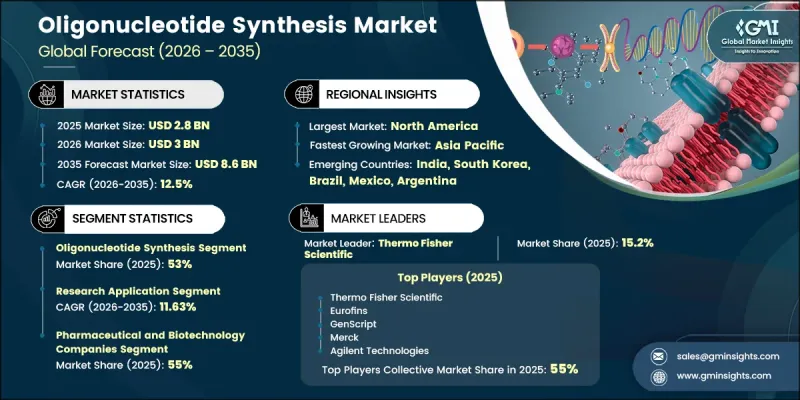
寡核苷酸治療藥物研發管線的成長、合成寡核苷酸在研發和臨床應用的廣泛使用,以及精準醫療和基因編輯技術的商業化,共同推動了市場擴張。寡核苷酸合成仍然是生命科學領域至關重要的基礎技術,為治療藥物開發、分子研究和合成生物學研究提供必需的核酸成分。主要商業合成供應商持續投資於產能建設,加上多個終端用戶產業的持續需求,預計將推動市場長期成長。此外,分子診斷解決方案和精準醫療方法的日益普及也持續刺激合成寡核苷酸的需求。合成寡核苷酸仍然是醫療和研究領域中各種基因組和分子分析應用的重要組成部分。
| 市場範圍 | |
|---|---|
| 開始年份 | 2025 |
| 預測期 | 2026-2035 |
| 初始市場規模 | 28億美元 |
| 預計金額 | 86億美元 |
| 複合年成長率 | 12.5% |
產品與服務部門佔據53%的市場佔有率,預計2026年至2035年將以12.05%的複合年成長率成長。此板塊提供商業合成解決方案,生產符合研究級、分析級和GMP標準的寡核苷酸,以滿足客戶特定的序列長度、純度規格和化學修飾要求。該板塊的市場領先地位反映了合成服務在幾乎所有下游應用(從科學研究到先進藥物開發和商業化生產)中發揮的關鍵作用。
製藥和生物技術公司佔據55%的市場佔有率,預計到2035年將以12.65%的複合年成長率成長。該細分市場的主導地位得益於其在藥物研發多個階段(包括標靶發現、先導化合物最佳化、臨床前評估、臨床生產和商業化生產)對合成寡核苷酸的日益依賴。為了提高供應可靠性並防止產能中斷,許多企業正與獲得GMP認證的合成供應商建立長期夥伴關係,這凸顯了可靠的生產能力對於推進基於寡核苷酸的藥物研發項目以及維持監管和運營連續性的重要性。
北美寡核苷酸合成市場預計到2025年將達到9.559億美元,這得益於其成熟的製藥和生物技術生態系統以及強大的研發基礎設施。美國佔據該地區市場收入的大部分,這得益於持續的聯邦研究經費投入、眾多臨床階段生物技術公司的聚集,以及多家專注於寡核苷酸合成技術和生產服務的領先供應商。
目錄
第1章:調查方法和範圍
第2章執行摘要
第3章 行業洞察
- 產業生態系分析
- 影響產業的因素
- 促進因素
- 分子診斷與精準醫療應用領域的拓展
- 全球疾病趨勢
- 合成生物學的快速技術進步
- 增加對研發活動的投入
- 產業潛在風險與挑戰
- 政府制定的嚴格規章制度和指導方針
- 高成本、生物安全、生物安保和倫理問題。
- 市場機遇
- 新興市場對科研級寡糖的需求潛力尚未開發。
- 用於合成生物學和 CRISPR篩檢的高複雜度寡核苷酸叢集的出現。
- 促進因素
- 成長潛力分析
- 監理情勢
- 北美洲
- 歐洲
- 亞太地區
- 技術與創新展望
- 最新科技趨勢
- 新興技術
- 價格趨勢分析
- 未來市場趨勢
- 人工智慧和生成式人工智慧對市場的影響
- 波特的分析
- PESTLE分析
第4章 競爭情勢
- 介紹
- 企業市佔率分析
- 北美洲
- 歐洲
- 亞太地區
- 企業矩陣分析
- 主要市場公司的競爭分析
- 競爭定位矩陣
- 主要進展
- 併購
- 夥伴關係和聯盟
- 新產品發布
- 業務拓展計劃
第5章 市場估算與預測:依產品類型分類,2022-2035年
- 寡核苷酸合成
- 標準寡核苷酸合成
- 客製化寡核苷酸合成
- 試劑和耗材
- 裝置
第6章 市場估計與預測:依應用領域分類,2022-2035年
- 研究
- 合成生物學
- 藥物發現
- 其他研究用途
- 治療
- 神經病學
- 罕見疾病
- 心血管疾病
- 感染疾病
- 其他治療領域
- 診斷
第7章 市場估計與預測:依最終用途分類,2022-2035年
- 製藥和生物技術公司
- 學術研究機構
- 合約研究機構
- 其他最終用戶
第8章 市場估計與預測:依地區分類,2022-2035年
- 北美洲
- 美國
- 加拿大
- 歐洲
- 德國
- 英國
- 法國
- 西班牙
- 義大利
- 荷蘭
- 亞太地區
- 中國
- 印度
- 日本
- 澳洲
- 韓國
- 拉丁美洲
- 巴西
- 墨西哥
- 阿根廷
- 中東和非洲
- 南非
- 沙烏地阿拉伯
- UAE
第9章:公司簡介
- Agilent Technologies
- Azenta Life Sciences
- Bioneer
- Eurofins
- Eurogentec
- GenScript
- Integrated DNA Technologies
- LGC Biosearch Technologies
- Maravai LifeSciences
- Merck
- Thermo Fisher Scientific
- Twist Bioscience
The Global Oligonucleotide Synthesis Market was valued at USD 2.8 billion in 2025 and is estimated to grow at a CAGR of 12.5% to reach USD 8.6 billion by 2035.
Market expansion is driven by the growing pipeline of oligonucleotide therapeutics, the rising adoption of synthetic oligonucleotides across research and clinical settings, and the increasing commercialization of precision medicine and gene-editing technologies. Oligonucleotide synthesis continues to be a critical enabling technology across the life sciences sector, supplying essential nucleic acid components for therapeutic development, molecular research, and synthetic biology initiatives. Ongoing investments in manufacturing capabilities by leading commercial synthesis providers, together with sustained demand from multiple end-use industries, are expected to reinforce long-term market growth. Furthermore, the expanding implementation of molecular diagnostic solutions and precision medicine approaches continues to strengthen demand for synthetic oligonucleotides, which remain indispensable components in a wide range of genomic and molecular analysis applications across healthcare and research settings.
| Market Scope | |
|---|---|
| Start Year | 2025 |
| Forecast Year | 2026-2035 |
| Start Value | $2.8 Billion |
| Forecast Value | $8.6 Billion |
| CAGR | 12.5% |
The products and services segment accounts for 53% share and is forecast to grow at a CAGR of 12.05% between 2026 and 2035. This segment includes commercial synthesis solutions that deliver research-grade, analytical-grade, and GMP-grade oligonucleotides designed to meet customer-specific sequence lengths, purity specifications, and chemical modification requirements. Its leading market position reflects the indispensable role of synthesis services as the foundation for virtually every downstream application, supporting activities ranging from scientific research to advanced pharmaceutical development and commercial manufacturing.
The pharmaceutical and biotechnology companies segment held 55% share and is projected to register a CAGR of 12.65% throughout 2035. Their market leadership is supported by the increasing reliance on synthetic oligonucleotides across multiple stages of drug development, including target discovery, lead optimization, preclinical evaluation, clinical manufacturing, and commercial production. To strengthen supply reliability and ensure uninterrupted manufacturing capacity, many organizations are entering long-term partnerships with GMP-certified synthesis providers, highlighting the strategic importance of dependable production capabilities for advancing oligonucleotide-based drug development programs and maintaining regulatory and operational continuity.
North America Oligonucleotide Synthesis Market captured USD 955.9 million in 2025, supported by its well-established pharmaceutical and biotechnology ecosystem and extensive research infrastructure. The United States generates most of the regional revenue, benefiting from consistent federal research funding, a strong concentration of clinical-stage biotechnology companies, and the presence of several leading providers specializing in oligonucleotide synthesis technologies and manufacturing services.
Key companies operating in the global oligonucleotide synthesis market include Thermo Fisher Scientific, Integrated DNA Technologies, LGC Biosearch Technologies, Bioneer, Eurogentec, Azenta Life Sciences, Eurofins, Maravai LifeSciences, GenScript, Twist Bioscience, Merck, and Agilent. Companies operating in the oligonucleotide synthesis market are strengthening their market position by expanding manufacturing capacity, enhancing GMP-compliant production capabilities, and investing in advanced synthesis technologies that improve scalability, quality, and turnaround times. Many participants are broadening their product portfolios through the introduction of customized oligonucleotide solutions with diverse purity levels and chemical modifications to address evolving customer requirements. Strategic collaborations with pharmaceutical companies, biotechnology firms, and research organizations remain a key approach for securing long-term business opportunities and supporting drug development pipelines. Organizations are also focusing on geographic expansion by establishing new production facilities and strengthening regional distribution networks.
Table of Contents
Chapter 1 Methodology and Scope
- 1.1 Market scope and definition
- 1.2 Research approach
- 1.3 Quality commitments
- 1.3.1 GMI AI policy & data integrity commitment
- 1.3.1.1 Source consistency protocol
- 1.3.1 GMI AI policy & data integrity commitment
- 1.4 Research trail & confidence scoring
- 1.4.1 Research trail components
- 1.4.2 Scoring components
- 1.5 Data collection
- 1.5.1 Partial list of primary sources
- 1.6 Data mining sources
- 1.6.1 Paid sources
- 1.6.1.1 Sources, by region
- 1.6.1 Paid sources
- 1.7 Base estimates and calculations
- 1.7.1 Base year calculation for any one approach
- 1.8 Forecast model
- 1.8.1 Quantified market impact analysis
- 1.8.1.1 Mathematical impact of growth parameters on forecast
- 1.8.1 Quantified market impact analysis
- 1.9 Research transparency addendum
- 1.9.1 Source attribution framework
- 1.9.2 Quality assurance metrics
- 1.9.3 Our commitment to trust
Chapter 2 Executive Summary
- 2.1 Industry 360° synopsis
- 2.2 Key market trends
- 2.2.1 Regional trends
- 2.2.2 Product type trends
- 2.2.3 Application trends
- 2.2.4 End use trends
- 2.3 CXO perspectives: Strategic imperatives
Chapter 3 Industry Insights
- 3.1 Industry ecosystem analysis
- 3.2 Industry impact forces
- 3.2.1 Growth drivers
- 3.2.1.1 Expanding Applications in Molecular Diagnostics and Precision Medicine.
- 3.2.1.2 Growing Prevalence of Diseases Globally.
- 3.2.1.3 Rapid Technology Advancements in Synthetic Biology.
- 3.2.1.4 Rising Investments Towards Research and Development Activities
- 3.2.2 Industry pitfalls and challenges
- 3.2.2.1 Stringent Government Regulations and Guidelines.
- 3.2.2.2 High Cost, Biosafety, Biosecurity, and Ethical Issues.
- 3.2.3 Market opportunities
- 3.2.3.1 Untapped Potential in Emerging Markets for Research-Grade Oligo Demand
- 3.2.3.2 Emergence of High-Complexity Oligo Pools for Synthetic Biology & CRISPR Screening
- 3.2.1 Growth drivers
- 3.3 Growth potential analysis
- 3.4 Regulatory landscape
- 3.4.1 North America
- 3.4.2 Europe
- 3.4.3 Asia Pacific
- 3.5 Technology and innovation landscape
- 3.5.1 Current technological trends
- 3.5.2 Emerging technologies
- 3.6 Pricing trend analysis (Driven by Primary Research)
- 3.7 Future market trends
- 3.8 Impact of AI & Generative AI on the market (Driven by Primary Research)
- 3.9 Porter's analysis
- 3.10 PESTEL analysis
Chapter 4 Competitive Landscape, 2025
- 4.1 Introduction
- 4.2 Company market share analysis
- 4.2.1 North America
- 4.2.2 Europe
- 4.2.3 Asia Pacific
- 4.3 Company matrix analysis
- 4.4 Competitive analysis of major market players
- 4.5 Competitive positioning matrix
- 4.6 Key developments
- 4.6.1 Merger and acquisition
- 4.6.2 Partnership and collaboration
- 4.6.3 New product launches
- 4.6.4 Expansion plans
Chapter 5 Market Estimates and Forecast, By Product Type, 2022 - 2035 ($ Mn)
- 5.1 Key trends
- 5.2 Oligonucleotide Synthesis
- 5.2.1 Standard oligonucleotide synthesis
- 5.2.2 Custom oligonucleotide synthesis
- 5.3 Reagents and Consumables
- 5.4 Equipments
Chapter 6 Market Estimates and Forecast, By Application, 2022 - 2035 ($ Mn)
- 6.1 Key trends
- 6.2 Research
- 6.2.1 Synthetic biology
- 6.2.2 Drug discovery
- 6.2.3 Other research applications
- 6.3 Therapeutics
- 6.3.1 Neurology
- 6.3.2 Rare diseases
- 6.3.3 Cardiovascular disease
- 6.3.4 Infectious diseases
- 6.3.5 Other therapeutic areas
- 6.4 Diagnostics
Chapter 7 Market Estimates and Forecast, By End Use, 2022 - 2035 ($ Mn)
- 7.1 Key trends
- 7.2 Pharmaceutical and biotechnology companies
- 7.3 Academic and research institutes
- 7.4 Contract research organization
- 7.5 Other end users
Chapter 8 Market Estimates and Forecast, By Region, 2022 - 2035 ($ Mn)
- 8.1 Key trends
- 8.2 North America
- 8.2.1 U.S.
- 8.2.2 Canada
- 8.3 Europe
- 8.3.1 Germany
- 8.3.2 UK
- 8.3.3 France
- 8.3.4 Spain
- 8.3.5 Italy
- 8.3.6 Netherlands
- 8.4 Asia Pacific
- 8.4.1 China
- 8.4.2 India
- 8.4.3 Japan
- 8.4.4 Australia
- 8.4.5 South Korea
- 8.5 Latin America
- 8.5.1 Brazil
- 8.5.2 Mexico
- 8.5.3 Argentina
- 8.6 Middle East and Africa
- 8.6.1 South Africa
- 8.6.2 Saudi Arabia
- 8.6.3 UAE
Chapter 9 Company Profiles
- 9.1 Agilent Technologies
- 9.2 Azenta Life Sciences
- 9.3 Bioneer
- 9.4 Eurofins
- 9.5 Eurogentec
- 9.6 GenScript
- 9.7 Integrated DNA Technologies
- 9.8 LGC Biosearch Technologies
- 9.9 Maravai LifeSciences
- 9.10 Merck
- 9.11 Thermo Fisher Scientific
- 9.12 Twist Bioscience

 全球寡核苷酸合成市場(到 2031 年):按供應部門(合成產品(耗材和設備)、合成寡核苷酸(DNA 和 RNA)、基於寡核苷酸的藥物(ASO 和 siRNA))、治療領域(罕見疾病、神經系統疾病和癌症)以及競爭對手分類。
 寡核苷酸合成市場:依產品類型、合成規模、交付方式、應用和最終用戶分類-2026-2032年全球市場預測
 寡核苷酸合成市場-全球產業規模、佔有率、趨勢、機會、預測:依產品類型、應用、最終用戶、地區、競爭格局分類,2021-2031年
 寡核苷酸合成市場報告:趨勢、預測與競爭分析(至2035年)
 寡核苷酸合成市場報告:按產品、應用、最終用途和地區分類(2026-2034 年)
 寡核苷酸合成市場:依設備與服務、技術、核酸、應用、最終用戶和地區分類
 寡核苷酸合成試劑市場規模、佔有率和趨勢分析報告:按產品、應用、最終用途、地區和細分市場預測(2026-2033 年)寡核苷酸合成市場(第四版):按寡核苷酸長度、應用、類別、類型、產品和地區分類 - 預測及人工智慧 (AI) 的影響 - 高階主管和顧問指南 (2026–2030)
 寡核苷酸合成設備市場規模、佔有率和成長分析:按類型、技術、外形規格、應用、最終用戶和地區分類-2026-2033年產業預測
 2026-2030年全球寡核苷酸合成市場