

 |
市場調查報告書
商品編碼
2101646
城市園藝產品市場:市場機會、成長要素、產業趨勢分析及2026-2035年預測Urban Gardening Products Market Opportunity, Growth Drivers, Industry Trend Analysis, and Forecast 2026 - 2035 |
||||||

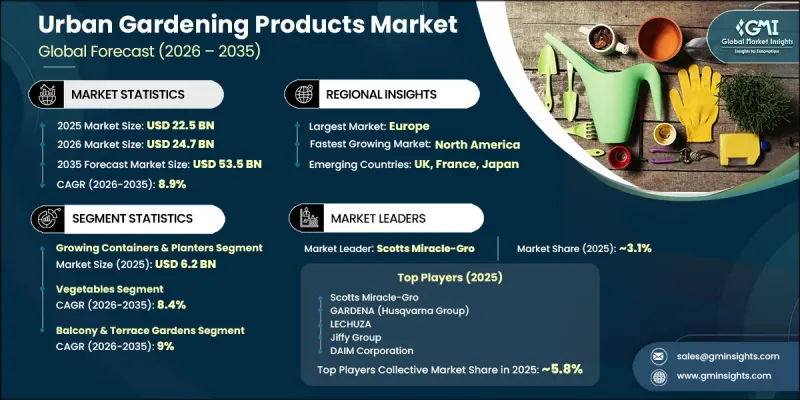
全球城市園藝產品市場預計到 2025 年將價值 225 億美元,並將以 8.9% 的複合年成長率成長,到 2035 年達到 535 億美元。
消費者生活方式的結構性變化推動了這一成長,公寓和緊湊型住宅成為都市區生活的主要模式。因此,消費者越來越傾向於室內種植和陽台園藝,需要緊湊、高效且模組化的解決方案。垂直種植系統、種植袋、容器套裝和室內種植套裝等城市園藝產品正穩步受到住宅的歡迎。人們對居家休閒活動和健康生活方式日益成長的興趣也促進了產品的普及。製造商正積極回應,提供專為空間有限的城市環境設計的、最大限度利用空間的園藝解決方案,包括適用於陽台、露台和室內空間的多功能系統。智慧城市建設的推進和消費者對自家種植食品日益成長的興趣持續推動全球需求。永續性意識也發揮著至關重要的作用,消費者越來越傾向於選擇環保的園藝解決方案,例如可生物分解的種植箱、堆肥系統、有機肥料和能夠減少用水量和生活垃圾的自動灌溉技術。
| 市場範圍 | |
|---|---|
| 開始年份 | 2025 |
| 預測期 | 2026-2035 |
| 上市時的市場規模 | 225億美元 |
| 預計金額 | 535億美元 |
| 複合年成長率 | 8.9% |
預計到2025年,容器和種植箱市場的銷售額將達到62億美元,並在2026年至2035年間以7.4%的複合年成長率成長。該細分市場是推動市場成長的主要動力,因為它在空間有限的住宅環境中發揮著至關重要的作用,尤其是在傳統園藝空間不足的情況下。都市區消費者越來越依賴容器系統在陽台、屋頂、露台和室內等有限空間種植植物,這使得容器種植箱成為城市園藝解決方案的基礎產品類型。
預計到2025年,蔬菜市佔率將達到43.3%,並在2035年之前以8.4%的複合年成長率成長。由於消費者對營養、食品安全以及新鮮自家種植農產品的益處的認知不斷提高,蔬菜市場持續保持領先地位。強調增加蔬菜攝取量的健康飲食建議進一步提升了蔬菜市場的受歡迎程度。城市園藝使家庭能夠種植番茄、生菜、菠菜、辣椒和黃瓜等蔬菜,這不僅提供了一種經濟便捷的方式來增加膳食多樣性,還能確保人們能夠獲得新鮮、無化學添加的食品。
德國城市園藝產品市場預計到2025年將達到16億美元,並在2026年至2035年間以8.2%的複合年成長率成長。該國市場的強勁成長得益於民眾高度的環保意識和長期以來對家庭園藝的文化偏好。都市區消費者擴大採用陽台園藝系統、小型溫室和室內香草種植方案,將其作為永續生活方式的一部分。具有環保意識的家庭對可回收的種植材料、環保園藝工具和有機土壤改良劑的需求持續成長。
目錄
第1章:調查方法和範圍
第2章執行摘要
第3章 行業洞察
- 產業生態系分析
- 供應商情況
- 利潤率
- 每個階段增加的價值
- 影響價值鏈的因素
- 影響產業的因素
- 促進因素
- 隨著都市化的加快,對小型園藝產品的需求日益成長。
- 人們日益增強的永續發展意識正在推動城市園藝產品的流行。
- 人們日益增強的健康意識正在推動家庭園藝的趨勢。
- 潛在風險和挑戰
- 都市區空間有限,阻礙了園藝用品的大規模普及。
- 園藝用品價格上漲,阻礙了更多人的購買。
- 機會
- 智慧園藝技術為高級產品創造了成長機會。
- 永續園藝產品正在推動全球環保意識市場的擴張。
- 促進因素
- 成長潛力分析
- 未來市場趨勢
- 技術與創新展望
- 最新科技趨勢
- 新興技術
- 監理情勢
- 標準和合規要求
- 區域監理框架
- 認證標準
- 波特的分析
- PESTLE分析
- 價格分析
- 對過去價格趨勢的分析
- 依球員類型分類的定價策略(高級球員、超值球員、成本加成球員)
- 按產品類型和最終用戶分類的價格敏感度
- 貿易數據分析
- 按產品類別分類的進出口量和進口額趨勢
- 主要貿易路線及關稅對城市園藝產品的影響
- 人工智慧和生成式人工智慧對市場的影響
- 利用人工智慧改造現有園藝產品經營模式
- 按細分市場分類的人工智慧生成用例和實施藍圖(植物健康檢查、個人化栽培指南、自動灌溉)。
- 人工智慧在城市園藝中的風險、限制和監管考量
- 目前分銷基礎設施和通路滲透情況
- 按地區和業務類型(線上/專賣店/量販店)分類的通路涵蓋範圍
- 最後一公里基礎設施挑戰和不斷變化的管道(DTC訂閱、社交電商)
第4章 競爭情勢
- 介紹
- 企業市佔率分析
- 按地區
- 企業矩陣分析
- 主要市場公司的競爭分析
- 競爭定位矩陣
- 主要進展
- 併購
- 夥伴關係和聯盟
- 新產品發布
- 業務拓展計劃
第5章 市場估算與預測:依產品類型分類,2022-2035年
- 栽培容器和種植箱
- 栽培系統和工具包
- 栽培基質、肥料和營養物質
- 種子、幼苗和繁殖材料
- 灌溉和澆水解決方案
- 栽培照明和照明系統
- 園藝工具、害蟲防治用品和配件
第6章 市場估算與預測:依作物類型分類,2022-2035年
- 蔬菜
- 香草和微型菜苗
- 水果
- 開花植物和觀賞植物
- 其他
第7章 市場估計與預測:依種植環境分類,2022-2035年
- 陽台露台花園
- 屋頂花園
- 室內和窗台園藝
- 社區花園和共用空間
- 其他
第8章 市場估算與預測:依最終用戶分類,2022-2035年
- 住宅
- 公寓居住者和都市區租屋居住者
- 進入許可權露台和屋頂的住宅
- 商業的
- 餐廳、咖啡館及餐飲服務業
- 飯店、度假村和招待設施
- 對機構而言
- 學校和教育機構
- 企業園區及辦公大樓
- 社區花園和地方政府項目
第9章 市場估價與預測:依通路分類,2022-2035年
- 線上零售
- 專業園藝中心和苗圃
- 超級市場、大賣場、家居建材商店
- 直接面對消費者的訂閱盒和種子俱樂部
- 其他
第10章 市場估價與預測:依地區分類,2022-2035年
- 北美洲
- 美國
- 加拿大
- 歐洲
- 德國
- 英國
- 法國
- 義大利
- 西班牙
- 亞太地區
- 中國
- 印度
- 日本
- 韓國
- 澳洲
- 拉丁美洲
- 巴西
- 墨西哥
- 阿根廷
- 中東和非洲
- 沙烏地阿拉伯
- UAE
- 南非
第11章:公司簡介
- 世界頂尖公司
- The Scotts Miracle-Gro Company
- GARDENA(Husqvarna Group)
- LECHUZA
- Jiffy Group
- Click & Grow
- 該地區的領先企業
- DAIM Corporation
- CropKing Inc.
- ZipGrow Inc.
- Minigarden
- Veritable SAS
- 新興企業和專業公司
- SweGreen AB
- Urban Planty
- Myriad Garden GmbH
- Lyine Group
- Urban Ponics
The Global Urban Gardening Products Market was valued at USD 22.5 billion in 2025 and is estimated to grow at a CAGR of 8.9% to reach USD 53.5 billion by 2035.
The expansion is driven by a structural shift in consumer living patterns, where apartment-based and compact residential housing is becoming the dominant urban lifestyle model. As a result, consumers are increasingly adopting indoor planting and balcony-based gardening practices that require compact, efficient, and modular solutions. Urban gardening products such as vertical planting systems, grow bags, container-based kits, and indoor cultivation setups are gaining consistent traction across residential users. Rising interest in home-based leisure activities and wellness-oriented lifestyles is also reinforcing product adoption. Manufacturers are responding by designing space-optimized gardening solutions tailored for constrained urban environments, including multifunctional systems suitable for balconies, terraces, and indoor areas. Expanding smart city development and increasing consumer focus on self-grown food production continue to strengthen demand globally. Sustainability awareness is also playing a key role, with consumers increasingly preferring environmentally responsible gardening solutions such as biodegradable planters, composting systems, organic fertilizers, and automated irrigation technologies that reduce water usage and household waste.
| Market Scope | |
|---|---|
| Start Year | 2025 |
| Forecast Year | 2026-2035 |
| Start Value | $22.5 Billion |
| Forecast Value | $53.5 Billion |
| CAGR | 8.9% |
The containers & planters segment generated USD 6.2 billion in 2025 and is projected to grow at a CAGR of 7.4% between 2026 and 2035. This segment leads the market due to its essential role in enabling plant cultivation in compact residential environments where conventional gardening space is unavailable. Urban consumers increasingly depend on container-based systems to grow plants in restricted areas such as balconies, rooftops, terraces, and indoor spaces, making them a foundational product category within urban gardening solutions.
The vegetables segment accounted for 43.3% share in 2025 and is expected to grow at a CAGR of 8.4% through 2035. This segment remains dominant due to rising consumer awareness around nutrition, food security, and the benefits of fresh homegrown produce. Health-focused dietary recommendations emphasizing increased vegetable consumption are further supporting adoption. Urban gardening enables households to cultivate vegetables such as tomatoes, lettuce, spinach, chilies, and cucumbers, offering a cost-effective and accessible way to improve dietary diversity while ensuring access to fresh, chemical-free food.
Germany Urban Gardening Products Market reached USD 1.6 billion in 2025 and is projected to grow at a CAGR of 8.2% between 2026 and 2035. The country's market strength is supported by strong environmental awareness and a long-standing cultural preference for home gardening practices. Urban consumers are increasingly adopting balcony-based gardening systems, compact greenhouse setups, and indoor herb cultivation solutions as part of sustainable living habits. Demand for recyclable planting materials, eco-friendly gardening tools, and organic soil enhancers continues to increase across environmentally conscious households.
Major companies operating in the global urban gardening products industry include The Scotts Miracle-Gro Company, GARDENA (Husqvarna Group), LECHUZA, Jiffy Group, Click & Grow, CropKing Inc., DAIM Corporation, Minigarden, Veritable SAS, ZipGrow Inc., Myriad Garden GmbH, Urban Planty, SweGreen AB, Urban Ponics, and Lyine Group. Companies in the urban gardening products market are focusing on expanding product portfolios with modular and space-saving designs tailored for compact urban homes. Many players are investing in sustainable and eco-friendly materials such as biodegradable plastics and recyclable substrates to align with environmental expectations. Product innovation is centered on smart gardening systems that integrate automated watering, nutrient monitoring, and app-based control features. Strategic partnerships with e-commerce platforms and home improvement retailers are strengthening distribution reach across urban centers.
Table of Contents
Chapter 1 Methodology & Scope
- 1.1 Market scope and definition
- 1.2 Research design
- 1.2.1 Research approach
- 1.2.2 Data collection methods
- 1.3 Data mining sources
- 1.3.1 Global
- 1.3.2 Regional/Country
- 1.4 Base estimates and calculations
- 1.4.1 Base year calculation
- 1.4.2 Key trends for market estimation
- 1.5 Primary research and validation
- 1.5.1 Primary sources
- 1.6 Forecast model
- 1.7 Research assumptions and limitations
Chapter 2 Executive Summary
- 2.1 Industry 360° synopsis
- 2.2 Key market trends
- 2.2.1 Regional
- 2.2.2 Product type
- 2.2.3 Crop type
- 2.2.4 Cultivation setting
- 2.2.5 End user
- 2.2.6 Distribution channel
Chapter 3 Industry Insights
- 3.1 Industry ecosystem analysis
- 3.1.1 Supplier landscape
- 3.1.2 Profit margin
- 3.1.3 Value addition at each stage
- 3.1.4 Factor affecting the value chain
- 3.2 Industry impact forces
- 3.2.1 Growth drivers
- 3.2.1.1 Rising urbanization increases demand for compact gardening products
- 3.2.1.2 Growing sustainability awareness supports urban gardening product adoption.
- 3.2.1.3 Increasing health consciousness boosts home-grown food cultivation trends
- 3.2.2 Pitfalls & Challenges
- 3.2.2.1 Limited urban space restricts large-scale gardening product adoption
- 3.2.2.2 High premium gardening product costs limit broader affordability
- 3.2.3 Opportunities
- 3.2.3.1 Smart gardening technologies create premium product growth opportunities
- 3.2.3.2 Sustainable gardening products support eco-friendly market expansion globally
- 3.2.1 Growth drivers
- 3.3 Growth potential analysis
- 3.4 Future market trends
- 3.5 Technology and innovation landscape
- 3.5.1 Current technological trends
- 3.5.2 Emerging technologies
- 3.6 Regulatory landscape
- 3.6.1 Standards and compliance requirements
- 3.6.2 Regional regulatory frameworks
- 3.6.3 Certification standards
- 3.7 Porter's analysis
- 3.8 PESTEL analysis
- 3.9 Pricing analysis (driven by primary research)
- 3.9.1 Historical price trend analysis (driven by primary research)
- 3.9.2 Pricing strategy by player type (premium / value / cost-plus) (driven by primary research)
- 3.9.3 Price sensitivity by product category & end user
- 3.10 Trade data analysis (driven by paid database)
- 3.10.1 Import/export volume & value trends by product category (driven by paid database)
- 3.10.2 Key trade corridors & tariff impact on urban gardening products (driven by paid database)
- 3.11 Impact of AI & generative AI on the market
- 3.11.1 AI-driven disruption of existing gardening product business models
- 3.11.2 GenAI use cases & adoption roadmap by segment (plant health diagnostics, personalized growing guides, automated irrigation)
- 3.11.3 Risks, limitations & regulatory considerations of AI in urban gardening
- 3.12 Distribution infrastructure & channel penetration landscape (driven by primary research)
- 3.12.1 Channel coverage by region & format (online vs. specialty vs. mass retail) (driven by primary research)
- 3.12.2 Last-mile infrastructure gaps & emerging channel shifts (DTC subscriptions, social commerce) (driven by primary research)
Chapter 4 Competitive Landscape, 2025
- 4.1 Introduction
- 4.2 Company market share analysis
- 4.2.1 By Region
- 4.2.1.1 North America
- 4.2.1.2 Europe
- 4.2.1.3 Asia Pacific
- 4.2.1.4 Latin America
- 4.2.1.5 Middle East & Africa
- 4.2.1 By Region
- 4.3 Company matrix analysis
- 4.4 Competitive analysis of major market players
- 4.5 Competitive positioning matrix
- 4.6 Key developments
- 4.6.1 Mergers & acquisitions
- 4.6.2 Partnerships & collaborations
- 4.6.3 New product launches
- 4.6.4 Expansion plans
Chapter 5 Market Estimates & Forecast, By Product Type, 2022 - 2035, (USD Billion) (Thousand Units)
- 5.1 Key trends
- 5.2 Growing containers & planters
- 5.3 Growing systems & kits
- 5.4 Growing media, fertilizers & nutrients
- 5.5 Seeds, seedlings & propagation supplies
- 5.6 Irrigation & watering solutions
- 5.7 Grow lights & lighting systems
- 5.8 Gardening tools, pest management & accessories
Chapter 6 Market Estimates & Forecast, By Crop Type, 2022 - 2035, (USD Billion) (Thousand Units)
- 6.1 Key trends
- 6.2 Vegetables
- 6.3 Herbs & microgreens
- 6.4 Fruits
- 6.5 Flowers & ornamentals
- 6.6 Others
Chapter 7 Market Estimates & Forecast, By Cultivation Setting, 2022 - 2035, (USD Billion) (Thousand Units)
- 7.1 Key trends
- 7.2 Balcony & terrace gardens
- 7.3 Rooftop gardens
- 7.4 Indoor & window gardens
- 7.5 Community gardens & shared spaces
- 7.6 Others
Chapter 8 Market Estimates & Forecast, By End User, 2022 - 2035, (USD Billion) (Thousand Units)
- 8.1 Key trends
- 8.2 Residential
- 8.2.1 Apartment dwellers & urban renters
- 8.2.2 Homeowners with terraces & rooftop access
- 8.3 Commercial
- 8.3.1 Restaurants, cafes & food service establishments
- 8.3.2 Hotels, resorts & hospitality venues
- 8.4 Institutional
- 8.4.1 Schools & educational institutions
- 8.4.2 Corporate campuses & offices
- 8.4.3 Community gardens & municipal programs
Chapter 9 Market Estimates & Forecast, By Distribution Channel, 2022 - 2035, (USD Billion) (Thousand Units)
- 9.1 Key trends
- 9.2 Online retail
- 9.3 Specialty garden centers & nurseries
- 9.4 Supermarkets, hypermarkets & home improvement stores
- 9.5 Direct-to-consumer subscription boxes & seed clubs
- 9.6 Others
Chapter 10 Market Estimates & Forecast, By Region, 2022 - 2035, (USD Billion) (Thousand Units)
- 10.1 Key trends
- 10.2 North America
- 10.2.1 U.S.
- 10.2.2 Canada
- 10.3 Europe
- 10.3.1 Germany
- 10.3.2 UK
- 10.3.3 France
- 10.3.4 Italy
- 10.3.5 Spain
- 10.4 Asia Pacific
- 10.4.1 China
- 10.4.2 India
- 10.4.3 Japan
- 10.4.4 South Korea
- 10.4.5 Australia
- 10.5 Latin America
- 10.5.1 Brazil
- 10.5.2 Mexico
- 10.5.3 Argentina
- 10.6 MEA
- 10.6.1 Saudi Arabia
- 10.6.2 UAE
- 10.6.3 South Africa
Chapter 11 Company Profiles
- 11.1 Top Global Players
- 11.1.1 The Scotts Miracle-Gro Company
- 11.1.2 GARDENA (Husqvarna Group)
- 11.1.3 LECHUZA
- 11.1.4 Jiffy Group
- 11.1.5 Click & Grow
- 11.2 Regional Champions
- 11.2.1 DAIM Corporation
- 11.2.2 CropKing Inc.
- 11.2.3 ZipGrow Inc.
- 11.2.4 Minigarden
- 11.2.5 Veritable SAS
- 11.3 Emerging & Specialized Players
- 11.3.1 SweGreen AB
- 11.3.2 Urban Planty
- 11.3.3 Myriad Garden GmbH
- 11.3.4 Lyine Group
- 11.3.5 Urban Ponics

 園藝花盆市場規模、佔有率和成長分析:按材料、產品類型、最終用途、通路、規模和地區分類-2026-2033年產業預測
 永續生活市場規模、佔有率和成長分析:按產品類型、原料、價格範圍、消費者群體、分銷管道和地區分類-2026-2033年產業預測
 全球花園圍籬市場規模、佔有率、趨勢和成長分析報告(2026-2034年)
 花園圍籬市場:依材料類型、安裝類型、應用程式、最終用戶和通路分類-2026-2032年全球預測花園邊緣裝飾市場:按產品類型、安裝類型、應用程式、最終用戶和銷售管道-2026-2032年全球預測景觀和花園邊緣產品市場(按材料、產品、安裝類型、應用、分銷管道和最終用戶分類),全球預測,2026-2032年
 盆景市場-全球產業規模、佔有率、趨勢、機會和預測:按類型、風格、分銷管道、地區和競爭格局分類,2021-2031年盆景市場-2026-2031年預測自吸水窗台花盆市場:按產品類型、材料、技術、價格範圍、分銷管道、最終用戶和應用分類-2026-2032年全球預測全球園藝花盆市場-產業規模、佔有率、趨勢、機會及預測,依產品類型、應用、配銷通路、地區及競爭格局分類,2021-2031年預測