

 |
市場調查報告書
商品編碼
2101614
下一代顧客忠誠度市場:商業機會、成長要素、產業趨勢分析及2026-2035年預測Next Generation Customer Loyalty Market Opportunity, Growth Drivers, Industry Trend Analysis, and Forecast 2026 - 2035 |
||||||

全球下一代客戶忠誠度市場預計到 2025 年將達到 124 億美元,並以 12.6% 的複合年成長率成長,到 2035 年將達到 391 億美元。
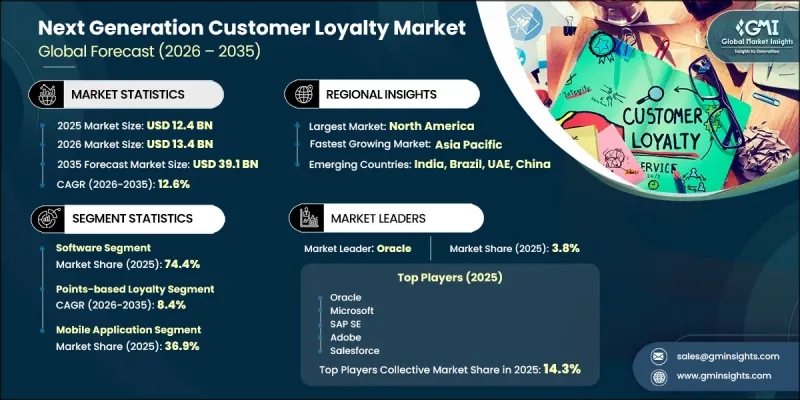
隨著各行各業的公司加大對智慧客戶參與平台的投資,以加強與客戶的長期關係並提高客戶客戶維繫率,新一代客戶忠誠度市場正經歷強勁成長。人工智慧 (AI) 正成為現代忠誠度解決方案的關鍵技術,它能夠基於行為洞察、購買活動、互動模式和偏好數據,實現高度個人化的客戶體驗。雲端原生基礎設施、即時分析和智慧數據處理的進步顯著提高了忠誠度決策的速度和準確性,使公司能夠幾乎即時地提供個人化獎勵。同時,公司正在拋棄傳統的基於交易的獎勵計劃,轉而採用專注於提供更有意義的客戶體驗的互動模式。這種演變反映了忠誠度策略向以客戶為中心的轉變,旨在提升情感互動、增強品牌親和性並最大化客戶終身價值。預計在預測期內,數位互動技術的持續創新將推動新一代客戶忠誠度市場的持續成長。
| 市場範圍 | |
|---|---|
| 開始年份 | 2025 |
| 預測期 | 2026-2035 |
| 上市時的市場規模 | 124億美元 |
| 預測金額 | 391億美元 |
| 複合年成長率 | 12.6% |
人工智慧 (AI) 驅動的個人化正在不斷重塑下一代客戶忠誠度模式,使企業能夠基於即時客戶洞察,提供高度客製化的獎勵、促銷和互動策略。先進數據基礎設施和智慧分析的普及顯著縮短了從客戶互動到忠誠度計畫實施的回應時間,使企業能夠建立更具動態性和回應性的忠誠度計畫。隨著企業努力加強與客戶的關係,與傳統忠誠度模式相比,能夠帶來更高參與度、更佳客戶滿意度和更高收益的個人化互動策略正變得日益重要。
預計到2025年,軟體細分市場將佔據74.4%的市場佔有率,並在2026年至2035年間以13.5%的複合年成長率成長。該細分市場涵蓋忠誠度管理軟體、個人化平台、分析解決方案、獎勵管理應用以及將忠誠度計畫與更廣泛的企業舊有系統,以支持其不斷發展的客戶參與策略,基於雲端的軟體交付模式的日益普及正在加速市場擴張。
預計到2025年,行動應用市場市佔率將達到36.9%,成為領先的客戶參與管道。行動平台憑藉其在單一應用程式中提供個人化優惠、即時通知、安全認證、數位支付功能以及基於位置的客戶體驗等功能,成為用戶參與忠誠度計畫的首選介面。隨著企業擴大採用「行動優先」的互動策略,行動應用作為提供無縫、持續的忠誠度體驗的平台,在各個行業中持續發揮著主導作用,從而提升客戶參與度。
中國新一代客戶忠誠度市場佔40%的市場佔有率,預計2025年市場規模將達13億美元。由於數位商務與客戶忠誠度解決方案的廣泛融合,中國仍然是該地區規模最大、成長最快的市場之一。忠誠度互動日益融入日常數位購物活動中,創造了高度便利的顧客體驗,進而鼓勵顧客持續參與。數位交易與忠誠度生態系統的緊密結合,正將客戶忠誠度轉變為更廣泛的數位商務格局中不可或缺的要素,同時也推動了全部區域市場的持續擴張。
目錄
第1章:調查方法
第2章執行摘要
第3章 行業洞察
- 產業生態系分析
- 供應商情況
- 利潤率分析
- 成本結構
- 每個階段增加的價值
- 影響價值鏈的因素
- 中斷
- 影響產業的因素
- 促進因素
- 忠誠度計畫。
- 「行動優先」與「全通路」互動模式的快速普及。
- 從交易型忠誠度轉變為體驗型和情感型忠誠度的轉變。
- 隨著 cookie 的逐步淘汰,第一方資料和零方資料策略正在擴展。
- 產業潛在風險與挑戰
- 傳統POS系統和分散的IT環境正在延緩即時會員忠誠度計畫的實施。
- 資料隱私和同意的嚴格合規負擔(GDPR、CCPA)
- 市場機遇
- 無需應用程式即可註冊的電子錢包原生會員卡。
- 合作夥伴關係和忠誠度生態系統擴大了會員覆蓋範圍。
- 代幣化和基於區塊鏈的忠誠度計畫是Web3的差異化因素
- 利用模組化SaaS忠誠度平台實現中小企業市場的民主化
- 促進因素
- 技術與創新展望
- 最新科技趨勢
- 新興技術
- 成長潛力分析
- 價格分析
- 對過去價格趨勢的分析
- 定價策略:按業務類型分類
- 監理情勢
- 北美洲
- 美國聯邦貿易委員會(FTC)
- 美國消費者金融保護局(CFPB)
- 美國國家標準與技術研究院(NIST)
- 歐洲
- 歐洲資料保護委員會(EDPB)
- 歐盟委員會
- 聯邦網路局(BNetzA)
- 法國資料保護局(CNIL)
- 亞太地區
- 工業資訊化部(MIIT)
- 生態與環境部(MEE)
- 經濟產業省
- 拉丁美洲
- 國家計量、品質和技術研究院(INMETRO)
- 國家交通管理局(DENATRAN)
- 基礎設施、通訊和運輸部(SICT)
- 中東和非洲
- 能源和基礎設施部
- 阿拉伯聯合大公國計量局(ESMA)
- 沙烏地阿拉伯標準、計量和品質組織(SASO)
- 北美洲
- 波特的分析
- PESTLE分析
- 專利分析
- 按技術領域分類的專利申請趨勢
- 主要專利擁有者和未開發領域的分析
- 成本細分分析
- 人工智慧和生成式人工智慧對市場的影響
- 利用人工智慧改造現有經營模式
- 按細分市場分類的生成式人工智慧用例和部署藍圖
- 風險、限制和監管考量
- 永續性和環境方面
- 永續計劃
- 減少廢棄物策略
- 生產中的能源效率
- 具有環保意識的舉措
- 考慮碳足跡
- 預測假設和情境分析
- 基本案例:驅動複合年成長率的關鍵宏觀經濟與產業變量
- 樂觀情境:宏觀經濟與產業的順風
- 悲觀情景:宏觀經濟放緩或產業逆風
第4章 競爭情勢
- 介紹
- 企業市佔率分析
- 北美洲
- 歐洲
- 亞太地區
- LATAM
- 中東和非洲
- 主要市場公司的競爭分析
- 競爭定位矩陣
- 主要進展
- 併購
- 夥伴關係和聯盟
- 新產品發布
- 業務拓展計劃及資金籌措
- 按公司規模進行基準測試
- 排名分類標準與選擇標準
- 按銷售額、地區和創新能力分類的層級定位矩陣。
第5章 市場估計與預測:依解法分類,2022-2035年
- 軟體
- 忠誠度平台和引擎
- 分析和數據智慧
- 宣傳活動和優惠管理
- 客戶資料平台 (CDP) 整合層
- 服務
- 專業服務
- 託管服務
第6章 市場估計與預測:依項目類型分類,2022-2035年
- 積分制忠誠度計劃
- 基於等級的VIP忠誠度
- 訂閱版稅
- 聯盟/夥伴關係/忠誠
- 遊戲化/體驗式忠誠度
- 代幣化/基於區塊鏈的版稅
- 其他
第7章 市場估計與預測:依互動管道分類,2022-2035年
- 行動應用
- 網路和電子郵件
- 銷售點(POS)
- 社交/通訊
- 其他
第8章 市場估算與預測:依最終用途分類,2022-2035年
- 零售與電子商務
- BFSI
- 旅遊與飯店
- 電訊
- 衛生保健
- 媒體與娛樂
- FMCG
- 其他
第9章 市場估計與預測:依地區分類,2022-2035年
- 北美洲
- 美國
- 加拿大
- 歐洲
- 德國
- 英國
- 法國
- 義大利
- 西班牙
- 俄羅斯
- 挪威
- 荷蘭
- 瑞典
- 亞太地區
- 中國
- 印度
- 日本
- 澳洲
- 韓國
- 新加坡
- 泰國
- 印尼
- 越南
- 拉丁美洲
- 巴西
- 墨西哥
- 阿根廷
- 中東和非洲
- 南非
- 沙烏地阿拉伯
- UAE
- 土耳其
第10章:公司簡介
- 世界公司
- Salesforce
- Oracle
- SAP
- Adobe
- Microsoft
- Epsilon
- Merkle
- Zeta Global
- Blackhawk Network
- 當地公司
- Capillary Technologies
- Antavo
- Kobie Marketing
- Eagle Eye Solutions
- Yotpo
- Annex Cloud
- LoyaltyLion
- Talon.One
- Voucherify
- Optimove
- TrueLoyal
The Global Next Generation Customer Loyalty Market was valued at USD 12.4 billion in 2025 and is estimated to grow at a CAGR of 12.6% to reach USD 39.1 billion by 2035.
The next generation customer loyalty market is experiencing strong growth as organizations across multiple industries increasingly invest in intelligent customer engagement platforms that strengthen long-term consumer relationships and improve retention. Artificial intelligence has become a defining technology within modern loyalty solutions by enabling highly personalized customer experiences based on behavioral insights, purchasing activity, engagement patterns, and preference data. Advancements in cloud-native infrastructure, real-time analytics, and intelligent data processing have significantly improved the speed and accuracy of loyalty decision-making, allowing businesses to deliver personalized rewards almost instantly. At the same time, organizations are moving beyond traditional transaction-based reward programs and adopting engagement models focused on delivering more meaningful customer experiences. This evolution reflects a broader shift toward customer-centric loyalty strategies designed to improve emotional engagement, increase brand affinity, and maximize lifetime customer value. Continuous innovation in digital engagement technologies is expected to support sustained expansion of the next generation customer loyalty market throughout the forecast period.
| Market Scope | |
|---|---|
| Start Year | 2025 |
| Forecast Year | 2026-2035 |
| Start Value | $12.4 Billion |
| Forecast Value | $39.1 Billion |
| CAGR | 12.6% |
Artificial intelligence-powered personalization continues to redefine the next generation customer loyalty market by enabling businesses to deliver highly customized rewards, promotions, and engagement strategies based on real-time customer intelligence. The availability of advanced data infrastructure and intelligent analytics has substantially reduced response times between customer interactions and loyalty actions, allowing organizations to create more dynamic and responsive loyalty programs. As enterprises seek stronger customer relationships, greater emphasis is being placed on personalized engagement strategies that generate higher participation, stronger customer satisfaction, and improved revenue performance compared with conventional loyalty models.
The software segment accounted for 74.4% share in 2025 and is anticipated to grow at a CAGR of 13.5% between 2026 and 2035. The segment includes loyalty management software, personalization platforms, analytics solutions, reward management applications, and integration technologies that connect loyalty programs with broader enterprise ecosystems. Growing adoption of cloud-based software delivery models is accelerating market expansion as organizations continue replacing legacy systems with scalable, flexible, and data-driven loyalty platforms capable of supporting evolving customer engagement strategies.
The mobile application segment captured 36.9% share in 2025, making it the leading customer engagement channel. Mobile platforms have become the preferred interface for loyalty program participation by delivering personalized offers, real-time notifications, secure authentication, digital payment capabilities, and location-aware customer experiences within a single application. As businesses increasingly embrace mobile-first engagement strategies, mobile applications continue to serve as the primary platform for delivering seamless and continuous loyalty experiences that strengthen customer interaction across multiple industries.
China Next Generation Customer Loyalty Market accounted for 40% share, generating USD 1.3 billion in 2025. The country continues to represent one of the region's largest and fastest-growing markets, supported by the widespread integration of digital commerce and customer loyalty solutions. Loyalty engagement has become increasingly embedded within everyday digital purchasing activities, creating highly convenient customer experiences that encourage continuous interaction. This close integration between digital transactions and loyalty ecosystems has transformed customer loyalty into an essential component of the broader digital commerce landscape while supporting sustained market expansion across the region.
Leading participants in the global next generation customer loyalty market include Salesforce, Adobe, Oracle, SAP SE, Microsoft, Antavo, and Capillary Technologies. Companies operating in the next generation customer loyalty market are strengthening their competitive positions by investing in artificial intelligence, advanced analytics, and cloud-based loyalty platforms that deliver highly personalized customer experiences. Businesses continue expanding platform capabilities through improved automation, real-time decision-making, and deeper integration with enterprise applications to provide seamless omnichannel engagement. Product innovation remains a key priority as vendors introduce flexible loyalty solutions that support changing customer expectations and evolving business models. Companies are also pursuing strategic partnerships, expanding global operations, and enhancing research and development efforts to strengthen technology capabilities and broaden their customer base.
Table of Contents
Chapter 1 Research Methodology
- 1.1 Research approach
- 1.2 Quality Commitments
- 1.2.1 GMI AI policy & data integrity commitment
- 1.2.1.1 Source consistency protocol
- 1.2.1 GMI AI policy & data integrity commitment
- 1.3 Research Trail & Confidence Scoring
- 1.3.1 Research Trail Components
- 1.3.2 Scoring Components
- 1.4 Data Collection
- 1.4.1 Partial list of primary sources
- 1.5 Data mining sources
- 1.5.1 Paid sources
- 1.5.1.1 Sources, by region
- 1.5.1 Paid sources
- 1.6 Base estimates and calculations
- 1.6.1 Base year calculation for any one approach
- 1.7 Forecast model
- 1.7.1 Quantified Market impact analysis
- 1.7.1.1 Mathematical impact of growth parameters on forecast
- 1.7.1 Quantified Market impact analysis
- 1.8 Research transparency addendum
- 1.8.1 Source attribution framework
- 1.8.2 Quality assurance metrics
- 1.8.3 Our commitment to trust
Chapter 2 Executive Summary
- 2.1 Industry 360° synopsis, 2022 - 2035
- 2.2 Key Market trends
- 2.2.1 Regional
- 2.2.2 Solution
- 2.2.3 Program Type
- 2.2.4 Engagement Channel
- 2.2.5 End Use
- 2.3 TAM Analysis, 2026-2035
- 2.4 CXO perspectives: Strategic imperatives
Chapter 3 Industry Insights
- 3.1 Industry ecosystem analysis
- 3.1.1 Supplier landscape
- 3.1.2 Profit margin analysis
- 3.1.3 Cost structure
- 3.1.4 Value addition at each stage
- 3.1.5 Factor affecting the value chain
- 3.1.6 Disruptions
- 3.2 Industry impact forces
- 3.2.1 Growth drivers
- 3.2.1.1 Rising Demand for AI-Driven Hyper-Personalization in Loyalty Programs
- 3.2.1.2 Rapid Proliferation of Mobile-First & Omnichannel Engagement Models
- 3.2.1.3 Shift from Transactional to Experiential & Emotional Loyalty
- 3.2.1.4 Growing First-Party & Zero-Party Data Strategies Amid Cookie Deprecation
- 3.2.2 Industry pitfalls and challenges
- 3.2.2.1 Legacy POS & IT Fragmentation Delaying Real-Time Loyalty Execution
- 3.2.2.2 Stringent Data Privacy & Consent Compliance Burdens (GDPR, CCPA)
- 3.2.3 Market opportunities
- 3.2.3.1 Digital Wallet-Native Loyalty Passes Enabling App-Free Enrollment
- 3.2.3.2 Coalition & Partner Loyalty Ecosystems Expanding Member Reach
- 3.2.3.3 Tokenized & Blockchain-Based Loyalty as Web3 Differentiation
- 3.2.3.4 SME Market Democratization via Modular SaaS Loyalty Platforms
- 3.2.1 Growth drivers
- 3.3 Technology and innovation landscape
- 3.3.1 Current technological trends
- 3.3.2 Emerging technologies
- 3.4 Growth potential analysis
- 3.5 Pricing Analysis (Driven by primary research)
- 3.5.1 Historical Price Trend Analysis
- 3.5.2 Pricing Strategy by Player Type
- 3.6 Regulatory landscape
- 3.6.1 North America
- 3.6.1.1 U.S. Federal Trade Commission (FTC)
- 3.6.1.2 Consumer Financial Protection Bureau (CFPB)
- 3.6.1.3 National Institute of Standards and Technology (NIST)
- 3.6.2 Europe
- 3.6.2.1 European Data Protection Board (EDPB)
- 3.6.2.2 European Commission
- 3.6.2.3 Federal Network Agency (BNetzA)
- 3.6.2.4 French Data Protection Authority (CNIL)
- 3.6.3 Asia Pacific
- 3.6.3.1 Ministry of Industry and Information Technology (MIIT)
- 3.6.3.2 Ministry of Ecology and Environment (MEE)
- 3.6.3.3 Ministry of Economy, Trade and Industry (METI)
- 3.6.4 Latin America
- 3.6.4.1 National Institute of Metrology, Quality and Technology (INMETRO)
- 3.6.4.2 National Traffic Department (DENATRAN)
- 3.6.4.3 Secretariat of Infrastructure, Communications and Transport (SICT)
- 3.6.5 Middle East & Africa
- 3.6.5.1 Ministry of Energy and Infrastructure
- 3.6.5.2 Emirates Authority for Standardization and Metrology (ESMA)
- 3.6.5.3 Saudi Standards, Metrology and Quality Organization (SASO)
- 3.6.1 North America
- 3.7 Porter's analysis
- 3.8 PESTEL analysis
- 3.9 Patent analysis (Driven by primary research)
- 3.9.1 Patent Filing Trends by Technology Domain
- 3.9.2 Top Patent Holders & White Space Analysis
- 3.10 Cost breakdown analysis
- 3.11 Impact of AI and Generative AI on the Market
- 3.11.1 AI Driven Disruption of Existing Business Models
- 3.11.2 GenAI Use Cases and Adoption Roadmap by Segment
- 3.11.3 Risks Limitations and Regulatory Considerations
- 3.12 Sustainability and environmental aspects
- 3.12.1 Sustainable practices
- 3.12.2 Waste reduction strategies
- 3.12.3 Energy efficiency in production
- 3.12.4 Eco-friendly Initiatives
- 3.12.5 Carbon footprint considerations
- 3.13 Forecast assumptions & scenario analysis (Driven by Primary Research)
- 3.13.1 Base Case- Key Macro & Industry Variables Driving CAGR
- 3.13.2 Optimistic Scenarios- Favorable macro and industry tailwinds
- 3.13.3 Pessimistic Scenario - Macroeconomic slowdown or industry headwinds
Chapter 4 Competitive Landscape, 2025
- 4.1 Introduction
- 4.2 Company Market share analysis
- 4.2.1 North America
- 4.2.2 Europe
- 4.2.3 Asia Pacific
- 4.2.4 LATAM
- 4.2.5 MEA
- 4.3 Competitive analysis of major market players
- 4.4 Competitive positioning matrix
- 4.5 Key developments
- 4.5.1 Mergers & acquisitions
- 4.5.2 Partnerships & collaborations
- 4.5.3 New Product Launches
- 4.5.4 Expansion Plans and funding
- 4.6 Company tier benchmarking
- 4.6.1 Tier classification criteria & qualifying thresholds
- 4.6.2 Tier positioning matrix by revenue, geography & innovation
Chapter 5 Market Estimates & Forecast, By Solution, 2022 - 2035 (USD Mn)
- 5.1 Key trends
- 5.2 Software
- 5.2.1 Loyalty Platform & Engine
- 5.2.2 Analytics & Data Intelligence
- 5.2.3 Campaign & Offer Management
- 5.2.4 Customer Data Platform (CDP) Integration Layer
- 5.3 Services
- 5.3.1 Professional Services
- 5.3.2 Managed Services
Chapter 6 Market Estimates & Forecast, By Program Type, 2022 - 2035 (USD Mn)
- 6.1 Key trends
- 6.2 Points-Based Loyalty
- 6.3 Tier-Based / VIP Loyalty
- 6.4 Subscription-Based Loyalty
- 6.5 Coalition / Partner Loyalty
- 6.6 Gamified / Experiential Loyalty
- 6.7 Tokenized / Blockchain-Based Loyalty
- 6.8 Others
Chapter 7 Market Estimates & Forecast, By Engagement Channel, 2022 - 2035 (USD Mn)
- 7.1 Key trends
- 7.2 Mobile Application
- 7.3 Web & E-mail
- 7.4 Point-of-Sale (POS)
- 7.5 Social / Messaging
- 7.6 Others
Chapter 8 Market Estimates & Forecast, By End Use, 2022 - 2035 (USD Mn)
- 8.1 Key trends
- 8.2 Retail & E-Commerce
- 8.3 BFSI
- 8.4 Travel & Hospitality
- 8.5 Telecommunications
- 8.6 Healthcare
- 8.7 Media & Entertainment
- 8.8 FMCG
- 8.9 Others
Chapter 9 Market Estimates & Forecast, By Region, 2022 - 2035 (USD Mn)
- 9.1 Key trends
- 9.2 North America
- 9.2.1 US
- 9.2.2 Canada
- 9.3 Europe
- 9.3.1 Germany
- 9.3.2 UK
- 9.3.3 France
- 9.3.4 Italy
- 9.3.5 Spain
- 9.3.6 Russia
- 9.3.7 Norway
- 9.3.8 Netherlands
- 9.3.9 Sweden
- 9.4 Asia Pacific
- 9.4.1 China
- 9.4.2 India
- 9.4.3 Japan
- 9.4.4 Australia
- 9.4.5 South Korea
- 9.4.6 Singapore
- 9.4.7 Thailand
- 9.4.8 Indonesia
- 9.4.9 Vietnam
- 9.5 Latin America
- 9.5.1 Brazil
- 9.5.2 Mexico
- 9.5.3 Argentina
- 9.6 MEA
- 9.6.1 South Africa
- 9.6.2 Saudi Arabia
- 9.6.3 UAE
- 9.6.4 Turkey
Chapter 10 Company Profiles
- 10.1 Global Players
- 10.1.1 Salesforce
- 10.1.2 Oracle
- 10.1.3 SAP
- 10.1.4 Adobe
- 10.1.5 Microsoft
- 10.1.6 Epsilon
- 10.1.7 Merkle
- 10.1.8 Zeta Global
- 10.1.9 Blackhawk Network
- 10.2 Regional Players
- 10.2.1 Capillary Technologies
- 10.2.2 Antavo
- 10.2.3 Kobie Marketing
- 10.2.4 Eagle Eye Solutions
- 10.2.5 Yotpo
- 10.2.6 Annex Cloud
- 10.2.7 LoyaltyLion
- 10.2.8 Talon.One
- 10.2.9 Voucherify
- 10.2.10 Optimove
- 10.2.11 TrueLoyal

 忠誠度管理市場:按組件、專案類型、定價模式、部署類型、組織規模和產業分類-2026-2032年全球市場預測
 忠誠度管理市場:按元件、部署方式、組織規模、最終用戶和地區分類
 氣候變遷感知型旅遊策略市場預測至2034年:按策略類型、最終用戶和區域分類的全球分析
 忠誠度管理市場報告:按類型、組織規模、部署模式、產業垂直領域和地區分類,2026-2034 年
 忠誠度管理市場分析及預測(至 2035 年):按類型、產品、服務、技術、組件、應用、部署、最終用戶、功能和解決方案分類
 2026-2030年全球忠誠度管理市場
 忠誠度管理市場規模、佔有率和成長分析:按組件、部署類型、組織規模和地區分類-2026-2033年產業預測
 忠誠度管理市場規模、佔有率、成長及全球產業分析:依類型、應用和地區劃分的洞察與預測(2026-2034年)日本忠誠度管理市場規模、佔有率、趨勢和預測(按產品/服務、組織規模、部署模式、行業垂直領域和地區分類),2026-2034年
 忠誠度管理軟體:全球市場佔有率和排名、總收入和需求預測(2025-2031 年)