

 |
市場調查報告書
商品編碼
2101609
衛星電源系統市場:商業機會、成長要素、產業趨勢分析及2026-2035年預測Satellite Power Systems Market Opportunity, Growth Drivers, Industry Trend Analysis, and Forecast 2026 - 2035 |
||||||

全球衛星電源系統市場預計到 2025 年將達到 35 億美元,年複合成長率為 9.7%,到 2035 年將達到 87 億美元。
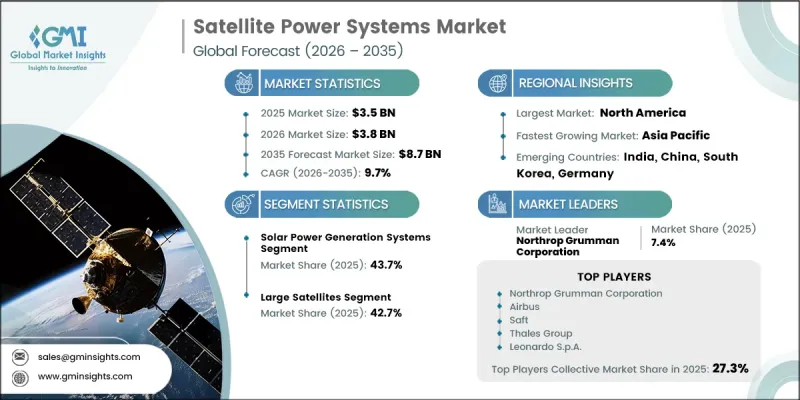
市場成長的驅動力在於產業正從有限的衛星生產轉向持續、大批量的製造項目,這需要可靠的星載發電、儲能和電源管理技術。這種轉變催生了對能夠支援日益複雜的衛星任務的先進電源子系統的持續需求。通訊、導航、地球觀測和其他高性能有效載荷不斷成長的電力需求,促使製造商開發更輕、更有效率的電源解決方案,同時確保運作可靠性。同時,太陽能電池技術、電池性能和配電架構的持續創新正在提高系統效率並降低整體發射重量。隨著功率密度、轉換效率和整合子系統性能的不斷提升,衛星電源系統市場的長期前景更加光明,因為衛星營運商需要可靠、輕巧、高功率的能源解決方案,以支援下一代太空船在各種任務場景下運作。
| 市場範圍 | |
|---|---|
| 開始年份 | 2025 |
| 預測期 | 2026-2035 |
| 初始市場規模 | 35億美元 |
| 預計金額 | 87億美元 |
| 複合年成長率 | 9.7% |
發電技術的進步正在改變衛星電源系統市場,在提高能源效率的同時,也降低了衛星發電所需的品質。高效率多結太陽能電池技術在AM0條件下,單電池效率已達到約32%至33%,單電池比功率輸出超過3000瓦/公斤。這些性能提升使得衛星製造商能夠在不顯著增加發射品質的情況下,縮小太陽能電池陣列的尺寸或提高向機載有效載荷提供的功率,從而實現性能更高、成本效益更高的太空船設計。
預計到2025年,光伏系統市佔率將達到43.7%,並在2035年之前以9.3%的複合年成長率成長。由於光伏技術仍然是地球軌道衛星的主要電力源,該細分市場保持主導地位。太陽能轉換效率、耐久性和輕量化陣列設計的不斷進步,進一步加速了光伏系統在各種尺寸和任務需求的衛星中的應用。
到2025年,重量超過1000公斤的大型衛星將佔42.7%的市場佔有率,成為業界最大的衛星類別。這一主導地位主要歸功於每顆衛星上安裝的電源系統價值顯著更高。大型衛星平台需要大容量太陽能電池陣列、先進的電池組件以及複雜的電源管理系統,以滿足其漫長運作週期內嚴苛的任務需求,這導致每顆衛星的電源子系統支出大幅增加。
預計到2025年,北美衛星電源系統市佔率將達到44.5%,並在2026年至2035年間以9.3%的複合年成長率成長。這一區域成長主要得益於商業衛星開發商和政府採購機構的強大實力,以及高度發展的衛星電源技術製造生態系統。機構對航太專案的持續投資為整個衛星價值鏈上的發電、儲能和電源管理解決方案供應商提供了穩定的需求環境。
全球衛星電源系統市場由空中巴士、萊昂納多公司、諾斯羅普·格魯曼公司、三菱電機株式會社、泰雷茲集團、OHB SE、Beyond Gravity、Intuitive Machines、穆格、Thelma A/S、Rocket Lab USA/Solaero Technologies、Basa FACEs Solar Power GGimooss、Graformil Zank、Gakform、icak Lithium Power、Enasis/ABSL Space Products、夏普能源解決方案日本公司 (SESJ)、上海空間動力研究院 (SISP)、Nanoavionics、EnduroSat、AAC Clyde Space 和 ICSpace(Innovative Solutions In Space)等公司主導。這些公司透過持續投資先進的太陽能電池技術、高性能電池系統和智慧電源管理解決方案,不斷提升太空船的效率和運作可靠性,從而鞏固其市場地位。製造商致力於輕量化系統設計、高功率密度和更優的能量轉換能力,以滿足衛星不斷變化的性能需求。與衛星製造商建立戰略合作夥伴關係、簽訂長期供應協議以及擴大生產能力,正在加強客戶關係並改善訂單前景。
目錄
第1章:調查方法和範圍
第2章執行摘要
第3章 行業洞察
- 產業生態系分析
- 影響產業的因素
- 促進因素
- 商業衛星發射和巨型衛星群部署的快速擴張
- 擴大地球觀測、通訊、導航和國防衛星計畫。
- 航太用太陽能電池、電池和電源管理電子設備的持續進步。
- 政府加大對太空探勘和國家航太計畫的投資
- 產業潛在風險與挑戰
- 對耐輻射、航太級電源組件有很高的資格要求。
- 經認證可用於航太領域的特殊電子元件供應有限。
- 市場機遇
- 高效率衛星供電技術的進步
- 小型衛星和低地球衛星群的擴展
- 促進因素
- 成長潛力分析
- 監理情勢
- 技術展望
- 最新科技趨勢
- 新興技術
- 價格趨勢分析
- 未來市場趨勢
- 專利分析
- 波特的分析
- PESTLE分析
- 人工智慧和生成式人工智慧對市場的影響
- 價值鏈分析
- 投資與資金籌措分析
- 消費者洞察
第4章 競爭情勢
- 介紹
- 企業市佔率分析:按地區分類
- 北美洲
- 歐洲
- 亞太地區
- 中東和非洲
- 拉丁美洲
- 主要進展
- 重要合作夥伴關係和合作
- 主要併購活動
- 產品創新和新產品發布
- 市場擴大策略
- 競爭定位矩陣
第5章 市場規模及預測:依組件類型分類,2022-2035年
- 太陽能發電系統
- 太陽能電池
- 太陽能板和陣列
- 能源儲存系統
- 鋰離子(Li-Ion)電池
- 鎳氫(NiH2)電池
- 全固態電池
- 超級電容和混合儲能系統
- 電池管理電子元件
- 其他
- 電源管理和分配(PMAD)系統
- 電源調節單元(PCU)
- 直流-直流轉換器和穩壓器
- 電力控制設備(EPC)
- 配電單元 (PDU) 和開關設備
第6章 市場規模及預測:依衛星等級分類,2022-2035年
- 小型衛星(小於100公斤)
- 中型衛星(100-1000公斤)
- 大型衛星(超過1000公斤)
第7章 市場規模及預測:依應用領域分類,2022-2035年
- 通訊衛星
- 地球觀測衛星
- 導航衛星
- 軍用/國防衛星
- 科學研究衛星
- 太空站和載人太空系統
- 其他
第8章 市場規模及預測:依軌道類型分類,2022-2035年
- 低地球軌道(LEO)
- 中軌道(MEO)
- 地球靜止軌道(GEO)
- 深空/高橢圓軌道(HEO)
第9章 市場規模及預測:依最終用戶分類,2022-2035年
- 主要趨勢
- 商業衛星營運商
- 政府和私人航太機構
- 國防/軍事組織
第10章 市場規模及預測:依地區分類,2022-2035年
- 北美洲
- 美國
- 加拿大
- 歐洲
- 德國
- 法國
- 英國
- 西班牙
- 義大利
- 亞太地區
- 中國
- 日本
- 韓國
- 印度
- 澳洲
- 中東和非洲
- 沙烏地阿拉伯
- UAE
- 南非
- 拉丁美洲
- 巴西
- 阿根廷
- 墨西哥
第11章:公司簡介
- Airbus
- Northrop Grumman Corporation
- Thales Group
- Leonardo SpA
- Mitsubishi Electric Corporation
- OHB SE
- Intuitive Machines
- Beyond Gravity
- Terma A/S
- Moog Inc.
- AZUR SPACE Solar Power GmbH
- Spectrolab Inc.
- Rocket Lab USA/SolAero Technologies
- Sierra Space
- Redwire Space
- Saft
- EaglePicher Technologies
- EnerSys/ABSL Space Products
- GS Yuasa Lithium Power
- Sharp Energy Solutions Corporation(SESJ)
- Shanghai Institute of Space Power-Sources(SISP)
- NanoAvionics
- AAC Clyde Space
- EnduroSat
- ISISpace(Innovative Solutions In Space)
The Global Satellite Power Systems Market was valued at USD 3.5 billion in 2025 and is estimated to grow at a CAGR of 9.7% to reach USD 8.7 billion by 2035.
Market growth is driven by the industry's shift from limited satellite production toward continuous, high-volume manufacturing programs that require dependable onboard power generation, energy storage, and power management technologies. This transformation is creating sustained demand for advanced power subsystems capable of supporting increasingly sophisticated satellite missions. Rising power requirements for communication, navigation, Earth observation, and other high-performance payloads are encouraging manufacturers to develop lighter, more efficient power solutions without compromising operational reliability. At the same time, ongoing innovation in solar cell technology, battery performance, and power distribution architecture is improving system efficiency while reducing overall launch weight. Continuous improvements in power density, conversion efficiency, and integrated subsystem performance are strengthening the long-term outlook for the satellite power systems market as satellite operators seek reliable, lightweight, and high-output energy solutions for next-generation spacecraft operating across diverse mission profiles.
| Market Scope | |
|---|---|
| Start Year | 2025 |
| Forecast Year | 2026-2035 |
| Start Value | $3.5 Billion |
| Forecast Value | $8.7 Billion |
| CAGR | 9.7% |
Advancements in power generation technology continue to reshape the satellite power systems market by improving energy efficiency while lowering the mass required for onboard power production. High-efficiency multi-junction solar cell technologies now deliver cell-level AM0 efficiencies of approximately 32% to 33%, while achieving specific power levels exceeding 3,000 W/kg at the cell scale. These performance improvements enable satellite manufacturers to either reduce solar array size or increase available power for onboard payloads without significantly increasing launch mass, supporting more capable and cost-efficient spacecraft designs.
The solar power generation systems segment held 43.7% share in 2025 and is projected to grow at a CAGR of 9.3% throughout 2035. The segment maintains its leadership because photovoltaic technology remains the primary source of electrical power for satellites operating in Earth orbit. Continued advancements in solar energy conversion efficiency, durability, and lightweight array designs are further reinforcing the adoption of solar-based power systems across satellites of varying sizes and mission requirements.
The large satellites weighing more than 1,000 kg accounted for 42.7% share in 2025, making them the largest satellite class within the industry. Their leading position is primarily attributed to the substantially higher value of onboard power systems installed in each spacecraft. Larger satellite platforms require high-capacity solar arrays, advanced battery assemblies, and sophisticated power management equipment capable of supporting demanding mission profiles over extended operational lifecycles, resulting in significantly higher power subsystem expenditures per satellite.
North America Satellite Power Systems Market captured 44.5% share in 2025 and is forecast to grow at a CAGR of 9.3% during 2026-2035. Regional growth is supported by the strong presence of commercial satellite developers, government procurement organizations, and a highly developed manufacturing ecosystem specializing in satellite power technologies. Ongoing institutional investments in space programs continue to provide a stable demand environment for manufacturers supplying power generation, energy storage, and power management solutions across the satellite value chain.
The competitive landscape of the global satellite power systems market includes Airbus, Leonardo S.p.A., Northrop Grumman Corporation, Mitsubishi Electric Corporation, Thales Group, OHB SE, Beyond Gravity, Intuitive Machines, Moog Inc., Terma A/S, Rocket Lab USA / SolAero Technologies, AZUR SPACE Solar Power GmbH, Spectrolab Inc., Sierra Space, Redwire Space, EaglePicher Technologies, Saft, GS Yuasa Lithium Power, EnerSys / ABSL Space Products, Sharp Energy Solutions Corporation (SESJ), Shanghai Institute of Space Power-Sources (SISP), NanoAvionics, EnduroSat, AAC Clyde Space, and ISISpace (Innovative Solutions In Space). Companies operating in the satellite power systems market are strengthening their market positions through continuous investment in advanced solar technologies, high-performance battery systems, and intelligent power management solutions that improve spacecraft efficiency and operational reliability. Manufacturers are focusing on lightweight system designs, higher power density, and improved energy conversion capabilities to meet evolving satellite performance requirements. Strategic collaborations with satellite manufacturers, long-term supply agreements, and expanded production capabilities are supporting stronger customer relationships while increasing order visibility.
Table of Contents
Chapter 1 Methodology & Scope
- 1.1 Research approach
- 1.2 Quality commitments
- 1.2.1 GMI AI policy & data integrity commitment
- 1.2.1.1 Source consistency protocol
- 1.2.1 GMI AI policy & data integrity commitment
- 1.3 Research trail & confidence scoring
- 1.3.1 Research trail components
- 1.3.2 Scoring components
- 1.4 Data collection
- 1.4.1 Partial list of primary sources
- 1.5 Data mining sources
- 1.5.1 Paid sources
- 1.5.1.1 Sources, by region
- 1.5.1 Paid sources
- 1.6 Base estimates and calculations
- 1.6.1 Base year calculation for any one approach
- 1.7 Market estimates & forecasts parameters
- 1.8 Forecast model
- 1.8.1 Quantified market impact analysis
- 1.8.1.1 Mathematical impact of growth parameters on forecast
- 1.8.1 Quantified market impact analysis
- 1.9 Research transparency addendum
- 1.9.1 Source attribution framework
- 1.9.2 Quality assurance metrics
- 1.9.3 Our commitment to trust
- 1.10 Market definitions
Chapter 2 Executive Summary
- 2.1 Industry synopsis, 2022 - 2035
- 2.1.1 Component type trends
- 2.1.2 Satellite Class trends
- 2.1.3 Application trends
- 2.1.4 Orbit type trends
- 2.1.5 End user trends
- 2.1.6 Regional trends
Chapter 3 Industry Insights
- 3.1 Industry ecosystem analysis
- 3.2 Industry impact forces
- 3.2.1 Growth drivers
- 3.2.1.1 Rapid growth in commercial satellite launches and mega-constellation deployments
- 3.2.1.2 Expanding Earth observation, communication, navigation, and defense satellite programs
- 3.2.1.3 Continuous advancements in space-grade solar cells, batteries, and power management electronics
- 3.2.1.4 Rising government investments in space exploration and national space programs
- 3.2.2 Industry pitfalls and challenges
- 3.2.2.1 High qualification requirements for radiation-hardened, space-grade power components
- 3.2.2.2 Limited availability of specialized space-qualified electronic components
- 3.2.3 Market opportunities
- 3.2.3.1 Advancement of high-efficiency satellite power technologies
- 3.2.3.2 Expansion of small satellites and leo constellations
- 3.2.1 Growth drivers
- 3.3 Growth potential analysis
- 3.4 Regulatory landscape (Driven by primary research)
- 3.4.1 North America
- 3.4.2 Europe
- 3.4.3 Asia Pacific
- 3.4.4 Latin America
- 3.4.5 MEA
- 3.5 Technology landscape
- 3.5.1 Current technological trends
- 3.5.2 Emerging technologies
- 3.6 Pricing trend analysis (Driven by primary research)
- 3.7 Future market trends
- 3.8 Patent analysis
- 3.9 Porter's analysis
- 3.10 PESTEL analysis
- 3.11 Impact of AI and Generative AI on the market (Driven by primary research)
- 3.12 Value chain analysis (Driven by primary research)
- 3.13 Investment & funding analysis (Driven by primary research)
- 3.14 Consumer insights (Driven by primary research)
Chapter 4 Competitive Landscape, 2025
- 4.1 Introduction
- 4.2 Company market share analysis, by region, 2025
- 4.2.1 North America
- 4.2.2 Europe
- 4.2.3 Asia Pacific
- 4.2.4 Middle East & Africa
- 4.2.5 Latin America
- 4.3 Key developments
- 4.3.1 Key partnerships & collaborations
- 4.3.2 Major M&A activities
- 4.3.3 Product innovations & launches
- 4.3.4 Market expansion strategies
- 4.4 Competitive positioning matrix
Chapter 5 Market Size and Forecast, By Component Type, 2022 - 2035 (USD Million)
- 5.1 Key trends
- 5.2 Solar power generation systems
- 5.2.1 Photovoltaic cells
- 5.2.2 Solar panels & arrays
- 5.3 Energy Storage Systems
- 5.3.1 Lithium-ion (Li-Ion) batteries
- 5.3.2 Nickel-hydrogen (NiH₂) batteries
- 5.3.3 Solid-state batteries
- 5.3.4 Supercapacitors & hybrid storage
- 5.3.5 Battery management electronics
- 5.3.6 Others
- 5.4 Power management & distribution (PMAD) systems
- 5.4.1 Power conditioning units (PCUs)
- 5.4.2 DC-DC converters & voltage regulators
- 5.4.3 Electrical power controllers (EPCs)
- 5.4.4 Power distribution units (PDUs) & switchgear
Chapter 6 Market Size and Forecast, By Satellite Class , 2022 - 2035 (USD Million)
- 6.1 Key trends
- 6.2 Small satellites (≤ 100 kg)
- 6.3 Medium satellites (100–1,000 kg)
- 6.4 Large satellites (>1,000 kg)
Chapter 7 Market Size and Forecast, By Application, 2022 - 2035 (USD Million)
- 7.1 Key trends
- 7.2 Communication satellites
- 7.3 Earth observation satellites
- 7.4 Navigation satellites
- 7.5 Military & defense satellites
- 7.6 Scientific & research satellites
- 7.7 Space stations & human spaceflight systems
- 7.8 Others
Chapter 8 Market Size and Forecast, By Orbit Type, 2022 - 2035 (USD Million)
- 8.1 Key trends
- 8.2 Low earth orbit (LEO)
- 8.3 Medium earth orbit (MEO)
- 8.4 Geostationary orbit (GEO)
- 8.5 Deep space / highly elliptical orbit (HEO)
Chapter 9 Market Size and Forecast, By End User, 2022 - 2035 (USD Million)
- 9.1 Key Trends
- 9.2 Commercial satellite operators
- 9.3 Government & civil space agencies
- 9.4 Defense & military organizations
Chapter 10 Market Size and Forecast, By Region, 2022 - 2035 (USD Million)
- 10.1 Key trends
- 10.2 North America
- 10.2.1 U.S.
- 10.2.2 Canada
- 10.3 Europe
- 10.3.1 Germany
- 10.3.2 France
- 10.3.3 UK
- 10.3.4 Spain
- 10.3.5 Italy
- 10.4 Asia Pacific
- 10.4.1 China
- 10.4.2 Japan
- 10.4.3 South Korea
- 10.4.4 India
- 10.4.5 Australia
- 10.5 Middle East & Africa
- 10.5.1 Saudi Arabia
- 10.5.2 UAE
- 10.5.3 South Africa
- 10.6 Latin America
- 10.6.1 Brazil
- 10.6.2 Argentina
- 10.6.3 Mexico
Chapter 11 Company Profiles
- 11.1 Airbus
- 11.2 Northrop Grumman Corporation
- 11.3 Thales Group
- 11.4 Leonardo S.p.A.
- 11.5 Mitsubishi Electric Corporation
- 11.6 OHB SE
- 11.7 Intuitive Machines
- 11.8 Beyond Gravity
- 11.9 Terma A/S
- 11.10 Moog Inc.
- 11.11 AZUR SPACE Solar Power GmbH
- 11.12 Spectrolab Inc.
- 11.13 Rocket Lab USA / SolAero Technologies
- 11.14 Sierra Space
- 11.15 Redwire Space
- 11.16 Saft
- 11.17 EaglePicher Technologies
- 11.18 EnerSys / ABSL Space Products
- 11.19 GS Yuasa Lithium Power
- 11.20 Sharp Energy Solutions Corporation (SESJ)
- 11.21 Shanghai Institute of Space Power-Sources (SISP)
- 11.22 NanoAvionics
- 11.23 AAC Clyde Space
- 11.24 EnduroSat
- 11.25 ISISpace (Innovative Solutions In Space)

 電子產業液冷市場預測(至2034年)-按冷卻方式、組件、冷卻液類型、應用、最終用戶和地區分類的全球分析
 電力電子市場:按組件、技術、功能、裝置類型、應用和最終用戶分類-2026-2032年全球市場預測全球電力電子市場預測至2034年:按元件類型、材料、電壓、應用、最終用戶和地區分類
 電力電子市場:依元件、材料、終端應用產業及地區分類
 2026年全球太空碎片清除衛星電子設備市場報告
 電力電子市場規模、佔有率、成長及全球產業分析:按類型、應用和地區分類,並提供2026-2034年的洞察和預測感應式電壓穩壓器市場:按類型、應用、終端用戶產業、通路和技術分類,全球預測(2026-2032年)軟X光充電器市場:外形規格、充電技術、輸出功率等級、應用、最終用戶分類,全球預測(2026-2032年)智慧固體斷路器市場按應用、額定電壓、額定電流、終端用戶產業和安裝方式分類-全球預測,2026-2032年
 電力電子市場分析及預測(至2035年):依類型、產品類型、服務、技術、組件、應用、裝置、最終使用者、功能及安裝類型分類