


 |
市場調查報告書
商品編碼
2101554
沼氣燃氣引擎市場機會、成長要素、產業趨勢分析及2026-2035年預測。Biogas Engines Market Opportunity, Growth Drivers, Industry Trend Analysis, and Forecast 2026 - 2035 |
||||||

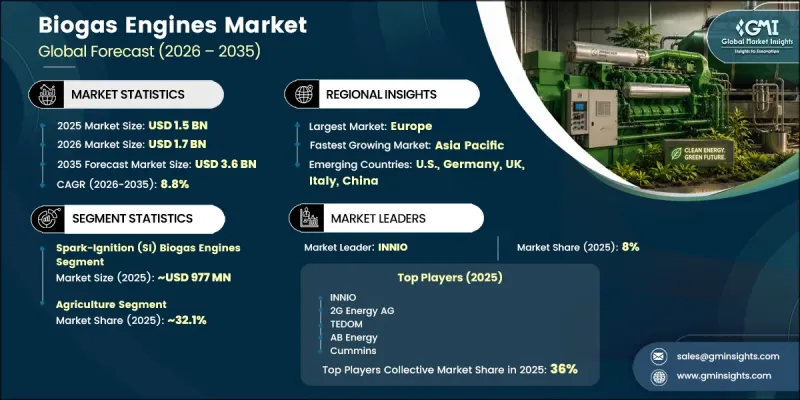
全球沼氣燃氣引擎市場預計到 2025 年將達到 15 億美元,年複合成長率為 8.8%,到 2035 年將達到 36 億美元。
隨著能源結構從依賴石化燃料的分散式發電轉向更清潔的生物燃料能源系統,沼氣熱電聯產(CHP)解決方案在已開發經濟體和新興經濟體中的作用日益凸顯。不斷提高的脫碳目標、對有機廢棄物處理基礎設施投資的增加以及引擎技術的持續進步,為市場成長創造了有利條件。生物甲烷的兼容性、數位化監控能力以及稀薄燃燒系統的進步,在提高運作效率的同時,也加速了專案的部署。這些技術進步持續吸引資本投資,並推動了沼氣燃氣引擎系統的應用。隨著可再生能源發電優先事項的不斷轉變,對高效、低排放且能在各種運作環境下提供可靠性能的發電技術的需求日益成長,這正對市場產生積極影響。
| 市場範圍 | |
|---|---|
| 開始年份 | 2025 |
| 預測期 | 2026-2035 |
| 初始市場規模 | 15億美元 |
| 預測金額 | 36億美元 |
| 複合年成長率 | 8.8% |
從傳統農業沼氣轉向高品質生物甲烷的轉變,正對整個燃氣引擎市場的研發產生重大影響。甲烷濃度達95%或以上的生物甲烷,經提純至天然氣品質,不僅能提高燃燒穩定性,還能促進其併入電網。同時,滿足這些燃料特性需要先進的引擎平台,這些平台不僅要在高壓縮比下高效運作,還必須符合日益嚴格的氮氧化物和甲烷排放法規。隨著監管要求的日益嚴格,製造商正優先考慮提高燃燒效率、燃料柔軟性和排放性能,以滿足不斷變化的客戶需求和合規要求。
預計到2025年,火星點火式(SI)沼氣燃氣引擎市佔率將達到65.1%,銷售額將達9.77億美元。火星點火式引擎採用電點火系統啟動燃燒,專為最大限度地利用富甲烷燃料而設計。由於其在穩定的燃料條件下能夠高效可靠地運行,火星點火式引擎成為生物甲烷燃料汽電共生(CHP)系統和利用穩定燃料來源的沼氣設施的首選解決方案。
累計到2025年,農業領域的銷售額將達到4.82億美元,佔市場佔有率的32.1%,並預計在2035年之前以8.6%的複合年成長率成長。農業持續供應豐富的有機原料,這些原料適用於沼氣生產,為沼氣引擎的長期應用創造了機會。充足的原料供應以及對可再生能源基礎設施的持續投資,支撐了農業領域對沼氣燃氣引擎系統的持續需求,鞏固了其作為市場最大終端用戶行業之一的地位。
預計到2025年,北美沼氣燃氣引擎市佔率將達到19.6%。該地區持續受益於成熟的沼氣生產網路,迄今為止,該網路已獲得約398億美元的巨額資本投資。大量沼氣設施的建成,為引擎維護、全生命週期服務、設備現代化改造和零件採購帶來了穩定的需求。不斷擴展的基礎設施將持續增強該地區引擎製造商和服務供應商的長期商機。
全球沼氣燃氣引擎市場的主要參與者包括INNIO、2G Energy AG、TEDOM、AB Energy、康明斯、MAN Energy Solutions、Caterpillar、科勒動力/燃氣引擎能源、山東綠輪動力設備有限公司以及艾特斯動力(無錫天能動力機械)。這些公司正透過拓展售後服務、投資數位化監控平台以及強化預測性維護解決方案,提高設備可靠性和客戶維繫,進而增強自身競爭力。為滿足不斷變化的環境法規,製造商也優先發展燃料柔軟性強、燃燒效率高、排放氣體更低的引擎平台。產品客製化以滿足不同的運作條件和特定應用需求,仍然是供應商在競標中脫穎而出的關鍵因素。此外,各公司還在拓展區域服務網路、加強全生命週期支持,並透過策略性併購來擴大設備裝置容量和技術實力。
目錄
第1章:調查方法和範圍
第2章執行摘要
第3章 行業洞察
- 產業生態系分析
- 原物料供應及採購分析
- 生產能力評估
- 供應鏈韌性與風險因素
- 配電網路分析
- 影響產業的因素
- 促進因素
- 產業潛在風險與挑戰
- 監理情勢
- 成長潛力分析
- 波特的分析
- PESTLE分析
- 成本結構分析:沼氣燃氣引擎
- 新機會與趨勢
- 數位化和物聯網整合
- 未開發市場和應用領域的成長
- 投資分析及未來展望
- 價格趨勢分析
- 按地區
- 透過電源
- 貿易數據分析
- 進出口額趨勢
- 主要貿易路線及關稅的影響
- 人工智慧和生成式人工智慧對市場的影響
- 利用人工智慧最佳化生產
- 預測性維護和故障檢測
第4章 競爭情勢
- 介紹
- 企業市佔率分析:按地區分類
- 北美洲
- 歐洲
- 亞太地區
- 中東和非洲
- 拉丁美洲
- 主要市場公司的競爭分析
- 競爭定位矩陣
- 主要進展
- 併購
- 夥伴關係和聯盟
- 新產品發布
- 業務拓展計劃及資金籌措
- 按公司規模進行基準測試
- 排名分類標準與遴選標準
- 按銷售額、地區和創新能力分類的層級定位矩陣。
第5章 市場規模及預測:依產品分類,2022-2035年
- 火星點火 (SI)燃氣引擎
- 雙燃料燃氣引擎
第6章 市場規模/預測:依電力分類,2022-2035年
- 100千瓦或以下
- >100 kW~500 kW
- >500 kW~1 MW
- >1 MW
第7章 市場規模及預測:依最終用途分類,2022-2035年
- 農業
- 污水處理
- 掩埋土地
- 產業
- 都市垃圾
- 其他
第8章 市場規模及預測:依冷卻系統分類,2022-2035年
- 空冷式
- 水冷
第9章 市場規模及預測:依安裝類型分類,2022-2035年
- 新的
- 更新
第10章 市場規模及預測:依地區分類,2022-2035年
- 北美洲
- 美國
- 加拿大
- 歐洲
- 德國
- 英國
- 奧地利
- 義大利
- 法國
- 瑞典
- 芬蘭
- 西班牙
- 荷蘭
- 波蘭
- 捷克共和國
- 亞太地區
- 中國
- 印度
- 日本
- 韓國
- 澳洲
- 馬來西亞
- 泰國
- 菲律賓
- 中東和非洲
- 沙烏地阿拉伯
- 南非
- UAE
- 肯亞
- 拉丁美洲
- 巴西
- 墨西哥
- 阿根廷
第11章:公司簡介
- 2G Energy AG
- AB Energy
- Bergen Engines
- Capstone Green Energy
- Caterpillar
- Clarke Energy
- Cummins
- Deutz AG
- Doosan Enerbility
- Everllence
- Guascor Energy
- INNIO
- JFE Engineering
- Kawasaki Heavy Industries
- Liebherr
- Mitsubishi Heavy Industries
- Perkins Engines
- Rolls Royce
- TEDOM
- Wartsila
- Weichai Power
- YANMAR HOLDINGS CO.
The Global Biogas Engines Market was valued at USD 1.5 billion in 2025 and is estimated to grow at a CAGR of 8.8% to reach USD 3.6 billion by 2035.
The growing emphasis on replacing fossil fuel-based distributed power generation with cleaner, feedstock-driven energy systems is strengthening the role of biogas-powered combined heat and power (CHP) solutions in both developed and emerging economies. Rising decarbonization targets, expanding investments in organic waste processing infrastructure, and continuous improvements in engine technologies are creating favorable conditions for market growth. Advancements in biomethane compatibility, digital monitoring capabilities, and lean-burn combustion systems are encouraging faster project deployment while improving operational efficiency. These technological developments continue to attract capital investments and support wider adoption of biogas engine systems. As renewable energy priorities continue to evolve, the market is benefiting from growing demand for efficient, low-emission power generation technologies that deliver reliable performance across a wide range of operating environments.
| Market Scope | |
|---|---|
| Start Year | 2025 |
| Forecast Year | 2026-2035 |
| Start Value | $1.5 Billion |
| Forecast Value | $3.6 Billion |
| CAGR | 8.8% |
The transition from conventional agricultural biogas toward upgraded biomethane has significantly influenced engine development across the biogas engines market. Biomethane refined to natural gas quality with methane concentrations of 95% or higher delivers greater combustion consistency while supporting grid integration opportunities. At the same time, these fuel characteristics require advanced engine platforms capable of operating efficiently at higher compression ratios while complying with increasingly stringent emission regulations governing nitrogen oxides and methane slip. As regulatory expectations continue to tighten, manufacturers are prioritizing enhanced combustion efficiency, fuel flexibility, and improved emissions performance to satisfy evolving customer and compliance requirements.
The spark-ignition (SI) biogas engines segment held 65.1% share, generating USD 977 million in 2025. SI engines rely on electrically generated ignition to initiate combustion and are specifically designed to maximize performance with methane-rich fuels. Their ability to deliver efficient and reliable operation under stable fuel conditions makes them the preferred solution for biomethane-powered CHP installations as well as biogas facilities utilizing consistent feedstock sources.
The agriculture segment generated USD 482 million, accounting for 32.1% share in 2025, and is forecast to grow at a CAGR of 8.6% through 2035. Agricultural operations continue to provide an abundant supply of organic feedstocks suitable for biogas production, creating long-term opportunities for engine deployment. Strong feedstock availability and ongoing investment in renewable energy infrastructure are supporting sustained demand for biogas engine systems throughout the agricultural sector while reinforcing its position as one of the market's largest end-use industries.
North America Biogas Engines Market accounted for 19.6% share in 2025. The regional market continues to benefit from a well-established biogas production network supported by substantial historical capital investments totaling approximately USD 39.8 billion. A significant installed base of biogas facilities has created consistent demand for engine maintenance, lifecycle services, equipment modernization, and replacement procurement. This growing installed infrastructure continues to strengthen long-term revenue opportunities for engine manufacturers and service providers operating throughout the region.
Companies operating in the global biogas engines market include INNIO, 2G Energy AG, TEDOM, AB Energy, Cummins Inc., MAN Energy Solutions, Caterpillar Inc., Kohler Power / Clarke Energy, Shandong Lvhuan Power Equipment, and Ettes Power (Wuxi Teneng Power & Machinery). Companies in the biogas engines market are strengthening their competitive positions by expanding aftermarket service capabilities, investing in digital monitoring platforms, and enhancing predictive maintenance solutions to improve equipment reliability and customer retention. Manufacturers are also prioritizing engine platforms with greater fuel flexibility, improved combustion efficiency, and lower emissions to comply with evolving environmental regulations. Product customization for diverse operating conditions and specialized applications continues to differentiate suppliers during competitive bidding processes. In addition, companies are expanding regional service networks, increasing lifecycle support offerings, and pursuing strategic mergers and acquisitions to broaden their installed equipment base and technical expertise.
Table of Contents
Chapter 1 Methodology & Scope
- 1.1 Research approach
- 1.2 Quality commitments
- 1.2.1 GMI AI policy & data integrity commitment
- 1.2.1.1 Source consistency protocol
- 1.2.1 GMI AI policy & data integrity commitment
- 1.3 Research trail & confidence scoring
- 1.3.1 Research trail components
- 1.3.2 Scoring components
- 1.4 Data collection
- 1.4.1 Partial list of primary sources
- 1.5 Data mining sources
- 1.5.1 Paid sources
- 1.5.1.1 Sources, by region
- 1.5.1 Paid sources
- 1.6 Base estimates and calculations
- 1.6.1 Base year calculation for any one approach
- 1.7 Market estimates & forecasts parameters
- 1.8 Forecast model
- 1.8.1 Quantified market impact analysis
- 1.8.1.1 Mathematical impact of growth parameters on forecast
- 1.8.1 Quantified market impact analysis
- 1.9 Research transparency addendum
- 1.9.1 Source attribution framework
- 1.9.2 Quality assurance metrics
- 1.9.3 Our commitment to trust
- 1.10 Market definitions
Chapter 2 Executive Summary
- 2.1 Industry synopsis, 2022 - 2035
- 2.1.1 Business trends
- 2.1.2 Product trends
- 2.1.3 Power trends
- 2.1.4 End use trends
- 2.1.5 Cooling system trends
- 2.1.6 Installation trends
- 2.1.7 Regional trends
Chapter 3 Industry Insights
- 3.1 Industry ecosystem analysis
- 3.1.1 Raw material availability & sourcing analysis
- 3.1.2 Manufacturing capacity assessment
- 3.1.3 Supply chain resilience & risk factors
- 3.1.4 Distribution network analysis
- 3.2 Industry impact forces
- 3.2.1 Growth drivers
- 3.2.2 Industry pitfalls & challenges
- 3.3 Regulatory landscape
- 3.4 Growth potential analysis
- 3.5 Porter's analysis
- 3.5.1 Bargaining power of suppliers
- 3.5.2 Bargaining power of buyers
- 3.5.3 Threat of new entrants
- 3.5.4 Threat of substitutes
- 3.6 PESTEL analysis
- 3.6.1 Political factors
- 3.6.2 Economic factors
- 3.6.3 Social factors
- 3.6.4 Technological factors
- 3.6.5 Legal factors
- 3.6.6 Environmental factors
- 3.7 Cost structure analysis of biogas engines
- 3.8 Emerging opportunities & trends
- 3.9 Digitalization & IoT integration
- 3.10 Growth in untapped markets & applications
- 3.11 Investment analysis & future prospects
- 3.12 Price trend analysis (USD/MW) (Driven by Primary Research)
- 3.12.1 By region (Driven by Primary Research)
- 3.12.2 By power (Driven by Primary Research)
- 3.13 Trade data analysis (Driven by Primary Research)
- 3.13.1 Import/export value trends (Driven by Primary Research)
- 3.13.2 Key trade corridors & tariff impact (Driven by Primary Research)
- 3.14 Impact of AI & Generative AI on the market (Driven by Primary Research)
- 3.14.1 AI-Driven production optimization (Driven by Primary Research)
- 3.14.2 Predictive maintenance & fault detection (Driven by Primary Research)
Chapter 4 Competitive Landscape, 2026
- 4.1 Introduction
- 4.2 Company market share analysis, by region, 2025
- 4.2.1 North America
- 4.2.2 Europe
- 4.2.3 Asia Pacific
- 4.2.4 Middle East & Africa
- 4.2.5 Latin America
- 4.3 Competitive analysis of major market players
- 4.4 Competitive positioning matrix
- 4.5 Key developments
- 4.5.1 Mergers & acquisitions
- 4.5.2 Partnerships & collaborations
- 4.5.3 New product launches
- 4.5.4 Expansion plans & funding
- 4.6 Company tier benchmarking
- 4.6.1 Tier classification criteria & qualifying thresholds
- 4.6.2 Tier positioning matrix by revenue, geography & innovation
Chapter 5 Market Size and Forecast, By Product, 2022 - 2035 (USD Million & MW)
- 5.1 Key trends
- 5.2 Spark-ignition (SI) biogas engines
- 5.3 Dual-fuel biogas engines
Chapter 6 Market Size and Forecast, By Power, 2022 - 2035 (USD Million & MW)
- 6.1 Key trends
- 6.2 ≤ 100 kW
- 6.3 > 100 kW - 500 kW
- 6.4 > 500 kW - 1 MW
- 6.5 > 1 MW
Chapter 7 Market Size and Forecast, By End Use, 2022 - 2035 (USD Million & MW)
- 7.1 Key trends
- 7.2 Agriculture
- 7.3 Wastewater treatment
- 7.4 Landfills
- 7.5 Industrial
- 7.6 Municipal waste
- 7.7 Others
Chapter 8 Market Size and Forecast, By Cooling System, 2022 - 2035 (USD Million & MW)
- 8.1 Key trends
- 8.2 Air-cooled
- 8.3 Water-cooled
Chapter 9 Market Size and Forecast, By Installation, 2022 - 2035 (USD Million & MW)
- 9.1 Key trends
- 9.2 New
- 9.3 Replacement
Chapter 10 Market Size and Forecast, By Region, 2022 - 2035 (USD Million & MW)
- 10.1 Key trends
- 10.2 North America
- 10.2.1 U.S.
- 10.2.2 Canada
- 10.3 Europe
- 10.3.1 Germany
- 10.3.2 UK
- 10.3.3 Austria
- 10.3.4 Italy
- 10.3.5 France
- 10.3.6 Sweden
- 10.3.7 Finland
- 10.3.8 Spain
- 10.3.9 Netherlands
- 10.3.10 Poland
- 10.3.11 Czech Republic
- 10.4 Asia Pacific
- 10.4.1 China
- 10.4.2 India
- 10.4.3 Japan
- 10.4.4 South Korea
- 10.4.5 Australia
- 10.4.6 Malaysia
- 10.4.7 Thailand
- 10.4.8 Philippines
- 10.5 Middle East & Africa
- 10.5.1 Saudi Arabia
- 10.5.2 South Africa
- 10.5.3 UAE
- 10.5.4 Kenya
- 10.6 Latin America
- 10.6.1 Brazil
- 10.6.2 Mexico
- 10.6.3 Argentina
Chapter 11 Company Profiles
- 11.1 2G Energy AG
- 11.2 AB Energy
- 11.3 Bergen Engines
- 11.4 Capstone Green Energy
- 11.5 Caterpillar
- 11.6 Clarke Energy
- 11.7 Cummins
- 11.8 Deutz AG
- 11.9 Doosan Enerbility
- 11.10 Everllence
- 11.11 Guascor Energy
- 11.12 INNIO
- 11.13 JFE Engineering
- 11.14 Kawasaki Heavy Industries
- 11.15 Liebherr
- 11.16 Mitsubishi Heavy Industries
- 11.17 Perkins Engines
- 11.18 Rolls Royce
- 11.19 TEDOM
- 11.20 Wartsila
- 11.21 Weichai Power
- 11.22 YANMAR HOLDINGS CO.

 沼氣廠市場:2026-2032年全球市場預測(依消化器類型、原料、消化技術、處理能力、運作模式、產品氣體類型和最終用戶分類)
 沼氣發電機市場規模、佔有率和成長分析:按類型、原料、運作模式和地區分類-2026-2033年產業預測
 沼氣廠市場:按類型、原料、運作方式、消化器類型、應用和地區分類
 沼氣廠市場規模、佔有率、成長及全球產業分析:按類型、應用和地區的洞察,2026-2034年的預測
 2026年全球沼氣廠市場報告
 沼氣廠市場規模、佔有率、趨勢和預測(按沼氣廠類型、原料、消化器類型、應用和地區分類),2026-2034年
 沼氣廠市場-全球產業規模、佔有率、趨勢、機會和預測,按運作模式、規模、原料類型、應用、產業垂直領域、地區和競爭格局分類,2021-2031年預測沼氣發電市場(按原料類型、工廠類型、工廠產能、技術、最終用戶和應用)—2025-2030 年全球預測
 沼氣廠:市場佔有率分析、產業趨勢與成長預測(2025-2030 年)
 沼氣廠建設市場報告:趨勢、預測與競爭分析(至 2030 年)