


 |
市場調查報告書
商品編碼
2101553
2026 年至 2035 年抗除草劑雜草控制市場的商業機會、成長要素、產業趨勢和預測。Herbicide-Resistant Weed Solutions Market Opportunity, Growth Drivers, Industry Trend Analysis, and Forecast 2026 - 2035 |
||||||

預計到 2025 年,全球抗除草劑雜草控制市場價值將達到 119 億美元,並有望以 6.2% 的複合年成長率成長,到 2035 年達到 219 億美元。
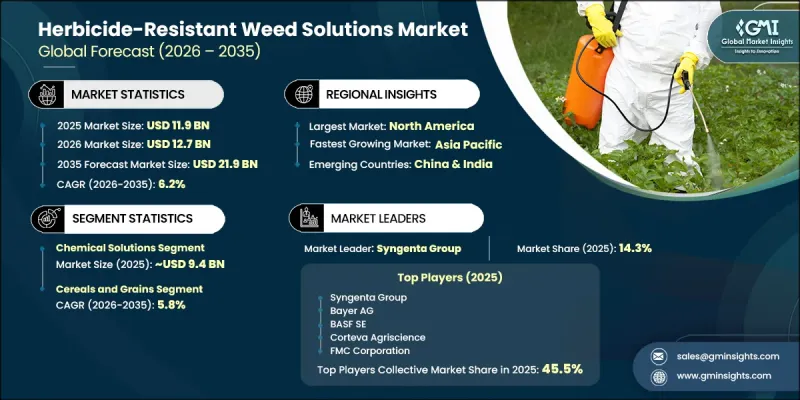
隨著生產者擴大採用綜合雜草管理策略來應對全部區域日益嚴峻的抗除草劑雜草挑戰,抗除草劑雜草防治市場正在穩步擴張。傳統的除草劑防治方案對付抗性雜草的效果日漸減弱,促使農民將生物、化學、機械和技術等多種主導方案結合,以確保作物產量。這種轉變正在改變採購模式,加強對農業研發的投入,並加速先進雜草管理技術的發展。不斷增加的抗除草劑雜草生物型記錄,使得人們對替代防治方法的需求持續成長,因為雜草族群的抗性難以透過常規耕作方式克服。因此,農業生產者更加重視結合多種作用機制和綜合管理技術的多元化雜草防治方案。人們對永續作物保護、提高農業生產力和抗性管理的日益重視,將繼續推動全球抗除草劑雜草防治市場的長期成長。
| 市場範圍 | |
|---|---|
| 開始年份 | 2025 |
| 預測期 | 2026-2035 |
| 上市時的市場規模 | 119億美元 |
| 預測金額 | 219億美元 |
| 複合年成長率 | 6.2% |
化學品業務部門預計將佔據79.2%的市場佔有率,並在2025年達到94億美元,2026年至2035年的複合年成長率(CAGR)為4.4%。該板塊涵蓋了廣泛的已註冊合成除草劑技術組合,以及旨在提高雜草控制效果的多種作用機制。儘管傳統除草劑產品仍佔據相當大的市場佔有率,但雜草抗藥性的日益增強正在推動市場對高價值配方、複合產品以及具有更佳長期性能的多樣化化學解決方案的需求。
預計到2025年,穀物市佔率將達到38.5%,並在2035年之前以5.8%的複合年成長率成長。該細分市場保持主導地位的原因在於穀物在全球範圍內的廣泛種植,以及大規模農業系統中對先進雜草管理解決方案日益成長的需求。隨著全部區域對除草劑抗性的擔憂日益加劇,農民們繼續實施綜合雜草控制策略,以提高產量並維持作物的長期生產力。
預計到2025年,北美抗除草劑雜草控制市場佔有率將達到35.6%。市場成長主要得益於先進農業技術的廣泛應用、綜合雜草管理措施的日益普及以及監管機構對雜草抗性控制的日益重視。隨著種植者尋求更有效、更永續的作物保護方案,對多模式雜草控制方案的需求不斷成長,並持續推動該地區的市場發展。
目錄
第1章:調查方法和範圍
第2章執行摘要
第3章 行業洞察
- 產業生態系分析
- 供應商情況
- 利潤率
- 每個階段增加的價值
- 影響價值鏈的因素
- 中斷
- 影響產業的因素
- 促進因素
- 產業潛在風險與挑戰
- 市場機遇
- 成長潛力分析
- 監理情勢
- 波特的分析
- PESTLE分析
- 價格趨勢
- 按地區
- 按解決方案類型
- 未來市場趨勢
- 技術與創新展望
- 最新科技趨勢
- 新興技術
- 專利趨勢
- 貿易統計
- 主要進口國
- 主要出口國
- 永續性和環境方面
- 永續計劃
- 減少廢棄物策略
- 生產中的能源效率
- 具有環保意識的舉措
第4章 競爭情勢
- 介紹
- 企業市佔率分析
- 按地區
- 北美洲
- 歐洲
- 亞太地區
- LATAM
- 中東和非洲
- 按地區
- 企業矩陣分析
- 主要市場公司的競爭分析
- 競爭定位矩陣
- 主要進展
- 併購
- 夥伴關係和聯盟
- 新產品發布
- 業務拓展計劃
第5章 市場估算與預測:依解法分類,2022年至2035年
- 化學溶液
- 單一作用機制(MOA)除草劑
- 具有多種作用機轉(MOA)的罐混劑
- 封裝連續式系統
- 抗除草劑作物性狀系統
- 機械和物理解決方案
- HWSC 設備(總合)
- 犁地系統
- 農業及割草設備
- 耕作和農業解決方案
- 用於雜草控制的覆蓋作物種子
- 競爭作物品種
- 作物輪作計劃和服務
- 化感作用干擾
- 生物解決方案
- 微生物除草劑
- 生化除草劑
- 天然來源的除草劑
- 整合/技術驅動型解決方案
第6章 市場估算與預測:依作物類型分類,2022年至2035年
- 穀類和穀類食品
- 玉米
- 小麥
- 米
- 大麥和高粱
- 油籽/豆類
- 大豆
- 菜籽
- 向日葵
- 乾豆
- 水果和蔬菜
- 特色作物
- 果園和葡萄園
- 草坪和觀賞植物
- 高爾夫球場
- 草坪農場
- 觀賞植物的生產
- 景觀設計
- 非農業用途
第7章 市場估算與預測:依最終使用者分類,2022年至2035年
- 大型商業農場
- 中小農場
- 非農業用戶
第8章 市場估計與預測:依地區分類,2022年至2035年
- 北美洲
- 美國
- 加拿大
- 歐洲
- 德國
- 英國
- 法國
- 西班牙
- 義大利
- 其他歐洲國家
- 亞太地區
- 中國
- 印度
- 日本
- 澳洲
- 韓國
- 其他亞太國家
- 拉丁美洲
- 巴西
- 墨西哥
- 阿根廷
- 其他拉丁美洲國家
- 中東和非洲
- 沙烏地阿拉伯
- 南非
- UAE
- 其他中東和非洲國家
第9章:公司簡介
- Syngenta Group
- Bayer AG
- BASF SE
- Corteva Agriscience
- FMC Corporation
- ADAMA Agricultural Solutions
- Nufarm Limited
- John Deere(See & Spray)
- CNH Industrial(Case IH/NH)
- Redekop Manufacturing
- De Bruin Engineering/IHSD
- AFGRI(Seed Terminator)
- Certis Biologicals
- Verdesian Life Sciences
- Blue River Technology(JD)
The Global Herbicide-Resistant Weed Solutions Market was valued at USD 11.9 billion in 2025 and is estimated to grow at a CAGR of 6.2% to reach USD 21.9 billion by 2035.
The herbicide-resistant weed solutions market is expanding steadily as growers increasingly adopt integrated weed management strategies to address the growing challenge of herbicide-resistant weed populations across major agricultural regions. Conventional herbicide programs are becoming less effective against resistant weed species, encouraging farmers to adopt a broader combination of biological, chemical, mechanical, and technology-driven solutions to protect crop productivity. This transition is reshaping purchasing patterns, strengthening investment in agricultural research, and accelerating the development of advanced weed management technologies. The continued rise in documented herbicide-resistant weed biotypes is creating long-term demand for alternative control methods, as resistance within weed populations cannot be easily reversed through standard farming practices. As a result, agricultural producers are placing greater emphasis on diversified weed control programs that combine multiple modes of action and integrated management techniques. Growing awareness of sustainable crop protection, improved farm productivity, and resistance management continues to support the long-term expansion of the global herbicide-resistant weed solutions market.
| Market Scope | |
|---|---|
| Start Year | 2025 |
| Forecast Year | 2026-2035 |
| Start Value | $11.9 Billion |
| Forecast Value | $21.9 Billion |
| CAGR | 6.2% |
The chemicals segment accounted for 79.2% share in 2025, representing USD 9.4 billion, and is projected to grow at a CAGR of 4.4% from 2026 to 2035. The segment includes a broad portfolio of registered synthetic herbicide technologies and multiple modes of action designed to improve weed control effectiveness. Although conventional herbicide products continue to maintain substantial treatment volumes, increasing weed resistance is driving greater demand for higher-value formulations, combination products, and diversified chemical solutions that offer improved long-term performance.
The cereals and grains segment represented 38.5% share in 2025 and is expected to grow at a CAGR of 5.8% through 2035. The segment maintains its leading position due to the extensive cultivation of cereal crops worldwide and the increasing need for advanced weed management solutions in large-scale farming systems. Growing concerns regarding herbicide resistance across major grain-producing regions continue to encourage farmers to adopt integrated weed control strategies that improve productivity while protecting long-term crop performance.
North America Herbicide-Resistant Weed Solutions Market accounted for 35.6% share in 2025. Market growth is supported by widespread adoption of advanced agricultural technologies, increasing implementation of integrated weed management practices, and growing regulatory emphasis on resistance management. Expanding demand for multi-mode weed control programs continues to strengthen the regional market as growers seek more effective and sustainable crop protection solutions.
Major companies operating in the global herbicide-resistant weed solutions market include BASF SE, Bayer AG, Syngenta Group, Corteva Agriscience, and FMC Corporation. Companies operating in the herbicide-resistant weed solutions market are strengthening their market position through continuous investment in research and development, advanced formulation technologies, and integrated weed management solutions. Manufacturers are expanding product portfolios with innovative herbicide combinations and multiple modes of action to improve weed control effectiveness while addressing resistance challenges. Strategic collaborations with agricultural research organizations, distributors, and farming communities are supporting wider adoption of sustainable crop protection practices.
Table of Contents
Chapter 1 Methodology & Scope
- 1.1 Research approach
- 1.2 Quality Commitments
- 1.2.1 GMI AI policy & data integrity commitment
- 1.2.1.1 Source consistency protocol
- 1.2.1 GMI AI policy & data integrity commitment
- 1.3 Research Trail & Confidence Scoring
- 1.3.1 Research Trail Components
- 1.3.2 Scoring Components
- 1.4 Data Collection
- 1.4.1 Partial list of primary sources
- 1.5 Data mining sources
- 1.5.1 Paid sources
- 1.5.1.1 Sources, by region
- 1.5.1 Paid sources
- 1.6 Base estimates and calculations
- 1.6.1 Base year calculation for any one approach
- 1.7 Forecast model
- 1.7.1 Quantified market impact analysis
- 1.7.1.1 Mathematical impact of growth parameters on forecast
- 1.7.1 Quantified market impact analysis
- 1.8 Research transparency addendum
- 1.8.1 Source attribution framework
- 1.8.2 Quality assurance metrics
- 1.8.3 Our commitment to trust
Chapter 2 Executive Summary
- 2.1 Industry 360° synopsis
- 2.2 Key market trends
- 2.2.1 Regional
- 2.2.2 By Solution Type
- 2.2.3 By Crop Type
- 2.2.4 By End User
- 2.3 TAM Analysis, 2026 - 2035
- 2.4 CXO perspectives: Strategic imperatives
Chapter 3 Industry Insights
- 3.1 Industry ecosystem analysis
- 3.1.1 Supplier landscape
- 3.1.2 Profit margin
- 3.1.3 Value addition at each stage
- 3.1.4 Factor affecting the value chain
- 3.1.5 Disruptions
- 3.2 Industry impact forces
- 3.2.1 Growth drivers
- 3.2.2 Industry pitfalls and challenges
- 3.2.3 Market opportunities
- 3.3 Growth potential analysis
- 3.4 Regulatory landscape
- 3.4.1 North America
- 3.4.2 Europe
- 3.4.3 Asia Pacific
- 3.4.4 Latin America
- 3.4.5 Middle East & Africa
- 3.5 Porter's analysis
- 3.6 PESTEL analysis
- 3.7 Price trends
- 3.7.1 By region
- 3.7.2 By Solution Type
- 3.8 Future market trends
- 3.9 Technology and Innovation landscape
- 3.9.1 Current technological trends
- 3.9.2 Emerging technologies
- 3.10 Patent Landscape
- 3.11 Trade statistics (HS code)
- 3.11.1 Major importing countries
- 3.11.2 Major exporting countries
- 3.12 Sustainability and environmental aspects
- 3.12.1 Sustainable practices
- 3.12.2 Waste reduction strategies
- 3.12.3 Energy efficiency in production
- 3.12.4 Eco friendly initiatives
Chapter 4 Competitive Landscape, 2025
- 4.1 Introduction
- 4.2 Company market share analysis
- 4.2.1 By region
- 4.2.1.1 North America
- 4.2.1.2 Europe
- 4.2.1.3 Asia Pacific
- 4.2.1.4 LATAM
- 4.2.1.5 MEA
- 4.2.1 By region
- 4.3 Company matrix analysis
- 4.4 Competitive analysis of major market players
- 4.5 Competitive positioning matrix
- 4.6 Key developments
- 4.6.1 Mergers & acquisitions
- 4.6.2 Partnerships & collaborations
- 4.6.3 New Product Launches
- 4.6.4 Expansion Plans
Chapter 5 Market Estimates and Forecast, By Solution Type, 2022 to 2035 (USD Million) (Tons)
- 5.1 Key trends
- 5.2 Chemical Solutions
- 5.2.1 Single MOA Herbicides
- 5.2.2 Multiple MOA Tank Mixtures
- 5.2.3 Pre-Packaged Sequential Systems
- 5.2.4 Herbicide-Tolerant Crop Trait Systems
- 5.3 Mechanical/Physical Solutions
- 5.3.1 HWSC Equipment (Total)
- 5.3.2 Tillage Systems
- 5.3.3 Cultivation & Mowing Equipment
- 5.4 Cultural/Agronomic Solutions
- 5.4.1 Cover Crop Seeds for Weed Suppression
- 5.4.2 Competitive Crop Varieties
- 5.4.3 Crop Rotation Programs & Services
- 5.4.4 Allelopathic Interference Methods
- 5.5 Biological Solutions
- 5.5.1 Microbial-Based Bioherbicides
- 5.5.2 Biochemical Herbicides
- 5.5.3 Naturally-Derived Herbicides
- 5.6 Integrated/Technology-Enabled Solutions
Chapter 6 Market Estimates and Forecast, By Crop Type, 2022 to 2035 (USD Million) (Tons)
- 6.1 Key trends
- 6.2 Cereals & Grains
- 6.2.1 Corn
- 6.2.2 Wheat
- 6.2.3 Rice
- 6.2.4 Barley & Sorghum
- 6.3 Oilseeds & Pulses
- 6.3.1 Soybeans
- 6.3.2 Canola
- 6.3.3 Sunflower
- 6.3.4 Dry Beans
- 6.4 Fruits & Vegetable
- 6.4.1 Specialty Crops
- 6.4.2 Orchards & Vineyards
- 6.5 Turf & Ornamental
- 6.5.1 Golf Courses
- 6.5.2 Sod Farms
- 6.5.3 Ornamental Production
- 6.5.4 Landscaping
- 6.6 Non-Crop Applications
Chapter 7 Market Estimates and Forecast, By End User, 2022 to 2035 (USD Million) (Tons)
- 7.1 Key trends
- 7.2 Large-Scale Commercial Farms
- 7.3 Small & Medium-Sized Farms
- 7.4 Non-Agricultural Users
Chapter 8 Market Estimates and Forecast, By Region, 2022 to 2035 (USD Million) (Tons)
- 8.1 Key trends
- 8.2 North America
- 8.2.1 U.S.
- 8.2.2 Canada
- 8.3 Europe
- 8.3.1 Germany
- 8.3.2 UK
- 8.3.3 France
- 8.3.4 Spain
- 8.3.5 Italy
- 8.3.6 Rest of Europe
- 8.4 Asia Pacific
- 8.4.1 China
- 8.4.2 India
- 8.4.3 Japan
- 8.4.4 Australia
- 8.4.5 South Korea
- 8.4.6 Rest of Asia Pacific
- 8.5 Latin America
- 8.5.1 Brazil
- 8.5.2 Mexico
- 8.5.3 Argentina
- 8.5.4 Rest of Latin America
- 8.6 Middle East and Africa
- 8.6.1 Saudi Arabia
- 8.6.2 South Africa
- 8.6.3 UAE
- 8.6.4 Rest of Middle East and Africa
Chapter 9 Company Profiles
- 9.1 Syngenta Group
- 9.2 Bayer AG
- 9.3 BASF SE
- 9.4 Corteva Agriscience
- 9.5 FMC Corporation
- 9.6 ADAMA Agricultural Solutions
- 9.7 Nufarm Limited
- 9.8 John Deere (See & Spray)
- 9.9 CNH Industrial (Case IH/NH)
- 9.10 Redekop Manufacturing
- 9.11 De Bruin Engineering / IHSD
- 9.12 AFGRI (Seed Terminator)
- 9.13 Certis Biologicals
- 9.14 Verdesian Life Sciences
- 9.15 Blue River Technology (JD)

 全球抗除草劑雜草控制市場:規模、佔有率、趨勢及成長分析報告(2026-2034)
 種間化學交感物質市場規模、佔有率和成長分析:依產品類型、原料、應用、最終用戶、形態和地區分類-2026-2033年產業預測
 生物除草劑市場:2026-2032年全球市場預測(按產品類型、配方、作物類型、應用方法、最終用戶和分銷管道分類)
 生物除草劑市場規模、佔有率和成長分析:按來源、作用機制、應用、作物類型、通路和地區分類-2026-2033年產業預測
 生物除草劑市場報告:按作物類型、原料、應用方法、製劑形式和地區分類(2026-2034 年)生物除草劑市場規模、佔有率、成長和全球產業分析:按類型、應用和地區分類,並對 2026-2034 年進行洞察和預測。
 生物除草劑市場-全球產業規模、佔有率、趨勢、機會及預測,依來源、劑型、施用方式、應用領域、區域及競爭格局分類,2020-2030年預測
 2032年生物除草劑市場預測:按類型、作用方式、劑型、作物類型、通路、應用和地區進行的全球分析
 生物除草劑市場規模、佔有率、趨勢分析報告:按應用、地區、細分市場、預測,2025-2030 年