

 |
市場調查報告書
商品編碼
2101545
個人雲端市場機會、成長要素、產業趨勢分析及2026-2035年預測Personal Cloud Market Opportunity, Growth Drivers, Industry Trend Analysis, and Forecast 2026 - 2035 |
||||||

全球個人雲端市場預計到 2025 年將達到 307 億美元,並以 12.8% 的複合年成長率成長,到 2035 年將達到 1,061 億美元。
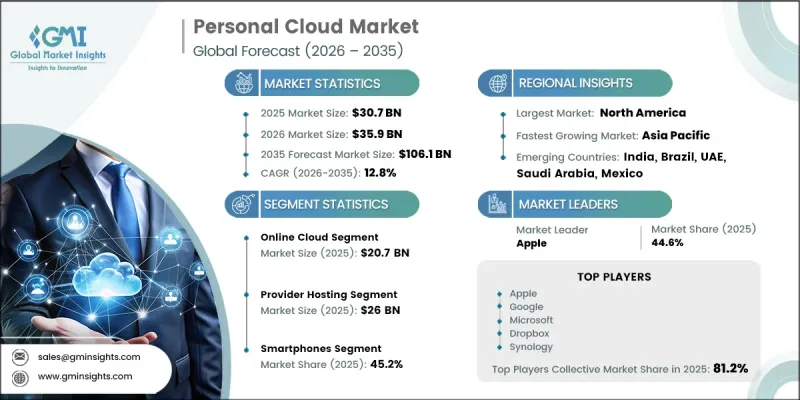
這一成長反映了業界從基礎雲端備份服務向功能豐富、支援多設備的優質儲存解決方案的演變,這些解決方案提供更高級的功能和更便捷的用戶體驗。數位內容的不斷湧現、連網裝置數量的持續成長以及對跨平台無縫同步需求的不斷增加,持續擴大目標商機。消費者期望儲存更大的文件,從多個設備存取訊息,並隨時安全、不間斷地存取其個人資料。數位連接的不斷改進和雲端服務的日益普及進一步推動了市場擴張。同時,人們對網路安全風險、意外資料遺失、硬體故障以及可靠資料復原解決方案的需求日益成長,推動了對自動備份、加密儲存、安全認證和持續同步功能的需求。這些趨勢持續增強了訂閱收入,並鼓勵用戶升級到具有更大儲存容量和更高級安全功能的優質個人雲端服務。
| 市場範圍 | |
|---|---|
| 開始年份 | 2025 |
| 預測期 | 2026-2035 |
| 初始市場規模 | 307億美元 |
| 預測金額 | 1061億美元 |
| 複合年成長率 | 12.8% |
預計到2025年,線上雲端服務將佔據67.4%的市場佔有率,市場規模達到207億美元。消費者對雲端儲存解決方案的持續支持,尤其是其快速部署、廣泛的設備相容性和極低的基礎設施需求,正在推動該領域的成長。智慧儲存管理功能、增強的搜尋能力和改進的資料組織功能的日益普及,也促進了高級訂閱計劃的使用成長。線上雲端服務仍然被廣泛用於文件儲存、資料同步、協作工作流程以及跨多個聯網設備安全存取數位內容。
到2025年,託管服務提供者將佔據84.7%的市場佔有率。隨著用戶越來越傾向於選擇託管雲端環境,無需擁有專用硬體即可簡化部署、維護、軟體更新、安全管理和遠端訪問,市場需求持續成長。與數位生態系統的深度整合以及基於訂閱的服務模式,也持續推動雲端服務的廣泛應用。此外,將雲端儲存與生產力工具、安全功能、人工智慧 (AI) 功能和其他數位服務結合的捆綁式服務,也有助於提升客戶維繫,並實現持續的收入成長。
預計2025年,北美個人雲端市場規模將達到128.2億美元。這一成長主要得益於連網型設備的普及、雲端生產力解決方案的日益普及以及對安全數位儲存服務需求的不斷成長。與獨立的儲存服務相比,將雲端儲存與增值軟體和訂閱服務相結合的整合式數位生態系統正日益成為市場成長的主要驅動力。該地區企業在差異化競爭方面繼續專注於訂閱捆綁、增強隱私功能和高級安全功能,以提升長期客戶參與和留存率。
目錄
第1章:調查方法和範圍
第2章執行摘要
第3章 行業洞察
- 產業生態系分析
- 供應商情況
- 成本結構
- 利潤率
- 每個階段增加的價值
- 垂直整合趨勢
- 顛覆者
- 影響產業的因素
- 促進因素
- 數位內容創作和生成量的增加
- 智慧型手機和連網型設備的廣泛普及
- 安全資料備份和災害復原。
- 遠距工作和混合協作的擴展
- 消費者對跨裝置同步的偏好日益成長
- 產業潛在風險與挑戰
- 資料隱私和網路安全問題
- 免費雲端儲存替代方案的可用性
- 市場機遇
- 人工智慧驅動的個人雲端服務的廣泛應用
- 對私有雲端和自架雲端解決方案的需求日益成長
- 擴展邊緣運算和混合雲端生態系統
- 增強與智慧家庭和物聯網設備的整合
- 隨著網路普及率的提高,開發中國家。
- 促進因素
- 成長潛力分析
- 技術與創新展望
- 最新技術
- 新興技術
- 監理情勢
- 北美洲
- 美國:《加州消費者隱私法案》(CCPA/CPRA)和聯邦貿易委員會(FTC)資料隱私法規
- 加拿大:《個人資料保護與電子文件法》(PIPEDA)和《消費者隱私保護法》(CPPA)
- 歐洲
- 德國:《聯邦資料保護法》(BDSG)和《一般資料保護規則》(GDPR)
- 英國:英國《一般資料保護規範》(GDPR) 和 2018 年資料保護法
- 法國:法國資料保護法與法國國家資訊與自由委員會(CNIL)雲端合規指南
- 義大利:義大利的個人資料保護法和GDPR合規框架
- 亞太地區
- 中國:《個人資訊保護法》和《資料安全法》
- 印度:《數位個人資料保護法》(DPDP 法案)及 CERT-In 網路安全指南
- 日本:《個人資訊保護法》(APPI)與網路安全指南
- 韓國:《個人資訊保護法》(PIPA)與《網路法》
- 澳洲:《1988 年隱私權法》和《澳洲隱私原則》(APP)
- 拉丁美洲
- 巴西:通用資料保護法 (LGPD) 和國家資料保護法 (ANPD) 的相關規定
- 墨西哥:《聯邦個人資料保護法》(LFPDPPP)
- 阿根廷:個人資料保護法和AAIP法規
- 中東和非洲(MEA)
- 阿拉伯聯合大公國:個人資料保護法 (PDPL) 和 DESC 雲端安全標準
- 沙烏地阿拉伯:個人資料保護法 (PDPL) 和國家網路安全局 (ECC)
- 南非:《個人資料保護法》(POPIA)和《網路犯罪法》
- 北美洲
- 成本細分分析
- 波特的分析
- PESTLE分析
- 專利分析
- 資料外洩和安全事件案例研究
- 永續發展與ESG趨勢(新)
- 資料中心能耗和碳足跡
- 可再生
- 供應商 ESG 措施和基準測試
- 人工智慧和生成式人工智慧對市場的影響
- 利用人工智慧改造現有經營模式
- 按細分市場分類的生成式人工智慧用例和部署藍圖
- 風險、限制和監管考量
- 預測假設和情境分析
- 基本案例:驅動複合年成長率的關鍵宏觀經濟與產業變量
- 樂觀情境:宏觀經濟與產業的順風
- 悲觀情景:宏觀經濟放緩或產業逆風
第4章 競爭情勢
- 介紹
- 企業市佔率分析
- 北美洲
- 歐洲
- 亞太地區
- 拉丁美洲
- 中東和非洲
- 競爭定位矩陣
- 主要進展
- 併購
- 夥伴關係和聯盟
- 新產品發布
- 業務拓展計劃及資金籌措
- 按公司規模進行基準測試
- 排名分類標準與遴選標準
- 按銷售額、地區和創新能力分類的層級定位矩陣。
第5章 市場估算與預測:依雲類型分類,2022-2035年
- 網路雲
- NAS(網路附加儲存)雲
- 伺服器設備雲
- 自製雲
第6章 市場估計與預測:依應用領域分類,2022-2035年
- 檔案儲存和備份
- 媒體串流
- 檔案共用與協作
- 設備同步
- 其他
第7章 市場估價與預測:依託管類型分類,2022-2035年
- 由網際網路服務供應商 (ISP) 提供主機服務
- 使用者/自架
第8章 市場估算與預測:依定價模式分類,2022-2035年
- 免費(免費增值)
- 基於訂閱
- 一次性許可(自架軟體)
- 捆綁硬體
第9章 市場估價與預測:依設備分類,2022-2035年
- 智慧型手機
- 個人電腦(桌上型電腦/筆記型電腦)
- 藥片
- 智慧電視和連網顯示器
- 其他
第10章 市場估價與預測:依最終用途產業分類,2022-2035年
- 個人/消費者
- 資訊科技與資訊科技服務
- BFSI
- 醫療保健和生命科學
- 電訊
- 零售與電子商務
- 政府/公共部門
- 製造業
- 媒體與娛樂
- 能源公用事業
- 其他
第11章 市場估價與預測:按地區分類,2022-2035年
- 北美洲
- 美國
- 加拿大
- 歐洲
- 英國
- 德國
- 法國
- 義大利
- 西班牙
- 比利時
- 荷蘭
- 瑞典
- 俄羅斯
- 亞太地區
- 中國
- 印度
- 日本
- 澳洲
- 新加坡
- 韓國
- 越南
- 印尼
- 泰國
- 拉丁美洲
- 巴西
- 墨西哥
- 阿根廷
- 中東和非洲
- 南非
- 沙烏地阿拉伯
- UAE
第12章:公司簡介
- 世界公司
- Amazon
- Apple
- Dropbox
- Microsoft
- Nextcloud
- Proton
- QNAP Systems
- Synchronoss Technologies
- Synology
- 當地公司
- Alibaba
- Baidu
- Huawei Technologies
- IONOS
- Jotta
- Naver
- Tencent
- 新興企業
- Filen Cloud
- Internxt Cloud
- UGREEN
The Global Personal Cloud Market was valued at USD 30.7 billion in 2025 and is estimated to grow at a CAGR of 12.8% to reach USD 106.1 billion by 2035.
The growth reflects the industry's evolution from basic cloud backup services toward premium, feature-rich, multi-device storage solutions that deliver greater functionality and user convenience. Rising digital content creation, increasing ownership of connected devices, and growing demand for seamless synchronization across multiple platforms continue to expand the addressable revenue opportunity. Consumers are storing larger files, accessing information from numerous devices, and expecting secure, uninterrupted access to personal data at any time. Continued improvements in digital connectivity and broader adoption of cloud-based services are further supporting market expansion. At the same time, growing awareness of cybersecurity risks, accidental data loss, hardware failures, and the need for reliable data recovery solutions is increasing demand for automated backup, encrypted storage, secure authentication, and continuous synchronization features. These trends continue to strengthen recurring subscription revenue while encouraging users to upgrade to premium personal cloud services with enhanced storage capacity and advanced security capabilities.
| Market Scope | |
|---|---|
| Start Year | 2025 |
| Forecast Year | 2026-2035 |
| Start Value | $30.7 Billion |
| Forecast Value | $106.1 Billion |
| CAGR | 12.8% |
The online cloud segment accounted for 67.4% share in 2025, reaching a value of USD 20.7 billion. Continued consumer preference for cloud-based storage solutions that offer rapid deployment, broad device compatibility, and minimal infrastructure requirements continues to support segment growth. Increasing adoption of intelligent storage management capabilities, improved search functionality, and enhanced data organization features is encouraging greater uptake of premium subscription plans. Online cloud services remain widely used for file storage, data synchronization, collaborative workflows, and secure access to digital content across multiple connected devices.
The provider hosting segment held 84.7% share in 2025. Demand continues to increase as users favor managed cloud environments that simplify deployment, maintenance, software updates, security management, and remote accessibility without requiring dedicated hardware ownership. Strong integration with digital ecosystems and subscription-based service models continues to support widespread adoption. In addition, bundled offerings that combine cloud storage with productivity tools, security features, artificial intelligence capabilities, and additional digital services continue to strengthen long-term customer retention and recurring revenue growth.
North America Personal Cloud Market accounted for USD 12.82 billion share in 2025, supported by widespread adoption of connected devices, expanding use of cloud-enabled productivity solutions, and increasing demand for secure digital storage services. Market growth is increasingly driven by integrated digital ecosystems that combine cloud storage with value-added software and subscription services rather than standalone storage offerings. Competitive differentiation within the region continues to focus on subscription bundles, enhanced privacy capabilities, and advanced security features that improve long-term customer engagement and retention.
Major companies operating in the global personal cloud market include Amazon, Dropbox, Apple, Microsoft, Proton, Baidu, Google, Nextcloud, Synology, and Synchronoss Technologies. Companies operating in the personal cloud market are strengthening their competitive position by expanding subscription-based service portfolios, enhancing cloud security capabilities, and integrating artificial intelligence into storage platforms. Market participants continue to invest in encryption technologies, automated backup solutions, intelligent data management, and seamless synchronization across multiple devices to improve the overall user experience. Strategic partnerships, ecosystem integration, and continuous product innovation remain central to increasing customer retention and expanding recurring revenue streams.
Table of Contents
Chapter 1 Methodology & Scope
- 1.1 Research approach
- 1.2 Quality Commitments
- 1.2.1 GMI AI policy & data integrity commitment
- 1.2.1.1 Source consistency protocol
- 1.2.1 GMI AI policy & data integrity commitment
- 1.3 Research Trail & Confidence Scoring
- 1.3.1 Research Trail Components
- 1.3.2 Scoring Components
- 1.4 Data Collection
- 1.4.1 Partial list of primary sources
- 1.5 Data mining sources
- 1.5.1 Paid sources
- 1.5.1.1 Sources, by region
- 1.5.1 Paid sources
- 1.6 Base estimates and calculations
- 1.6.1 Base year calculation
- 1.7 Forecast model
- 1.7.1 Quantified market impact analysis
- 1.7.1.1 Mathematical impact of growth parameters on forecast
- 1.7.1 Quantified market impact analysis
- 1.8 Research transparency addendum
- 1.8.1 Source attribution framework
- 1.8.2 Quality assurance metrics
- 1.8.3 Our commitment to trust
Chapter 2 Executive Summary
- 2.1 Industry 360° synopsis
- 2.2 Key market trends
- 2.2.1 Cloud Type
- 2.2.2 Application
- 2.2.3 Hosting Type
- 2.2.4 Pricing Model
- 2.2.5 Device
- 2.2.6 End Use Industry
- 2.3 TAM Analysis, 2026-2035
- 2.4 CXO perspectives: Strategic imperatives
Chapter 3 Industry Insights
- 3.1 Industry ecosystem analysis
- 3.1.1 Supplier landscape
- 3.1.2 Cost structure
- 3.1.3 Profit margin
- 3.1.4 Value addition at each stage
- 3.1.5 Vertical integration trends
- 3.1.6 Disruptors
- 3.2 Industry impact forces
- 3.2.1 Growth drivers
- 3.2.1.1 Rising Digital Content Creation and Data Generation
- 3.2.1.2 Increasing Adoption of Smartphones and Connected Devices
- 3.2.1.3 Growing Demand for Secure Data Backup and Disaster Recovery
- 3.2.1.4 Expansion of Remote Work and Hybrid Collaboration
- 3.2.1.5 Increasing Consumer Preference for Cross-Device Synchronization
- 3.2.2 Industry pitfalls & challenges
- 3.2.2.1 Data Privacy and Cybersecurity Concerns
- 3.2.2.2 Availability of Free Cloud Storage Alternative
- 3.2.3 Market opportunities
- 3.2.3.1 Growing Adoption of AI-Enabled Personal Cloud Services
- 3.2.3.2 Rising Demand for Private and Self-Hosted Cloud Solutions
- 3.2.3.3 Expansion of Edge Computing and Hybrid Cloud Ecosystems
- 3.2.3.4 Increasing Integration with Smart Home and IoT Devices
- 3.2.3.5 Emerging Demand from Developing Economies with Expanding Internet Penetration
- 3.2.1 Growth drivers
- 3.3 Growth potential analysis
- 3.4 Technology and Innovation landscape
- 3.4.1 Current technologies
- 3.4.2 Emerging technologies
- 3.5 Regulatory Landscape
- 3.5.1 North America
- 3.5.1.1 U.S.: California Consumer Privacy Act (CCPA/CPRA) & Federal Trade Commission (FTC) Data Privacy Regulations
- 3.5.1.2 Canada: Personal Information Protection and Electronic Documents Act (PIPEDA) & Consumer Privacy Protection Act (CPPA)
- 3.5.2 Europe
- 3.5.2.1 Germany: Federal Data Protection Act (BDSG) & General Data Protection Regulation (GDPR)
- 3.5.2.2 UK: UK GDPR & Data Protection Act 2018
- 3.5.2.3 France: French Data Protection Act & CNIL Cloud Compliance Guidelines
- 3.5.2.4 Italy: Italian Personal Data Protection Code & GDPR Compliance Framework
- 3.5.3 Asia Pacific
- 3.5.3.1 China: Personal Information Protection Law (PIPL) & Data Security Law (DSL)
- 3.5.3.2 India: Digital Personal Data Protection Act (DPDP Act) & CERT-In Cybersecurity Directions
- 3.5.3.3 Japan: Act on the Protection of Personal Information (APPI) & Cybersecurity Guidelines
- 3.5.3.4 South Korea: Personal Information Protection Act (PIPA) & Network Act
- 3.5.3.5 Australia: Privacy Act 1988 & Australian Privacy Principles (APPs)
- 3.5.4 Latin America
- 3.5.4.1 Brazil: General Data Protection Law (LGPD) & ANPD Regulations
- 3.5.4.2 Mexico: Federal Law on Protection of Personal Data (LFPDPPP)
- 3.5.4.3 Argentina: Personal Data Protection Act & AAIP Regulations
- 3.5.5 Middle East & Africa (MEA)
- 3.5.5.1 UAE: Personal Data Protection Law (PDPL) & DESC Cloud Security Standards
- 3.5.5.2 Saudi Arabia: Personal Data Protection Law (PDPL) & National Cybersecurity Authority (ECC)
- 3.5.5.3 South Africa: Protection of Personal Information Act (POPIA) & Cybercrimes Act
- 3.5.1 North America
- 3.6 Cost breakdown analysis
- 3.7 Porter's analysis
- 3.8 PESTEL analysis
- 3.9 Patent analysis (Driven by Primary Research)
- 3.10 Data breach & security incident case studies
- 3.11 Sustainability & ESG landscape (new)
- 3.11.1 Data center energy consumption & carbon footprint
- 3.11.2 Green hosting & renewable-powered storage initiatives
- 3.11.3 Vendor ESG commitments & benchmarking
- 3.12 Impact of AI & generative AI on the market
- 3.12.1 AI-driven disruption of existing business models
- 3.12.2 GenAI use cases & adoption roadmap by segment
- 3.12.3 Risks, limitations & regulatory considerations
- 3.13 Forecast assumptions & scenario analysis (Driven by Primary Research)
- 3.13.1 Base Case - key macro & industry variables driving CAGR
- 3.13.2 Optimistic Scenarios - Favorable Macro and Industry Tailwinds
- 3.13.3 Pessimistic Scenario - Macroeconomic slowdown or industry headwinds
Chapter 4 Competitive Landscape, 2025
- 4.1 Introduction
- 4.2 Company market share analysis
- 4.2.1 North America
- 4.2.2 Europe
- 4.2.3 Asia-Pacific
- 4.2.4 Latin America
- 4.2.5 Middle East & Africa
- 4.3 Competitive positioning matrix
- 4.4 Key developments
- 4.4.1 Mergers & acquisitions
- 4.4.2 Partnerships & collaborations
- 4.4.3 New product launches
- 4.4.4 Expansion plans and funding
- 4.5 Company tier benchmarking
- 4.5.1 Tier classification criteria & qualifying thresholds
- 4.5.2 Tier positioning matrix by revenue, geography & innovation
Chapter 5 Market Estimates & Forecast, By Cloud Type, 2022 - 2035 ($Mn)
- 5.1 Key trends
- 5.2 Online Cloud
- 5.3 NAS (Network-Attached Storage) Cloud
- 5.4 Server Device Cloud
- 5.5 Home-Made Cloud
Chapter 6 Market Estimates & Forecast, By Application, 2022 - 2035 ($Mn)
- 6.1 Key trends
- 6.2 File Storage & Backup
- 6.3 Media Streaming
- 6.4 File Sharing & Collaboration
- 6.5 Device Synchronization
- 6.6 Others
Chapter 7 Market Estimates & Forecast, By Hosting Type, 2022 - 2035 ($Mn)
- 7.1 Key trends
- 7.2 Provider Hosting
- 7.3 User/Self-Hosting
Chapter 8 Market Estimates & Forecast, By Pricing Model, 2022 - 2035 ($Mn)
- 8.1 Key trends
- 8.2 Free (Freemium)
- 8.3 Subscription-Based
- 8.4 One-Time License (Self-Hosted Software)
- 8.5 Hardware-Bundled
Chapter 9 Market Estimates & Forecast, By Device, 2022 - 2035 ($Mn)
- 9.1 Key trends
- 9.2 Smartphones
- 9.3 Personal Computers (Desktop/Laptop)
- 9.4 Tablets
- 9.5 Smart TV & Connected Displays
- 9.6 Others
Chapter 10 Market Estimates & Forecast, By End Use Industry, 2022 - 2035 ($Mn)
- 10.1 Key trends
- 10.2 Individual/Consumer
- 10.3 IT & ITeS
- 10.4 BFSI
- 10.5 Healthcare & Life Sciences
- 10.6 Telecommunications
- 10.7 Retail & E-Commerce
- 10.8 Government & Public Sector
- 10.9 Manufacturing
- 10.10 Media & Entertainment
- 10.11 Energy & Utilities
- 10.12 Others
Chapter 11 Market Estimates & Forecast, By Region, 2022 - 2035 ($Mn)
- 11.1 North America
- 11.1.1 US
- 11.1.2 Canada
- 11.2 Europe
- 11.2.1 UK
- 11.2.2 Germany
- 11.2.3 France
- 11.2.4 Italy
- 11.2.5 Spain
- 11.2.6 Belgium
- 11.2.7 Netherlands
- 11.2.8 Sweden
- 11.2.9 Russia
- 11.3 Asia Pacific
- 11.3.1 China
- 11.3.2 India
- 11.3.3 Japan
- 11.3.4 Australia
- 11.3.5 Singapore
- 11.3.6 South Korea
- 11.3.7 Vietnam
- 11.3.8 Indonesia
- 11.3.9 Thailand
- 11.4 Latin America
- 11.4.1 Brazil
- 11.4.2 Mexico
- 11.4.3 Argentina
- 11.5 MEA
- 11.5.1 South Africa
- 11.5.2 Saudi Arabia
- 11.5.3 UAE
Chapter 12 Company Profiles
- 12.1 Global Players
- 12.1.1 Amazon
- 12.1.2 Apple
- 12.1.3 Dropbox
- 12.1.4 Google
- 12.1.5 Microsoft
- 12.1.6 Nextcloud
- 12.1.7 Proton
- 12.1.8 QNAP Systems
- 12.1.9 Synchronoss Technologies
- 12.1.10 Synology
- 12.2 Regional Players
- 12.2.1 Alibaba
- 12.2.2 Baidu
- 12.2.3 Huawei Technologies
- 12.2.4 IONOS
- 12.2.5 Jotta
- 12.2.6 Naver
- 12.2.7 Tencent
- 12.3 Emerging players
- 12.3.1 Filen Cloud
- 12.3.2 Internxt Cloud
- 12.3.3 UGREEN

 全球個人雲端市場規模、佔有率、趨勢和成長分析報告(2026-2034)
 個人雲端市場:依託管類型、發展狀態和區域分類
 個人雲端市場:依服務類型、裝置類型、最終用戶和產業分類-2026-2032年全球市場預測
 個人雲端市場報告:按收入類型、託管類型、最終用戶和地區分類(2026-2034 年)
 個人雲端市場分析及預測(至 2035 年):按類型、產品類型、服務、技術、組件、應用、部署類型、最終用戶、功能和解決方案分類
 個人雲端市場-全球產業規模、佔有率、趨勢、機會和預測:按雲端類型、收入類型、用戶類型、託管類型、地區和競爭對手分類,2021-2031年日本個人雲端市場規模、佔有率、趨勢及預測(按收入類型、託管類型、最終用戶和地區分類)(2026-2034 年)
 個人雲端市場規模、佔有率和成長分析(按類型、最終用戶、收入類型、垂直產業和地區分類)-2026-2033年產業預測