

 |
市場調查報告書
商品編碼
2083389
2026 年至 2035 年清潔用品的市場機會、成長要素、產業趨勢和預測。Cleaning Products Market Opportunity, Growth Drivers, Industry Trend Analysis, and Forecast 2026 - 2035 |
||||||

全球清潔用品市場預計到 2025 年價值 2,953 億美元,年複合成長率為 4.8%,到 2035 年將達到 4,730 億美元。
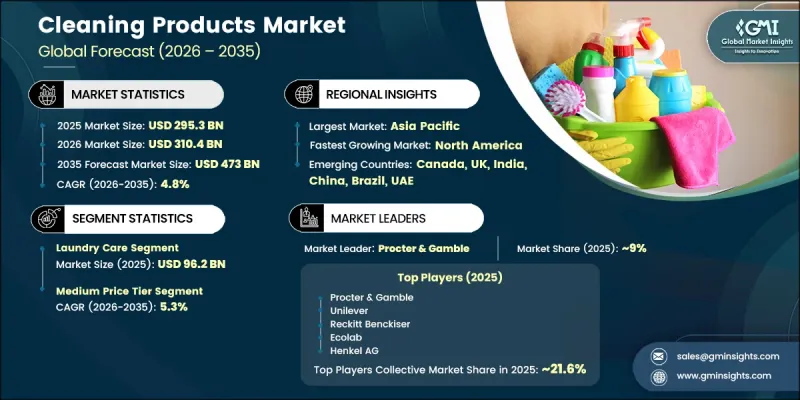
在全球住宅、商業、公共和工業應用領域強勁需求的推動下,清潔產品市場持續成長。不斷提高的衛生意識、更嚴格的產品配方標準以及新興經濟體消費的成長,都為這一長期市場成長提供了支撐。製造商不斷最佳化產品系列,力求在傳統清潔劑配方與環保、生物基、低排放的替代品之間取得平衡,以滿足不斷變化的消費者期望。同時,各行各業的組織都在堅持更高的衛生標準,從而持續推動商業環境中對認證清潔解決方案的需求。發展中地區的快速都市化和家庭收入水準的提高也擴大了包裝清潔產品的消費群體。這些結構性趨勢,加上持續的產品創新、優質化以及線上線下通路零售通路的拓展,進一步增強了全球清潔產品產業的長期發展機遇,促使製造商開發兼具清潔性能、安全性、永續性的解決方案。
| 市場範圍 | |
|---|---|
| 開始年份 | 2025 |
| 預測期 | 2026-2035 |
| 上市時的市場規模 | 2953億美元 |
| 預測金額 | 4730億美元 |
| 複合年成長率 | 4.8% |
預計2025年,衣物洗護市場規模將達到962億美元,佔全球市場的32.6%。由於該產業在已開發市場已相對成熟,家庭用戶普及率也較高,預計到2035年,其複合年成長率將達到4.3%。未來的成長主要受高級產品供應、產品形態的演變以及消費者對便捷高效洗滌解決方案日益成長的偏好驅動。同時,在這個價格敏感的市場中,消費者對成本績效產品的需求也預計將保持強勁。
預計到2035年,中端市場將以5.3%的複合年成長率成長,超過經濟型和高階市場。其廣泛的市場吸引力在於,它既能吸引那些尋求價格實惠且產品品質更高的消費者,也能吸引那些希望在不犧牲清潔性能的前提下尋找性價比更高的替代品的買家。這種平衡的價值提案將繼續支撐已開發市場和新興市場的持續需求。
預計到2035年,北美清潔產品市場將以5.5%的複合年成長率成長。這項成長主要得益於家庭清潔產品支出高企、線上零售滲透率不斷提高、消費者對環保配方的需求日益成長,以及有利於產品創新和認證的監管環境。這些因素進一步增強了消費者信心,並持續加速全部區域先進清潔解決方案的普及。
目錄
第1章:調查方法和範圍
第2章執行摘要
第3章 行業洞察
- 產業生態系分析
- 供應商情況
- 利潤率
- 每個階段增加的價值
- 影響價值鏈的因素
- 影響產業的因素
- 促進因素
- 全球對衛生和公共衛生的日益關注
- 消費者對環保和永續配方的需求日益成長
- 電子商務和線上零售通路的快速擴張
- 商業清潔服務和設施管理營運外包業務成長。
- 產業潛在風險與挑戰
- 各細分市場競爭激烈,利潤率面臨壓力。
- 逐步淘汰微塑膠和化學品相關的合規成本
- 消費者對成分透明度和潔淨標示標準的需求
- 原料成本的波動會影響配方的經濟效益。
- 機會
- 對天然、有機和經認證的生物基產品的需求日益成長
- 濃縮型、可重複填充型和零浪費產品形式的創新
- 新興市場尚未開發的成長潛力
- 適用於商業和工業領域的智慧互聯分配系統
- 促進因素
- 成長潛力分析
- 未來市場趨勢
- 技術與創新展望
- 最新科技趨勢
- 新興技術
- 監理情勢
- 標準和合規要求
- 區域監理框架
- 認證標準
- 貿易數據分析
- 進出口量及進口額趨勢
- 主要貿易路線及關稅的影響
- 價格分析
- 對過去價格趨勢的分析
- 按業務類型(高階/低階/大眾市場)分類的定價策略
- 人工智慧和生成式人工智慧對市場的影響
- 利用人工智慧改造現有經營模式
- 按細分市場分類的生成式人工智慧用例和部署藍圖
- 風險、限制和監管考量
- 波特的分析
- PESTLE分析
第4章 競爭情勢
- 介紹
- 企業市佔率分析
- 按地區
- 企業矩陣分析
- 主要市場公司的競爭分析
- 競爭定位矩陣
- 主要進展
- 併購
- 夥伴關係和聯盟
- 新產品發布
- 業務拓展計劃
第5章 市場估算與預測:依產品類型分類,2022-2035年
- 衣物洗護
- 洗衣精
- 洗衣凝珠和一次性洗衣液
- 衣物柔軟精和護理劑
- 專業衣物洗護
- 表面清潔劑
- 多用途清潔劑
- 廚房表面清潔劑
- 浴室表面清潔劑
- 抗菌消毒表面清潔劑
- 清潔劑
- 洗手用的清潔劑
- 洗碗機清潔劑(粉狀、液狀、片狀)
- 漂洗劑和洗碗機添加劑
- 廁所清潔劑
- 液體廁所清潔劑
- 馬桶邊緣清潔塊和水箱內部清潔片
- 凝膠型廁所清潔劑
- 地板清潔劑
- 適用於硬地板和瓷磚的清潔劑
- 適用於木地板和複合地板的清潔劑
- 商用、高耐用地板清潔機
- 玻璃和金屬清潔劑
- 玻璃和窗戶清潔劑
- 不銹鋼和鍍鉻清潔劑
- 多用途拋光劑和拋光產品
- 其他(管道疏通劑和堵塞清除劑)
第6章 市場估計與預測:依成分類型分類,2022-2035年
- 化學/合成
- 天然有機
第7章 市場估算與預測:依產品類型分類,2022-2035年
- 液體
- 粉末
- 噴
- 膠囊和平板電腦
- 擦拭巾
- 凝膠霜
- 其他(溶解片、條狀物)
第8章 市場估計與預測:依價格分類,2022-2035年
- 低的
- 中等的
- 高的
第9章 市場估計與預測:依最終用途分類,2022-2035年
- 住宅
- 商業的
- 旅館業(飯店、度假村、短期租賃)
- 醫療機構(醫院、診所、護理機構)
- 餐飲服務業/餐廳
- 辦公室和企業設施
- 教育機構
- 產業
- 食品飲料加工廠
- 製藥和生命科學設施
- 製造/倉儲業
第10章 市場估價與預測:依通路分類,2022-2035年
- 線上
- 電子商務
- 公司網站
- 離線
- 超級市場和大賣場
- 專賣店
- 其他零售店
第11章 市場估價與預測:按地區分類,2022-2035年
- 北美洲
- 美國
- 加拿大
- 歐洲
- 德國
- 英國
- 法國
- 義大利
- 西班牙
- 亞太地區
- 中國
- 印度
- 日本
- 韓國
- 澳洲
- 印尼
- 馬來西亞
- 拉丁美洲
- 巴西
- 墨西哥
- 阿根廷
- 中東和非洲
- 沙烏地阿拉伯
- UAE
- 南非
第12章:公司簡介
- 世界頂尖公司
- The Procter & Gamble Company
- Unilever plc
- Reckitt Benckiser Group plc
- Henkel AG & Co. KGaA
- SC Johnson & Son Inc.
- The Clorox Company
- Colgate-Palmolive Company
- 該地區的領先企業
- Ecolab Inc.
- Kao Corporation
- Church & Dwight Co. Inc.
- Godrej Consumer Products Ltd.
- Lion Corporation
- McBride plc
- 新興企業
- Seventh Generation
- Method Products
- Werner & Mertz GmbH
- Vikara Services Pvt. Ltd.
The Global Cleaning Products Market was valued at USD 295.3 billion in 2025 and is estimated to grow at a CAGR of 4.8% to reach USD 473 billion by 2035.
The cleaning products market continues to grow as demand remains strong across residential, commercial, institutional, and industrial applications worldwide. Long-term market growth is being supported by heightened awareness of hygiene, increasingly stringent product formulation standards, and rising consumption across emerging economies. Manufacturers are continuously refining product portfolios by balancing traditional cleaning formulations with environmentally friendly, bio-based, and low-emission alternatives to address evolving consumer expectations. At the same time, organizations across multiple industries are maintaining higher sanitation standards, creating recurring demand for certified cleaning solutions in commercial environments. Rapid urbanization and improving household income levels across developing regions are also enlarging the consumer base for packaged cleaning products. These structural trends, combined with continuous product innovation, premiumization, and wider retail accessibility through both online and offline channels, continue to strengthen long-term opportunities for the global cleaning products industry while encouraging manufacturers to develop solutions that combine cleaning performance, safety, sustainability, and affordability.
| Market Scope | |
|---|---|
| Start Year | 2025 |
| Forecast Year | 2026-2035 |
| Start Value | $295.3 Billion |
| Forecast Value | $473 Billion |
| CAGR | 4.8% |
The laundry care segment generated USD 96.2 billion in 2025, accounting for 32.6% share and the segment is forecast to grow at a CAGR of 4.3% through 2035, reflecting its relatively mature position in developed markets where household adoption is already widespread. Future growth will primarily be supported by premium product offerings, evolving product formats, and increasing consumer preference for convenient and high-performance laundry solutions, while value-oriented products continue to maintain strong demand across price-sensitive markets.
The medium price tier segment is projected to grow at a CAGR of 5.3% through 2035, outperforming both economy and premium price segments. Its broad market appeal stems from its ability to attract consumers seeking improved product quality at affordable prices while also appealing to buyers looking for cost-effective alternatives without compromising cleaning performance. This balanced value proposition continues to support sustained demand across both developed and emerging markets.
North America Cleaning Products Market is expected to grow at a CAGR of 5.5% through 2035. Growth is supported by high household spending on cleaning products, expanding online retail penetration, increasing demand for environmentally responsible formulations, and a favorable regulatory landscape that encourages product innovation and certification. These factors continue to strengthen consumer confidence while accelerating the adoption of advanced cleaning solutions throughout the region.
Major companies operating in the global cleaning products market include Henkel AG & Co. KGaA, The Procter & Gamble Company, Reckitt Benckiser Group plc, Unilever plc, The Clorox Company, S.C. Johnson & Son Inc., Colgate-Palmolive Company, Church & Dwight Co. Inc., Ecolab Inc., Kao Corporation, Lion Corporation, Godrej Consumer Products Ltd., McBride plc, Method Products, Seventh Generation, Werner & Mertz GmbH, Vikara Services Pvt. Ltd., and others. Companies operating in the cleaning products market are strengthening their competitive position through continuous product innovation, sustainable formulation development, and portfolio diversification. Manufacturers are increasing investments in bio-based ingredients, environmentally responsible packaging, and low-emission formulations to align with changing consumer preferences and evolving regulatory standards. Many companies are expanding their digital presence through direct-to-consumer platforms and e-commerce partnerships to improve customer engagement and broaden market reach. Businesses are also focusing on premium product development, value-added formulations, and specialized cleaning solutions for residential, commercial, and industrial applications. Strategic acquisitions, partnerships, and investments in manufacturing capacity are helping companies expand geographically while improving supply chain efficiency.
Table of Contents
Chapter 1 Methodology & Scope
- 1.1 Market scope and definition
- 1.2 Research design
- 1.2.1 Research approach
- 1.2.2 Data collection methods
- 1.3 Data mining sources
- 1.3.1 Global
- 1.3.2 Regional/Country
- 1.4 Base estimates and calculations
- 1.4.1 Base year calculation
- 1.4.2 Key trends for market estimation
- 1.5 Primary research and validation
- 1.5.1 Primary sources
- 1.6 Forecast model
- 1.7 Research assumptions and limitations
Chapter 2 Executive Summary
- 2.1 Industry 360° synopsis
- 2.2 Key market trends
- 2.2.1 Regional
- 2.2.2 Product type
- 2.2.3 Ingredient type
- 2.2.4 Form
- 2.2.5 Price
- 2.2.6 End use
- 2.2.7 Distribution channel
Chapter 3 Industry Insights
- 3.1 Industry ecosystem analysis
- 3.1.1 Supplier landscape
- 3.1.2 Profit margin
- 3.1.3 Value addition at each stage
- 3.1.4 Factor affecting the value chain
- 3.2 Industry impact forces
- 3.2.1 Growth drivers
- 3.2.1.1 Rising global emphasis on hygiene & sanitation
- 3.2.1.2 Growing consumer demand for eco-friendly & sustainable formulations
- 3.2.1.3 Rapid expansion of e-commerce & online retail channels
- 3.2.1.4 Growth of commercial cleaning services & outsourced facility management
- 3.2.2 Industry pitfalls & challenges
- 3.2.2.1 Intense price competition & margin pressure across all tiers
- 3.2.2.2 Microplastics & chemical phase-out compliance costs
- 3.2.2.3 Consumer demand for ingredient transparency & clean label standards
- 3.2.2.4 Raw material cost volatility impacting formulation economics
- 3.2.3 Opportunities
- 3.2.3.1 Rising demand for natural, organic & certified bio-based products
- 3.2.3.2 Innovation in concentrated, refillable & zero-waste product formats
- 3.2.3.3 Untapped growth in emerging markets
- 3.2.3.4 Smart & connected dispensing systems for commercial & industrial segments
- 3.2.1 Growth drivers
- 3.3 Growth potential analysis
- 3.4 Future market trends
- 3.5 Technology and innovation landscape
- 3.5.1 Current technological trends
- 3.5.2 Emerging technologies
- 3.6 Regulatory landscape
- 3.6.1 Standards and compliance requirements
- 3.6.2 Regional regulatory frameworks
- 3.6.3 Certification standards
- 3.7 Trade data analysis (HS Code 3402)
- 3.7.1 Import/export volume & value trends
- 3.7.2 Key trade corridors & tariff impact
- 3.8 Pricing analysis
- 3.8.1 Historical price trend analysis (driven by primary research)
- 3.8.2 Pricing strategy by player type (premium / value / mass market)
- 3.9 Impact of AI & generative AI on the market
- 3.9.1 AI-driven disruption of existing business models
- 3.9.2 GenAI use cases & adoption roadmap by segment
- 3.9.3 Risks, limitations & regulatory considerations
- 3.10 Porter's analysis
- 3.11 PESTEL analysis
Chapter 4 Competitive Landscape, 2025
- 4.1 Introduction
- 4.2 Company market share analysis
- 4.2.1 By Region
- 4.2.1.1 North America
- 4.2.1.2 Europe
- 4.2.1.3 Asia Pacific
- 4.2.1.4 Latin America
- 4.2.1.5 Middle East & Africa
- 4.2.1 By Region
- 4.3 Company matrix analysis
- 4.4 Competitive analysis of major market players
- 4.5 Competitive positioning matrix
- 4.6 Key developments
- 4.6.1 Mergers & acquisitions
- 4.6.2 Partnerships & collaborations
- 4.6.3 New product launches
- 4.6.4 Expansion plans
Chapter 5 Market Estimates & Forecast, By Product Type, 2022 - 2035, (USD Billion) (Million Units)
- 5.1 Key trends
- 5.2 Laundry care
- 5.2.1 Laundry detergents
- 5.2.2 Laundry pods & unit-dose formats
- 5.2.3 Fabric softeners & conditioners
- 5.2.4 Specialty laundry care
- 5.3 Surface cleaners
- 5.3.1 All-purpose cleaners
- 5.3.2 Kitchen surface cleaners
- 5.3.3 Bathroom surface cleaners
- 5.3.4 Antibacterial & disinfectant surface cleaners
- 5.4 Dishwashing products
- 5.4.1 Manual dishwashing liquids
- 5.4.2 Automatic dishwasher detergents (powder, liquid, tablets)
- 5.4.3 Rinse aids & dishwasher additives
- 5.5 Toilet cleaners
- 5.5.1 Liquid toilet bowl cleaners
- 5.5.2 Rim blocks & in-cistern tablets
- 5.5.3 Gel toilet cleaners
- 5.6 Floor cleaners
- 5.6.1 Hard floor & tile cleaners
- 5.6.2 Wood & laminate floor cleaners
- 5.6.3 Heavy-duty industrial floor cleaners
- 5.7 Glass & metal cleaners
- 5.7.1 Glass & window cleaners
- 5.7.2 Stainless steel & chrome cleaners
- 5.7.3 Multi-surface polish & shine products
- 5.8 Others (drain cleaners & unblocking agents)
Chapter 6 Market Estimates & Forecast, By Ingredient Type, 2022 - 2035, (USD Billion) (Million Units)
- 6.1 Key trends
- 6.2 Chemical/synthetic
- 6.3 Natural/organic
Chapter 7 Market Estimates & Forecast, By Product Form, 2022 - 2035, (USD Billion) (Million Units)
- 7.1 Key trends
- 7.2 Liquid
- 7.3 Powder
- 7.4 Spray
- 7.5 Pods & tablets
- 7.6 Wipes
- 7.7 Gel & cream
- 7.8 Others (dissolvable sheets, bars)
Chapter 8 Market Estimates & Forecast, By Price, 2022 - 2035, (USD Billion) (Million Units)
- 8.1 Key trends
- 8.2 Low
- 8.3 Medium
- 8.4 High
Chapter 9 Market Estimates & Forecast, By End Use, 2022 - 2035, (USD Billion) (Million Units)
- 9.1 Key trends
- 9.2 Residential
- 9.3 Commercial
- 9.3.1 Hospitality (hotels, resorts & short-term rentals)
- 9.3.2 Healthcare & medical facilities (hospitals, clinics, nursing homes)
- 9.3.3 Food service & restaurants
- 9.3.4 Offices & corporate facilities
- 9.3.5 Educational institutions
- 9.4 Industrial
- 9.4.1 Food & beverage processing plants
- 9.4.2 Pharmaceutical & life sciences facilities
- 9.4.3 Manufacturing & warehousing
Chapter 10 Market Estimates & Forecast, By Distribution Channel, 2022 - 2035, (USD Billion) (Million Units)
- 10.1 Key trends
- 10.2 Online
- 10.2.1 E-commerce
- 10.2.2 Company websites
- 10.3 Offline
- 10.3.1 Supermarkets & hypermarkets
- 10.3.2 Specialty stores
- 10.3.3 Others retail stores
Chapter 11 Market Estimates & Forecast, By Region, 2022 - 2035, (USD Billion) (Million Units)
- 11.1 Key trends
- 11.2 North America
- 11.2.1 U.S.
- 11.2.2 Canada
- 11.3 Europe
- 11.3.1 Germany
- 11.3.2 UK
- 11.3.3 France
- 11.3.4 Italy
- 11.3.5 Spain
- 11.4 Asia Pacific
- 11.4.1 China
- 11.4.2 India
- 11.4.3 Japan
- 11.4.4 South Korea
- 11.4.5 Australia
- 11.4.6 Indonesia
- 11.4.7 Malaysia
- 11.5 Latin America
- 11.5.1 Brazil
- 11.5.2 Mexico
- 11.5.3 Argentina
- 11.6 MEA
- 11.6.1 Saudi Arabia
- 11.6.2 UAE
- 11.6.3 South Africa
Chapter 12 Company Profiles
- 12.1 Top Global Players
- 12.1.1 The Procter & Gamble Company
- 12.1.2 Unilever plc
- 12.1.3 Reckitt Benckiser Group plc
- 12.1.4 Henkel AG & Co. KGaA
- 12.1.5 S.C. Johnson & Son Inc.
- 12.1.6 The Clorox Company
- 12.1.7 Colgate-Palmolive Company
- 12.2 Regional Champions
- 12.2.1 Ecolab Inc.
- 12.2.2 Kao Corporation
- 12.2.3 Church & Dwight Co. Inc.
- 12.2.4 Godrej Consumer Products Ltd.
- 12.2.5 Lion Corporation
- 12.2.6 McBride plc
- 12.3 Emerging Players
- 12.3.1 Seventh Generation
- 12.3.2 Method Products
- 12.3.3 Werner & Mertz GmbH
- 12.3.4 Vikara Services Pvt. Ltd.

 到2035年前植物性清潔劑市場的分析和預測:按類型、產品、技術、應用、形式、原料類型、最終用戶、功能、解決方案和銷售形式。
 微生物清潔產品市場-2026-2032年全球市場預測家用擦拭巾市場:2026-2032年全球市場預測(按產品類型、包裝類型、材料類型、香味類型、最終用戶和分銷管道分類)家用環保清潔產品市場:2026-2032年全球市場預測(依產品類型、成分類型、劑型、應用領域、最終用戶類型及銷售管道)
 家具拋光劑市場規模、佔有率和成長分析:按產品類型、表面類型、通路、最終用戶和地區分類-2026-2033年產業預測
 2026-2030年全球晾衣桿市場
 清潔產品市場-全球產業規模、佔有率、趨勢、機會和預測:按產品類型、形式、最終用戶、分銷管道、地區和競爭格局分類,2021-2031年
 家居護理原料市場:按類型、應用和地區分類
 清潔用品市場報告:趨勢、預測和競爭分析(至2035年)洗滌劑市場:按產品類型、應用、最終用戶、分銷管道和地區分類