


 |
市場調查報告書
商品編碼
2083386
2026-2035 年醫學影像人工智慧的市場機會、成長促進因素、產業趨勢與預測。Artificial Intelligence in Medical Imaging Market Opportunity, Growth Drivers, Industry Trend Analysis, and Forecast 2026 - 2035 |
||||||

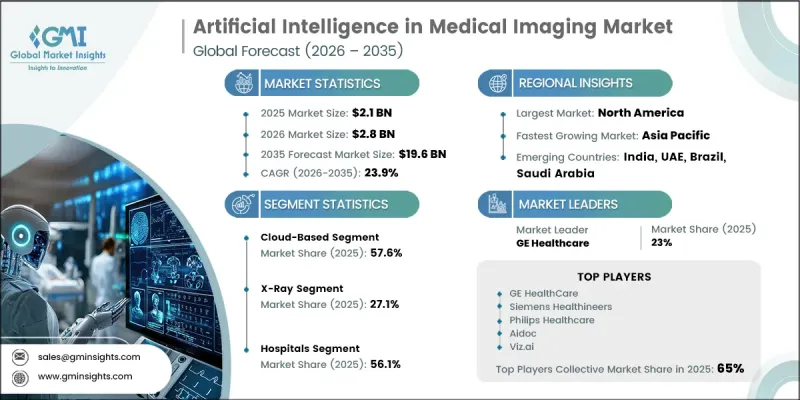
2025 年全球醫學影像人工智慧市場規模預計為 21 億美元,預計到 2035 年將達到 196 億美元,年複合成長率為 23.9%。
隨著深度學習技術與臨床影像工作流程的深度融合,市場正經歷快速變革,顯著提升了診斷準確性和營運效率。人工智慧驅動的影像解決方案正日益廣泛應用於腫瘤學、神經病學和心臟病學領域,以支持疾病早期檢測、減少診斷解讀的差異並最佳化治療方案的發展。臨床檢驗研究和同行評審的研究不斷證明,先進的演算法能夠在多種顯像模式下達到與經驗豐富的放射科醫生相媲美的診斷性能。人工智慧診斷工具法規核准的不斷擴大正在加速醫院的採用,並提升主要醫療系統的保險覆蓋範圍。同時,來自醫療技術供應商、影像設備製造商、學術機構和早期創新者的投資不斷增加,正在加速產品開發週期並拓展應用領域。包括國家生物醫學機構資助舉措在內的公共部門研究支持,持續推動著影像重建、心臟診斷和多模態資料整合領域的創新。隨著醫療系統將精準醫療和效率置於優先地位,人工智慧驅動的影像診斷正成為全球市場現代診斷基礎設施的核心要素。
| 市場範圍 | |
|---|---|
| 開始年份 | 2025 |
| 預測期 | 2026-2035 |
| 起始金額 | 21億美元 |
| 預測金額 | 196億美元 |
| 複合年成長率 | 23.9% |
到2025年,基於雲端的部署方案將佔據57.6%的市場。雲端基礎設施因其許多優勢而日益受到青睞,例如演算法快速部署、可擴展的運算能力、無縫的軟體更新以及更低的初始投資。這些優勢使得基於雲端的解決方案尤其適用於那些沒有大規模本地運算系統的醫療機構,從而能夠在各種不同的醫療環境中進行更廣泛的部署。
到2025年,醫院領域將佔據56.1%的市場。由於醫院擁有先進的影像基礎設施、龐大的患者群體以及在數位醫療領域強大的投資能力,它們仍然是主要的終端用戶環境。大規模醫療網路和大學附屬醫院是企業級人工智慧影像系統的早期採用者,因為其強大的影像處理能力足以抵消整合、授權和工作流程轉型方面的成本。
到2025年,北美將佔據醫療影像人工智慧市場43.8%的佔有率,並繼續保持其最大區域市場佔有率的地位。該地區的主導地位得益於監管機構批准的人工智慧影像解決方案的廣泛應用、醫院對IT的大力投資,以及優先考慮診斷準確性和營運效率的完善報銷機制。雖然美國佔據了該地區的大部分收入,但加拿大也在透過國家層面的數位醫療舉措,大力推廣先進的臨床影像技術,推動人工智慧在加拿大的應用不斷成長。
目錄
第1章:調查方法和範圍
第2章執行摘要
第3章 行業洞察
- 產業生態系分析
- 影響產業的因素
- 成長促進因素
- 人工智慧的技術進步
- 放射科醫生短缺正在加速人工智慧的應用。
- 提高診斷準確性並最佳化治療方案
- 增加研發投入有助於創新和市場擴張。
- 產業潛在風險與挑戰
- 監理機關核准流程延誤
- 人工智慧引發的診斷錯誤可能造成患者安全隱患
- 市場機遇
- 利用人工智慧擴大大規模健康篩檢和預防醫學的範圍
- AI影像平台與多模態臨床資料生態系的整合
- 成長促進因素
- 成長潛力分析
- 技術與創新展望
- 最新科技趨勢
- 新興技術
- 價格趨勢分析
- 監理情勢
- 波特的分析
- PESTLE分析
- 未來市場趨勢
- 人工智慧和生成式人工智慧對市場的影響
- 投資與資金籌措分析
- PACS整合
- 將基於PACS的AI整合到放射診斷系統中
- 人工智慧驅動的工作流程最佳化和報告產生效率
- 目前FDA已通過核准的人工智慧的狀況
- 擴大獲得FDA已通過核准的AI驅動型醫療影像解決方案
- 核准數量的增加正在推動市場滲透。
- 目前還款狀態
- 人工智慧支付趨勢及推動其應用的因素
- CMS支援人工智慧影像診斷的報銷流程
- NTAP 的批准使其能夠在關鍵的醫學影像應用中實施。
第4章 競爭情勢
- 介紹
- 企業市佔率分析
- 北美洲
- 歐洲
- 亞太地區
- 企業矩陣分析
- 主要市場公司的競爭分析
- 競爭定位矩陣
- 主要進展
- 併購
- 夥伴關係和聯盟
- 新產品發布
- 業務拓展計劃
第5章 市場估計與預測:依發展階段分類,2022-2035年
- 基於雲端的
- 現場
第6章 市場估計與預測:依模式分類,2022-2035年
- X光
- 電腦斷層掃描(CT)
- 磁振造影(MRI)
- 超音波影像
- 分子影像
- 核子醫學掃描術診斷
- 其他方式
第7章 市場估計與預測:依適應症分類,2022-2035年
- 乳房攝影
- 肺部影像
- 神經病學
- 心血管應用
- 肝臟影像
- 整形外科
- 其他改編
第8章 市場估計與預測:依應用領域分類,2022-2035年
- 診斷決策支持
- 放射治療計劃
- 手術和介入治療計劃
- 疾病監測隨時間推移
- 臨床研究和臨床試驗
- 其他用途
第9章 市場估計與預測:依最終用途分類,2022-2035年
- 醫院
- 診所
- 診斷中心
- 其他最終用戶
第10章 市場估價與預測:依地區分類,2022-2035年
- 北美洲
- 美國
- 加拿大
- 歐洲
- 德國
- 法國
- 英國
- 西班牙
- 義大利
- 荷蘭
- 亞太地區
- 中國
- 日本
- 印度
- 澳洲
- 韓國
- 拉丁美洲
- 巴西
- 墨西哥
- 阿根廷
- 中東和非洲
- 沙烏地阿拉伯
- 南非
- UAE
第11章:公司簡介
- GE HealthCare
- Siemens Healthineers
- Philips Healthcare
- Canon Medical Systems
- Fujifilm Holdings
- Aidoc
- Viz.ai
- RapidAI
- Tempus Radiology
- Lunit
- Qure.ai
- Annalise.ai
- Subtle Medical
- Rad AI
- Cleerly
The Global AI in Medical Imaging Market was valued at USD 2.1 billion in 2025 and is estimated to grow at a CAGR of 23.9% to reach USD 19.6 billion by 2035.
The market is undergoing rapid transformation as deep learning technologies become deeply embedded into clinical imaging workflows, significantly improving diagnostic accuracy and operational efficiency. AI-enabled imaging solutions are increasingly being used to support early disease identification, reduce variability in diagnostic interpretation, and enhance treatment planning across oncology, neurology, and cardiology applications. Clinical validation studies and peer-reviewed research continue to demonstrate that advanced algorithms can achieve diagnostic performance levels comparable to experienced radiologists across multiple imaging modalities. Growing regulatory acceptance of AI-based diagnostic tools is accelerating hospital adoption and expanding reimbursement pathways in major healthcare systems. In parallel, rising investments from healthcare technology providers, imaging equipment manufacturers, academic institutions, and early-stage innovators are accelerating product development cycles and broadening application areas. Public sector research support, including funding initiatives from national biomedical agencies, continues to advance innovation in imaging reconstruction, cardiac diagnostics, and multi-modal data integration. As healthcare systems prioritize precision medicine and efficiency, AI-based imaging is becoming a core component of modern diagnostic infrastructure across global markets.
| Market Scope | |
|---|---|
| Start Year | 2025 |
| Forecast Year | 2026-2035 |
| Start Value | $2.1 Billion |
| Forecast Value | $19.6 Billion |
| CAGR | 23.9% |
The cloud-based deployment segment accounted for 57.6% share in 2025. Cloud infrastructure is increasingly preferred due to its ability to support rapid algorithm deployment, scalable computing power, seamless software updates, and reduced upfront capital requirements. These advantages make cloud-based solutions especially suitable for healthcare facilities that lack large-scale on-premise computing systems, enabling broader adoption across diverse healthcare environments.
The hospital segment held a 56.1% share in 2025. Hospitals remain the primary end-use setting due to their advanced imaging infrastructure, high patient volumes, and strong institutional capacity for digital health investments. Large healthcare networks and academic medical centers are among the earliest adopters of enterprise-scale AI imaging systems, where high imaging throughput justifies the cost of integration, licensing, and workflow transformation.
North America AI in Medical Imaging Market accounted for 43.8% share in 2025, maintaining the largest regional share. The region's leadership is supported by widespread deployment of regulatory-cleared AI imaging solutions, strong hospital IT investment, and established reimbursement structures that prioritize diagnostic accuracy and operational efficiency. The United States represents most regional revenue, while Canada continues to expand adoption through national-level digital health initiatives focused on advanced clinical imaging technologies.
Major companies operating in the global AI in medical imaging market include Philips Healthcare, GE HealthCare, Siemens Healthineers, Fujifilm Holdings, Canon Medical Systems, Aidoc, Viz.ai, Qure.ai, Lunit, RapidAI, Annalise.ai, Subtle Medical, Tempus Radiology, Rad AI, and Cleerly Inc. Companies in the AI in medical imaging market are strengthening their market position through continuous advancement of AI algorithms, expansion of clinical validation studies, and integration of solutions into existing hospital imaging workflows. Many players are prioritizing partnerships with hospitals, academic institutions, and healthcare networks to accelerate real-world deployment and improve algorithm training using large-scale imaging datasets. Strategic collaborations with medical device manufacturers and cloud service providers are enabling scalable and interoperable platforms. Companies are also focusing on regulatory approvals across multiple regions to expand commercialization opportunities.
Table of Contents
Chapter 1 Methodology & Scope
- 1.1 Market scope and definitions
- 1.2 Research approach
- 1.3 Quality commitments
- 1.3.1 GMI AI policy & data integrity commitment
- 1.3.1.1 Source consistency protocol
- 1.3.1 GMI AI policy & data integrity commitment
- 1.4 Research trail & confidence scoring
- 1.4.1 Research trail components
- 1.4.2 Scoring components
- 1.5 Data collection
- 1.5.1 Partial list of primary sources
- 1.6 Data mining sources
- 1.6.1 Paid sources
- 1.6.1.1 Sources, by region
- 1.6.1 Paid sources
- 1.7 Base estimates and calculations
- 1.7.1 Base year calculation for any one approach
- 1.8 Forecast model
- 1.8.1 Quantified market impact analysis
- 1.8.1.1 Mathematical impact of growth parameters on forecast
- 1.8.1 Quantified market impact analysis
- 1.9 Research transparency addendum
- 1.9.1 Source attribution framework
- 1.9.2 Quality assurance metrics
- 1.9.3 Our commitment to trust
Chapter 2 Executive Summary
- 2.1 Industry 3600 synopsis
- 2.1.1 Business trends
- 2.1.2 Deployment trends
- 2.1.3 Modality trends
- 2.1.4 Indication trends
- 2.1.5 Application trends
- 2.1.6 End use trends
- 2.1.7 Regional trends
- 2.2 CXO perspectives: Strategic imperatives
Chapter 3 Industry Insights
- 3.1 Industry ecosystem analysis
- 3.2 Industry impact forces
- 3.2.1 Growth drivers
- 3.2.1.1 Technological advancements in AI
- 3.2.1.2 Shortage of radiologists accelerating the AI adoption
- 3.2.1.3 Improved diagnostic accuracy and treatment planning
- 3.2.1.4 Rising R&D investment supporting innovation and market expansion
- 3.2.2 Industry pitfalls and challenges
- 3.2.2.1 Slow regulatory approval process
- 3.2.2.2 Risk of patient safety concerns due to AI-driven diagnostic errors
- 3.2.3 Market opportunities
- 3.2.3.1 Expansion of AI-enabled population screening and preventive healthcare
- 3.2.3.2 Integration of AI imaging platforms with multimodal clinical data ecosystems
- 3.2.1 Growth drivers
- 3.3 Growth potential analysis
- 3.4 Technology and innovation landscape
- 3.4.1 Current technological trends
- 3.4.2 Emerging technologies
- 3.5 Pricing trend analysis (Driven by primary research)
- 3.6 Regulatory landscape (Driven by primary research)
- 3.6.1 North America
- 3.6.2 Europe
- 3.6.3 Asia Pacific
- 3.6.4 Latin America
- 3.6.5 MEA
- 3.7 Porter's analysis
- 3.8 PESTEL analysis
- 3.9 Future market trends
- 3.10 Impact of AI and Generative AI on the market (Driven by primary research)
- 3.11 Investment & funding analysis (Driven by primary research)
- 3.12 PACS integration
- 3.12.1 PACS-based AI integration into radiology systems
- 3.12.2 AI-driven workflow optimization and reporting efficiency
- 3.13 FDA-Cleared AI landscape
- 3.13.1 Expansion of FDA-cleared AI imaging solutions
- 3.13.2 Increasing approvals driving market adoption
- 3.14 Reimbursement landscape
- 3.14.1 AI reimbursement trends and adoption drivers
- 3.14.2 CMS reimbursement pathways supporting AI imaging
- 3.14.3 NTAP approvals enabling adoption in critical imaging applications
Chapter 4 Competitive Landscape, 2025
- 4.1 Introduction
- 4.2 Company market share analysis (Driven by primary research)
- 4.2.1 North America
- 4.2.2 Europe
- 4.2.3 Asia Pacific
- 4.3 Company matrix analysis
- 4.4 Competitive analysis of major market players
- 4.5 Competitive positioning matrix
- 4.6 Key developments
- 4.6.1 Merger and acquisition
- 4.6.2 Partnership and collaboration
- 4.6.3 New product launches
- 4.6.4 Expansion plans
Chapter 5 Market Estimates and Forecast, By Deployment, 2022 - 2035 ($ Mn)
- 5.1 Key trends
- 5.2 Cloud-based
- 5.3 On-premises
Chapter 6 Market Estimates and Forecast, By Modality, 2022 - 2035 ($ Mn)
- 6.1 Key trends
- 6.2 X-ray
- 6.3 Computed tomography (CT)
- 6.4 Magnetic Resonance Imaging (MRI)
- 6.5 Ultrasound imaging
- 6.6 Molecular imaging
- 6.7 Nuclear imaging
- 6.8 Other modalities
Chapter 7 Market Estimates and Forecast, By Indication, 2022 - 2035 ($ Mn)
- 7.1 Key trends
- 7.2 Breast imaging
- 7.3 Lung imaging
- 7.4 Neurology
- 7.5 Cardiovascular applications
- 7.6 Liver imaging
- 7.7 Orthopedics
- 7.8 Other indications
Chapter 8 Market Estimates and Forecast, By Application, 2022 - 2035 ($ Mn)
- 8.1 Key trends
- 8.2 Diagnostic decision support
- 8.3 Radiation therapy planning
- 8.4 Surgical & interventional planning
- 8.5 Longitudinal disease monitoring
- 8.6 Clinical research & trials
- 8.7 Other applications
Chapter 9 Market Estimates and Forecast, By End Use, 2022 - 2035 ($ Mn)
- 9.1 Key trends
- 9.2 Hospitals
- 9.3 Clinics
- 9.4 Diagnostic centers
- 9.5 Other end users
Chapter 10 Market Estimates and Forecast, By Region, 2022 - 2035 ($ Mn)
- 10.1 Key trends
- 10.2 North America
- 10.2.1 U.S.
- 10.2.2 Canada
- 10.3 Europe
- 10.3.1 Germany
- 10.3.2 France
- 10.3.3 UK
- 10.3.4 Spain
- 10.3.5 Italy
- 10.3.6 Netherlands
- 10.4 Asia Pacific
- 10.4.1 China
- 10.4.2 Japan
- 10.4.3 India
- 10.4.4 Australia
- 10.4.5 South Korea
- 10.5 Latin America
- 10.5.1 Brazil
- 10.5.2 Mexico
- 10.5.3 Argentina
- 10.6 Middle East & Africa
- 10.6.1 Saudi Arabia
- 10.6.2 South Africa
- 10.6.3 UAE
Chapter 11 Company Profiles
- 11.1 GE HealthCare
- 11.2 Siemens Healthineers
- 11.3 Philips Healthcare
- 11.4 Canon Medical Systems
- 11.5 Fujifilm Holdings
- 11.6 Aidoc
- 11.7 Viz.ai
- 11.8 RapidAI
- 11.9 Tempus Radiology
- 11.10 Lunit
- 11.11 Qure.ai
- 11.12 Annalise.ai
- 11.13 Subtle Medical
- 11.14 Rad AI
- 11.15 Cleerly

 2026年全球人工智慧(AI)遠距放射診斷服務市場報告
 人工智慧在醫學影像領域的市場:按組件、影像技術、應用、最終用戶和部署模式分類-2026-2032年全球市場預測
 人工智慧(AI)在超音波影像:市場洞察、競爭格局及市場預測(2034 年)
 全球醫學影像人工智慧市場:市場規模、佔有率、趨勢和成長分析(2026-2034)
 人工智慧驅動的醫學影像分析市場預測至2034年:全球分析(按組成部分、診斷影像方法、技術、工作流程階段、臨床功能、最終用戶和地區分類)
 全球人工智慧在醫學影像領域的市場:預測、競爭格局及保險報銷主導的商業化模式(2024-2035年)
 人工智慧在醫學影像領域的市場-全球產業規模、佔有率、趨勢、機會和預測:按技術、應用、模式、最終用途、地區和競爭格局分類,2021-2031年2026年全球人工智慧(AI)皮膚成像市場報告
 人工智慧市場規模、佔有率和趨勢分析報告—醫療影像領域:按技術、應用、最終用途、模式、地區和細分市場分類(2026-2033 年)人工智慧醫學影像市場預測至2034年—按成像方式、部署模式、技術、應用、最終用戶和地區分類的全球分析