

 |
市場調查報告書
商品編碼
2083381
橡膠靴市場機會、成長促進因素、產業趨勢分析及2026-2035年預測。Gumboot Market Opportunity, Growth Drivers, Industry Trend Analysis, and Forecast 2026 - 2035 |
||||||

全球橡膠靴市場預計到 2025 年將達到 13 億美元,年複合成長率為 5.2%,到 2035 年將達到 22 億美元。
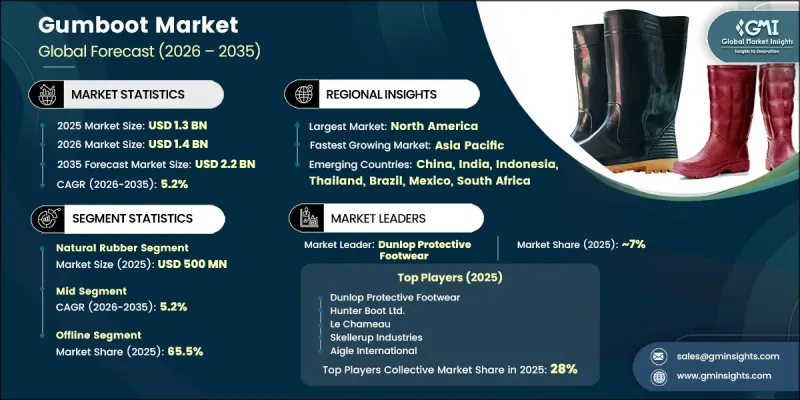
市場成長主要受工業、農業和商業領域對防護鞋需求不斷成長的驅動,而這又得益於日益嚴格的工作職場安全標準和不斷變化的勞動法規。橡膠靴在接觸水、化學品和有害物質的環境中日益被視為必不可少的安全裝備,並在農業、建築、採礦和食品加工等行業中廣泛應用。工業活動的擴張和農業現代化進程的持續推進進一步增強了對耐用防護鞋的需求。都市化和人口成長也促進了基礎建設和農業生產力的提高,進而推動了安全鞋消費量的成長。雇主和員工越來越重視既能可靠滿足安全要求又能提供長期性能的經濟高效的防護解決方案。從基礎橡膠到先進的PVC和氯丁橡膠產品,各種材質和設計的橡膠靴種類繁多,進一步擴大了其在各種職業環境中的應用。隨著全球職場安全意識的不斷提高,預計在預測期內,已開發市場和新興市場對橡膠靴的需求都將保持強勁。
| 市場範圍 | |
|---|---|
| 開始年份 | 2025 |
| 預測期 | 2026-2035 |
| 起始金額 | 13億美元 |
| 預測金額 | 22億美元 |
| 複合年成長率 | 5.2% |
天然橡膠產品佔37.6%的市場佔有率,預計2025年銷售額將達5億美元。其強大的市場地位源於其高耐用性、柔軟性和舒適性,使其成為在嚴苛的農業和工業環境中長時間使用的理想選擇。天然橡膠靴因其可靠的防水性、抗撕裂性和在長時間工作中保持舒適性而廣受歡迎。這些特性使其成為從事戶外和體力勞動者的首選。
預計到2025年,實體銷售管道將佔據65.5%的市場佔有率,並在2035年之前以4%的複合年成長率成長。由於消費者強烈希望在購買前親眼查看和觸摸產品,這一管道將繼續佔據主導地位。在實體店中,顧客可以直接檢查鞋子的合腳度、舒適度和耐用性,這對於防護鞋類尤其重要。這些分銷管道還能提供即時的產品供應和個人化支持,從而提升購買體驗。成熟的零售網路仍然是銷售的主要驅動力,尤其是在傳統購買行為仍然影響購買決策的地區。
預計到2025年,北美橡膠靴市場規模將達到3.3億美元,並在2035年之前以4.8%的複合年成長率成長。該國市場的發展得益於嚴格的職業安全健康標準、活躍的工業活動以及大規模的農業生產。在建築、農業、食品加工和工業維護等對防護鞋類至關重要的行業,需求仍然強勁。職場安全法律規範在促進橡膠靴的普及方面繼續發揮重要作用,合規要求影響公共和私營部門的採購決策和產品標準。
目錄
第1章:調查方法和範圍
第2章執行摘要
第3章 行業洞察
- 產業生態系分析
- 供應商情況
- 利潤率
- 每個階段增加的價值
- 影響價值鏈的因素
- 影響產業的因素
- 成長促進因素
- 產業潛在風險與挑戰
- 機會
- 成長潛力分析
- 價格波動和市場不可預測性
- 對品質保證和設備可靠性的擔憂
- 未來市場趨勢
- 技術與創新展望
- 最新科技趨勢
- 新興技術
- 價格分析
- 對過去價格趨勢的分析
- 依球員類型分類的定價策略(高級球員、超值球員、成本加成球員)
- 按產品類型和銷售量分類的平均售價
- 監理情勢
- 標準和合規要求
- 區域監理框架
- 認證標準
- 波特的分析
- PESTLE分析
- 貿易數據分析
- 進出口量及進口額趨勢
- 主要貿易路線及關稅的影響
- HS編碼分類及貿易流量分析
- 人工智慧和生成式人工智慧對市場的影響
- 人工智慧正在改變傳統的噴灑方式。
- 按農場規模分類的生成式人工智慧用例和實施藍圖
- 人工智慧噴霧器的風險、限制和監管考量
- 生產能力和生產情況
- 按地區和主要生產商分類的已安裝製造能力
- 運轉率和擴張計劃
第4章 競爭情勢
- 介紹
- 企業市佔率分析
- 按地區
- 企業矩陣分析
- 主要市場公司的競爭分析
- 競爭定位矩陣
- 主要進展
- 併購
- 夥伴關係和聯盟
- 新產品發布
- 業務拓展計劃
第5章 市場估計與預測:依材料分類,2022-2035年
- 天然橡膠
- PVC
- 氯丁橡膠
- 其他(例如EVA)
第6章 市場估計與預測:依價格區間分類,2022-2035年
- 低的
- 中等的
- 高的
第7章 市場估計與預測:依最終用途分類,2022-2035年
- 農業
- 工業與建築
- 戶外休閒
- 時尚休閒
- 其他(重型等)
第8章 市場估算與預測:依通路分類,2022-2035年
- 線上
- 離線
第9章 市場估計與預測:依地區分類,2022-2035年
- 北美洲
- 美國
- 加拿大
- 歐洲
- 德國
- 英國
- 法國
- 義大利
- 西班牙
- 亞太地區
- 中國
- 日本
- 印度
- 澳洲
- 韓國
- 拉丁美洲
- 巴西
- 墨西哥
- 阿根廷
- 中東和非洲
- 南非
- 沙烏地阿拉伯
- UAE
第10章:公司簡介
- 全球主要公司
- Dunlop Protective Footwear
- Hunter Boot Ltd.
- Bata Industrials
- Le Chameau
- Aigle International
- Muck Boot Company
- Bogs Footwear
- 當地公司
- Skellerup Industries
- Tingley Rubber Corporation
- Kamik(Genfoot Inc.)
- LaCrosse Footwear
- Bekina NV
- Servus
- XTRATUF
- Viking Footwear
- Tretorn
- 新興企業
- BBF Safety Group
- Mangla Industries
- Rockfish
- Dromex
- Rahman Group
The Global Gumboot Market was valued at USD 1.3 billion in 2025 and is estimated to grow at a CAGR of 5.2% to reach USD 2.2 billion by 2035.
Market growth is supported by rising demand for protective footwear across industrial, agricultural, and commercial applications, driven by stricter workplace safety standards and evolving occupational regulations. Gumboots are increasingly recognized as essential safety gear in environments exposed to water, chemicals, and hazardous materials, making them widely adopted across agriculture, construction, mining, and food processing operations. Expanding industrial activity and ongoing agricultural modernization are further strengthening demand for durable protective footwear. Rising urbanization and population growth are also contributing to infrastructure development and farm productivity improvements, which in turn support higher consumption of safety footwear. Employers and workers are increasingly prioritizing cost-effective protective solutions that ensure compliance with safety requirements while delivering long-lasting performance. The availability of gumboots in multiple material compositions and designs, ranging from basic rubber formats to advanced PVC and neoprene-based options, is further expanding adoption across diverse occupational environments. As workplace safety awareness continues to rise globally, demand for gumboots is expected to remain steady across both developed and emerging economies throughout the forecast period.
| Market Scope | |
|---|---|
| Start Year | 2025 |
| Forecast Year | 2026-2035 |
| Start Value | $1.3 Billion |
| Forecast Value | $2.2 Billion |
| CAGR | 5.2% |
The natural rubber segment accounted for 37.6% share, generating USD 500 million in 2025. Its strong market position is attributed to high durability, flexibility, and wearer comfort, making it well-suited for prolonged use in demanding agricultural and industrial conditions. Natural rubber gumboots are widely preferred due to their reliable waterproofing capabilities, resistance to tearing, and ability to maintain comfort during extended working hours. These characteristics make them a preferred choice among workers engaged in outdoor and physically intensive occupations.
The offline distribution channel held 65.5% share in 2025 and is projected to grow at a CAGR of 4% through 2035. This segment continues to dominate due to strong consumer preference for physical product evaluation before purchase. Offline retail formats allow customers to assess fit, comfort, and durability directly, which is particularly important for protective footwear. These distribution channels also provide immediate product availability and personalized assistance, enhancing the purchasing experience. Established retail networks remain a key driver of sales, particularly in regions where traditional purchasing behavior continues to influence buying decisions.
North America Gumboot Market accounted for USD 330 million in 2025 and is expected to grow at a CAGR of 4.8% through 2035. The country's market is supported by stringent occupational safety requirements, strong industrial activity, and large-scale agricultural operations. Demand remains steady across sectors such as construction, agriculture, food processing, and industrial maintenance, where protective footwear is essential. Regulatory frameworks governing workplace safety continue to play a critical role in driving adoption, as compliance requirements influence purchasing decisions and product standards across both public and private sectors.
Major companies operating in the global gumboot market include Aigle International, Bata Industrials, BBF Safety Group, Bekina NV, Bogs Footwear, Dromex, Dunlop Protective Footwear, Hunter Boot Ltd., Genfoot Inc., LaCrosse Footwear, Le Chameau, Mangla Industries, Muck Boot Company, Rahman Group, Rockfish, Servus, Skellerup Industries, Tingley Rubber Corporation, Tretorn, Viking Footwear, and XTRATUF. Companies operating in the gumboot market are focusing on product innovation, material advancements, and distribution expansion to strengthen their competitive position. Manufacturers are investing in research and development to enhance durability, waterproofing, comfort, and safety performance of gumboots across different occupational applications. Product diversification across rubber, PVC, and neoprene-based designs is helping companies address varied industry requirements. Strengthening partnerships with industrial suppliers, agricultural distributors, and retail networks is improving market accessibility and customer reach.
Table of Contents
Chapter 1 Methodology and Scope
- 1.1 Market scope and definition
- 1.2 Research design
- 1.2.1 Research approach
- 1.2.2 Data collection methods
- 1.3 Data mining sources
- 1.3.1 Global
- 1.3.2 Regional/Country
- 1.4 Base estimates and calculations
- 1.4.1 Base year calculation
- 1.4.2 Key trends for market estimation
- 1.5 Primary research and validation
- 1.5.1 Primary sources
- 1.6 Forecast model
- 1.7 Research assumptions and limitations
Chapter 2 Executive Summary
- 2.1 Industry 360° synopsis
- 2.2 Key market trends
- 2.2.1 Regional
- 2.2.2 Material
- 2.2.3 Price Range
- 2.2.4 End-use
- 2.2.5 Distribution Channel
Chapter 3 Industry Insights
- 3.1 Industry ecosystem analysis
- 3.1.1 Supplier landscape
- 3.1.2 Profit margin
- 3.1.3 Value addition at each stage
- 3.1.4 Factor affecting the value chain
- 3.2 Industry impact forces
- 3.2.1 Growth drivers
- 3.2.2 Industry pitfalls & challenges
- 3.2.3 Opportunities
- 3.3 Growth potential analysis
- 3.3.1 Price volatility and market unpredictability
- 3.3.2 Quality assurance and equipment reliability concerns
- 3.4 Future market trends
- 3.5 Technology and innovation landscape
- 3.5.1 Current technological trends
- 3.5.2 Emerging technologies
- 3.6 Pricing Analysis (Driven by Primary Research)
- 3.6.1 Historical Price Trend Analysis (Driven by Primary Research)
- 3.6.2 Pricing Strategy by Player Type (Premium/Value/Cost-plus) (Driven by Primary Research)
- 3.6.3 Average Selling Price by Product Type & Capacity
- 3.7 Regulatory landscape
- 3.7.1 Standards and compliance requirements
- 3.7.2 Regional regulatory frameworks
- 3.7.3 Certification standards
- 3.8 Porter's analysis
- 3.9 PESTEL analysis
- 3.10 Trade Data Analysis (Driven by Primary Research)
- 3.10.1 Import/Export Volume & Value Trends (Driven by Primary Research)
- 3.10.2 Key Trade Corridors & Tariff Impact (Driven by Primary Research)
- 3.10.3 HS Code Classification & Trade Flow Analysis
- 3.11 Impact of AI & Generative AI on the Market
- 3.11.1 AI-Driven Disruption of Traditional Spraying Methods
- 3.11.2 GenAI Use Cases & Adoption Roadmap by Farm Size
- 3.11.3 Risks, Limitations & Regulatory Considerations for AI-Enabled Sprayers
- 3.12 Capacity & Production Landscape (Driven by Primary Research)
- 3.12.1 Installed Manufacturing Capacity by Region & Key Producer (Driven by Primary Research)
- 3.12.2 Capacity Utilization Rates & Expansion Pipelines (Driven by Primary Research)
Chapter 4 Competitive Landscape, 2025
- 4.1 Introduction
- 4.2 Company market share analysis
- 4.2.1 By region
- 4.2.1.1 North America
- 4.2.1.2 Europe
- 4.2.1.3 Asia Pacific
- 4.2.1.4 Latin America
- 4.2.1.5 Middle East and Africa
- 4.2.1 By region
- 4.3 Company matrix analysis
- 4.4 Competitive analysis of major market players
- 4.5 Competitive positioning matrix
- 4.6 Key developments
- 4.6.1 Mergers & acquisitions
- 4.6.2 Partnerships & collaborations
- 4.6.3 New product launches
- 4.6.4 Expansion plans
Chapter 5 Market Estimates & Forecast, By Material, 2022 - 2035, (USD Billion) (Thousand Units)
- 5.1 Key trends
- 5.2 Natural rubber
- 5.3 PVC
- 5.4 Neoprene
- 5.5 Others (EVA, etc.)
Chapter 6 Market Estimates & Forecast, By Price Range, 2022 - 2035, (USD Billion) (Thousand Units)
- 6.1 Key trends
- 6.2 Low
- 6.3 Mid
- 6.4 High
Chapter 7 Market Estimates & Forecast, By End-use, 2022 - 2035, (USD Billion) (Thousand Units)
- 7.1 Key trends
- 7.2 Agricultural
- 7.3 Industrial & construction
- 7.4 Outdoor & recreational
- 7.5 Fashion & casual
- 7.6 Others (heavy duty, etc.)
Chapter 8 Market Estimates & Forecast, By Distribution Channel, 2022 - 2035, (USD Billion) (Thousand Units)
- 8.1 Key trends
- 8.2 Online
- 8.3 Offline
Chapter 9 Market Estimates and Forecast, By Region, 2022 - 2035 (USD Billion) (Thousand Units)
- 9.1 Key trends
- 9.2 North America
- 9.2.1 U.S.
- 9.2.2 Canada
- 9.3 Europe
- 9.3.1 Germany
- 9.3.2 UK
- 9.3.3 France
- 9.3.4 Italy
- 9.3.5 Spain
- 9.4 Asia Pacific
- 9.4.1 China
- 9.4.2 Japan
- 9.4.3 India
- 9.4.4 Australia
- 9.4.5 South Korea
- 9.5 Latin America
- 9.5.1 Brazil
- 9.5.2 Mexico
- 9.5.3 Argentina
- 9.6 Middle East and Africa
- 9.6.1 South Africa
- 9.6.2 Saudi Arabia
- 9.6.3 UAE
Chapter 10 Company Profiles
- 10.1 Top Global Player
- 10.1.1 Dunlop Protective Footwear
- 10.1.2 Hunter Boot Ltd.
- 10.1.3 Bata Industrials
- 10.1.4 Le Chameau
- 10.1.5 Aigle International
- 10.1.6 Muck Boot Company
- 10.1.7 Bogs Footwear
- 10.2 Regional Player
- 10.2.1 Skellerup Industries
- 10.2.2 Tingley Rubber Corporation
- 10.2.3 Kamik (Genfoot Inc.)
- 10.2.4 LaCrosse Footwear
- 10.2.5 Bekina NV
- 10.2.6 Servus
- 10.2.7 XTRATUF
- 10.2.8 Viking Footwear
- 10.2.9 Tretorn
- 10.3 Emerging Players
- 10.3.1 BBF Safety Group
- 10.3.2 Mangla Industries
- 10.3.3 Rockfish
- 10.3.4 Dromex
- 10.3.5 Rahman Group


