


 |
市場調查報告書
商品編碼
2083370
空冷式熱交換器市場:商業機會、成長要素、產業趨勢分析及 2026-2035 年預測。Air Cooled Heat Exchanger Market Opportunity, Growth Drivers, Industry Trend Analysis, and Forecast 2026 - 2035 |
||||||

全球空冷式熱交換器市場預計到 2025 年將達到 46 億美元,年複合成長率為 8.4%,到 2035 年將達到 102 億美元。
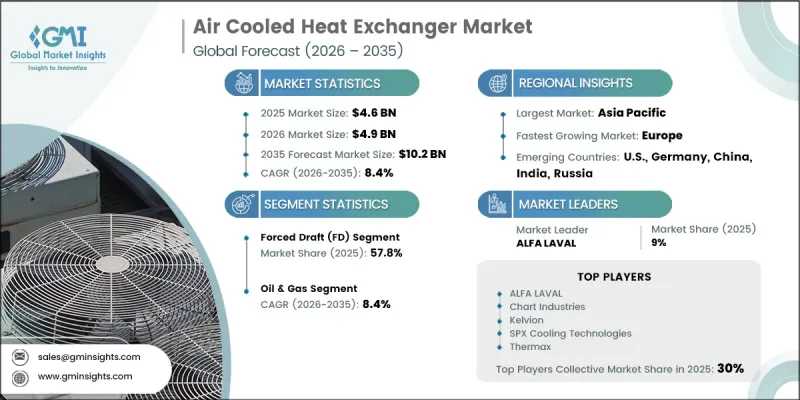
市場擴張受多種因素共同推動:工業用水環境法規日益嚴格、新興工業國家資本投資不斷增加,以及液化天然氣、石化和發電工程基礎設施建設持續推進。煉油、化工和能源基礎設施領域的大規模資本投資持續推動對空冷式熱交換器的穩定需求,尤其是在新建工廠和產能擴建項目中。製造地(特別是亞太地區和中東地區)的外國直接投資增加,也加速了工業設施設計階段對空冷系統的應用。此外,主要經濟體的法規結構正在限制高耗水冷卻技術,並促進向空冷替代方案的結構性轉變。更新的工業排放標準,包括歐盟工業排放指令(EU 2024/1785 號指令)的修訂,透過更嚴格的能源和用水限制,加強了合規要求,並強制要求特定設施實施環境管理體系,從而進一步促進了空冷系統在整個產業部門的應用。
| 市場範圍 | |
|---|---|
| 開始年份 | 2025 |
| 預測期 | 2026-2035 |
| 初始市場規模 | 46億美元 |
| 預測金額 | 102億美元 |
| 複合年成長率 | 8.4% |
強制通風式熱交換器市佔率佔57.8%,預計到2035年將以7.8%的複合年成長率成長。在這種配置中,風扇系統安裝在熱交換器管束的進氣側,為翅片管提供空氣,以提高熱交換效率。該設計被廣泛採用,因為它能夠保持較低的進氣溫度,確保穩定的熱性能,並簡化維護,避免製程停機。這些運作優勢使得強制通風式系統成為煉油廠冷卻、壓縮機站冷卻以及工業潤滑油溫度控制應用的首選方案。
預計到2025年,石油和天然氣行業將佔據16.2%的市場佔有率,並在2035年之前以8.4%的複合年成長率成長。空冷式熱交換器廣泛應用於氣體壓縮冷卻系統、原油加工、潤滑油冷卻以及上游、中游和下游製程製程氣體的溫度控制。符合API 661標準仍然是採購的基本要求,影響供應商的選擇,並維持整個產業的價格穩定。多個地區對液化天然氣基礎設施建設的持續投資,繼續推動大規模設備採購,而專案的每個階段通常都需要安裝多套設備。
預計到2025年,北美空冷式熱交換器市佔率將達到18.3%,並在2035年之前以8.1%的複合年成長率成長。美國是該地區的主要需求中心,這主要得益於沿海地區活躍的液化天然氣出口終端的開發、煉油廠的現代化和擴建項目,以及數據基礎設施和低溫運輸物流設施對高容量散熱系統日益成長的需求。對天然氣加工和液化天然氣出口基礎設施的持續投資,持續為多個裝置帶來穩定的採購需求,進一步強化了該地區市場成長的企劃為基礎特性。
目錄
第1章:調查方法和範圍
第2章執行摘要
第3章 行業洞察
- 產業生態系分析
- 零件可用性和採購分析
- 影響價值鏈的關鍵因素
- 中斷
- 影響產業的因素
- 促進因素
- 產業潛在風險與挑戰
- 成長潛力分析
- 監理情勢
- 波特的分析
- PESTLE分析
- 成本結構分析:空冷式熱交換器
- 新機會和趨勢
- 利用物聯網技術實現數位轉型
- 進入新興市場
- 投資分析及未來展望
- 人工智慧和生成式人工智慧對市場的影響
- 利用人工智慧最佳化生產
- 預測性維護和故障檢測
第4章 競爭情勢
- 介紹
- 企業市佔率分析:按地區分類
- 北美洲
- 歐洲
- 亞太地區
- 中東和非洲
- 拉丁美洲
- 主要市場公司的競爭分析
- 競爭定位矩陣
- 主要進展
- 併購
- 夥伴關係和聯盟
- 新產品發布
- 業務拓展計劃及資金籌措
- 按公司規模進行基準測試
- 排名分類標準與遴選標準
- 按銷售額、地區和創新能力分類的層級定位矩陣。
第5章 市場規模及預測:依類型分類,2022-2035年
- 強制通風
- 誘導通風
- 自然通風
第6章 市場規模與預測:依應用領域分類,2022-2035年
- 石油和天然氣
- 化學品
- 發電和冶金
- 海上
- 機械業
- 中央暖氣供應和冷
- 食品加工
- 其他
第7章 市場規模及預測:依地區分類,2022-2035年
- 北美洲
- 美國
- 加拿大
- 墨西哥
- 歐洲
- 德國
- 英國
- 法國
- 俄羅斯
- 義大利
- 西班牙
- 波蘭
- 土耳其
- 亞太地區
- 中國
- 日本
- 韓國
- 印度
- 印尼
- 馬來西亞
- 泰國
- 越南
- 菲律賓
- 澳洲
- 中東和非洲
- 沙烏地阿拉伯
- UAE
- 埃及
- 南非
- 拉丁美洲
- 巴西
- 阿根廷
第8章:公司簡介
- ALFA LAVAL
- Altex Industries
- AXH air-coolers
- Baker Hughes
- Bronswerk
- Boldrocchi
- Chart Industries
- Dry Coolers
- EMMEGI Heat Exchangers
- Evapco Dry Cooling
- Exchanger Industries
- Fbm Hudson Italiana
- Graham Hart(Process Technology)
- Kawasaki Heavy Industries
- Kelvion
- Marmon Industrial Water
- Positron Engineering
- SPG Dry Cooling
- Spiro-Gills Thermal Products
- SPX Cooling Tech
- Thermax
- Thermofin
The Global Air Cooled Heat Exchanger Market was valued at USD 4.6 billion in 2025 and is estimated to grow at a CAGR of 8.4% to reach USD 10.2 billion by 2035.
Market expansion is shaped by a combination of tightening environmental regulations on industrial water consumption, increasing capital investment in emerging industrial economies, and ongoing infrastructure development across LNG, petrochemical, and power generation projects. Large-scale capital deployment in refining, chemicals, and energy infrastructure continues to generate consistent demand for air cooled heat exchangers, particularly in new plant construction and capacity expansion projects. Rising foreign direct investment into manufacturing hubs, especially in Asia Pacific and the Middle East, is also accelerating the installation of air-cooled systems at the design stage of industrial facilities. In addition, regulatory frameworks in major economies are discouraging water-intensive cooling technologies and encouraging a structural transition toward air-cooled alternatives. Updated industrial emissions standards, including the EU Industrial Emissions Directive revision (Directive EU 2024/1785), are reinforcing compliance requirements through stricter limits on energy and water usage and mandating environmental management systems for covered installations, further strengthening adoption across industrial sectors.
| Market Scope | |
|---|---|
| Start Year | 2025 |
| Forecast Year | 2026-2035 |
| Start Value | $4.6 Billion |
| Forecast Value | $10.2 Billion |
| CAGR | 8.4% |
The forced draft segment held a 57.8% share and is expected to grow at a CAGR of 7.8% through 2035. In this configuration, fan systems are installed at the air inlet side of the heat exchanger bundle, pushing air across finned tubes to enhance heat transfer efficiency. This design is widely adopted due to its ability to maintain lower inlet air temperatures, ensure consistent thermal performance, and simplify maintenance procedures without requiring process shutdowns. These operational advantages make forced draft systems a preferred choice in refinery cooling operations, compressor station cooling systems, and industrial lubricant temperature regulation applications.
The oil and gas segment accounted for 16.2% share in 2025 and is projected to grow at a CAGR of 8.4% through 2035. Air cooled heat exchangers are widely used in gas compression cooling systems, crude oil processing, lube oil cooling applications, and process gas temperature control across upstream, midstream, and downstream operations. Compliance with API 661 standards remains a fundamental procurement requirement, shaping supplier selection and maintaining pricing discipline across the industry. Ongoing investment in LNG infrastructure development across multiple regions continues to support large-scale equipment procurement, with multi-unit installations commonly required across different project phases.
North America Air Cooled Heat Exchanger Market held 18.3% share in 2025 and is projected to grow at a CAGR of 8.1% through 2035. The United States represents the primary regional demand hub, driven by active LNG export terminal development along coastal regions, refinery modernization and expansion projects, and rising demand from data infrastructure and cold-chain logistics facilities requiring high-capacity heat rejection systems. Sustained investment in natural gas processing and LNG export infrastructure continues to generate consistent multi-unit procurement demand, reinforcing the project-based nature of market growth in the region.
Major companies operating in the global air cooled heat exchanger market include Kelvion, ALFA LAVAL, Chart Industries, Baker Hughes, Kawasaki Heavy Industries, SPX Cooling Technologies, Thermax, and Evapco Dry Cooling. Companies operating in the air cooled heat exchanger market are focusing on technological advancement, product customization, and capacity expansion to strengthen their market position. Manufacturers are investing in energy-efficient designs, improved heat transfer technologies, and corrosion-resistant materials to enhance system performance and durability. Strategic collaborations with engineering procurement and construction firms are helping suppliers secure large-scale project contracts. Expansion of manufacturing facilities in high-growth regions is improving supply chain efficiency and reducing delivery timelines. Companies are also strengthening aftermarket services, including maintenance, retrofitting, and performance optimization solutions, to enhance customer retention.
Table of Contents
Chapter 1 Methodology & Scope
- 1.1 Research design
- 1.2 Quality commitment
- 1.2.1 GMI AI policy & data integrity commitment
- 1.2.1.1 Source consistency protocol
- 1.2.1 GMI AI policy & data integrity commitment
- 1.3 Research trail & confidence scoring
- 1.3.1 Research trail components
- 1.3.2 Scoring components
- 1.4 Data collection
- 1.4.1 Partial list of primary sources
- 1.5 Data mining sources
- 1.5.1 Paid sources
- 1.5.1.1 Sources, by region
- 1.5.1 Paid sources
- 1.6 Base estimates and calculations
- 1.6.1 Base year calculation for any one approach
- 1.7 Market estimates & forecasts parameters
- 1.8 Forecast model
- 1.8.1 Quantified market impact analysis
- 1.8.1.1 Mathematical impact of growth parameters on forecast
- 1.8.1 Quantified market impact analysis
- 1.9 Research transparency addendum
- 1.9.1 Source attribution framework
- 1.9.2 Quality assurance metrics
- 1.9.3 Our commitment to trust
- 1.10 Market definitions
Chapter 2 Executive Summary
- 2.1 Industry synopsis, 2022 - 2035
- 2.1.1 Business trends
- 2.1.2 Type trends
- 2.1.3 Application trends
- 2.1.4 Regional trends
Chapter 3 Industry Insights
- 3.1 Industry ecosystem analysis
- 3.1.1 Component availability & sourcing analysis
- 3.1.2 Key factors affecting the value chain
- 3.1.3 Disruptions
- 3.2 Industry impact forces
- 3.2.1 Growth drivers
- 3.2.2 Industry pitfalls & challenges
- 3.3 Growth potential analysis
- 3.4 Regulatory landscape
- 3.5 Porter's analysis
- 3.5.1 Bargaining power of suppliers
- 3.5.2 Bargaining power of buyers
- 3.5.3 Threat of new entrants
- 3.5.4 Threat of substitutes
- 3.6 PESTEL analysis
- 3.6.1 Political factors
- 3.6.2 Economic factors
- 3.6.3 Social factors
- 3.6.4 Technological factors
- 3.6.5 Legal factors
- 3.6.6 Environmental factors
- 3.7 Cost structure analysis of air cooled heat exchanger (Driven by Primary Research)
- 3.8 Emerging opportunities & trends
- 3.8.1 Digital transformation with IoT technologies
- 3.8.2 Emerging market penetration
- 3.9 Investment analysis & future outlook
- 3.10 Impact of AI & Generative AI on the market (Driven by Primary Research)
- 3.10.1 AI-Driven production optimization (Driven by Primary Research)
- 3.10.2 Predictive maintenance & fault detection (Driven by Primary Research)
Chapter 4 Competitive Landscape, 2026
- 4.1 Introduction
- 4.2 Company market share analysis, by region, 2025
- 4.2.1 North America
- 4.2.2 Europe
- 4.2.3 Asia Pacific
- 4.2.4 Middle East & Africa
- 4.2.5 Latin America
- 4.3 Competitive analysis of major market players
- 4.4 Competitive positioning matrix
- 4.5 Key developments
- 4.5.1 Mergers & acquisitions
- 4.5.2 Partnerships & collaborations
- 4.5.3 New product launches
- 4.5.4 Expansion plans and funding
- 4.6 Company tier benchmarking
- 4.6.1 Tier classification criteria & qualifying thresholds
- 4.6.2 Tier positioning matrix by revenue, geography & innovation
Chapter 5 Market Size and Forecast, By Type, 2022 - 2035 (USD Million)
- 5.1 Key trends
- 5.2 Forced draft
- 5.3 Induced draft
- 5.4 Natural draft
Chapter 6 Market Size and Forecast, By Application, 2022 - 2035 (USD Million)
- 6.1 Key trends
- 6.2 Oil & gas
- 6.3 Chemical
- 6.4 Power generation & metallurgy
- 6.5 Marine
- 6.6 Mechanical industry
- 6.7 Central heating & refrigeration
- 6.8 Food processing
- 6.9 Others
Chapter 7 Market Size and Forecast, By Region, 2022 - 2035 (USD Million)
- 7.1 Key trends
- 7.2 North America
- 7.2.1 U.S.
- 7.2.2 Canada
- 7.2.3 Mexico
- 7.3 Europe
- 7.3.1 Germany
- 7.3.2 UK
- 7.3.3 France
- 7.3.4 Russia
- 7.3.5 Italy
- 7.3.6 Spain
- 7.3.7 Poland
- 7.3.8 Turkey
- 7.4 Asia Pacific
- 7.4.1 China
- 7.4.2 Japan
- 7.4.3 South Korea
- 7.4.4 India
- 7.4.5 Indonesia
- 7.4.6 Malaysia
- 7.4.7 Thailand
- 7.4.8 Vietnam
- 7.4.9 Philippines
- 7.4.10 Australia
- 7.5 Middle East & Africa
- 7.5.1 Saudi Arabia
- 7.5.2 UAE
- 7.5.3 Egypt
- 7.5.4 South Africa
- 7.6 Latin America
- 7.6.1 Brazil
- 7.6.2 Argentina
Chapter 8 Company Profiles
- 8.1 ALFA LAVAL
- 8.2 Altex Industries
- 8.3 AXH air-coolers
- 8.4 Baker Hughes
- 8.5 Bronswerk
- 8.6 Boldrocchi
- 8.7 Chart Industries
- 8.8 Dry Coolers
- 8.9 EMMEGI Heat Exchangers
- 8.10 Evapco Dry Cooling
- 8.11 Exchanger Industries
- 8.12 Fbm Hudson Italiana
- 8.13 Graham Hart (Process Technology)
- 8.14 Kawasaki Heavy Industries
- 8.15 Kelvion
- 8.16 Marmon Industrial Water
- 8.17 Positron Engineering
- 8.18 SPG Dry Cooling
- 8.19 Spiro-Gills Thermal Products
- 8.20 SPX Cooling Tech
- 8.21 Thermax
- 8.22 Thermofin

 全球空冷式熱交換器市場規模、佔有率、趨勢及成長分析報告(2026-2034)
 空冷式熱交換器市場:依材料類型、組件、結構類型、設計配置、產業、安裝類型、分銷網路和應用分類-全球預測,2026-2032年
 空冷式熱交換器市場分析及預測(至2035年):依類型、產品類型、服務、技術、組件、應用、材質、最終用戶、安裝類型、設備分類
 氣冷式熱交換器的全球市場(~2035年):各產品類型,各材料類型,各應用領域,各終端用戶,各地區,產業趨勢,預測
 空氣冷卻熱交換器市場規模、佔有率、趨勢分析報告:按類型、翅片類型、材料、結構、最終用途、地區、細分市場、預測,2025-2030 年
 全球風冷熱交換器市場:按類型、結構、材料、翅片設計、容量、最終用途產業、地區分類 - 2029 年預測