


 |
市場調查報告書
商品編碼
2083335
數位療法市場:商業機會、成長要素、產業趨勢分析及2026-2035年預測Digital Therapeutics Market Opportunity, Growth Drivers, Industry Trend Analysis, and Forecast 2026 - 2035 |
||||||

全球數位療法市場預計到 2025 年將達到 96 億美元,年複合成長率為 25.6%,到 2035 年將達到 934 億美元。
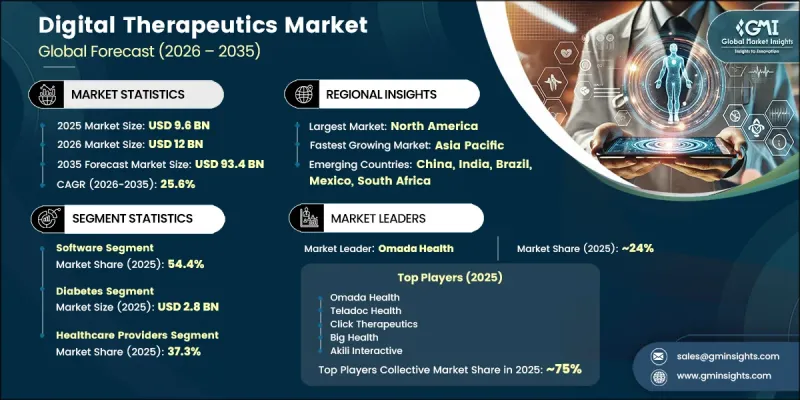
全球慢性病盛行率的上升推動了市場成長,也催生了對創新、技術驅動型疾病管理方法日益成長的需求。隨著醫療體係不斷優先發展預防醫學、長期病患監測和以治療為基礎的治療模式,數位療法作為一種能夠提供個人化、可擴充性醫療干預的有效解決方案,正日益受到認可。隨著人們對便利醫療服務的需求不斷成長、醫療成本不斷攀升以及患者對便捷治療方案的期望不斷提高,數位療法的應用正在加速發展。數位醫療基礎設施的進步、網路連接的增強以及遠端醫療也促進了市場發展。數位療法已成為現代醫療策略的關鍵要素,它能夠支持患者的持續參與、提高治療依從性並支持數據驅動的臨床決策。隨著醫療服務提供者、保險公司和患者對高效且經濟的治療方案的需求日益成長,預計數位療法市場將在預測期內保持持續成長。
| 市場範圍 | |
|---|---|
| 開始年份 | 2025 |
| 預測期 | 2026-2035 |
| 上市時的市場規模 | 96億美元 |
| 預測金額 | 934億美元 |
| 複合年成長率 | 25.6% |
人工智慧、機器學習、行動醫療平台、穿戴式科技和互動式數位參與工具等技術的不斷進步顯著提升了數位療法解決方案的能力。這些創新有助於增強個人化治療、提高患者參與度並改善治療效果,最終推動更廣泛的市場接受度。數位療法是基於實證醫學、軟體主導的干預措施,旨在透過臨床檢驗的調查方法預防、管理和治療多種疾病。這些解決方案透過各種數位管道提供,受到醫療監管機構的監管,並日益融入醫療服務體系。監管機構和醫療機構日益成長的支持正在建立一個框架,以促進整個行業的安全性、有效性和品質標準,從而進一步推動其應用。
到2025年,軟體領域將佔據54.4%的市場。該領域的成長主要得益於臨床檢驗的數位治療平台的廣泛應用、廣泛的可及性以及與互聯醫療生態系統的強大兼容性。以軟體為基礎的解決方案利用患者產生的數據、進階分析、行為科學原理和智慧演算法,提供高度個人化的治療方案。這些功能有助於長期行為改變,提高治療順從性,並改善慢性病管理。軟體主導療法的可擴展性也是其擴充性應用的重要因素,這些療法可以部署在多種數位裝置和醫療環境中。其可近性使其能夠惠及更廣泛的患者群體,包括那些難以獲得傳統醫療服務的患者,同時支持更有效率的醫療服務模式。
到2025年,醫療服務提供者將佔據37.3%的市場佔有率。醫療機構正日益將數位療法融入患者照護流程,以增強監測能力、改善治療效果和提升臨床療效。即時獲取患者資訊、高級分析和個人化干預策略,使臨床醫生能夠做出更明智的治療決策並最佳化醫療服務。臨床檢驗和監管的數位療法解決方案的日益普及進一步推動了醫療服務提供者的採用。法規核准和正式檢驗流程透過證明這些技術的安全性、可靠性和有效性,增強了醫療專業人員的信心,有助於提高處方率和使用率。
到2025年,北美將佔據全球數位療法市場58.1%的佔有率,成為該地區全球市場成長的最大驅動力。該地區持續面臨慢性疾病的沉重負擔,因此對擴充性的、技術驅動的治療解決方案有著強勁的需求,這些方案能夠支持持續的患者管理和個人化護理。對預防醫學、遠端監測和基於價值的醫療模式的日益重視,進一步推動了整個醫療保健生態系統對數位療法的採用。此外,該地區的雇主也擴大將數位健康解決方案納入員工健康計劃,以改善員工福祉、提高生產力並降低醫療成本。這種應用範圍從傳統醫療機構擴展到其他領域,正在創造更多成長機遇,並擴大數位療法在多個用戶群體中的應用。
目錄
第1章:調查方法和範圍
第2章執行摘要
第3章 行業洞察
- 產業生態系分析
- 影響產業的因素
- 促進因素
- 慢性病盛行率增加
- 降低成本的需求日益成長
- 擴大高品質醫療服務的提供範圍
- 數位療法的日益普及
- 產業潛在風險與挑戰
- 資料安全和隱私問題
- 熟練的IT專業人員短缺
- 市場機遇
- 預防醫學和以價值為導向的醫療保健正日益受到重視。
- 聯合治療模式的擴展
- 促進因素
- 成長潛力分析
- 技術展望
- 最新科技趨勢
- 新興技術
- 監理情勢
- 波特的分析
- PESTLE分析
- 人工智慧和生成式人工智慧對市場的影響
- 投資與資金籌措分析
- 未來市場趨勢
- 目前FDA已通過核准的數字療法的現狀
- 獲得美國食品藥物管理局(FDA)批准的產品供應有限。
- 獲得FDA批准的主要產品和主要公司
- 健康應用程式與受監管的數位療法 (DTx) 之間的差距
- 目前還款狀態
- 保險公司提供的福利面臨的挑戰
- 雇主出資模式與保險公司出資模式
- 德國的DiGA還款框架
第4章 競爭情勢
- 介紹
- 企業市佔率分析
- 北美洲
- 歐洲
- 企業矩陣分析
- 主要市場公司的競爭分析
- 競爭定位矩陣
- 主要進展
- 併購
- 夥伴關係和聯盟
- 新產品發布
- 業務拓展計劃
第5章 市場估計與預測:依組件分類,2022-2035年
- 軟體
- 現場
- 基於雲端的
- 硬體
- 穿戴式裝置
- 感測器和監控設備
- 其他設備
- 服務
- 諮詢與整合
- 培訓和教育
- 其他服務
第6章 市場估計與預測:依應用領域分類,2022-2035年
- 糖尿病
- 肥胖
- 心血管系統
- 心理和行為健康
- 高血壓
- 失眠
- 其他用途
第7章 市場估計與預測:依最終用途分類,2022-2035年
- 醫療服務提供方
- 醫院
- 診所
- 遠端醫療平台
- 付款人
- 病人
- 其他最終用戶
第8章 市場估計與預測:依地區分類,2022-2035年
- 北美洲
- 美國
- 加拿大
- 歐洲
- 德國
- 英國
- 法國
- 西班牙
- 義大利
- 荷蘭
- 亞太地區
- 中國
- 印度
- 日本
- 澳洲
- 韓國
- 拉丁美洲
- 巴西
- 墨西哥
- 阿根廷
- 中東和非洲
- 南非
- 沙烏地阿拉伯
- UAE
第9章:公司簡介
- Akili Interactive
- AmerisourceBergen
- Better Therapeutics
- Big Health
- Click Therapeutics
- DarioHealth
- Kaia Health
- Omada Health
- Orexo
- Otsuka Holdings
- Propeller Health
- Sidekick Health
- Teladoc Health
- Virta Health
- WellDoc
The Global Digital Therapeutics Market was valued at USD 9.6 billion in 2025 and is estimated to grow at a CAGR of 25.6% to reach USD 93.4 billion by 2035.
Market growth is driven by the increasing prevalence of chronic health conditions worldwide, creating a stronger need for innovative and technology-enabled disease management approaches. As healthcare systems continue to prioritize preventive care, long-term patient monitoring, and outcome-based treatment models, digital therapeutics are gaining recognition as effective solutions capable of delivering personalized and scalable healthcare interventions. The growing demand for accessible care, combined with rising healthcare expenditures and increasing patient expectations for convenient treatment options, is further accelerating adoption. Advances in digital health infrastructure, expanding connectivity, and greater acceptance of remote healthcare services are also contributing to market development. Digital therapeutics have emerged as an important component of modern healthcare strategies by supporting continuous patient engagement, improving treatment adherence, and enabling data-driven clinical decision-making. As healthcare providers, payers, and patients increasingly seek efficient and cost-effective treatment alternatives, the Digital Therapeutics Market is expected to witness sustained growth throughout the forecast period.
| Market Scope | |
|---|---|
| Start Year | 2025 |
| Forecast Year | 2026-2035 |
| Start Value | $9.6 Billion |
| Forecast Value | $93.4 Billion |
| CAGR | 25.6% |
Continuous advancements in technologies such as artificial intelligence, machine learning, mobile health platforms, wearable technologies, and interactive digital engagement tools are significantly improving the capabilities of digital therapeutics solutions. These innovations are enhancing personalization, increasing patient participation, and supporting better treatment outcomes, which in turn is driving broader market acceptance. Digital therapeutics consist of evidence-based software-driven interventions developed to prevent, manage, and treat a wide range of medical conditions through clinically validated methodologies. Delivered through various digital channels, these solutions are subject to healthcare regulatory oversight and are becoming increasingly integrated into healthcare delivery systems. Growing support from regulatory agencies and healthcare authorities is further encouraging adoption by establishing frameworks that promote safety, effectiveness, and quality standards across the industry.
The software segment held 54.4% share in 2025. Segment growth is supported by the increasing use of clinically validated digital treatment platforms, widespread accessibility, and strong compatibility with connected healthcare ecosystems. Software-based solutions facilitate highly customized treatment pathways by utilizing patient-generated data, advanced analytics, behavioral science principles, and intelligent algorithms. These capabilities support long-term behavioral change, strengthen treatment compliance, and improve the management of chronic conditions. The scalability of software-driven therapeutics also contributes significantly to adoption, as these solutions can be deployed across multiple digital devices and healthcare environments. Their accessibility enables broader patient reach, including populations with limited access to traditional healthcare services, while supporting more efficient healthcare delivery models.
The healthcare providers segment captured 37.3% share in 2025. Healthcare organizations are increasingly integrating digital therapeutics into patient care pathways to enhance monitoring capabilities, improve treatment effectiveness, and support better clinical outcomes. Access to real-time patient insights, advanced analytics, and personalized intervention strategies allows clinicians to make more informed treatment decisions and optimize healthcare delivery. Adoption among healthcare providers is further supported by the growing availability of clinically validated and regulatory-compliant digital therapeutic solutions. Regulatory clearances and formal validation processes strengthen confidence among medical professionals by demonstrating the safety, reliability, and effectiveness of these technologies, contributing to higher prescription and utilization rates.
North America Digital Therapeutics Market accounted for 58.1% share in 2025, establishing the region as the largest contributor to global market growth. The region continues to face a significant burden of chronic health conditions, creating strong demand for scalable, technology-enabled therapeutic solutions that support ongoing patient management and personalized care. Increasing emphasis on preventive healthcare, remote monitoring, and value-based care models is further encouraging adoption throughout the healthcare ecosystem. Additionally, employers across the region are increasingly incorporating digital health solutions into workforce wellness initiatives to enhance employee well-being, improve productivity, and reduce healthcare-related costs. This expanding application beyond conventional healthcare settings is creating additional growth opportunities and broadening the adoption of digital therapeutics across multiple user groups.
Key participants operating in the Global Digital Therapeutics Market include Teladoc Health, WellDoc, Omada Health, Kaia Health, Otsuka Holdings, Click Therapeutics, Virta Health, DarioHealth, Big Health, Sidekick Health, Orexo, Better Therapeutics, Akili Interactive, Propeller Health, and AmerisourceBergen. Companies competing in the Digital Therapeutics Market are implementing a range of strategic initiatives to strengthen their market position and expand their customer base. Key strategies include continuous investment in research and development to enhance clinical effectiveness, improve user engagement, and develop personalized treatment solutions. Market participants are increasingly incorporating advanced technologies such as artificial intelligence, predictive analytics, and data-driven healthcare tools to improve therapeutic outcomes and differentiate their offerings. Strategic collaborations with healthcare providers, payers, technology companies, and research organizations are helping firms accelerate commercialization and broaden market access. Companies are also focusing on obtaining regulatory approvals, expanding reimbursement coverage, and generating strong clinical evidence to increase physician confidence and adoption rates.
Table of Contents
Chapter 1 Methodology and Scope
- 1.1 Research approach
- 1.2 Quality commitments
- 1.2.1 GMI AI policy & data integrity commitment
- 1.2.1.1 Source consistency protocol
- 1.2.1 GMI AI policy & data integrity commitment
- 1.3 Research trail & confidence scoring
- 1.3.1 Research trail components
- 1.3.2 Scoring components
- 1.4 Data collection
- 1.4.1 Partial list of primary sources
- 1.5 Data mining sources
- 1.5.1 Paid sources
- 1.5.1.1 Sources, by region
- 1.5.1 Paid sources
- 1.6 Base estimates and calculations
- 1.6.1 Base year calculation for any one approach
- 1.7 Forecast model
- 1.7.1 Quantified market impact analysis
- 1.7.1.1 Mathematical impact of growth parameters on forecast
- 1.7.1 Quantified market impact analysis
- 1.8 Research transparency addendum
- 1.8.1 Source attribution framework
- 1.8.2 Quality assurance metrics
- 1.8.3 Our commitment to trust
Chapter 2 Executive Summary
- 2.1 Industry 360° synopsis
- 2.2 Key market trends
- 2.2.1 Business trends
- 2.2.2 Component trends
- 2.2.3 Application trends
- 2.2.4 End use trends
- 2.2.5 Regional trends
- 2.3 CXO perspectives: Strategic imperatives
Chapter 3 Industry Insights
- 3.1 Industry ecosystem analysis
- 3.2 Industry impact forces
- 3.2.1 Growth drivers
- 3.2.1.1 Increasing prevalence of chronic disease
- 3.2.1.2 Rising demand for cost containment
- 3.2.1.3 Expansion of quality-of-care delivery
- 3.2.1.4 Growing popularity of digital therapeutics
- 3.2.2 Industry pitfalls and challenges
- 3.2.2.1 Data security and privacy concerns
- 3.2.2.2 Lack of skilled IT professionals
- 3.2.3 Market opportunities
- 3.2.3.1 Increasing shift toward preventive and value-based care
- 3.2.3.2 Expansion of combination therapy models
- 3.2.1 Growth drivers
- 3.3 Growth potential analysis
- 3.4 Technology landscape (Driven by primary research)
- 3.4.1 Current technological trends
- 3.4.2 Emerging technologies
- 3.5 Regulatory landscape (Driven by primary research)
- 3.5.1 North America
- 3.5.2 Europe
- 3.5.3 Asia Pacific
- 3.5.4 Latin America
- 3.5.5 Middle East and Africa
- 3.6 Porter's analysis
- 3.7 PESTEL analysis
- 3.8 Impact of AI and Generative AI on the market (Driven by primary research)
- 3.9 Investment & funding analysis
- 3.10 Future market trends
- 3.11 FDA-cleared digital therapeutics landscape
- 3.11.1 Limited FDA-cleared product availability
- 3.11.2 Key FDA-cleared products & players
- 3.11.3 Gap between wellness apps & regulated DTx
- 3.12 Reimbursement landscape
- 3.12.1 Payer coverage challenges
- 3.12.2 Employer-sponsored vs payer-reimbursed models
- 3.12.3 Germany DiGA reimbursement framework
Chapter 4 Competitive Landscape, 2025
- 4.1 Introduction
- 4.2 Company market share analysis (Driven by primary research)
- 4.2.1 North America
- 4.2.2 Europe
- 4.3 Company matrix analysis
- 4.4 Competitive analysis of major market players
- 4.5 Competitive positioning matrix
- 4.6 Key developments
- 4.6.1 Merger and acquisition
- 4.6.2 Partnership and collaboration
- 4.6.3 New product launches
- 4.6.4 Expansion plans
Chapter 5 Market Estimates and Forecast, By Component, 2022 - 2035 ($ Mn)
- 5.1 Key trends
- 5.2 Software
- 5.2.1 On-premises
- 5.2.2 Cloud-based
- 5.3 Hardware
- 5.3.1 Wearable devices
- 5.3.2 Sensors and monitoring devices
- 5.3.3 Other devices
- 5.4 Services
- 5.4.1 Consulting and integration
- 5.4.2 Training and education
- 5.4.3 Other services
Chapter 6 Market Estimates and Forecast, By Application, 2022 - 2035 ($ Mn)
- 6.1 Key trends
- 6.2 Diabetes
- 6.3 Obesity
- 6.4 Cardiovascular
- 6.5 Mental & behavior health
- 6.6 Hypertension
- 6.7 Insomnia
- 6.8 Other applications
Chapter 7 Market Estimates and Forecast, By End Use, 2022 - 2035 ($ Mn)
- 7.1 Key trends
- 7.2 Healthcare providers
- 7.2.1 Hospitals
- 7.2.2 Clinics
- 7.2.3 Telehealth platforms
- 7.3 Payers
- 7.4 Patients
- 7.5 Other end users
Chapter 8 Market Estimates and Forecast, By Region, 2022 - 2035 ($ Mn)
- 8.1 Key trends
- 8.2 North America
- 8.2.1 U.S.
- 8.2.2 Canada
- 8.3 Europe
- 8.3.1 Germany
- 8.3.2 UK
- 8.3.3 France
- 8.3.4 Spain
- 8.3.5 Italy
- 8.3.6 Netherlands
- 8.4 Asia Pacific
- 8.4.1 China
- 8.4.2 India
- 8.4.3 Japan
- 8.4.4 Australia
- 8.4.5 South Korea
- 8.5 Latin America
- 8.5.1 Brazil
- 8.5.2 Mexico
- 8.5.3 Argentina
- 8.6 Middle East and Africa
- 8.6.1 South Africa
- 8.6.2 Saudi Arabia
- 8.6.3 UAE
Chapter 9 Company Profiles
- 9.1 Akili Interactive
- 9.2 AmerisourceBergen
- 9.3 Better Therapeutics
- 9.4 Big Health
- 9.5 Click Therapeutics
- 9.6 DarioHealth
- 9.7 Kaia Health
- 9.8 Omada Health
- 9.9 Orexo
- 9.10 Otsuka Holdings
- 9.11 Propeller Health
- 9.12 Sidekick Health
- 9.13 Teladoc Health
- 9.14 Virta Health
- 9.15 WellDoc

 自適應行為療法平台市場預測至2034年-全球分析(按治療方法、適應方法、交付管道、實施頻率、最終用戶和地區分類)
 2026年全球心理健康數位療法(DTX)市場報告
 全球數位療法 (DTx) 市場(至 2031 年):按產品(軟體/身臨其境型)、應用(治療(糖尿病、中樞神經系統疾病、心血管疾病、復健)、預防)、收入模式(訂閱/企業)、銷售管道(B2B/B2C)和最終用戶(醫院/保險公司/雇主)分類
 數位偏頭痛治療設備:市場洞察、競爭格局和市場預測 - 2034 年數位治療個人化平台市場:預測(至2034年)-按產品、組件、技術、應用、最終用戶和地區分類的全球分析數位語言治療市場預測至2034年—按治療類型、技術、交付方式、患者人口統計特徵、最終用戶和地區分類的全球分析
 數位偏頭痛治療設備市場-全球市場預測(2026-2032年)數位治療遊戲市場預測(2034 年)—按治療領域、年齡層、技術、應用、最終用戶和地區分類的全球分析數位治療設備市場:2026-2032年全球市場預測(按治療領域、給藥方法、分銷管道和最終用戶分類)數位療法市場:2026-2032年全球市場預測(依產品類型、治療領域、平台、通路類型、最終用戶和部署模式分類)