


 |
市場調查報告書
商品編碼
2083319
2026 年至 2035 年分散式臨床試驗的市場機會、成長促進因素、產業趨勢分析與預測。Decentralized Clinical Trials Market Opportunity, Growth Drivers, Industry Trend Analysis, and Forecast 2026 - 2035 |
||||||

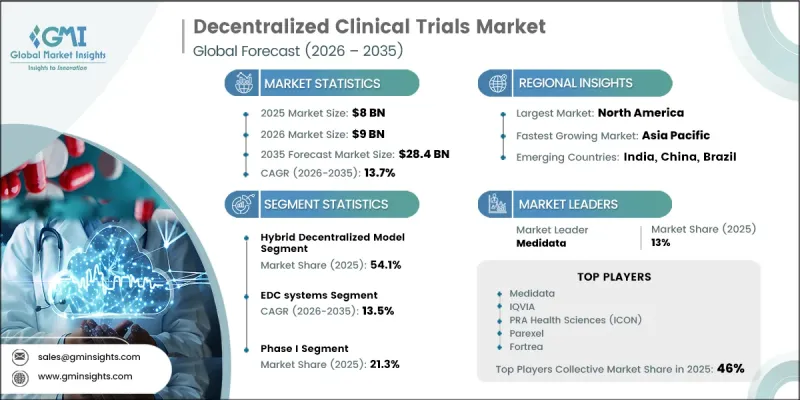
全球分散式臨床試驗市場預計到 2025 年將價值 80 億美元,並將以 13.7% 的複合年成長率成長,到 2035 年達到 284 億美元。
市場成長的驅動力來自監管機構日益成長的認可度、數位醫療技術的持續進步,以及申辦方對更有效率、更經濟、更多樣化的臨床試驗設計日益成長的需求。遠距遠端醫療平台、電子病患報告結局 (ePRO) 解決方案、遠端監測技術和數位資料收集工具的日益普及,顯著提高了進行分散式臨床試驗的可行性。隨著監管機構越來越重視患者的可及性、參與度和多樣性,製藥公司和研究機構正擴大將分散式功能融入其試驗框架中。遠端試驗管理減輕了傳統研究機構的營運負擔,同時提高了參與者的便利性和保留率。這些優勢在涉及多個地理位置的大規模患者群體的研究中尤其重要,因為分散式方法能夠提高營運效率、降低成本並縮短研究週期。
| 市場範圍 | |
|---|---|
| 開始年份 | 2025 |
| 預測期 | 2026-2035 |
| 起始金額 | 80億美元 |
| 預測金額 | 284億美元 |
| 複合年成長率 | 13.7% |
預計到2025年,混合分散式模式將佔據54.1%的市場佔有率,並在2035年之前以13.7%的複合年成長率成長。此模式已成為眾多中後期臨床試驗的首選設計,因為它結合了遠端病人參與功能和必要的現場臨床評估。透過整合精心挑選的分散式元素,同時保留必要的現場活動,申辦者可以在參與者便利性與監管和營運要求之間取得平衡。這種混合模式使機構能夠在確保對關鍵臨床程序和資料收集活動進行必要監督的同時,提高參與者招募率、增加保留率並提升試驗效率。
預計到2025年,I期臨床試驗市佔率將達到21.3%,並在2035年之前以13.6%的複合年成長率成長。由於早期臨床研究需要密集的監測、安全性評估和詳細的資料收集,因此在此階段採用分散式調查方法仍較為謹慎。許多I期臨床試驗仍需要直接的臨床監督和受控環境,以確保受試者的安全和臨床實驗藥物的準確評估。然而,遠端監測技術和數位健康平台的不斷進步,為早期研究計畫中更廣泛地採用分散式研究方法創造了機會。
預計到2025年,北美分散式臨床試驗市場將佔據44.2%的市場佔有率,並在2035年之前以13.8%的複合年成長率成長。該地區憑藉其先進的醫療基礎設施、強大的臨床研究生態系統、廣泛的數位醫療技術應用以及有利的法規環境,仍然是分散式臨床研究的領先市場。美國繼續佔據該地區最大的收入佔有率,這得益於活躍的臨床試驗活動、強大的技術應用以及專注於分散式研究解決方案的關鍵行業相關人員的存在。
目錄
第1章:調查方法和範圍
第2章執行摘要
第3章 行業洞察
- 產業生態系分析
- 影響產業的因素
- 成長促進因素
- 數位健康領域的技術進步
- 成本效益及縮短施工時間
- 監管支持和框架制定
- 改善病患就醫途徑並擴大多元性
- 產業潛在風險與挑戰
- 資料完整性和標準化
- 法規的複雜性和各地區之間的不一致性
- 市場機遇
- 人工智慧與穿戴式裝置的融合
- 進入服務不足的新興市場。
- 成長促進因素
- 成長潛力分析
- 監理情勢
- 技術展望
- 最新科技趨勢
- 新興技術
- 混合測試設計的運行架構
- 未來市場趨勢
- 資料收集與技術整合
- 中央臨床資料儲存庫中電子病患報告結局(ePRO)的標準化
- 設備互通性:穿戴式感測器和數位健康技術(DHT)的技術整合
- 維護資料完整性、管理設備差異性以及減少資料缺失的技術策略。
- 波特的分析
- PESTLE分析
- 人工智慧和生成式人工智慧對市場的影響
第4章 競爭情勢
- 介紹
- 企業市佔率分析
- 北美洲
- 歐洲
- 亞太地區
- 企業矩陣分析
- 主要市場公司的競爭分析
- 競爭定位矩陣
- 主要進展
- 併購
- 夥伴關係和聯盟
- 新產品發布
- 業務拓展計劃
第5章 市場估算與預測:依去中心化模型分類,2022-2035年
- 混合型
- 完整類型
- 基於站點的分散式模型
第6章 市場估計與預測:依技術分類,2022-2035年
- 遠端醫療平台
- 穿戴式裝置
- 行動醫療應用
- 電子資料擷取(EDC)系統
- 電子病患報告結果(ePRO)
- 其他技術
第7章 市場估計與預測:依治療領域分類,2022-2035年
- 腫瘤學
- 循環系統
- 神經病學
- 感染疾病
- 呼吸系統疾病
- 其他慢性疾病
第8章 市場估計與預測:依調查階段分類,2022-2035年
- 第一階段
- 第二階段
- 第三階段
- 第四階段
第9章 市場估計與預測:依地區分類,2022-2035年
- 北美洲
- 美國
- 加拿大
- 歐洲
- 德國
- 法國
- 英國
- 荷蘭
- 西班牙
- 義大利
- 亞太地區
- 中國
- 日本
- 韓國
- 印度
- 澳洲
- 拉丁美洲
- 巴西
- 阿根廷
- 墨西哥
- 中東和非洲
- 沙烏地阿拉伯
- UAE
- 南非
第10章:公司簡介
- Bio-Optronics
- Clinical Research IO
- ClinOne
- ClinTex
- Covance
- Curebase
- Florence Healthcare
- Fortrea
- IQVIA
- Mahalo Health
- Medable
- Medidata
- OpenClinica
- Parexel
- PPD(Thermo Fisher Scientific)
- PRA Health Sciences(ICON)
- Propharma
- Reify Health
- Sanguine Bio
- Sano Genetics
- Science 37
- Signant Health
- Trialize
- Veeva Systems
The Global Decentralized Clinical Trials Market was valued at USD 8 billion in 2025 and is estimated to grow at a CAGR of 13.7% to reach USD 28.4 billion by 2035.
Market growth is driven by greater regulatory acceptance, continuous advancements in digital health technologies, and increasing demand from sponsors for more efficient, cost-effective, and diverse clinical trial designs. The growing availability of telehealth platforms, electronic patient-reported outcome solutions, remote monitoring technologies, and digital data collection tools has significantly improved the feasibility of decentralized trial execution. As regulatory agencies place greater emphasis on patient accessibility, engagement, and diversity, pharmaceutical companies and research organizations are increasingly incorporating decentralized capabilities into their study frameworks. Remote trial management reduces operational burdens associated with traditional research sites while improving participant convenience and retention. These advantages are particularly valuable in large-scale studies that involve extensive patient populations across multiple geographic locations, where decentralized approaches can streamline operations, reduce costs, and accelerate study timelines.
| Market Scope | |
|---|---|
| Start Year | 2025 |
| Forecast Year | 2026-2035 |
| Start Value | $8 Billion |
| Forecast Value | $28.4 Billion |
| CAGR | 13.7% |
The hybrid decentralized model segment accounted for 54.1% share in 2025 and is expected to grow at a CAGR of 13.7% through 2035. This model has emerged as the preferred trial design across numerous mid-stage and late-stage clinical studies because it combines remote patient engagement capabilities with essential in-person clinical assessments. By integrating selected decentralized elements while maintaining necessary site-based activities, sponsors can balance participant convenience with regulatory and operational requirements. The hybrid approach enables organizations to improve patient recruitment, increase retention rates, and enhance study efficiency while preserving the oversight needed for critical clinical procedures and data collection activities.
Phase I studies segment held a 21.3% share in 2025 and is projected to grow at a CAGR of 13.6% through 2035. Adoption of decentralized methodologies within this phase remains more selective due to the intensive monitoring, safety assessments, and detailed data collection requirements associated with early-stage clinical research. Many studies at this stage continue to require direct clinical supervision and controlled environments to ensure participant safety and accurate evaluation of investigational therapies. Nevertheless, ongoing advancements in remote monitoring technologies and digital health platforms are creating opportunities for broader implementation of decentralized components within early-phase research programs.
North America Decentralized Clinical Trials Market captured a 44.2% share in 2025 and is anticipated to grow at a CAGR of 13.8% through 2035. The region remains the leading market for decentralized clinical research due to its advanced healthcare infrastructure, strong clinical research ecosystem, widespread adoption of digital health technologies, and favorable regulatory environment. The United States continues to account for the largest share of regional revenue, supported by significant clinical trial activity, robust technology deployment, and the presence of major industry participants focused on decentralized research solutions.
Key companies operating in the global decentralized clinical trials market include Curebase, Florence Healthcare, OpenClinica, Trialize, Reify Health, Signant Health, Clinical Research IO, Sanguine Bio, Medable, Propharma, Parexel, Medidata, IQVIA, ClinOne, Fortrea, Veeva Systems, ClinTex, Sano Genetics, Covance, Bio-Optronics, Mahalo Health, Science 37, PRA Health Sciences (ICON), and PPD (Thermo Fisher Scientific). Companies operating in the decentralized clinical trials market are focusing on technology innovation, strategic collaborations, and service expansion to strengthen their market position. Leading organizations are investing in advanced digital platforms that support remote patient monitoring, virtual site management, electronic data capture, and real-time analytics. Partnerships with pharmaceutical companies, contract research organizations, healthcare providers, and technology firms are helping market participants expand their service capabilities and geographic reach. Businesses are also enhancing interoperability, cybersecurity, and patient engagement tools to improve trial efficiency and participant experiences. In addition, companies are expanding cloud-based solutions, artificial intelligence capabilities, and data integration platforms to streamline clinical operations.
Table of Contents
Chapter 1 Methodology & Scope
- 1.1 Research approach
- 1.2 Quality commitments
- 1.2.1 GMI AI policy & data integrity commitment
- 1.2.1.1 Source consistency protocol
- 1.2.1 GMI AI policy & data integrity commitment
- 1.3 Research trail & confidence scoring
- 1.3.1 Research trail components
- 1.3.2 Scoring components
- 1.4 Data collection
- 1.4.1 Partial list of primary sources
- 1.5 Data mining sources
- 1.5.1 Paid sources
- 1.5.1.1 Sources, by region
- 1.5.1 Paid sources
- 1.6 Base estimates and calculations
- 1.6.1 Base year calculation for any one approach
- 1.7 Market estimates & forecasts parameters
- 1.8 Forecast model
- 1.8.1 Quantified market impact analysis
- 1.8.1.1 Mathematical impact of growth parameters on forecast
- 1.8.1 Quantified market impact analysis
- 1.9 Research transparency addendum
- 1.9.1 Source attribution framework
- 1.9.2 Quality assurance metrics
- 1.9.3 Our commitment to trust
Chapter 2 Executive Summary
- 2.1 Industry 360° synopsis
- 2.1.1 Business trends
- 2.1.2 Decentralization model trends
- 2.1.3 Technology trends
- 2.1.4 Therapeutic area trends
- 2.1.5 Study phase trends
- 2.1.6 Regional trends
- 2.2 CXO perspectives: Strategic imperatives
Chapter 3 Industry Insights
- 3.1 Industry ecosystem analysis
- 3.2 Industry impact forces
- 3.2.1 Growth drivers
- 3.2.1.1 Technological advancement in digital health
- 3.2.1.2 Cost efficiency and accelerated timelines
- 3.2.1.3 Regulatory support and framework development
- 3.2.1.4 Improved patient accessibility and diversity
- 3.2.2 Industry pitfalls and challenges
- 3.2.2.1 Data integrity and standardization
- 3.2.2.2 Regulatory complexity and regional inconsistencies
- 3.2.3 Market opportunities
- 3.2.3.1 Integration of AI and wearables
- 3.2.3.2 Expansion into underserved and emerging markets
- 3.2.1 Growth drivers
- 3.3 Growth potential analysis
- 3.4 Regulatory landscape (Driven by primary research)
- 3.4.1 North America
- 3.4.2 Europe
- 3.4.3 Asia Pacific
- 3.4.4 Latin America
- 3.4.5 MEA
- 3.5 Technology landscape
- 3.5.1 Current technological trends
- 3.5.2 Emerging technologies
- 3.6 Operational architecture of hybrid trial designs
- 3.7 Future market trends
- 3.8 Data capture and technology integration
- 3.8.1 Standardizing Electronic patient-reported outcomes (ePRO) within central clinical data repositories
- 3.8.2 Device interoperability: Technical integration of wearable sensors and digital health technologies (DHTs)
- 3.8.3 Technical strategies for preserving data integrity, managing device variance, and mitigating missing data
- 3.9 Porter's analysis
- 3.10 PESTEL analysis
- 3.11 Impact of AI and Generative AI on the market (Driven by primary research)
Chapter 4 Competitive Landscape, 2025
- 4.1 Introduction
- 4.2 Company market share analysis
- 4.2.1 North America
- 4.2.2 Europe
- 4.2.3 Asia Pacific
- 4.3 Company matrix analysis
- 4.4 Competitive analysis of major market players
- 4.5 Competitive positioning matrix
- 4.6 Key developments
- 4.6.1 Merger and acquisition
- 4.6.2 Partnership and collaboration
- 4.6.3 New product launches
- 4.6.4 Expansion plans
Chapter 5 Market Estimates and Forecast, By Decentralization Model, 2022 - 2035 (USD Million)
- 5.1 Key trends
- 5.2 Hybrid
- 5.3 Fully
- 5.4 Site-based decentralized model
Chapter 6 Market Estimates and Forecast, By Technology, 2022 - 2035 (USD Million)
- 6.1 Key trends
- 6.2 Telemedicine platforms
- 6.3 Wearable devices
- 6.4 Mobile health applications
- 6.5 Electronic data capture (EDC) systems
- 6.6 Electronic patient-reported outcomes (ePRO)
- 6.7 Other technologies
Chapter 7 Market Estimates and Forecast, By Therapeutic Area, 2022 - 2035 (USD Million)
- 7.1 Key trends
- 7.2 Oncology
- 7.3 Cardiology
- 7.4 Neurology
- 7.5 Infectious diseases
- 7.6 Respiratory disorders
- 7.7 Other chronic conditions
Chapter 8 Market Estimates and Forecast, By Study Phase, 2022 - 2035 (USD Million)
- 8.1 Key trends
- 8.2 Phase I
- 8.3 Phase II
- 8.4 Phase III
- 8.5 Phase IV
Chapter 9 Market Estimates and Forecast, By Region, 2022 - 2035 (USD Million)
- 9.1 Key trends
- 9.2 North America
- 9.2.1 U.S.
- 9.2.2 Canada
- 9.3 Europe
- 9.3.1 Germany
- 9.3.2 France
- 9.3.3 UK
- 9.3.4 Netherlands
- 9.3.5 Spain
- 9.3.6 Italy
- 9.4 Asia Pacific
- 9.4.1 China
- 9.4.2 Japan
- 9.4.3 South Korea
- 9.4.4 India
- 9.4.5 Australia
- 9.5 Latin America
- 9.5.1 Brazil
- 9.5.2 Argentina
- 9.5.3 Mexico
- 9.6 Middle East & Africa
- 9.6.1 Saudi Arabia
- 9.6.2 UAE
- 9.6.3 South Africa
Chapter 10 Company Profiles
- 10.1 Bio-Optronics
- 10.2 Clinical Research IO
- 10.3 ClinOne
- 10.4 ClinTex
- 10.5 Covance
- 10.6 Curebase
- 10.7 Florence Healthcare
- 10.8 Fortrea
- 10.9 IQVIA
- 10.10 Mahalo Health
- 10.11 Medable
- 10.12 Medidata
- 10.13 OpenClinica
- 10.14 Parexel
- 10.15 PPD (Thermo Fisher Scientific)
- 10.16 PRA Health Sciences (ICON)
- 10.17 Propharma
- 10.18 Reify Health
- 10.19 Sanguine Bio
- 10.20 Sano Genetics
- 10.21 Science 37
- 10.22 Signant Health
- 10.23 Trialize
- 10.24 Veeva Systems

 利用區塊鏈和數位孿生技術進行去中心化臨床試驗分散式臨床試驗市場規模、佔有率、成長及全球產業分析、區域趨勢及預測(2026年至2034年)
 分散式臨床試驗市場預測至2034年-全球分析(按組成部分、技術類型、研究設計模型、臨床試驗階段、治療領域、研究類型、服務類型、最終用戶和地區分類)臨床試驗技術市場預測至2034年-全球分析(按組件、部署模式、臨床試驗階段、臨床試驗設計、技術類型、交付模式、治療領域、最終用戶和地區分類)
 分散式臨床試驗市場規模、佔有率和成長分析:按服務類型、試驗階段、治療領域、技術類型、最終用戶、部署模式和地區分類-2026-2033年產業預測
 分散式臨床試驗:全球市場
 分散式臨床試驗市場-全球產業規模、佔有率、趨勢、機會及預測(依研究設計、治療領域、最終用戶、地區及競爭格局分類,2021-2031年)
 按組成部分、試驗階段、治療領域、申辦者類型和實施模式分類的去中心化臨床試驗市場-2026-2032年全球預測