


 |
市場調查報告書
商品編碼
2083318
棒材工具市場機會、成長促進因素、產業趨勢分析及2026-2035年預測Bar Tools Market Opportunity, Growth Drivers, Industry Trend Analysis, and Forecast 2026 - 2035 |
||||||

全球棒材刀具市場預計到 2025 年將達到 20.4 億美元,年複合成長率為 4.5%,到 2035 年將達到 31.6 億美元。
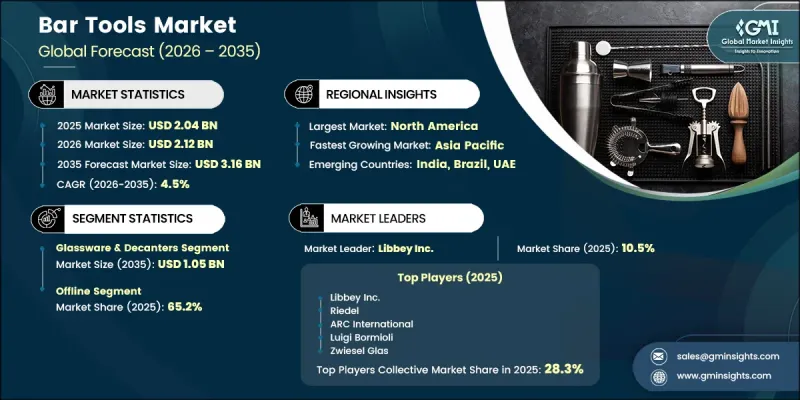
隨著全球飯店、旅遊和餐飲服務業的持續擴張,酒吧用品市場也呈現穩定成長態勢。飯店、餐廳、酒廊和以飲品為主的場所數量不斷增加,對耐用、專業級的酒吧用品產生了穩定的需求。雞尾酒文化的日益普及也推動了市場發展,消費者和企業都在尋求更精緻的調酒術體驗。除了商業性需求外,家庭娛樂和家庭自釀飲品的日益普及也促使私人家庭投資高階酒吧用品。消費者越來越重視那些既能提升飲品調製和呈現效果,又兼具美觀和耐用性的產品。對精緻家居環境和更高品質娛樂體驗的追求,推動了對採用耐用材料製成的高品質酒吧用品的需求。這些不斷變化的偏好正在推動全球酒吧用品產業的創新和優質化。
| 市場範圍 | |
|---|---|
| 開始年份 | 2025 |
| 預測期 | 2026-2035 |
| 起始金額 | 20.4億美元 |
| 預測金額 | 31.6億美元 |
| 複合年成長率 | 4.5% |
雞尾酒文化的日益普及推動了專業酒吧用具(包括專業和住宅)的需求成長。消費者越來越熱衷於打造個人化的飲酒體驗,這促使他們對兼具美觀和實用性的酒吧工具的需求不斷成長。隨著消費者對性能和美觀的雙重追求,設計精良、經久耐用的高級產品越來越受歡迎。家庭娛樂趨勢的擴展進一步促進了個人酒吧空間的興起,越來越多的消費者投資購買設備,以提升休閒聚會和調酒體驗。
預計到2025年,玻璃杯和醒酒器細分市場的銷售額將達到6.3億美元,到2035年將達到10.5億美元。由於這些產品在飲品供應和展示中發揮著至關重要的作用,因此該細分市場一直保持著主導地位。雖然有些沖調配件可以被其他產品取代,但選擇合適的盛裝容器仍然是影響視覺吸引力、顧客滿意度和整體飲品品質感知的關鍵因素。
預計到2025年,實體銷售管道將佔據65.2%的市場。實體零售佔據主導地位的主要原因是,在購買酒吧設備時,親身觸摸和評估產品至關重要。專業調酒師、餐飲業採購人員以及注重品質的消費者在做出購買決定之前,往往更傾向於檢查產品的設計、重量、平衡性和易用性。專業廚具店、高階零售商、百貨公司展廳和批發採購中心持續為顧客提供直接觸摸產品和即時購買的便利,鞏固了線下銷售管道的優勢。
到2025年,美國酒吧用具市場將佔據84.5%的市場。該地區的成長主要得益於蓬勃發展的酒店業、不斷擴張的夜生活行業,以及美國和加拿大各地酒吧、餐廳和高級餐飲場所的持續需求。消費者對雞尾酒調製和居家飲酒體驗日益成長的興趣,推動了對專業酒吧用具的需求,尤其是在都市區的年輕消費者和高所得家庭中。此外,線上零售平台和高階廚具品牌的擴張,提高了產品供應量,增強了消費者認知度,並擴大了品牌在北美的影響力。
目錄
第1章:調查方法和範圍
第2章執行摘要
第3章 行業洞察
- 產業生態系分析
- 供應商情況
- 利潤率
- 每個階段增加的價值
- 影響價值鏈的因素
- 影響產業的因素
- 成長促進因素
- 可支配收入增加以及消費者對高階調酒設備的興趣日益濃厚。
- 全球精釀雞尾酒吧的激增以及調酒術日益普及
- 電子商務的快速發展擴大了產品的供應範圍。
- 產業潛在風險與挑戰
- 供應鏈中斷與原物料價格波動
- 仿冒品和低品質進口商品正在損害高階市場。
- 機會
- 智慧物聯網相容酒吧工具
- 優質化個人化禮品類別
- 成長促進因素
- 成長潛力分析
- 監理框架
- 關鍵市場趨勢與顛覆性因素
- 技術與創新展望
- 當前趨勢
- 新進展
- 價格分析
- 對過去價格趨勢的分析
- 依球員類型分類的定價策略(高級球員、超值球員、成本加成球員)
- 未來市場趨勢
- 貿易數據分析
- 進出口量及進口額趨勢
- 主要貿易路線及關稅的影響
- 人工智慧和生成式人工智慧對市場的影響
- 利用人工智慧改造現有經營模式
- 按細分市場分類的生成式人工智慧用例和部署藍圖
- 風險、限制和監管考量
- 波特的分析
- PESTLE分析
- 目前分銷基礎設施和通路滲透情況
- 按地區與業態(現代零售與傳統零售)分類的通路覆蓋率
- 最後一公里基礎設施差異和不斷變化的管道。
- 消費行為分析
- 購買模式
- 偏好分析
- 不同地區的消費行為差異
- 電子商務對購買決策的影響
第4章 競爭情勢
- 介紹
- 企業市佔率分析
- 按地區
- 企業矩陣分析
- 主要市場公司的競爭分析
- 競爭定位矩陣
- 主要進展
- 併購
- 夥伴關係和聯盟
- 新產品發布
- 業務拓展計劃
第5章 市場估算與預測:依產品類型分類,2022-2035年
- 雞尾酒調製工具
- 雞尾酒調酒器
- 量酒器和量杯
- 糊糊
- 吧匙和調酒杯
- 濾網(霍桑式、朱利普式、細網式)
- 葡萄酒和啤酒配件
- 開瓶器
- 開瓶器
- 倒酒器/滴酒器
- 葡萄酒塞和真空儲存容器
- 冰處理工具
- 冰鎬和碎冰器
- 冰鉗和冰勺
- 製冰模具和冰格
- 冰桶和冷藏箱
- 玻璃器皿和醒酒器
- 雞尾酒杯
- 葡萄酒杯
- 小酒杯和玻璃杯
- 醒酒器和玻璃瓶
- 桿工具套裝
- 其他
第6章 市場估計與預測:依應用領域分類,2022-2035年
- 住宅
- 商業
第7章 市場估價與預測:依通路分類,2022-2035年
- 線上
- 電子商務
- 企業網站
- 離線
- 超級市場和大賣場
- 專賣店
- 其他(個體店、百貨公司等)
第8章 市場估計與預測:依地區分類,2022-2035年
- 北美洲
- 美國
- 加拿大
- 歐洲
- 德國
- 英國
- 法國
- 西班牙
- 義大利
- 亞太地區
- 中國
- 日本
- 印度
- 澳洲
- 韓國
- 拉丁美洲
- 巴西
- 墨西哥
- 阿根廷
- 中東和非洲
- 南非
- 沙烏地阿拉伯
- UAE
第9章:公司簡介
- 世界公司
- Alessi SpA
- 業務概覽
- 財務數據
- 產品格局
- 戰略展望
- SWOT分析
- ARC International
- Georg Jensen A/S
- Libbey Inc.
- Luigi Bormioli
- OXO
- Riedel
- WMF GmbH
- Zwiesel Glas
- Alessi SpA
- 本地公司
- Carlisle FoodService Products
- Nambe
- Norpro
- Rabbit Wine
- Tablecraft Products
- The Vollrath Company
- Trudeau Corporation
- Vacu Vin
- 新興企業
- American Metalcraft
- Cocktail Kingdom
- Cresimo
- True Brands
The Global Bar Tools Market was valued at USD 2.04 billion in 2025 and is estimated to grow at a CAGR of 4.5% to reach USD 3.16 billion by 2035.
The market is witnessing steady growth as the hospitality, tourism, and food service industries continue to expand worldwide. Increasing numbers of hotels, restaurants, lounges, and beverage-focused establishments are creating consistent demand for durable, professional-grade bar tools. The growing influence of cocktail culture is also contributing to market development as consumers and businesses increasingly seek advanced mixology experiences. Alongside commercial demand, the rising popularity of home entertainment and personal beverage preparation is encouraging households to invest in premium bar accessories. Consumers are showing greater interest in aesthetically appealing, long-lasting products that improve drink preparation and presentation. The shift toward sophisticated home setups and elevated entertaining experiences is strengthening demand for high-quality barware made from durable materials. These changing preferences are supporting innovation and premiumization across the global bar tools industry.
| Market Scope | |
|---|---|
| Start Year | 2025 |
| Forecast Year | 2026-2035 |
| Start Value | $2.04 Billion |
| Forecast Value | $3.16 Billion |
| CAGR | 4.5% |
The expansion of cocktail culture has increased the need for specialized bar equipment across professional and residential environments. Consumers are increasingly interested in creating customized beverage experiences, which has encouraged demand for visually attractive and functional bar tools. Premium products featuring refined designs and durable construction are gaining popularity as buyers prioritize both performance and appearance. The growth of home-based entertainment trends has further supported the development of personal bar spaces, with more consumers investing in equipment that enhances casual gatherings and beverage preparation.
The glassware and decanters segment generated USD 0.63 billion in 2025 and is expected to reach USD 1.05 billion by 2035. This segment maintains the leading position in the market due to the essential role these products play in beverage serving and presentation. Although some preparation accessories can be replaced with alternative options, the selection of suitable serving vessels remains a key factor influencing visual appeal, customer satisfaction, and the overall perception of beverage quality.
The offline distribution channels segment accounted for 65.2% share in 2025. The dominance of physical retail is primarily linked to the importance of hands-on evaluation when purchasing bar equipment. Professional bartenders, hospitality buyers, and quality-focused consumers often prefer examining product design, weight, balance, and handling comfort before completing purchases. Specialty kitchenware stores, premium retail outlets, department store displays, and wholesale purchasing centers continue to provide customers with direct product access and immediate purchase convenience, supporting the strength of offline sales channels.
United States Bar Tools Market held an 84.5% share in 2025. The region's growth is supported by a strong hospitality landscape, expanding nightlife sector, and continued demand from bars, restaurants, and premium dining establishments across the US and Canada. Rising consumer interest in cocktail preparation and home-based beverage experiences is increasing demand for professional-quality bar tools, particularly among younger urban consumers and higher-income households. Additionally, the expansion of online retail platforms and premium kitchenware brands is improving product availability, increasing consumer awareness, and strengthening brand reach throughout North America.
Major players operating in the global bar tools industry are Cocktail Kingdom, Alessi S.p.A., WMF GmbH, American Metalcraft, Libbey Inc., OXO, ARC International, True Brands, Carlise FoodService Products, Georg Jensen A/S, Riedel, Luigi Bormioli, The Vollrath Company, Nambe, Rabbit Wine, Norpro, Tablecraft Products, Trudeau Corporation, Vacu Vin, Cresimo, and Zwiesel Glas. Companies operating in the bar tools market are adopting strategies focused on product innovation, premium product development, digital expansion, and stronger distribution networks to improve their market position. Leading manufacturers are introducing products with enhanced functionality, modern designs, and durable materials to meet changing consumer preferences. Businesses are also strengthening their presence through e-commerce platforms, retail partnerships, brand collaborations, and expanded product portfolios. Investments in customer engagement, sustainable manufacturing practices, and customized solutions are helping companies attract both professional users and home consumers while building long-term market competitiveness.
Table of Contents
Chapter 1 Methodology & Scope
- 1.1 Research approach
- 1.2 Quality Commitments
- 1.2.1 GMI AI policy & data integrity commitment
- 1.2.1.1 Source consistency protocol
- 1.2.1 GMI AI policy & data integrity commitment
- 1.3 Research Trail & Confidence Scoring
- 1.3.1 Research Trail Components
- 1.3.2 Scoring Components
- 1.4 Data Collection
- 1.4.1 Partial list of primary sources
- 1.5 Data mining sources
- 1.5.1 Paid sources
- 1.5.1.1 Sources, by region
- 1.5.1 Paid sources
- 1.6 Base estimates and calculations
- 1.6.1 Base year calculation for any one approach
- 1.7 Forecast model
- 1.7.1 Quantified market impact analysis
- 1.7.1.1 Mathematical impact of growth parameters on forecast
- 1.7.1 Quantified market impact analysis
- 1.8 Research transparency addendum
- 1.8.1 Source attribution framework
- 1.8.2 Quality assurance metrics
- 1.8.3 Our commitment to trust
Chapter 2 Executive Summary
- 2.1 Industry 360° synopsis
- 2.2 Key market trends
- 2.2.1 Regional
- 2.2.2 Product Type
- 2.2.3 Application
- 2.2.4 Distribution Channel
Chapter 3 Industry Insights
- 3.1 Industry ecosystem analysis
- 3.1.1 Supplier landscape
- 3.1.2 Profit margin
- 3.1.3 Value addition at each stage
- 3.1.4 Factor affecting the value chain
- 3.2 Industry impact forces
- 3.2.1 Growth drivers
- 3.2.1.1 Rising disposable income & consumer interest in premium bartending equipment
- 3.2.1.2 Surge in craft cocktail bars & mixology popularity worldwide
- 3.2.1.3 Rapid e-commerce growth enabling wider product accessibility
- 3.2.2 Industry pitfalls & challenges
- 3.2.2.1 Supply chain disruptions & raw material price volatility
- 3.2.2.2 Brand counterfeiting & low-quality imports eroding premium segment
- 3.2.3 Opportunities
- 3.2.3.1 Smart & IoT-integrated bar tools
- 3.2.3.2 Premiumization & personalized gifting segment
- 3.2.1 Growth drivers
- 3.3 Growth potential analysis
- 3.4 Regulatory framework
- 3.5 Major market trends and disruptions
- 3.6 Technology/innovation landscape
- 3.6.1 Current trends
- 3.6.2 Emerging trends
- 3.7 Pricing Analysis (driven by primary research)
- 3.7.1 Historical price trend analysis (driven by primary research)
- 3.7.2 Pricing strategy by player type (premium / value / cost-plus) (driven by primary research)
- 3.8 Future market trends
- 3.9 Trade data analysis (driven by paid database) (HS Code- 7323.93.0060/ 7323.99.90/ 8205.59.90)
- 3.9.1 Import/export volume & value trends (driven by primary research)
- 3.9.2 Key trade corridors & tariff impact (driven by primary research)
- 3.10 Impact of AI & Generative AI on the Market
- 3.10.1 AI-driven disruption of existing business models
- 3.10.2 Gen-AI use cases & adoption roadmap by segment
- 3.10.3 Risks, limitations & regulatory considerations
- 3.11 Porter's analysis
- 3.12 PESTEL analysis
- 3.13 Distribution infrastructure & channel penetration landscape (driven by primary research)
- 3.13.1 Channel coverage by region & format (modern vs. traditional trade) (driven by primary research)
- 3.13.2 Last-mile infrastructure gaps & emerging channel shifts (driven by primary Research).
- 3.14 Consumer behavior analysis
- 3.14.1 Purchasing patterns
- 3.14.2 Preference analysis
- 3.14.3 Regional variations in consumer behavior
- 3.14.4 Impact of e-commerce on buying decisions
Chapter 4 Competitive landscape, 2025
- 4.1 Introduction
- 4.2 Company market share analysis
- 4.2.1 By region
- 4.2.1.1 North America
- 4.2.1.2 Europe
- 4.2.1.3 Asia Pacific
- 4.2.1.4 Latin America
- 4.2.1.5 Middle East and Africa
- 4.2.1 By region
- 4.3 Company matrix analysis
- 4.4 Competitive analysis of major market players
- 4.5 Competitive positioning matrix
- 4.6 Key developments
- 4.6.1 Mergers & acquisitions
- 4.6.2 Partnerships & collaborations
- 4.6.3 New product launches
- 4.6.4 Expansion plans
Chapter 5 Market Estimates & Forecast, By Product Type, 2022 - 2035 (USD Billion, Thousand Units)
- 5.1 Key trends
- 5.2 Cocktail making tools
- 5.2.1 Cocktail shakers
- 5.2.2 Jiggers & measuring cups
- 5.2.3 Muddlers
- 5.2.4 Bar spoons & mixing glasses
- 5.2.5 Strainers (hawthorne, julep, fine mesh)
- 5.3 Wine & beer accessories
- 5.3.1 Corkscrews
- 5.3.2 Bottle openers
- 5.3.3 Wine pourers & drip catchers
- 5.3.4 Wine stoppers & vacuum preservers
- 5.4 Ice handling tools
- 5.4.1 Ice picks & chippers
- 5.4.2 Ice tongs & scoops
- 5.4.3 Ice molds & cube trays
- 5.4.4 Ice buckets & coolers
- 5.5 Glassware & decanters
- 5.5.1 Cocktail glasses
- 5.5.2 Wine glasses
- 5.5.3 Shot glasses & tumblers
- 5.5.4 Decanters & carafes
- 5.6 Bar tool sets
- 5.7 Others
Chapter 6 Market Estimates & Forecast, By Application, 2022 - 2035 (USD Billion, Thousand Units)
- 6.1 Key trends
- 6.2 Residential
- 6.3 Commercial
Chapter 7 Market Estimates & Forecast, By Distribution Channel, 2022 - 2035 (USD Billion, Thousand Units)
- 7.1 Key trends
- 7.2 Online
- 7.2.1 E-Commerce
- 7.2.2 Company website
- 7.3 Offline
- 7.3.1 Supermarkets/Hypermarkets
- 7.3.2 Specialty Stores
- 7.3.3 Others (Individual stores, Departmental stores, etc.)
Chapter 8 Market Estimates & Forecast, By Region, 2022 - 2035 (USD Billion, Thousand Units)
- 8.1 Key trends
- 8.2 North America
- 8.2.1 U.S.
- 8.2.2 Canada
- 8.3 Europe
- 8.3.1 Germany
- 8.3.2 UK
- 8.3.3 France
- 8.3.4 Spain
- 8.3.5 Italy
- 8.4 Asia Pacific
- 8.4.1 China
- 8.4.2 Japan
- 8.4.3 India
- 8.4.4 Australia
- 8.4.5 South Korea
- 8.5 Latin America
- 8.5.1 Brazil
- 8.5.2 Mexico
- 8.5.3 Argentina
- 8.6 MEA
- 8.6.1 South Africa
- 8.6.2 Saudi Arabia
- 8.6.3 UAE
Chapter 9 Company Profiles
- 9.1 Global Companies
- 9.1.1 Alessi S.p.A.
- 9.1.1.1 Business Overview
- 9.1.1.2 Financial Data
- 9.1.1.3 Product Landscape
- 9.1.1.4 Strategic Outlook
- 9.1.1.5 SWOT Analysis
- 9.1.2 ARC International
- 9.1.3 Georg Jensen A/S
- 9.1.4 Libbey Inc.
- 9.1.5 Luigi Bormioli
- 9.1.6 OXO
- 9.1.7 Riedel
- 9.1.8 WMF GmbH
- 9.1.9 Zwiesel Glas
- 9.1.1 Alessi S.p.A.
- 9.2 Regional Companies
- 9.2.1 Carlisle FoodService Products
- 9.2.2 Nambe
- 9.2.3 Norpro
- 9.2.4 Rabbit Wine
- 9.2.5 Tablecraft Products
- 9.2.6 The Vollrath Company
- 9.2.7 Trudeau Corporation
- 9.2.8 Vacu Vin
- 9.3 Emerging Companies
- 9.3.1 American Metalcraft
- 9.3.2 Cocktail Kingdom
- 9.3.3 Cresimo
- 9.3.4 True Brands

