

 |
市場調查報告書
商品編碼
2083309
全球直流-直流轉換器市場機會、成長促進因素、產業趨勢分析及2026-2035年預測。Global DC-DC Converter Market Opportunity, Growth Drivers, Industry Trend Analysis, and Forecast 2026 - 2035 |
||||||

全球直流-直流轉換器市場預計到 2025 年將達到 127 億美元,年複合成長率為 8.4%,到 2035 年將達到 280 億美元。
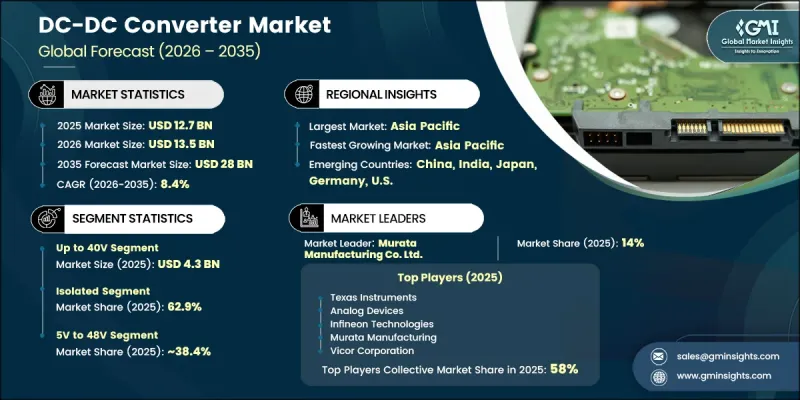
全球對高效能電源轉換和整體電子系統能源利用率提升的需求不斷成長,是推動該市場成長的主要動力。交通運輸、工業自動化和電力基礎設施電氣化進程的加速,正在推動直流-直流轉換器的應用。電動車、可再生能源系統和電池儲能解決方案的廣泛部署,顯著提升了市場需求。製造商正日益專注於緊湊高效的設計,以實現更高的功率密度和更低的能量損耗。此外,工業數位化和自動化趨勢正在加速產品在先進機械和智慧系統中的整合。資料中心、通訊基礎設施和攜帶式電子設備的持續擴張,也為市場的持續發展注入了動力,因為直流-直流轉換器在各種應用中發揮穩定電壓調節和高效配電的關鍵作用。
| 市場範圍 | |
|---|---|
| 開始年份 | 2025 |
| 預測期 | 2026-2035 |
| 起始金額 | 127億美元 |
| 預測金額 | 280億美元 |
| 複合年成長率 | 8.4% |
到2025年,40V及以下電壓等級的電源市場規模將達到43億美元,主要得益於其在低壓和中壓電子系統的廣泛應用。此電壓等級的電源應用領域十分廣泛,包括消費性電子、汽車電子、工業自動化、通訊設備、物聯網設備和智慧感測器等。它能夠為智慧型手機、筆記型電腦和網路系統等對效率和空間利用要求極高的緊湊型、電力消耗敏感型設備提供穩定的電壓調節。其優勢包括功率損耗低、轉換效率高、設計緊湊以及經濟高效的電源管理,使其成為需要可靠低功耗運行的現代電子應用的理想之選。
預計到2025年,隔離式電源轉換器市場佔有率將達到62.9%,主要得益於各關鍵產業對電氣安全、降噪和穩定電源轉換性能日益成長的需求。隔離式DC-DC轉換器可在輸入和輸出電路之間提供電氣隔離,保護敏感元件免受電壓尖峰、接地迴路問題和電磁干擾的影響。其在汽車系統、通訊網路、航太應用、可再生能源裝置和先進醫療設備等領域的應用日益廣泛。隨著電動車解決方案、工業自動化技術以及節能基礎設施的不斷發展,對能夠確保運作穩定性並符合嚴格安全要求的隔離式電源轉換系統的需求將進一步成長。
預計到2025年,北美直流-直流轉換器市場將佔據31.1%的市場佔有率,這主要得益於關鍵產業的強勁產業和技術發展。該地區在汽車電子、通訊網路、航太與國防系統、工業自動化、雲端運算基礎設施和可再生能源項目等領域的滲透率預計將顯著提高。對電動車、智慧電網現代化和先進電源管理系統的投資增加正在加速市場成長。高效能運算系統、醫療用電子設備和精密工業機械的需求不斷成長,進一步推動了區域市場的成長,因為高效可靠的電源轉換對於下一代技術仍然至關重要。
目錄
第1章:調查方法和範圍
第2章執行摘要
第3章 行業洞察
- 產業生態系分析
- 供應商情況
- 利潤率
- 成本結構
- 每個階段增加的價值
- 影響價值鏈的因素
- 中斷
- 影響產業的因素
- 成長促進因素
- 電動車產量快速成長
- 增加可再生能源產能
- 資料中心和人工智慧基礎設施的快速擴張
- 工業自動化和工業4.0的普及應用
- 氮化鎵和碳化矽功率半導體技術的進步
- 產業潛在風險與挑戰
- 溫度控管和功率損耗
- 不穩定的半導體供應鏈
- 市場機遇
- 氮化鎵和碳化矽技術的介紹
- 電動車充電基礎設施的部署
- 成長促進因素
- 成長潛力分析
- 監理情勢
- 波特的分析
- PESTLE分析
- 技術與創新展望
- 最新科技趨勢
- 新興技術
- 價格趨勢
- 歷史價格分析(2022-2025)
- 影響價格趨勢的因素
- 區域價格波動
- 價格預測(2026-2035)
- 貿易數據分析
- 進出口量及進口額趨勢
- 主要貿易路線及關稅的影響
- 人工智慧和生成式人工智慧對市場的影響
- 利用人工智慧改造現有經營模式
- 按細分市場分類的生成式人工智慧用例和部署藍圖
- 風險、限制和監管考量
- 生產能力和生產情況
- 設備產能:按地區和主要生產商分類
- 運轉率和擴張計劃
第4章 競爭情勢
- 介紹
- 企業市佔率分析
- 按地區
- 市場集中度分析
- 主要市場公司的競爭分析
- 競爭定位矩陣
- 主要進展
- 併購
- 夥伴關係和聯盟
- 新產品發布
- 業務拓展計劃及資金籌措
- 按公司規模進行基準測試
- 排名分類標準與遴選標準
- 按收入、地區和創新能力分類的層級定位矩陣
第5章 市場估計與預測:依類型分類,2022-2035年
- 絕緣型
- 非絕緣型
第6章 市場估算與預測:依輸入電壓分類,2022-2035年
- 40伏特或更低
- 40V~100V
- 100V~500V
- 500V~1,000V
第7章 市場估算與預測:依輸出電壓分類,2022-2035年
- 5伏特或更低
- 5V~48V
- 48V~100V
- 100V~500V
- 500V~1,000V
第8章 市場估計與預測:依產量分類,2022-2035年
- 10瓦或以下
- 10W~50W
- 50W~250W
- 250W~500W
- 500W~1,000W
- 1000瓦或以上
第9章 市場估計與預測:依最終用途分類,2022-2035年
- 電訊
- 車
- 消費性電子產品
- 能源與電力
- 航太/國防
- 衛生保健
- 其他
第10章 市場估價與預測:依地區分類,2022-2035年
- 北美洲
- 美國
- 加拿大
- 歐洲
- 德國
- 英國
- 法國
- 西班牙
- 義大利
- 荷蘭
- 其他歐洲國家
- 亞太地區
- 中國
- 印度
- 日本
- 澳洲
- 韓國
- 其他亞太國家
- 拉丁美洲
- 巴西
- 墨西哥
- 阿根廷
- 其他拉丁美洲國家
- 中東和非洲
- 南非
- 沙烏地阿拉伯
- UAE
- 其他中東和非洲國家
第11章:公司簡介
- 全球主要公司
- Texas Instruments Incorporated
- Analog Devices Inc
- Infineon Technologies AG
- Delta Electronics Inc
- Murata Manufacturing Co. Ltd
- NXP Semiconductors NV
- Renesas Electronics Corporation
- STMicroelectronics NV
- TDK Corporation
- ABB Ltd
- 本地公司
- Advanced Energy Industries Inc
- Bel Fuse Inc
- Flex Ltd
- TDK Lambda Corporation
- Vicor Corporation
- Cosel Co., Ltd
- Meggitt Plc
- 利基公司
- Crane Holdings Co
- RECOM Power GmbH
- Traco Electronic AG
The Global DC-DC Converter Market was valued at USD 12.7 billion in 2025 and is estimated to grow at a CAGR of 8.4% to reach USD 28 billion in 2035.
The market growth is driven by rising global demand for efficient power conversion and improved energy utilization across modern electronic systems. Expanding electrification trends across transportation, industrial automation, and power infrastructure are strengthening the adoption of DC-DC converters. Growing deployment in electric vehicles, renewable energy systems, and battery energy storage solutions is significantly boosting demand. Manufacturers are increasingly focusing on compact, high-efficiency designs that support higher power density and reduced energy losses. In addition, industrial digitalization and automation trends are further accelerating product integration across advanced machinery and smart systems. The continuous expansion of data centers, telecommunications infrastructure, and portable electronics is also contributing to sustained market momentum, as DC-DC converters play a critical role in stable voltage regulation and efficient power distribution across diverse applications.
| Market Scope | |
|---|---|
| Start Year | 2025 |
| Forecast Year | 2026-2035 |
| Start Value | $12.7 Billion |
| Forecast Value | $28 Billion |
| CAGR | 8.4% |
The up to 40V segment accounted for USD 4.3 billion in 2025, owing to widespread use in low and medium voltage electronic systems. This segment is widely adopted across consumer electronics, automotive electronics, industrial automation, telecommunications equipment, Internet of Things devices, and smart sensors. It supports stable voltage regulation in compact, energy-sensitive devices such as smartphones, laptops, and networking systems, where efficiency and space optimization are critical. Its advantages include reduced power loss, high conversion efficiency, compact design, and cost-effective power management, making it highly suitable for modern electronic applications requiring reliable low-power operation.
The isolated segment held a 62.9% share in 2025, driven by rising demand for electrical safety, noise reduction, and stable power conversion performance across critical industries. Isolated DC-DC converters provide galvanic separation between input and output circuits, protecting sensitive components from voltage spikes, ground loop issues, and electromagnetic interference. Their adoption is increasing across automotive systems, telecommunications networks, aerospace applications, renewable energy installations, and advanced medical equipment. Growing integration of electric mobility solutions, industrial automation technologies, and energy-efficient infrastructure is further reinforcing demand for isolated power conversion systems that ensure operational stability and compliance with strict safety requirements.
North America DC-DC Converter Market accounted for 31.1% share in 2025, supported by strong industrial and technological development across key sectors. The region demonstrates significant adoption across automotive electronics, telecommunications networks, aerospace and defense systems, industrial automation, cloud computing infrastructure, and renewable energy projects. Increasing investments in electric mobility, smart grid modernization, and advanced power management systems are accelerating market expansion. Rising demand for high-performance computing systems, medical electronics, and precision industrial machinery is further strengthening regional growth, as efficient and reliable power conversion remains essential for next-generation technologies.
Key players operating in the global DC-DC converter industry include Analog Devices Inc, Delta Electronics, Murata Manufacturing Co. Ltd., Texas Instruments Incorporated, Infineon Technologies AG, Vicor Corporation, Renesas Electronics Corporation, STMicroelectronics, TDK Lambda Corporation, NXP Semiconductors, RECOM Power GmbH, Cosel Co. Ltd, Traco Electronic AG, Bel Fuse Inc, Advanced Energy Industries Inc, ABB, Flex Ltd., FDK Corporation, Meggitt Plc, Crane Holdings Co, and Murata Manufacturing Co. Ltd. Companies in the DC-DC converter market are strengthening their position by focusing on high-efficiency, compact power conversion solutions designed for next-generation electronics. They are heavily investing in R&D to improve power density, thermal performance, and energy efficiency while reducing overall system losses. Strategic partnerships with automotive, telecom, and industrial OEMs are enabling deeper integration into end-use systems. Manufacturers are also expanding production capacity and optimizing global supply chains to improve delivery efficiency and cost competitiveness. In addition, firms are emphasizing customized and application-specific converter designs to meet diverse voltage and power requirements.
Table of Contents
Chapter 1 Methodology and Scope
- 1.1 Market scope and definition
- 1.2 Research design
- 1.2.1 Research approach
- 1.2.2 Data collection methods
- 1.3 Data mining sources
- 1.3.1 Global
- 1.3.2 Regional/Country
- 1.4 Base estimates and calculations
- 1.4.1 Base year calculation
- 1.4.2 Key trends for market estimation
- 1.5 Primary research and validation
- 1.5.1 Primary sources
- 1.6 Forecast model
- 1.7 Research assumptions and limitations
Chapter 2 Executive Summary
- 2.1 Industry 360° synopsis, 2022 - 2035
- 2.2 Key market trends
- 2.2.1 Type trends
- 2.2.2 Input voltage trends
- 2.2.3 Output voltage trends
- 2.2.4 Output power trends
- 2.2.5 End use trends
- 2.2.6 Regional trends
- 2.3 TAM Analysis, 2026-2035
- 2.4 CXO perspectives: Strategic imperatives
Chapter 3 Industry Insights
- 3.1 Industry ecosystem analysis
- 3.1.1 Supplier Landscape
- 3.1.2 Profit Margin
- 3.1.3 Cost structure
- 3.1.4 Value addition at each stage
- 3.1.5 Factor affecting the value chain
- 3.1.6 Disruptions
- 3.2 Industry impact forces
- 3.2.1 Growth drivers
- 3.2.1.1 Rapid growth of electric vehicle production
- 3.2.1.2 Increase of renewable energy capacity
- 3.2.1.3 Rapid growth of data center and ai infrastructure.
- 3.2.1.4 Increasing adoption of industrial automation and industry 4.0.
- 3.2.1.5 Progress of gan and sic power semiconductor technology.
- 3.2.2 Industry pitfalls and challenges
- 3.2.2.1 Thermal management and power losses
- 3.2.2.2 Unstable semiconductor supply chain
- 3.2.3 Market opportunities
- 3.2.3.1 Gan & sic technology adoption
- 3.2.3.2 Ev charging infrastructure rollout
- 3.2.1 Growth drivers
- 3.3 Growth potential analysis
- 3.4 Regulatory landscape
- 3.4.1 North America
- 3.4.2 Europe
- 3.4.3 Asia Pacific
- 3.4.4 Latin America
- 3.4.5 Middle East & Africa
- 3.5 Porter's analysis
- 3.6 PESTEL analysis
- 3.7 Technology and Innovation landscape
- 3.7.1 Current technological trends
- 3.7.2 Emerging technologies
- 3.8 Price trends (Based on paid Database)
- 3.8.1 Historical Price Analysis (2022-2025)
- 3.8.2 Price Trend Drivers
- 3.8.3 Regional Price Variations
- 3.8.4 Price Forecast (2026-2035)
- 3.9 Trade Data Analysis (Driven by Primary Research)
- 3.9.1 Import/Export Volume & Value Trends
- 3.9.2 Key Trade Corridors & Tariff Impact
- 3.10 Impact of AI & Generative AI on the Market
- 3.10.1 AI-Driven Disruption of Existing Business Models
- 3.10.2 GenAI Use Cases & Adoption Roadmap by Segment
- 3.10.3 Risks, Limitations & Regulatory Considerations
- 3.11 Capacity & Production Landscape (Driven by Primary Research)
- 3.11.1 Installed Capacity by Region & Key Producer
- 3.11.2 Capacity Utilization Rates & Expansion Pipelines
Chapter 4 Competitive Landscape, 2025
- 4.1 Introduction
- 4.2 Company market share analysis
- 4.2.1 By region
- 4.2.1.1 North America
- 4.2.1.2 Europe
- 4.2.1.3 Asia Pacific
- 4.2.1.4 Latin America
- 4.2.1.5 Middle East & Africa
- 4.2.2 Market concentration analysis
- 4.2.1 By region
- 4.3 Competitive analysis of major market players
- 4.4 Competitive positioning matrix
- 4.5 Key developments
- 4.5.1 Mergers & acquisitions
- 4.5.2 Partnerships & collaborations
- 4.5.3 New product launches
- 4.5.4 Expansion plans and funding
- 4.6 Company tier benchmarking
- 4.6.1 Tier classification criteria & qualifying thresholds
- 4.6.2 Tier positioning matrix by revenue, geography & innovation
Chapter 5 Market Estimates and Forecast, By Type, 2022 - 2035 (USD Billion & Units)
- 5.1 Key trends
- 5.2 Isolated
- 5.3 Non-Isolated
Chapter 6 Market Estimates and Forecast, By Input Voltage, 2022 - 2035 (USD Billion & Units)
- 6.1 Up to 40V
- 6.2 40V to 100V
- 6.3 100V to 500V
- 6.4 500V to 1,000V
Chapter 7 Market Estimates and Forecast, By Output Voltage, 2022 - 2035 (USD Billion & Units)
- 7.1 Up to 5V
- 7.2 5V to 48V
- 7.3 48V to 100V
- 7.4 100V to 500V
- 7.5 500V to 1,000V
Chapter 8 Market Estimates and Forecast, By Output Power, 2022 - 2035 (USD Billion & Units)
- 8.1 Up to 10W
- 8.2 10W to 50W
- 8.3 50W to 250W
- 8.4 250W to 500W
- 8.5 500W to 1,000W
- 8.6 Above 1,000W
Chapter 9 Market Estimates and Forecast, By End Use, 2022 - 2035 (USD Billion & Units)
- 9.1 Telecommunication
- 9.2 Automotive
- 9.3 Consumer electronics
- 9.4 Energy & power
- 9.5 Aerospace & defense
- 9.6 Healthcare
- 9.7 Others
Chapter 10 Market Estimates and Forecast, By Region, 2022 - 2035 (USD Million & Units)
- 10.1 Key trends
- 10.2 North America
- 10.2.1 U.S.
- 10.2.2 Canada
- 10.3 Europe
- 10.3.1 Germany
- 10.3.2 UK
- 10.3.3 France
- 10.3.4 Spain
- 10.3.5 Italy
- 10.3.6 Netherlands
- 10.3.7 Rest of Europe
- 10.4 Asia Pacific
- 10.4.1 China
- 10.4.2 India
- 10.4.3 Japan
- 10.4.4 Australia
- 10.4.5 South Korea
- 10.4.6 Rest of Asia Pacific
- 10.5 Latin America
- 10.5.1 Brazil
- 10.5.2 Mexico
- 10.5.3 Argentina
- 10.5.4 Rest of Latin America
- 10.6 Middle East and Africa
- 10.6.1 South Africa
- 10.6.2 Saudi Arabia
- 10.6.3 UAE
- 10.6.4 Rest of MEA
Chapter 11 Company Profiles
- 11.1 Global Key Players
- 11.1.1 Texas Instruments Incorporated
- 11.1.2 Analog Devices Inc
- 11.1.3 Infineon Technologies AG
- 11.1.4 Delta Electronics Inc
- 11.1.5 Murata Manufacturing Co. Ltd
- 11.1.6 NXP Semiconductors N.V
- 11.1.7 Renesas Electronics Corporation
- 11.1.8 STMicroelectronics N.V
- 11.1.9 TDK Corporation
- 11.1.10 ABB Ltd
- 11.2 Regional players
- 11.2.1 Advanced Energy Industries Inc
- 11.2.2 Bel Fuse Inc
- 11.2.3 Flex Ltd
- 11.2.4 TDK Lambda Corporation
- 11.2.5 Vicor Corporation
- 11.2.6 Cosel Co., Ltd
- 11.2.7 Meggitt Plc
- 11.3 Niche players
- 11.3.1 Crane Holdings Co
- 11.3.2 RECOM Power GmbH
- 11.3.3 Traco Electronic AG

 DC-DC轉換器市場:全球市場預測,2026-2032年航太級直流-直流轉換器市場-2026-2032年全球市場預測飛機直流-直流轉換器市場-2026-2032年全球市場預測
 獨立式直流-直流轉換器市場規模、佔有率和成長分析:按產品類型、輸入電壓、輸出功率、應用、銷售管道和地區分類-2026-2033年產業預測
 DC-DC轉換器市場 - 全球產業規模、佔有率、趨勢、機會、預測:按輸入電壓、輸出電壓、安裝方式、應用、地區和競爭格局分類,2021-2031年
 DC-DC轉換器市場規模、佔有率、趨勢和預測:按安裝方式、輸入電壓、輸出電壓、應用和地區分類,2026-2034年直流電能表市場:依安裝方式、類型、通訊方式和應用分類,全球預測(2026-2032年)
 全球直流-直流轉換器市場-策略分析與預測(2026-2031)
 DC-DC轉換器市場分析及預測(至2035年):按類型、產品類型、技術、組件、應用、形狀、材質、功能、安裝類型和最終用戶分類飛機直流-直流轉換器市場分析及預測(至2035年):按類型、產品類型、技術、組件、應用、最終用戶、功能、安裝類型和解決方案分類