


 |
市場調查報告書
商品編碼
2083305
休閒包裝器材市場:商機、成長要素、產業趨勢分析及2026-2035年預測Snack Packaging Machine Market Opportunity, Growth Drivers, Industry Trend Analysis, and Forecast 2026 - 2035 |
||||||

2025年全球零食包裝器材市場價值48億美元,預計2035年將以5%的複合年成長率成長至78億美元。
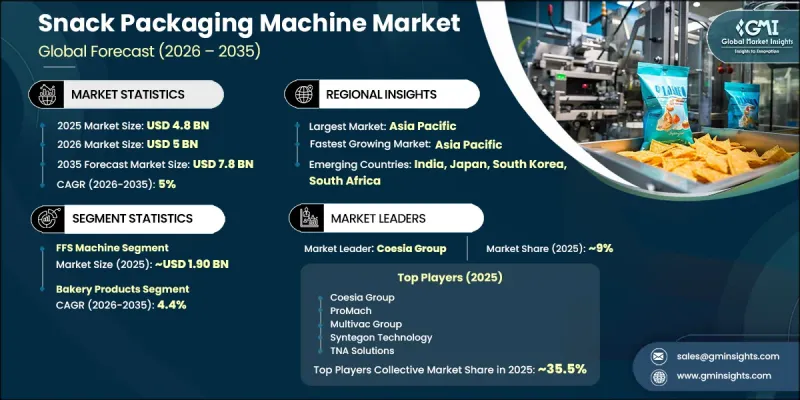
由於全球零食消費量不斷成長,零食包裝器材市場正穩定擴張。尤其是在新興經濟體,城市生活方式和飲食習慣的改變正在加速包裝零食產品的需求。同時,全部區域的包裝基礎設施日漸老化,導致大規模設備更新換代週期加快,尤其是在北美和歐洲。製造商正擴大採用支援多種包裝規格並整合數位化和人工智慧功能的先進包裝系統,以提高生產效率。關注永續包裝材料的監管趨勢也在影響投資決策,推動採用與可回收、可堆肥和生物基薄膜相容的機械設備。這些變化導致了超出正常更新周期的額外資本投資,尤其是在生產者延伸責任制(EPR)框架日益嚴格的地區。向全自動化生產線的轉變如今已體現在資本投資趨勢、設備籌資策略和產品開發平臺的各個方面。
| 市場範圍 | |
|---|---|
| 開始年份 | 2025 |
| 預測期 | 2026-2035 |
| 初始市場規模 | 48億美元 |
| 預測金額 | 78億美元 |
| 複合年成長率 | 5% |
預計到2025年,成型填充封口(FFS)機械市場規模將達到19億美元,並在2035年之前以5.4%的複合年成長率成長,這主要得益於其對軟性包裝需求的高度適應性以及對不斷發展的永續發展標準的良好適應性。現代FFS系統在設計上越來越重視保持高速高效的生產性能,同時還能相容於各種包裝材料,包括可回收和可堆肥薄膜。其多功能性和成本效益使其成為零嘴零食製造業的首選解決方案。
預計到2025年,烘焙產品市佔率將達到28.1%,並在2035年之前以4.4%的複合年成長率成長。烘焙產品零食包裝仍高度依賴枕式包裝和專為單件及散裝包裝應用而設計的自動化封口系統。該領域的投資趨勢受到從硬質包裝轉變為軟性包裝的驅動,這推動了生產線設備的升級。此外,對可回收和紙質包裝材料的需求不斷成長,也影響機器規格,尤其是在那些高度重視永續性包裝法規的地區。
預計2025年,北美休閒包裝器材市場規模將達到12.6億美元,市佔率將達26.4%。該地區市場成長的主要驅動力是食品加工產業的大規模設備升級。由於現有包裝基礎設施的很大一部分已接近使用壽命,製造商正在投資最先進的、數位化互聯的、多規格的包裝系統。這種轉變在提高營運效率的同時,也提升了新安裝設備的整體價值,從而進一步鞏固了該地區對先進包裝機械的穩定需求。
目錄
第1章:調查方法和範圍
第2章執行摘要
第3章 行業洞察
- 產業生態系分析
- 供應商情況
- 利潤率
- 每個階段增加的價值
- 影響價值鏈的因素
- 影響產業的因素
- 促進因素
- 全球零食消費量的成長和 SKU 數量的增加正在推動對高速、靈活生產線的投資。
- 為解決人手不足和加工能力緊張的問題,對自動化的需求日益成長。
- 自有品牌零食的擴張導致委託製造對機械設備的採購量增加。
- 隨著電子商務和 DTC 管道的發展,對能夠處理小批量和可變格式的機器的需求日益成長。
- 產業潛在風險與挑戰
- 高昂的資本投入和較長的投資回收期阻礙了中小企業採用該技術。
- 傳統生產線維修中的技術複雜性與整合挑戰
- 機會
- 開發與生物基和可堆肥薄膜相容的機械
- 工業4.0與智慧工廠的融合-互聯包裝生產線的機會
- 新興市場零食產業的擴張正在推動人們首次使用自動販賣機購買。
- 模組化和可重構的機器設計可實現快速的 SKU 切換。
- 促進因素
- 成長潛力分析
- 供應鏈分析
- 主要原料-不銹鋼、伺服元件、半導體晶片
- 零件採購集中化和單一來源風險
- 供應鏈中斷與前置作業時間波動
- 近岸外包與區域供應鏈重組
- 未來市場趨勢
- 技術與創新展望
- 最新科技趨勢
- 新興技術
- 監理情勢
- 食品安全與包裝器材標準(FDA、歐盟機械指令)
- 永續包裝的法規和生產者延伸責任制 (EPR)
- 工業機械能效法規
- 區域間法規差異及跨境合規
- 貿易數據分析
- 按機械類型分類的進出口量和進口額趨勢
- 主要貿易路線及關稅的影響
- 人工智慧和生成式人工智慧對市場的影響
- 人工智慧驅動的轉型—預測性維護和遠距離診斷
- 生成式人工智慧的應用案例與實施藍圖—生產線模擬、操作員培訓、品質偵測視覺系統
- 風險、限制和監管考量
- 價格分析
- 2019-2024年歷史價格趨勢分析
- 依球員類型分類的定價策略(高級球員、超值球員、成本加成球員)
- 按型號分類的價格基準-FFS包裝機、枕式包裝機和真空包裝機
- 波特的分析
- PESTLE分析
第4章 競爭情勢
- 介紹
- 企業市佔率分析
- 企業矩陣分析
- 主要市場公司的競爭分析
- 競爭定位矩陣
- 主要進展
- 併購
- 夥伴關係和聯盟
- 新產品發布
- 業務拓展計劃
第5章 市場估價與預測:依機器類型分類,2022-2035年
- 主要趨勢
- 成型填色封口 (FFS) 機
- 立式成型、填充和封口 (VFFS) 機
- 枕頭套/標準VFFS
- VFFS 用於側縫的包裝袋
- 多車道 VFFS
- 臥式成型、填充和封口 (HFFS) 機械
- 用於條狀包裝和小袋的FFS機器
- 立式成型、填充和封口 (VFFS) 機
- 枕頭式包裝機
- 標準水平式包裝機
- 高速多間距枕式包裝機
- 真空包裝機
- 托盤封口機/真空熱成型機
- 腔真空包裝機
- 裝盒機
- 水平式墨盒
- 立式墨水匣
- 其他
- 裝袋機
- 多頭稱重機
- 格紋
第6章 市場估價與預測:依包裝類型分類,2022-2035年
- 主要趨勢
- 軟包裝
- 枕頭套和枕頭袋
- 立式袋(SUP) 和 DOI 包裝
- 條狀包裝和小袋
- 流延包裝
- 多包裝和俱樂部包裝規格
- 硬包裝
- 紙箱和紙盒
- 馬口鐵罐和複合罐
- 熱成型托盤與翻蓋包裝盒
第7章 市場估計與預測:依營運區分,2022-2035年
- 主要趨勢
- 自動的
- 全自動整合生產線
- 機器人生產線末端自動化系統
- 半自動
- 操作員輔助式半自動機器
- 適用於中小企業的半自動桌上型電腦
第8章 市場估價與預測:依包裝材料分類,2022-2035年
- 主要趨勢
- 塑膠薄膜
- 雙軸延伸聚丙烯(BOPP)
- PET和金屬化PET薄膜
- 聚乙烯(PE)薄膜
- 紙張和紙板
- 牛皮紙覆膜
- 塗佈紙板
- 金屬和箔層壓
- 鋁箔層壓
- 複合材料/箔材和薄膜層壓材料
- 其他
- 生物基可堆肥薄膜(PLA、PHA)
- 多層高阻隔層壓板
第9章 市場估計與預測:依應用領域分類,2022-2035年
- 主要趨勢
- 烘焙產品
- 餅乾和曲奇
- 餅乾和麵包丁
- 威化餅
- 糖果糕餅
- 巧克力和巧克力脆片
- 糖果軟糖
- 太妃糖和硬糖
- 鹹味零食
- 薯片/薯條
- 膨化食品(玉米泡芙、圈圈)
- 爆米花
- 墨西哥玉米片和Pretzels脆餅
- 堅果和乾果
- 杏仁、腰果、綜合堅果
- 乾果和葡萄乾
- 肉類零食
- 肉乾和肉乾條
- 肉條和香腸零食
- 其他
- 蛋白質零食和能量棒
- 海藻和植物性零食
第10章 市場估價與預測:依地區分類,2022-2035年
- 主要趨勢
- 北美洲
- 美國
- 加拿大
- 歐洲
- 德國
- 法國
- 英國
- 義大利
- 西班牙
- 亞太地區
- 中國
- 日本
- 印度
- 澳洲
- 韓國
- 拉丁美洲
- 巴西
- 墨西哥
- 阿根廷
- 中東和非洲
- 沙烏地阿拉伯
- UAE
- 南非
第11章:公司簡介
- Coesia Group
- ProMach
- Multivac Group
- Syntegon Technology
- TNA Solutions
- Ishida Co. Ltd.
- GEA Group(Food segment)
- IMA Group(Food division)
- BW Packaging
- Heat and Control
- Rovema
- PFM
- ULMA
- Theegarten
- SN Maschinenbau
- Nichrome
- Soontrue
- Atlas
- Fuji Machinery
The Global Snack Packaging Machine Market was valued at USD 4.8 billion in 2025 and is estimated to grow at a CAGR of 5% to reach USD 7.8 billion by 2035.
The snack packaging machine market is expanding steadily due to rising global snack consumption, particularly in emerging economies where urban lifestyles and changing dietary habits are accelerating demand for packaged snack products. At the same time, aging packaging infrastructure across developed regions is driving significant equipment replacement cycles, especially in North America and Europe. Manufacturers are increasingly adopting advanced packaging systems capable of handling multiple formats and integrating digital and AI-enabled functionalities to improve production efficiency. Regulatory developments focused on sustainable packaging materials are also influencing investment decisions, encouraging the adoption of machinery compatible with recyclable, compostable, and biobased films. These changes are resulting in additional capital expenditure beyond routine replacement cycles, particularly in regions where extended producer responsibility frameworks are becoming more stringent. The shift toward fully automated production lines is now evident across capital investment trends, equipment procurement strategies, and product development pipelines.
| Market Scope | |
|---|---|
| Start Year | 2025 |
| Forecast Year | 2026-2035 |
| Start Value | $4.8 Billion |
| Forecast Value | $7.8 Billion |
| CAGR | 5% |
The form-fill-seal (FFS) machine segment accounted for USD 1.90 billion in 2025 and is projected to grow at a CAGR of 5.4% through 2035, owing to its strong alignment with flexible packaging requirements and its adaptability to evolving sustainability standards. Modern FFS systems are increasingly designed to operate with a wide range of packaging materials, including recyclable and compostable films, while maintaining high-speed and efficient production performance. Their versatility and cost efficiency continue to make them a preferred solution across snack manufacturing operations.
The bakery products segment held 28.1% share in 2025 and is expected to grow at a CAGR of 4.4% during 2035. Bakery-based snack packaging continues to rely heavily on flow wrapping and automated sealing systems designed for individual and bulk packaging applications. Investment trends in this segment are being influenced by the ongoing transition from rigid packaging formats to flexible alternatives, which is driving equipment upgrades across production lines. In addition, increasing demand for recyclable and paper-compatible packaging materials is shaping machinery specifications, particularly in regions focused on sustainability-driven packaging compliance.
North America Snack Packaging Machine Market accounted for USD 1.26 billion, representing 26.4% share in 2025. Market growth in the region is primarily driven by large-scale equipment replacement cycles across the food processing industry. A significant portion of existing packaging infrastructure is reaching end-of-life, prompting manufacturers to invest in modern, digitally connected, and multi-format packaging systems. This shift is improving operational efficiency while also increasing overall equipment value across new installations, reinforcing steady demand for advanced snack packaging machinery in the region.
Major companies operating in the global snack packaging machine market include Syntegon Technology, Coesia Group, ProMach, Multivac Group, TNA Solutions, Ishida Co. Ltd., GEA Group, IMA Group, BW Packaging, Heat and Control, Rovema, PFM, ULMA, Fuji Machinery, Theegarten, SN Maschinenbau, Nichrome, Soontrue, Atlas, and Fuji. Companies operating in the snack packaging machine market are strengthening their market position by investing in advanced automation technologies, AI-enabled systems, and digitally integrated packaging solutions that improve operational efficiency and production flexibility. Many manufacturers are expanding research and development activities to design equipment compatible with sustainable packaging materials such as recyclable and compostable films. Strategic partnerships with snack producers are helping companies align machinery development with evolving packaging requirements and regulatory standards. Businesses are also focusing on modular machine architectures, predictive maintenance capabilities, and smart monitoring systems to enhance equipment performance and reduce downtime.
Table of Contents
Chapter 1 Methodology & Scope
- 1.1 Market scope and definition
- 1.2 Research design
- 1.2.1 Research approach
- 1.2.2 Data collection methods
- 1.3 Data mining sources
- 1.3.1 Global
- 1.3.2 Regional/Country
- 1.4 Base estimates and calculations
- 1.4.1 Base year calculation
- 1.4.2 Key trends for market estimation
- 1.5 Primary research and validation
- 1.5.1 Primary sources
- 1.6 Forecast model
- 1.7 Research assumptions and limitations
Chapter 2 Executive Summary
- 2.1 Industry 360° synopsis
- 2.2 Key market trends
- 2.2.1 Region
- 2.2.2 Machine Type
- 2.2.3 Packaging Type
- 2.2.4 Operation
- 2.2.5 Packaging Material
- 2.2.6 Application
Chapter 3 Industry Insights
- 3.1 Industry ecosystem analysis
- 3.1.1 Supplier landscape
- 3.1.2 Profit margin
- 3.1.3 Value addition at each stage
- 3.1.4 Factor affecting the value chain
- 3.2 Industry impact forces
- 3.2.1 Growth drivers
- 3.2.1.1 Rising Global Snack Consumption & SKU Proliferation Driving High-Speed Flexible Line Investment
- 3.2.1.2 Growing Demand for Automation to Address Labor Shortages & Throughput Pressure
- 3.2.1.3 Expansion of Private-Label Snack Brands Increasing Co-Packer Machine Procurement
- 3.2.1.4 E-Commerce & DTC Channel Growth Requiring Smaller-Batch & Variable-Format Machines
- 3.2.2 Industry pitfalls & challenges
- 3.2.2.1 High Capital Expenditure & Long Payback Periods Limiting SME Adoption
- 3.2.2.2 Technical Complexity & Integration Challenges in Retrofitting Legacy Production Lines
- 3.2.3 Opportunities
- 3.2.3.1 Bio-Based & Compostable Film-Compatible Machine Development
- 3.2.3.2 Industry 4.0 & Smart Factory Integration - Connected Packaging Line Opportunity
- 3.2.3.3 Emerging Market Snack Industry Expansion Driving First-Time Machine Purchases
- 3.2.3.4 Modular & Reconfigurable Machine Design for Rapid SKU Changeover
- 3.2.1 Growth drivers
- 3.3 Growth potential analysis
- 3.4 Supply Chain Analysis
- 3.4.1 Key Raw Materials - Stainless Steel, Servo Components, Semiconductor Chips
- 3.4.2 Component Sourcing Concentration & Single-Source Risks
- 3.4.3 Supply Chain Disruptions & Lead Time Volatility
- 3.4.4 Near-Shoring & Regional Supply Chain Restructuring
- 3.5 Future market trends
- 3.6 Technology and innovation landscape
- 3.6.1 Current technological trends
- 3.6.2 Emerging technologies
- 3.7 Regulatory landscape
- 3.7.1 Food Safety & Packaging Machinery Standards (FDA, EU Machinery Directive)
- 3.7.2 Sustainable Packaging Mandates & Extended Producer Responsibility (EPR)
- 3.7.3 Energy Efficiency Regulations for Industrial Machinery
- 3.7.4 Regional Regulatory Fragmentation & Cross-Border Compliance
- 3.8 Trade data analysis (HS Code - 8422)
- 3.8.1 Import/Export Volume & Value Trends by Machine Type (Driven by Primary Research)
- 3.8.2 Key Trade Corridors & Tariff Impact (Driven by Primary Research)
- 3.9 Impact of AI & generative AI on the market
- 3.9.1 AI-Driven Disruption - Predictive Maintenance & Remote Diagnostics
- 3.9.2 GenAI Use Cases & Adoption Roadmap - Line Simulation, Operator Training, Quality Vision Systems
- 3.9.3 Risks, Limitations & Regulatory Considerations
- 3.10 Pricing Analysis
- 3.10.1 Historical Price Trend Analysis (2019-2024) (Driven by Primary Research)
- 3.10.2 Pricing Strategy by Player Type (Premium / Value / Cost-plus) (Driven by Primary Research)
- 3.10.3 Price Benchmarking by Machine Type - FFS vs. Flow Wrappers vs. Vacuum (Driven by Primary Research)
- 3.11 Porter’s analysis
- 3.12 PESTEL analysis
Chapter 4 Competitive Landscape, 2025
- 4.1 Introduction
- 4.2 Company market share analysis
- 4.3 Company matrix analysis
- 4.4 Competitive analysis of major market players
- 4.5 Competitive positioning matrix
- 4.6 Key developments
- 4.6.1 Mergers & acquisitions
- 4.6.2 Partnerships & collaborations
- 4.6.3 New product launches
- 4.6.4 Expansion plans
Chapter 5 Market Estimates & Forecast, By Machine Type, 2022 - 2035, (USD Billion) (Million Units)
- 5.1 Key Trends
- 5.2 Form-Fill-Seal (FFS) Machines
- 5.2.1 Vertical Form-Fill-Seal (VFFS) Machines
- 5.2.1.1 Pillow Bag/Standard VFFS
- 5.2.1.2 Gusseted Pouch VFFS
- 5.2.1.3 Multi-Lane VFFS
- 5.2.2 Horizontal Form-Fill-Seal (HFFS) Machines
- 5.2.3 Stick Pack & Sachet FFS Machines
- 5.2.1 Vertical Form-Fill-Seal (VFFS) Machines
- 5.3 Flow Wrapping Machines
- 5.3.1 Standard Horizontal Flow Wrappers
- 5.3.2 High-Speed Multi-Pitch Flow Wrappers
- 5.4 Vacuum Packaging Machines
- 5.4.1 Tray Sealer / Vacuum Thermoforming Machines
- 5.4.2 Chamber Vacuum Machines
- 5.5 Cartoning Machines
- 5.5.1 Horizontal Cartoners
- 5.5.2 Vertical Cartoners
- 5.6 Others
- 5.6.1 Bagging Machines
- 5.6.2 Multihead Weighers
- 5.6.3 Checkweighers
Chapter 6 Market Estimates & Forecast, By Packaging Type, 2022 - 2035, (USD Billion) (Million Units)
- 6.1 Key Trends
- 6.2 Flexible Packaging
- 6.2.1 Pillow Bags & Pouches
- 6.2.2 Stand-Up Pouches (SUP) & Doy-Packs
- 6.2.3 Stick Packs & Sachets
- 6.2.4 Flow-Wrapped Packs
- 6.2.5 Multi-Pack & Club-Pack Formats
- 6.3 Rigid Packaging
- 6.3.1 Paperboard Cartons & Boxes
- 6.3.2 Tins & Composite Cans
- 6.3.3 Thermoformed Trays & Clamshells
Chapter 7 Market Estimates & Forecast, By Operation, 2022 - 2035, (USD Billion) (Million Units)
- 7.1 Key Trends
- 7.2 Automatic
- 7.2.1 Fully Automatic Integrated Lines
- 7.2.2 Robotic End-of-Line Automated Systems
- 7.3 Semi-Automatic
- 7.3.1 Operator-Assisted Semi-Automatic Machines
- 7.3.2 Semi-Automatic Tabletop Machines for SMEs
Chapter 8 Market Estimates & Forecast, By Packaging Material, 2022 - 2035, (USD Billion) (Million Units)
- 8.1 Key Trends
- 8.2 Plastic Films
- 8.2.1 BOPP (Biaxially Oriented Polypropylene)
- 8.2.2 PET & Metalized PET Films
- 8.2.3 PE (Polyethylene) Films
- 8.3 Paper & Paperboard
- 8.3.1 Kraft Paper Laminates
- 8.3.2 Coated Paperboard
- 8.4 Metal & Foil Laminates
- 8.4.1 Aluminum Foil Laminates
- 8.4.2 Composite / Foil-Film Laminates
- 8.5 Others
- 8.5.1 Bio-Based & Compostable Films (PLA, PHA)
- 8.5.2 Multi-Layer High-Barrier Laminates
Chapter 9 Market Estimates & Forecast, By Application, 2022 - 2035, (USD Billion) (Million Units)
- 9.1 Key Trends
- 9.2 Bakery Products
- 9.2.1 Cookies & Biscuits
- 9.2.2 Crackers & Croutons
- 9.2.3 Wafers & Bars
- 9.3 Confectionery
- 9.3.1 Chocolate & Chocolate-Coated Snacks
- 9.3.2 Candy & Gummies
- 9.3.3 Toffees & Hard Candy
- 9.4 Savory Snacks
- 9.4.1 Potato Chips & Crisps
- 9.4.2 Extruded Snacks (Corn Puffs, Rings)
- 9.4.3 Popcorn
- 9.4.4 Tortilla Chips & Pretzels
- 9.5 Nuts & Dried Fruits
- 9.5.1 Almonds, Cashews & Mixed Nuts
- 9.5.2 Dried Fruits & Raisins
- 9.6 Meat Snacks
- 9.6.1 Jerky & Dried Meat Strips
- 9.6.2 Meat Sticks & Sausage Snacks
- 9.7 Others
- 9.7.1 Protein Snacks & Energy Bars
- 9.7.2 Seaweed & Vegetable-Based Snacks
Chapter 10 Market Estimates & Forecast, By Region, 2022 - 2035, (USD Billion) (Million Units)
- 10.1 Key Trends
- 10.2 North America
- 10.2.1 U.S.
- 10.2.2 Canada
- 10.3 Europe
- 10.3.1 Germany
- 10.3.2 France
- 10.3.3 UK
- 10.3.4 Italy
- 10.3.5 Spain
- 10.4 Asia Pacific
- 10.4.1 China
- 10.4.2 Japan
- 10.4.3 India
- 10.4.4 Australia
- 10.4.5 South Korea
- 10.5 Latin America
- 10.5.1 Brazil
- 10.5.2 Mexico
- 10.5.3 Argentina
- 10.6 MEA
- 10.6.1 Saudi Arabia
- 10.6.2 UAE
- 10.6.3 South Africa
Chapter 11 Company Profiles
- 11.1 Coesia Group
- 11.2 ProMach
- 11.3 Multivac Group
- 11.4 Syntegon Technology
- 11.5 TNA Solutions
- 11.6 Ishida Co. Ltd.
- 11.7 GEA Group (Food segment)
- 11.8 IMA Group (Food division)
- 11.9 BW Packaging
- 11.10 Heat and Control
- 11.11 Rovema
- 11.12 PFM
- 11.13 ULMA
- 11.14 Theegarten
- 11.15 SN Maschinenbau
- 11.16 Nichrome
- 11.17 Soontrue
- 11.18 Atlas
- 11.19 Fuji Machinery

