


 |
市場調查報告書
商品編碼
2083258
高價值魚類水耕(RAS)的市場機會、成長促進因素、產業趨勢分析及 2026-2035 年預測。Aquaponics and RAS for High-Value Fish Market Opportunity, Growth Drivers, Industry Trend Analysis, and Forecast 2026 - 2035 |
||||||

預計到 2025 年,全球高價值魚類水耕和循環水產養殖系統 (RAS) 市場價值將達到 23 億美元,並以 12.5% 的複合年成長率成長,到 2035 年將達到 73 億美元。
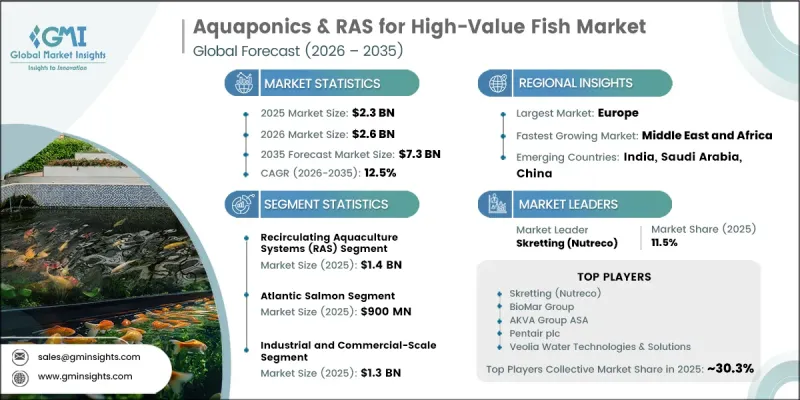
隨著能夠提升生物安全性、產品可追溯性和全年養殖的受控生產方式日益普及,全球漁業中高價值魚類的水耕和循環水產養殖系統(RAS)市場正在不斷擴大。消費者對優質水產品的需求不斷成長,對無抗生素蛋白質來源的偏好日益提高,以及對食品生產透明度的期望不斷提高,都推動了對先進水產養殖技術的投資增加。這些系統使生產者能夠在不受季節或地理限制的情況下,養殖高價值魚類並保持穩定的品質和生產效率。隨著需求持續超過傳統生產方式的產能,養殖水產品的普及也促進了該市場的成長。優質魚類消費量的成長以及對永續和擴充性水產養殖解決方案日益成長的需求,為全球商業水產養殖企業創造了有利的成長機會。隨著陸基水產養殖投資的持續增加,預計高價值魚類的水耕和循環水產養殖系統(RAS)市場將在預測期內持續擴張。
| 市場範圍 | |
|---|---|
| 開始年份 | 2025 |
| 預測期 | 2026-2035 |
| 起始金額 | 23億美元 |
| 預測金額 | 73億美元 |
| 複合年成長率 | 12.5% |
循環水產養殖系統(RAS)佔64%的市場佔有率,預計到2025年銷售額將達到14億美元。該系統之所以仍是主要的生產系統,是因為它能夠實現集約化和生物安全的養殖,並允許在穩定的營運記錄下進行優質魚類的商業化生產。其強大的市場地位源於其能夠維持可控的水質、提高生產效率、減少環境影響,並支持大規模水產養殖作業,從而滿足全球對高價值魚貝類日益成長的需求。
年產量超過1億噸的工業和商業規模業務部門佔58%的市場佔有率,預計到2025年市場規模將達到13億美元。該板塊之所以佔據市場主導地位,是因為大規模生產設施可以透過將基礎設施投資分散到更大的產量上,從而提高營運經濟效益。隨著產能的擴大,先進的過濾系統、水處理技術、溫度控管設備和整合監控平台的成本效益也不斷提高。產業營運數據顯示,年產量超過1000噸的設施與年產量2億噸的同類設施相比,每公斤生產成本可降低約30-40%,為持續投資大規模營運提供了有力支撐。
北美高價值魚類水耕和循環水產養殖系統(RAS)市佔率為26.1%,預計到2025年市場規模將達6億美元。市場成長的促進因素包括:對本地優質水產品的強勁需求、對工業規模陸基水產養殖設施投資的不斷增加,以及持續鼓勵先進魚類生產技術的法規環境。此外,人們對永續水產品生產的日益關注以及對供應鏈韌性的日益重視,進一步鞏固了北美在全球市場中的地位。
目錄
第1章:調查方法和範圍
第2章執行摘要
第3章 行業洞察
- 產業生態系分析
- 供應商情況
- 利潤率
- 每個階段增加的價值
- 影響價值鏈的因素
- 中斷
- 影響產業的因素
- 成長促進因素
- 產業潛在風險與挑戰
- 市場機遇
- 成長潛力分析
- 監理情勢
- 波特的分析
- PESTLE分析
- 價格趨勢
- 按地區
- 按種子類型
- 未來市場趨勢
- 技術與創新展望
- 最新科技趨勢
- 新興技術
- 專利趨勢
- 貿易統計
- 主要進口國
- 主要出口國
- 永續性和環境方面
- 永續計劃
- 減少廢棄物策略
- 生產中的能源效率
- 具有環保意識的舉措
- 考慮碳足跡
第4章 競爭情勢
- 介紹
- 企業市佔率分析
- 按地區
- 北美洲
- 歐洲
- 亞太地區
- 拉丁美洲
- 中東和非洲
- 按地區
- 主要市場公司的競爭分析
- 競爭定位矩陣
- 主要進展
- 併購
- 夥伴關係和聯盟
- 新產品發布
- 業務拓展計劃
第5章 市場估計與預測:依系統類型分類,2022-2035年
- 循環水產養殖系統(RAS)
- 淡水循環水系統
- 海水/海洋循環水系統
- 微鹹水循環水養殖系統
- 水耕系統
- 魚菜共生系統
- 分離式魚菜共生系統
- 平行單元過程水耕法
- 混合RAS-BFT系統
- 整合式光伏再生系統(PV-RAS)
- 其他/新興系統類型
第6章 市場估算與預測:依魚類品種分類,2022-2035年
- 大西洋鮭魚
- 幼鮭生產後(在循環水養殖系統中轉移到海洋之前)
- 透過陸基水產養殖實現全週期養殖
- 虹鱒
- 高價值海洋魚類
- 歐洲鱸魚
- 大菱鮃
- 黃尾鰤
- 鰻魚(Anguilla spp.)
- 鱘魚和魚子醬
- 白鯨/鱘魚
- 西伯利亞鱘魚/貝氏鱘魚
- 其他鱘魚種類
- 其他魚類(梭鱸、北極紅點鮭等)
第7章 市場估計與預測:依生產階段分類,2022-2035年
- 商業化種植
- 田徑運動全週期發展
- 陸海混合生產
- 幼魚和幼魚的養殖(水產養殖場)
- 淡水養殖系統
- 海水/壓榨麥芽栽培系統
- 孵化場和親魚管理
- 卵孵化與早期幼蟲培育
- 親魚的調整與產卵
- 研究與開發設施
第8章 市場估算與預測:依系統規模分類,2022-2035年
- 工業和商業規模(年產量超過100噸)
- 大型工業循環水產養殖系統(年產1000噸以上)
- 中型工業循環水產養殖系統(年產量100-1000噸)
- 中型企業(年產量10-100噸)
- 都市區和郊區的小規模農場
- 小規模/特殊用途(年產量低於10噸)
- 飯店、餐廳和公共設施的系統
- 地方社區糧食安全系統
第9章 市場估計與預測:依地區分類,2022-2035年
- 北美洲
- 美國
- 加拿大
- 歐洲
- 德國
- 英國
- 法國
- 西班牙
- 義大利
- 其他歐洲國家
- 亞太地區
- 中國
- 印度
- 日本
- 澳洲
- 韓國
- 其他亞太國家
- 拉丁美洲
- 巴西
- 墨西哥
- 阿根廷
- 其他拉丁美洲國家
- 中東和非洲
- 沙烏地阿拉伯
- 南非
- UAE
- 其他中東和非洲國家
第10章:公司簡介
- Bayer Crop Science AG
- Corteva Agriscience
- Syngenta Group
- BASF SE
- Limagrain
- KWS SAAT SE & Co. KGaA
- Yuan Longping High-Tech Agriculture Co. Ltd
- DLF Seeds A/S
- Rijk Zwaan
- Sakata Seed Corporation
- AgReliant Genetics LLC
- Advanta Seeds
- East-West Seed
- Bejo Zaden BV
- Enza Zaden
The Global Aquaponics and Recirculating Aquaculture Systems (RAS) For High-Value Fish Market was valued at USD 2.3 billion in 2025 and is estimated to grow at a CAGR of 12.5% to reach USD 7.3 billion by 2035.
The aquaponics and recirculating aquaculture systems (RAS) for high-value fish market is expanding as the global seafood industry increasingly adopts controlled-environment production methods that offer enhanced biosecurity, product traceability, and year-round cultivation. Growing consumer demand for premium seafood, rising preference for antibiotic-free protein sources, and increasing expectations for transparent food production are encouraging greater investment in advanced aquaculture technologies. These systems enable producers to cultivate high-value fish species regardless of seasonal limitations or geographic constraints while maintaining consistent quality and production efficiency. The market is also benefiting from the ongoing transition toward farmed seafood as demand continues to outpace the capacity of conventional production methods. Increasing consumption of premium fish varieties and the need for sustainable, scalable aquaculture solutions are creating favorable growth opportunities across commercial operations worldwide. As investments in land-based fish production continue to rise, the aquaponics and recirculating aquaculture systems (RAS) for high-value fish market is expected to experience sustained expansion throughout the forecast period.
| Market Scope | |
|---|---|
| Start Year | 2025 |
| Forecast Year | 2026-2035 |
| Start Value | $2.3 Billion |
| Forecast Value | $7.3 Billion |
| CAGR | 12.5% |
The recirculating aquaculture systems (RAS) segment accounted for 64% share, generating USD 1.4 billion in 2025. This segment remains the leading production system because it supports intensive, biosecure cultivation while enabling commercial-scale production of premium fish species with consistent operational performance. Its strong market position is driven by the ability to maintain controlled water quality, improve production efficiency, reduce environmental impact, and support large-scale fish farming operations capable of meeting increasing global demand for high-value seafood.
The industrial and commercial-scale operations exceeding 100 MT per year segment represented 58% share, generating USD 1.3 billion in 2025. This segment dominates the market because large-scale production facilities benefit from improved operational economics by spreading infrastructure investments across greater production volumes. Advanced filtration systems, water treatment technologies, thermal management equipment, and integrated monitoring platforms become increasingly cost-efficient as production capacity expands. Industry operating data indicates that facilities producing more than 1,000 MT per year can achieve production costs approximately 30-40% lower on a per-kilogram basis than comparable facilities operating at 200 MT per year, supporting continued investment in large-scale operations.
North America Aquaponics and Recirculating Aquaculture Systems (RAS) For High-Value Fish Market accounted for 26.1% share, generating USD 600 million in 2025. Market growth is supported by strong demand for locally produced premium seafood, increasing investment in industrial-scale land-based aquaculture facilities, and a regulatory environment that continues to encourage advanced fish production technologies. Rising interest in sustainable seafood production and greater emphasis on supply chain resilience continue to strengthen North America's position within the global market.
Major companies operating in the global aquaponics and recirculating aquaculture systems (RAS) for high-value fish market include Nordic Aquafarms, Cermaq Group AS, AquaMaof Technologies Ltd., Aller Aqua Group, Atlantic Sapphire AS, Billund Aquaculture Service A/S, Kingfish Zeeland B.V., Mowi ASA, Salmon Evolution ASA, Cargill Aqua Nutrition (EWOS), and Grieg Seafood ASA. Companies operating in the aquaponics and recirculating aquaculture systems (RAS) for high-value fish market are strengthening their competitive position by investing in advanced water treatment technologies, automated monitoring systems, and energy-efficient production facilities that improve operational performance and fish health. Many organizations are expanding commercial-scale production capacity while adopting digital management platforms to optimize water quality, feeding efficiency, and overall productivity. Strategic investments in research and development are supporting innovations in sustainable aquaculture, biosecurity, and resource optimization. Companies are also forming partnerships across the aquaculture value chain to strengthen distribution, improve production capabilities, and expand market access.
Table of Contents
Chapter 1 Methodology & Scope
- 1.1 Market scope and definition
- 1.2 Research design
- 1.2.1 Research approach
- 1.2.2 Data collection methods
- 1.3 Data mining sources
- 1.3.1 Global
- 1.3.2 Regional/Country
- 1.4 Base estimates and calculations
- 1.4.1 Base year calculation
- 1.4.2 Key trends for market estimation
- 1.5 Primary research and validation
- 1.5.1 Primary sources
- 1.6 Forecast model
- 1.7 Research assumptions and limitations
Chapter 2 Executive Summary
- 2.1 Industry 360° synopsis
- 2.2 Key market trends
- 2.2.1 System type
- 2.2.2 Fish species
- 2.2.3 Production Stage
- 2.2.4 System scale
- 2.2.5 Regional
- 2.3 TAM Analysis, 2026-2035
- 2.4 CXO perspectives: Strategic imperatives
Chapter 3 Industry Insights
- 3.1 Industry ecosystem analysis
- 3.1.1 Supplier landscape
- 3.1.2 Profit margin
- 3.1.3 Value addition at each stage
- 3.1.4 Factor affecting the value chain
- 3.1.5 Disruptions
- 3.2 Industry impact forces
- 3.2.1 Growth drivers
- 3.2.2 Industry pitfalls and challenges
- 3.2.3 Market opportunities
- 3.3 Growth potential analysis
- 3.4 Regulatory landscape
- 3.4.1 North America
- 3.4.2 Europe
- 3.4.3 Asia Pacific
- 3.4.4 Latin America
- 3.4.5 Middle East & Africa
- 3.5 Porter's analysis
- 3.6 PESTEL analysis
- 3.7 Price trends
- 3.7.1 By region
- 3.7.2 By seed type
- 3.8 Future market trends
- 3.9 Technology and Innovation landscape
- 3.9.1 Current technological trends
- 3.9.2 Emerging technologies
- 3.10 Patent Landscape
- 3.11 Trade statistics (HS code)
- 3.11.1 Major importing countries
- 3.11.2 Major exporting countries
- 3.12 Sustainability and environmental aspects
- 3.12.1 Sustainable practices
- 3.12.2 Waste reduction strategies
- 3.12.3 Energy efficiency in production
- 3.12.4 Eco-friendly initiatives
- 3.13 Carbon footprint consideration
Chapter 4 Competitive Landscape, 2025
- 4.1 Introduction
- 4.2 Company market share analysis
- 4.2.1 By region
- 4.2.1.1 North America
- 4.2.1.2 Europe
- 4.2.1.3 Asia Pacific
- 4.2.1.4 LATAM
- 4.2.1.5 MEA
- 4.2.1 By region
- 4.3 Competitive analysis of major market players
- 4.4 Competitive positioning matrix
- 4.5 Key developments
- 4.5.1 Mergers & acquisitions
- 4.5.2 Partnerships & collaborations
- 4.5.3 New Product Launches
- 4.5.4 Expansion Plans
Chapter 5 Market Estimates and Forecast, By System Type, 2022-2035 (USD Billion)
- 5.1 Key trends
- 5.2 Recirculating aquaculture systems (RAS)
- 5.2.1 Freshwater RAS
- 5.2.2 Saltwater/marine RAS
- 5.2.3 Brackish water RAS
- 5.3 Aquaponic systems
- 5.3.1 Coupled aquaponic systems
- 5.3.2 Decoupled aquaponic systems
- 5.3.3 Parallel unit process aquaponics
- 5.4 Hybrid RAS-BFT systems
- 5.5 Photovoltaic-integrated RAS (PV-RAS)
- 5.6 Others/emerging system types
Chapter 6 Market Estimates and Forecast, By Fish Species, 2022-2035 (USD Million)
- 6.1 Key trends
- 6.2 Atlantic salmon
- 6.2.1 Post-smolt production (RAS pre-sea transfer)
- 6.2.2 Full cycle land-based grow-out
- 6.3 Rainbow trout
- 6.3.1 Marine high-value species
- 6.3.2 European sea bass
- 6.3.3 Turbot
- 6.3.4 Yellowtail kingfish
- 6.3.5 Eel (Anguilla spp.)
- 6.4 Sturgeon & caviar
- 6.4.1 Beluga/Huso sturgeon
- 6.4.2 Siberian/Baerii sturgeon
- 6.4.3 Other sturgeon species
- 6.5 Others (Pike-perch, Arctic char, etc.)
Chapter 7 Market Estimates and Forecast, By Production Stage, 2022-2035 (USD Million)
- 7.1 Key trends
- 7.2 Commercial grow-out
- 7.2.1 Full cycle land-based grow-out
- 7.2.2 Hybrid land-sea production
- 7.3 Fingerling & juvenile grow-out (nursery)
- 7.3.1 Freshwater nursery systems
- 7.3.2 Saltwater/pre-smolt nursery systems
- 7.4 Hatchery & broodstock management
- 7.4.1 Egg incubation & early larval rearing
- 7.4.2 Broodstock conditioning & spawning
- 7.5 Research & development facilities
Chapter 8 Market Estimates and Forecast, By System Scale, 2022-2035 (USD Million)
- 8.1 Key trends
- 8.2 Industrial/commercial scale (>100 MT/yr)
- 8.2.1 Large industrial RAS (>1,000 MT/yr)
- 8.2.2 Mid-industrial RAS (100-1,000 MT/yr)
- 8.3 Mid-scale operations (10-100 MT/yr)
- 8.3.1 Urban & peri-urban micro-farms
- 8.4 Small-scale & specialty (<10 MT/yr)
- 8.4.1 Hotel, restaurant & institutional systems
- 8.4.2 Community food security systems
Chapter 9 Market Estimates and Forecast, By Region, 2022-2035 (USD Million)
- 9.1 Key trends
- 9.2 North America
- 9.2.1 U.S.
- 9.2.2 Canada
- 9.3 Europe
- 9.3.1 Germany
- 9.3.2 UK
- 9.3.3 France
- 9.3.4 Spain
- 9.3.5 Italy
- 9.3.6 Rest of Europe
- 9.4 Asia Pacific
- 9.4.1 China
- 9.4.2 India
- 9.4.3 Japan
- 9.4.4 Australia
- 9.4.5 South Korea
- 9.4.6 Rest of Asia Pacific
- 9.5 Latin America
- 9.5.1 Brazil
- 9.5.2 Mexico
- 9.5.3 Argentina
- 9.5.4 Rest of Latin America
- 9.6 Middle East and Africa
- 9.6.1 Saudi Arabia
- 9.6.2 South Africa
- 9.6.3 UAE
- 9.6.4 Rest of Middle East and Africa
Chapter 10 Company Profiles
- 10.1 Bayer Crop Science AG
- 10.2 Corteva Agriscience
- 10.3 Syngenta Group
- 10.4 BASF SE
- 10.5 Limagrain
- 10.6 KWS SAAT SE & Co. KGaA
- 10.7 Yuan Longping High-Tech Agriculture Co. Ltd
- 10.8 DLF Seeds A/S
- 10.9 Rijk Zwaan
- 10.10 Sakata Seed Corporation
- 10.11 AgReliant Genetics LLC
- 10.12 Advanta Seeds
- 10.13 East-West Seed
- 10.14 Bejo Zaden B.V.
- 10.15 Enza Zaden

 材料測量感測器市場規模、佔有率和成長分析:按感測器類型、測量參數、應用、終端用戶產業、測量模式和地區分類-2026-2033年產業預測
 2034年航太複合材料市場預測-全球分析(材料類型、纖維類型、基體類型、樹脂類型、製造流程、產品形式、航太平台、應用、最終用戶和地區分類)全球建築材料市場預測(至2034年):依材料類型、結構建築、規模、設計方法、功能特性、製造技術、應用、最終用戶和地區分類奈米結構金屬材料市場:預測(至2034年)-按材料類型、材料結構、製造流程、產品形狀、性能增強、應用、終端用戶產業和地區分類的全球分析低碳環保建築材料市場:2034 年預測-按材料類型、功能、應用、最終用戶和地區分類的全球分析功能性粉末材料市場預測至2034年-按材料類型、性能、形態、應用、產業和地區分類的全球分析
 2026年全球海泡石材料市場報告
 先進材料市場:2026-2032年全球市場預測(依材料種類、加工技術、形態、通路及應用分類)
 半導體超鏡市場:按組件、鍍膜類型、鏡面類型、應用、國家和地區分類-全球產業分析、市場規模、市場佔有率及2026年至2033年預測
 2026 年至 2035 年菌絲體衍生材料市場的商業機會、成長要素、產業趨勢分析與預測。