

 |
市場調查報告書
商品編碼
2083256
2026 年至 2035 年防汗服飾的市場機會、成長要素、產業趨勢與預測。Sweat-Resistant Apparel Market Opportunity, Growth Drivers, Industry Trend Analysis, and Forecast 2026 - 2035 |
||||||

全球防汗服飾市場預計到 2025 年將達到 650 億美元,年複合成長率為 7.4%,到 2035 年將達到 1,338 億美元。
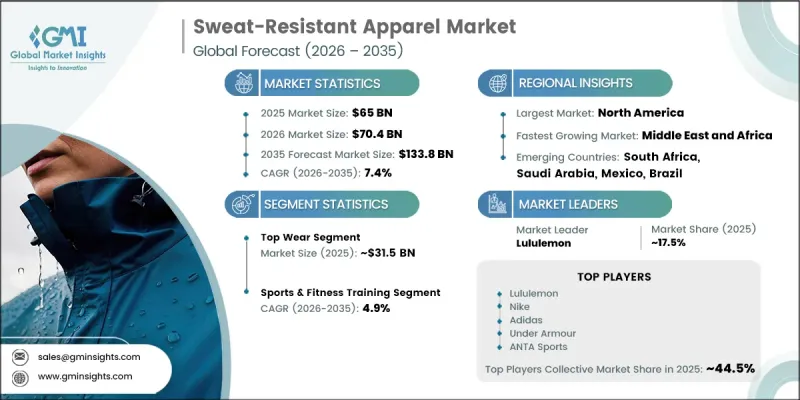
隨著消費者越來越重視功能性而非純粹的美觀,服裝產業正發生顯著的結構性轉變。吸濕排汗、除臭、輕盈和耐用等特性不再是可有可無的高階功能,而是廣受認可的基本要求。這種轉變正在重塑傳統運動服飾製造商與新興的D2C(直接面對消費者)品牌之間的競爭格局,後者正迅速擴大其在中高階服飾市場的佔有率。紡織工程和材料科學的進步使得高性能吸濕排汗材料的大規模生產成為可能,進一步加速了這一轉變。纖維結構的創新提高了水分的定向輸送能力,使汗水能夠有效率地從皮膚表面排放,同時保持透氣性和舒適性。智慧紡織技術的融合標誌著市場的重大變革。新一代服裝擴大整合了嵌入式感測系統,可以追蹤體溫波動、水分變化模式和運動強度等生理指標。這些技術進步重新定義了服裝,使其從被動式服裝轉變為主動式性能監控系統,從而提升了其在運動服、生活方式服飾和專業應用等眾多領域的重要性。消費者對舒適性、健康和性能最佳化的日益重視,持續推動全球市場對服裝的需求。
| 市場範圍 | |
|---|---|
| 開始年份 | 2025 |
| 預測期 | 2026-2035 |
| 初始市場規模 | 650億美元 |
| 預測金額 | 1338億美元 |
| 複合年成長率 | 7.4% |
預計到2025年,上裝市場銷售額將達到315億美元,並在2035年之前以6.1%的複合年成長率成長。由於運動時汗液主要集中在上身衣物上,且上裝用途廣泛,涵蓋健身、休閒和工作服等多種場合,因此該品類在市場中保持著強勁的主導。集吸濕排汗、輕量保暖和先進防護塗層於一體的多功能服裝,日益成為市場需求的驅動力,使其能夠全年穿著,並將消費價值拓展到傳統運動應用之外。
預計到2035年,休閒和休閒市場規模將達到508億美元。其快速成長的驅動力在於靈活辦公模式的日益普及以及以生活方式主導的服飾選擇,這些因素模糊了運動服和日常服裝之間的界限。消費者越來越追求兼具舒適性、吸濕排汗性和多功能性的服飾,這推動了該品類從小眾運動服飾領域向主流衣櫥必備單品的轉變。
預計到2025年,北美防汗服飾市場規模將達221億美元。該地區的成長主要受到監管要求的推動,這些要求強制規定使用更安全的材料成分,從而加速了整個服裝供應鏈向受監管纖維配方的過渡。這個法律規範促使製造商廣泛致力於重新配製材料,並提高了對兼具高防汗性和高性能布料的需求。
目錄
第1章:調查方法和範圍
第2章執行摘要
第3章 行業洞察
- 產業生態系分析
- 供應商情況
- 利潤率
- 每個階段增加的價值
- 影響價值鏈的因素
- 影響產業的因素
- 促進因素
- 全球健康意識和積極生活方式的普及
- 休閒時尚潮流:運動服和休閒裝之間的界線正在變得模糊。
- 持續創新吸濕排汗和抗菌功能纖維技術
- 疫情後,個人護理和舒適服裝的需求激增。
- 產業潛在風險與挑戰
- 高性能布料製造成本高
- 大眾市場和新興經濟體消費者群體的價格敏感性
- 合成纖維釋放微塑膠引發的環境問題
- 機會
- 對永續和環保吸汗布料的需求日益成長
- 將智慧紡織品和生物識別穿戴設備整合到功能性服裝中
- 拓展至工作服和工裝領域
- 亞太地區和拉丁美洲市場滲透率不斷提高
- 促進因素
- 成長潛力分析
- 未來市場趨勢
- 技術與創新展望
- 吸濕排汗速乾布料技術
- 抗菌除臭處理
- 智慧紡織品與穿戴式科技的融合
- 永續和生物基布料的創新
- 監理情勢
- 關於紡織品標籤和消費者安全的相關法規
- 環境合規性(REACH、OEKO-TEX 標準)
- 服裝製造中的公平貿易和勞動標準
- 貿易數據分析
- 進出口量及進口額趨勢
- 主要貿易路線及關稅的影響
- 人工智慧和生成式人工智慧對市場的影響
- 利用人工智慧改造現有經營模式
- 按細分市場分類的生成式人工智慧用例和部署藍圖
- 風險、限制和監管考量
- 價格分析
- 波特的分析
- PESTLE分析
- 消費行為分析
第4章 競爭情勢
- 介紹
- 企業市佔率分析
- 企業矩陣分析
- 主要市場公司的競爭分析
- 競爭定位矩陣
- 主要進展
- 併購
- 夥伴關係和聯盟
- 新產品發布
- 業務拓展計劃
第5章 市場估算與預測:依產品類型分類,2022-2035年
- 主要趨勢
- 上衣
- 襯衫和T卹
- 夾克和外套
- 背心和吊帶衫
- 其他
- 下裝
- 貼身褲和褲襪
- 短褲
- 褲子/褲子
- 其他
- 內衣及貼身衣物
- 內衣及貼身衣物
- 吸汗內衣
- 其他
第6章 市場估算與預測:依材料類型分類,2022-2035年
- 主要趨勢
- 合成纖維
- 聚酯纖維
- 尼龍
- 人造絲/粘膠纖維
- 氨綸/萊卡混紡
- 其他
- 天然纖維和混紡纖維
- 棉混紡
- 竹纖維
- 亞麻布
- 美利奴羊毛
- 其他
第7章 市場估計與預測:依最終用戶分類,2022-2035年
- 主要趨勢
- 男性
- 運動服和運動服
- 休閒與休閒
- 女士
- 運動服/運動服
- 休閒與休閒
- 孩子們
- 運動和休閒服飾
- 日常穿著
第8章 市場估計與預測:依應用領域分類,2022-2035年
- 主要趨勢
- 運動與健身訓練
- 健身房和室內訓練
- 跑步和騎行
- 團隊運動
- 戶外探險活動
- 健行
- 高爾夫球
- 露營和探險服裝
- 休閒裝和休閒裝
- 日常休閒裝
- 旅行和通勤服裝
- 社交聚會
- 瑜珈與身心健身
- 瑜珈
- 皮拉提斯拉伸
- 其他(工作服/工作裝備)
第9章 市場估計與預測:依價格區間分類,2022-2035年
- 主要趨勢
- 低價位(大眾市場)
- 中階
- 優質的
第10章 市場估價與預測:依通路分類,2022-2035年
- 主要趨勢
- 線上
- 品牌官方電商網站
- 第三方電子商務平台(亞馬遜、Flipkart 等)
- 離線
- 運動休閒服飾專賣店
- 超級市場和大賣場
- 品牌自營零售店
- 大型零售商
- 其他
第11章 市場估價與預測:按地區分類,2022-2035年
- 主要趨勢
- 北美洲
- 美國
- 加拿大
- 歐洲
- 德國
- 法國
- 英國
- 義大利
- 西班牙
- 亞太地區
- 中國
- 日本
- 印度
- 澳洲
- 韓國
- 拉丁美洲
- 巴西
- 墨西哥
- 阿根廷
- 中東和非洲
- 沙烏地阿拉伯
- UAE
- 南非
第12章:公司簡介
- Nike, Inc.
- Adidas AG
- Under Armour, Inc.
- Lululemon Athletica
- Puma SE
- Columbia Sportswear
- Decathlon SA
- On AG
- ASICS Corporation
- New Balance Athletics
- Gymshark Ltd.
- Vuori, Inc.
- Rhone Apparel Inc.
- Fabletics, Inc.
- Alo Yoga
- Sweaty Betty
- ANTA Sports Products
- Li-Ning Company Ltd.
- 2XU
- Castore
- Satisfy Running
- Craft Sportswear
- PE Nation
The Global Sweat-Resistant Apparel Market was valued at USD 65 billion in 2025 and is estimated to grow at a CAGR of 7.4% to reach USD 133.8 billion in 2035.
The industry is undergoing a clear structural shift as consumers increasingly prioritize functional performance attributes over purely aesthetic apparel considerations. Sweat resistance, odor management, and lightweight durability are now widely regarded as core expectations rather than optional premium features. This transition is reshaping competitive positioning between established sportswear manufacturers and emerging direct-to-consumer brands that are rapidly gaining share across mid-range and premium apparel categories. Advances in textile engineering and materials science are further accelerating market transformation by enabling large-scale production of high-performance moisture management fabrics. Innovations in fiber architecture have improved directional moisture transport, allowing sweat to move efficiently away from the skin while maintaining breathability and comfort. The integration of smart textile technologies represents a significant evolution in the market, with next-generation apparel increasingly incorporating embedded sensing systems capable of tracking physiological indicators such as body temperature variation, hydration patterns, and exertion levels. These developments are redefining apparel as an active performance and monitoring system rather than a passive clothing category, expanding its relevance across sportswear, lifestyle, and professional use cases. Growing consumer awareness of comfort, wellness, and performance optimization continues to reinforce demand across global markets.
| Market Scope | |
|---|---|
| Start Year | 2025 |
| Forecast Year | 2026-2035 |
| Start Value | $65 Billion |
| Forecast Value | $133.8 Billion |
| CAGR | 7.4% |
The top wear segment generated USD 31.5 billion in 2025 and is expected to grow at a CAGR of 6.1% through 2035. This category maintains strong market leadership due to the high concentration of sweat generation in upper-body clothing during physical activity, along with its widespread use across fitness, casual, and workwear applications. Demand is increasingly driven by multifunctional garments that combine moisture management, lightweight insulation, and advanced protective coatings, enabling year-round usage and expanding consumer value beyond traditional sports applications.
The casual and athleisure segment is projected to reach USD 50.8 billion by 2035. Its rapid expansion is supported by the normalization of flexible work environments and lifestyle-driven apparel choices that blur the distinction between performance wear and everyday clothing. Consumers increasingly demand garments that deliver comfort, moisture control, and adaptability across multiple settings, reinforcing the category's transition from niche athletic use to mainstream wardrobe essentials.
North America Sweat-Resistant Apparel Market captured USD 22.1 billion in 2025. Regional growth is strongly influenced by regulatory requirements mandating safer material compositions, which are accelerating the shift toward compliant textile formulations across the apparel supply chain. These regulatory frameworks are prompting widespread reformulation efforts among manufacturers and strengthening demand for advanced sweat-resistant and performance-oriented fabrics.
Major companies operating in the global sweat-resistant apparel market include Nike, Inc., Adidas AG, Under Armour, Inc., Lululemon Athletica, Puma SE, Columbia Sportswear, Decathlon S.A., On AG, ASICS Corporation, New Balance Athletics, Gymshark Ltd., Vuori, Inc., Rhone Apparel Inc., Fabletics, Inc., Alo Yoga, Sweaty Betty, ANTA Sports Products, Li-Ning Company Ltd., 2XU, Castore, Satisfy Running, Craft Sportswear, and P.E Nation. Companies in the sweat-resistant apparel market are prioritizing advanced fabric innovation, smart textile integration, and sustainable material development to strengthen competitive positioning. Manufacturers are investing in moisture-wicking technologies, breathable fiber structures, and performance-enhancing coatings that improve comfort and durability. Many brands are expanding direct-to-consumer channels and digital retail ecosystems to enhance customer engagement and improve margin control. Strategic collaborations with sports professionals, fitness influencers, and technology partners are supporting stronger brand differentiation and product validation. Firms are also focusing on sustainability-driven product lines, including PFAS-free and recycled fabric solutions, to comply with evolving regulations.
Table of Contents
Chapter 1 Methodology & Scope
- 1.1 Market scope and definition
- 1.2 Research design
- 1.2.1 Research approach
- 1.2.2 Data collection methods
- 1.3 Data mining sources
- 1.3.1 Global
- 1.3.2 Regional/Country
- 1.4 Base estimates and calculations
- 1.4.1 Base year calculation
- 1.4.2 Key trends for market estimation
- 1.5 Primary research and validation
- 1.5.1 Primary sources
- 1.6 Forecast model
- 1.7 Research assumptions and limitations
Chapter 2 Executive Summary
- 2.1 Industry 360° synopsis
- 2.2 Key market trends
- 2.2.1 Region
- 2.2.2 Product Type
- 2.2.3 Material
- 2.2.4 Application
- 2.2.5 End-user
- 2.2.6 Price Range
- 2.2.7 Distribution channel
Chapter 3 Industry Insights
- 3.1 Industry ecosystem analysis
- 3.1.1 Supplier landscape
- 3.1.2 Profit margin
- 3.1.3 Value addition at each stage
- 3.1.4 Factor affecting the value chain
- 3.2 Industry impact forces
- 3.2.1 Growth drivers
- 3.2.1.1 Rising Health Consciousness & Active Lifestyle Adoption Globally
- 3.2.1.2 Athleisure Fashion Trend Blurring Lines Between Sportswear & Casualwear
- 3.2.1.3 Continuous Innovation in Moisture-Wicking & Antimicrobial Fabric Technologies
- 3.2.1.4 Post-Pandemic Surge in Personal Hygiene & Comfort Apparel Demand
- 3.2.2 Industry pitfalls & challenges
- 3.2.2.1 High Production Costs of Advanced Performance Fabrics
- 3.2.2.2 Price Sensitivity in Mass-Market & Emerging Economy Consumer Segments
- 3.2.2.3 Environmental Concerns Over Synthetic Fabric Microplastic Shedding
- 3.2.3 Opportunities
- 3.2.3.1 Growing Demand for Sustainable & Eco-Friendly Sweat-Resistant Fabrics
- 3.2.3.2 Integration of Smart Textiles & Biometric Wearables in Performance Apparel
- 3.2.3.3 Expansion into Occupational & Workwear Application Segments
- 3.2.3.4 Rising Market Penetration in Asia Pacific & Latin America
- 3.2.1 Growth drivers
- 3.3 Growth potential analysis
- 3.4 Future market trends
- 3.5 Technology and innovation landscape
- 3.5.1 Moisture-Wicking & Quick-Dry Fabric Technologies
- 3.5.2 Antimicrobial & Odor-Control Treatments
- 3.5.3 Smart Textiles & Wearable Tech Integration
- 3.5.4 Sustainable & Bio-Based Fabric Innovations
- 3.6 Regulatory landscape
- 3.6.1 Textile Labeling & Consumer Safety Regulations
- 3.6.2 Environmental Compliance (REACH, OEKO-TEX Standards)
- 3.6.3 Fair Trade & Labor Standards in Apparel Manufacturing
- 3.7 Trade data analysis (HS Code - )
- 3.7.1 Import/Export Volume & Value Trends (Driven by Primary Research)
- 3.7.2 Key Trade Corridors & Tariff Impact
- 3.8 Impact of AI & generative AI on the market
- 3.8.1 AI-Driven Disruption of Existing Business Models
- 3.8.2 GenAI Use Cases & Adoption Roadmap by Segment
- 3.8.3 Risks, Limitations & Regulatory Considerations
- 3.9 Pricing Analysis
- 3.10 Porter's analysis
- 3.11 PESTEL analysis
- 3.12 Consumer behavior analysis
Chapter 4 Competitive Landscape, 2025
- 4.1 Introduction
- 4.2 Company market share analysis
- 4.3 Company matrix analysis
- 4.4 Competitive analysis of major market players
- 4.5 Competitive positioning matrix
- 4.6 Key developments
- 4.6.1 Mergers & acquisitions
- 4.6.2 Partnerships & collaborations
- 4.6.3 New product launches
- 4.6.4 Expansion plans
Chapter 5 Market Estimates & Forecast, By Product Type, 2022 - 2035, (USD Billion) (Million Units)
- 5.1 Key Trends
- 5.2 Top Wear
- 5.2.1 Shirts & T-shirts
- 5.2.2 Jackets & Outerwear
- 5.2.3 Tank Tops & Vests
- 5.2.4 Others
- 5.3 Bottom Wear
- 5.3.1 Leggings & Tights
- 5.3.2 Shorts
- 5.3.3 Pants & Trousers
- 5.3.4 Others
- 5.4 Innerwear & Undergarments
- 5.4.1 Undershirts & Base Layers
- 5.4.2 Sweat-Resistant Underwear
- 5.4.3 Others
Chapter 6 Market Estimates & Forecast, By Material Type, 2022 - 2035, (USD Billion) (Million Units)
- 6.1 Key Trends
- 6.2 Synthetic Fabrics
- 6.2.1 Polyester
- 6.2.2 Nylon
- 6.2.3 Rayon/Viscose
- 6.2.4 Spandex/Lycra Blends
- 6.2.5 Others
- 6.3 Natural & Blended Fabrics
- 6.3.1 Cotton Blends
- 6.3.2 Bamboo Fabric
- 6.3.3 Linen
- 6.3.4 Merino Wool
- 6.3.5 Others
Chapter 7 Market Estimates & Forecast, By End-user, 2022 - 2035, (USD Billion) (Million Units)
- 7.1 Key Trends
- 7.2 Men
- 7.2.1 Performance & Athletic Wear
- 7.2.2 Casual & Athleisure
- 7.3 Women
- 7.3.1 Performance & Athletic Wear
- 7.3.2 Casual & Athleisure
- 7.4 Kids
- 7.4.1 Sports & Active Wear
- 7.4.2 Everyday Wear
Chapter 8 Market Estimates & Forecast, By Application, 2022 - 2035, (USD Billion) (Million Units)
- 8.1 Key Trends
- 8.2 Sports & Fitness Training
- 8.2.1 Gym & Indoor Training
- 8.2.2 Running & Cycling
- 8.2.3 Team Sports
- 8.3 Outdoor & Adventure Activities
- 8.3.1 Hiking & Trekking
- 8.3.2 Golf
- 8.3.3 Camping & Expedition Wear
- 8.4 Casual & Athleisure Wear
- 8.4.1 Everyday Casual
- 8.4.2 Travel & Commute Wear
- 8.4.3 Social Occasions
- 8.5 Yoga & Mind-Body Fitness
- 8.5.1 Yoga
- 8.5.2 Pilates & Stretching
- 8.6 Others (Occupational / Workwear)
Chapter 9 Market Estimates & Forecast, By Price Range, 2022 - 2035, (USD Billion) (Million Units)
- 9.1 Key Trends
- 9.2 Low (Mass Market)
- 9.3 Medium (Mid-Range)
- 9.4 High (Premium)
Chapter 10 Market Estimates & Forecast, By Distribution Channel, 2022 - 2035, (USD Billion) (Million Units)
- 10.1 Key Trends
- 10.2 Online
- 10.2.1 Brand-Owned E-commerce Websites
- 10.2.2 Third-Party E-commerce Platforms (Amazon, Flipkart, etc.)
- 10.3 Offline
- 10.3.1 Specialty Sports & Athleisure Stores
- 10.3.2 Supermarkets & Hypermarkets
- 10.3.3 Brand-Owned Retail Stores
- 10.3.4 Big-Box Retailers
- 10.3.5 Others
Chapter 11 Market Estimates & Forecast, By Region, 2022 - 2035, (USD Billion) (Million Units)
- 11.1 Key Trends
- 11.2 North America
- 11.2.1 U.S.
- 11.2.2 Canada
- 11.3 Europe
- 11.3.1 Germany
- 11.3.2 France
- 11.3.3 UK
- 11.3.4 Italy
- 11.3.5 Spain
- 11.4 Asia Pacific
- 11.4.1 China
- 11.4.2 Japan
- 11.4.3 India
- 11.4.4 Australia
- 11.4.5 South Korea
- 11.5 Latin America
- 11.5.1 Brazil
- 11.5.2 Mexico
- 11.5.3 Argentina
- 11.6 MEA
- 11.6.1 Saudi Arabia
- 11.6.2 UAE
- 11.6.3 South Africa
Chapter 12 Company Profiles
- 12.1 Nike, Inc.
- 12.2 Adidas AG
- 12.3 Under Armour, Inc.
- 12.4 Lululemon Athletica
- 12.5 Puma SE
- 12.6 Columbia Sportswear
- 12.7 Decathlon S.A.
- 12.8 On AG
- 12.9 ASICS Corporation
- 12.10 New Balance Athletics
- 12.11 Gymshark Ltd.
- 12.12 Vuori, Inc.
- 12.13 Rhone Apparel Inc.
- 12.14 Fabletics, Inc.
- 12.15 Alo Yoga
- 12.16 Sweaty Betty
- 12.17 ANTA Sports Products
- 12.18 Li-Ning Company Ltd.
- 12.19 2XU
- 12.20 Castore
- 12.21 Satisfy Running
- 12.22 Craft Sportswear
- 12.23 P.E Nation

 智慧紡織品和功能性布料市場預測至2034年—按材料類型、功能、技術、應用、最終用戶和地區分類的全球分析
 功能性服飾市場-2026-2032年全球市場預測
 功能性服裝市場報告:按產品類型、應用、分銷管道和地區分類(2026-2034 年)阻燃服飾市場:依材料類型、產品類型、阻燃類型、最終用途及通路分類-2026-2032年全球預測
 全球功能性服裝市場規模、佔有率、趨勢和成長分析報告(2026-2034)
 戶外運動服飾市場-全球產業規模、佔有率、趨勢、機會及預測(按類型、類別、通路、地區和競爭格局分類,2021-2031年)
 2026-2030年全球阻燃服飾市場全球防墜落工作服市場(按產品類型、材料、最終用戶和分銷管道分類)預測(2026-2032年)吸濕排汗襪市場:按材質、性別、年齡層、價格範圍、應用和分銷管道分類的全球預測,2026-2032年
 功能性服裝市場規模、佔有率和成長分析(按產品類型、布料類型、後整理類型、應用、分銷管道和地區分類)-2026-2033年產業預測