


 |
市場調查報告書
商品編碼
2083133
2026-2035 年飛機多功能顯示系統的市場機會、成長促進因素、產業趨勢分析與預測。Multifunction Display Systems for Aircraft Market Opportunity, Growth Drivers, Industry Trend Analysis, and Forecast 2026 - 2035 |
||||||

全球飛機多功能顯示系統市場預計到 2025 年將達到 17 億美元,並預計到 2035 年將以 7.8% 的複合年成長率成長至 37 億美元。
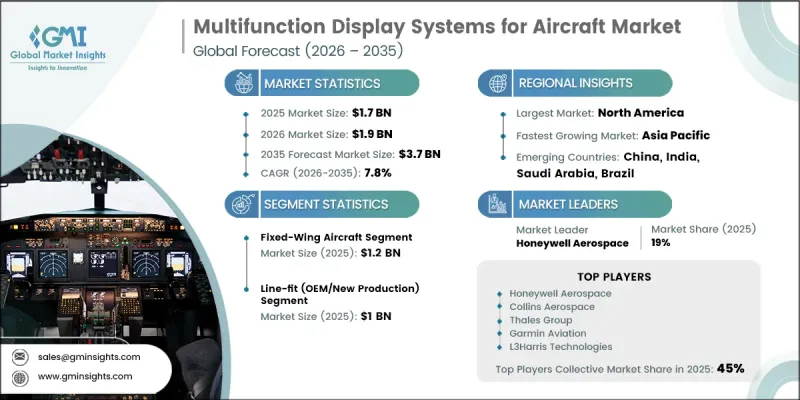
飛機多功能顯示系統市場的成長主要受以下因素驅動:航空法規的不斷完善、駕駛座現代化投資的增加,以及民用、公務和國防航空領域對整合航空電子解決方案日益成長的需求。飛機營運商和製造商越來越重視先進的駕駛座技術,這些技術能夠提升情境察覺、提高運作效率、降低維護需求,並支援未來互聯和自動化航空能力的發展。這些因素在新飛機生產項目和維修項目中都創造了需求。此外,國防航空領域仍然是重要的收入來源,軍方機構正投資升級老舊機隊,採用最新的數位駕駛座技術。從傳統飛行儀表向先進顯示架構的轉變,正在提升運作效率、任務效能和飛行員的決策能力。同時,全球飛機產量的持續成長也為持續的需求奠定了堅實的基礎,支援多功能顯示系統在全球各種航空平台上的持續部署。
| 市場範圍 | |
|---|---|
| 開始年份 | 2025 |
| 預測期 | 2026-2035 |
| 起始金額 | 17億美元 |
| 預測金額 | 37億美元 |
| 複合年成長率 | 7.8% |
預計2025年,固定翼飛機市場規模將達12億美元。該市場主導地位的鞏固得益於民航機機隊的廣泛採用以及軍用飛機的現代化舉措。固定翼飛機憑藉其作戰多功能性、高效性和有效載荷能力,在運輸、監視和國防行動中繼續發揮至關重要的作用。對先進航太技術、節能飛機設計和機身現代化改造項目的持續投資,預計將推動該市場持續成長。
預計到2025年,生產Line-Fit(或OEM/新生產)市場規模將達到10億美元。此細分市場的成長主要得益於飛機製造活動的活性化以及在生產早期階段應用先進航空電子技術。對下一代飛機項目的投資增加,以及對更高營運性能和效率日益成長的需求,推動了工廠安裝多功能顯示系統的持續普及。航太製造流程的進步和長期飛機現代化計劃也為該細分市場的持續成長做出了貢獻。
預計到2025年,美國飛機多功能顯示系統市場規模將達到5.893億美元,主要得益於大規模的軍用航空電子設備採購項目、龐大的民用航空市場以及公務航空領域積極的維修活動。這些需求來源共同創造了一個多元化的市場環境,為國防相關企業、民航機製造商、航空電子設備供應商和售後服務服務供應商帶來了不斷擴大的商機,從而推動了該行業的持續發展。
目錄
第1章:調查方法和範圍
第2章執行摘要
第3章 行業洞察
- 產業生態系分析
- 供應商情況
- 利潤率
- 成本結構
- 每個階段增加的價值
- 影響價值鏈的因素
- 中斷
- 影響產業的因素
- 成長促進因素
- 飛機駕駛座系統與航空電子技術現代化進展
- 擴大下一代民航機和公務機的引進
- 國防航空現代化計劃的擴展
- 互聯駕駛座和智慧航空電子技術整合的進展
- 顯示處理和觸控螢幕介面的技術進步
- 產業潛在風險與挑戰
- 高昂的認證和開發成本
- 複雜的航空電子設備整合要求
- 市場機遇
- 對城市空中運輸和無人飛行器的需求日益成長
- 增加飛機維修和升級活動
- 成長促進因素
- 成長潛力分析
- 價格分析
- 對過去價格趨勢的分析
- 依球員類型分類的定價策略(高級球員、超值球員、成本加成球員)
- 監理情勢
- 北美洲
- 歐洲
- 亞太地區
- 拉丁美洲
- 中東和非洲
- 波特的分析
- PESTLE分析
- 技術與創新展望
- 最新科技趨勢
- 新興技術
- 新興經營模式
- 合規要求
- 專利和智慧財產權分析
- 貿易數據分析
- 進出口量及進口額趨勢
- 主要貿易路線及關稅的影響
- 人工智慧和生成式人工智慧對市場的影響
- 利用人工智慧改造現有經營模式
- 按細分市場分類的生成式人工智慧用例和部署藍圖
- 生產能力和生產情況
- 生產能力:主要製造商
- 運轉率和擴張計劃
第4章 競爭情勢
- 介紹
- 企業市佔率分析
- 按地區
- 北美洲
- 歐洲
- 亞太地區
- 拉丁美洲
- 中東和非洲
- 市場集中度分析
- 按地區
- 主要市場公司的競爭分析
- 競爭定位矩陣
- 主要進展
- 併購
- 夥伴關係和聯盟
- 新產品發布
- 業務拓展計劃及資金籌措
- 按公司規模進行基準測試
- 排名分類標準與遴選標準
- 按收入、地區和創新能力分類的層級定位矩陣。
第5章 市場估算與預測:依顯示技術分類,2022-2035年
- LCD/AMLCD(液晶顯示器/主動矩陣液晶顯示器)
- OLED(有機發光二極體)
- MicroLED
- 其他顯示技術
第6章 市場估計與預測:依平台分類,2022-2035年
- 固定翼飛機
- 旋翼飛機
- 無人駕駛飛行器(UAV/UAS)
第7章 市場估計與預測:依安裝類型分類,2022-2035年
- Line-Fit(OEM/全新生產)
- 改裝(售後/升級)
第8章 市場估算與預測:依最終用戶產業分類,2022-2035年
- 商業航空
- 軍事航空
- 公務航空/通用航空
- 其他
第9章 市場估計與預測:依地區分類,2022-2035年
- 北美洲
- 美國
- 加拿大
- 歐洲
- 德國
- 英國
- 法國
- 西班牙
- 義大利
- 亞太地區
- 中國
- 印度
- 日本
- 澳洲
- 韓國
- 拉丁美洲
- 巴西
- 墨西哥
- 阿根廷
- 中東和非洲
- 南非
- 沙烏地阿拉伯
- UAE
第10章:公司簡介
- 全球主要公司
- Honeywell Aerospace
- Collins Aerospace
- Thales Group
- Garmin Aviation
- L3Harris Technologies
- 該地區的主要公司
- 北美洲
- Astronautics Corporation of America
- Avidyne Corporation
- Aspen Avionics
- Dynon Avionics
- 亞太地區
- Elbit Systems
- Safran Electronics &Defense
- 歐洲
- 1 BAE Systems
- 2 Leonardo DRS
- 北美洲
- 小眾玩家/顛覆者
- ScioTeq
- Genesys Aerosystems
The Global Multifunction Display Systems for Aircraft Market was valued at USD 1.7 billion in 2025 and is estimated to grow at a CAGR of 7.8% to reach USD 3.7 billion by 2035.
Growth in the Multifunction Display Systems for Aircraft Market is driven by evolving aviation regulations, increasing investments in cockpit modernization, and the rising demand for integrated avionics solutions across commercial, business, and defense aviation sectors. Aircraft operators and manufacturers are increasingly prioritizing advanced cockpit technologies that improve situational awareness, streamline flight operations, lower maintenance requirements, and support future connected and automated aviation capabilities. These factors are generating demand across both new aircraft production programs and retrofit installations. In addition, defense aviation continues to represent a significant source of revenue as military organizations invest in upgrading aging aircraft fleets with modern digital cockpit technologies. The transition from legacy flight instrumentation to advanced display architectures is enhancing operational efficiency, mission effectiveness, and pilot decision-making capabilities. At the same time, increasing global aircraft production levels are creating a strong foundation for sustained demand, supporting continued adoption of multifunction display systems across a broad range of aviation platforms worldwide.
| Market Scope | |
|---|---|
| Start Year | 2025 |
| Forecast Year | 2026-2035 |
| Start Value | $1.7 Billion |
| Forecast Value | $3.7 Billion |
| CAGR | 7.8% |
The fixed-wing aircraft segment accounted for USD 1.2 billion in 2025. The segment's leadership position is supported by widespread deployment across commercial aviation fleets and military aircraft modernization initiatives. Fixed-wing platforms continue to play a critical role in transportation, surveillance, and defense operations due to their operational versatility, efficiency, and payload capabilities. Ongoing investments in advanced aerospace technologies, fuel-efficient aircraft designs, and fleet modernization programs are expected to support continued growth across this segment.
The line-fit, or OEM/new production segment, generated USD 1 billion in 2025. Growth within this segment is being fueled by increasing aircraft manufacturing activity and the incorporation of sophisticated avionics technologies during the original production phase. Rising investments in next-generation aircraft programs, combined with growing demand for enhanced operational performance and efficiency, continue to strengthen the adoption of factory-installed multifunction display systems. Advancements in aerospace manufacturing processes and long-term fleet renewal initiatives are also contributing to sustained segment expansion.
United States Multifunction Display Systems for Aircraft Market reached USD 589.3 million in 2025, supported by extensive military avionics procurement programs, a large commercial aviation sector, and significant retrofit activity within business aviation. The combination of these demand sources creates a diversified market environment where revenue opportunities extend across defense contractors, commercial aircraft manufacturers, avionics suppliers, and aftermarket service providers, supporting continued industry development.
Key companies operating in the Multifunction Display Systems for Aircraft Market include Collins Aerospace, Honeywell Aerospace, Garmin Aviation, Thales Group, BAE Systems, Northrop Grumman, Elbit Systems, Leonardo DRS, Astronautics Corporation of America, ScioTeq, Aspen Avionics, Avidyne Corporation, Dynon Avionics, BendixKing, Genesys Aerosystems, Radiant Power, Safran Electronics & Defense, and L3Harris Technologies. Companies operating in the Multifunction Display Systems for Aircraft Market are focusing on technological innovation, strategic partnerships, and product portfolio expansion to strengthen their competitive position. Significant investments are being directed toward the development of advanced avionics platforms featuring enhanced display quality, greater system integration, improved connectivity, and support for next-generation flight operations. Many market participants are collaborating with aircraft manufacturers, defense organizations, and aviation operators to secure long-term supply agreements and expand their presence across both OEM and retrofit segments. Companies are also emphasizing software enhancements, cybersecurity capabilities, and digital cockpit solutions to address evolving operational requirements.
Table of Contents
Chapter 1 Methodology and Scope
- 1.1 Market scope and definition
- 1.2 Research design
- 1.2.1 Research approach
- 1.2.2 Data collection methods
- 1.3 Data mining sources
- 1.3.1 Global
- 1.3.2 Regional/Country
- 1.4 Base estimates and calculations
- 1.4.1 Base year calculation
- 1.4.2 Key trends for market estimation
- 1.5 Primary research and validation
- 1.5.1 Primary sources
- 1.6 Forecast model
- 1.7 Research assumptions and limitations
Chapter 2 Executive Summary
- 2.1 Industry 360° synopsis, 2022 - 2035
- 2.2 Key market trends
- 2.2.1 Display Technology trends
- 2.2.2 Platform trends
- 2.2.3 Fitment Type trends
- 2.2.4 End-user industry trends
- 2.2.5 Regional trends
- 2.3 TAM Analysis, 2026-2035
- 2.4 CXO perspectives: Strategic imperatives
Chapter 3 Industry Insights
- 3.1 Industry ecosystem analysis
- 3.1.1 Supplier Landscape
- 3.1.2 Profit Margin
- 3.1.3 Cost structure
- 3.1.4 Value addition at each stage
- 3.1.5 Factor affecting the value chain
- 3.1.6 Disruptions
- 3.2 Industry impact forces
- 3.2.1 Growth drivers
- 3.2.1.1 Increasing modernization of aircraft cockpit systems and avionics technologies
- 3.2.1.2 Growing adoption of next-generation commercial and business aircraft
- 3.2.1.3 Expansion of defense aviation modernization programs
- 3.2.1.4 Rising integration of connected cockpit and smart avionics technologies
- 3.2.1.5 Technological advancements in display processing and touchscreen interfaces
- 3.2.2 Industry pitfalls and challenges
- 3.2.2.1 High certification and development costs
- 3.2.2.2 Complex avionics integration requirements
- 3.2.3 Market opportunities
- 3.2.3.1 Growing demand for urban air mobility and autonomous aircraft
- 3.2.3.2 Increasing retrofit and aircraft upgrade activities
- 3.2.1 Growth drivers
- 3.3 Growth potential analysis
- 3.4 Pricing Analysis (Driven by Primary Research)
- 3.4.1 Historical Price Trend Analysis
- 3.4.2 Pricing Strategy by Player Type (Premium / Value / Cost-plus)
- 3.5 Regulatory landscape
- 3.5.1 North America
- 3.5.2 Europe
- 3.5.3 Asia Pacific
- 3.5.4 Latin America
- 3.5.5 Middle East & Africa
- 3.6 Porter’s analysis
- 3.7 PESTEL analysis
- 3.8 Technology and Innovation landscape
- 3.8.1 Current technological trends
- 3.8.2 Emerging technologies
- 3.9 Emerging Business Models
- 3.10 Compliance Requirements
- 3.11 Patent and IP analysis
- 3.12 Trade Data Analysis (Based on Paid Database)
- 3.12.1 Import/Export Volume & Value Trends
- 3.12.2 Key Trade Corridors & Tariff Impact
- 3.13 Impact of AI & Generative AI on the Market (Driven by Primary Research)
- 3.13.1 AI-Driven Disruption of Existing Business Models
- 3.13.2 GenAI Use Cases & Adoption Roadmap by Segment
- 3.14 Capacity & Production Landscape (Driven by Primary Research)
- 3.14.1 Production Capacity by Key Producer
- 3.14.2 Capacity Utilization Rates & Expansion Pipelines
Chapter 4 Competitive Landscape, 2025
- 4.1 Introduction
- 4.2 Company market share analysis, 2025
- 4.2.1 By Region
- 4.2.1.1 North America
- 4.2.1.2 Europe
- 4.2.1.3 Asia-Pacific
- 4.2.1.4 Latin America
- 4.2.1.5 Middle East and Africa
- 4.2.2 Market Concentration Analysis
- 4.2.1 By Region
- 4.3 Competitive analysis of major market players
- 4.4 Competitive positioning matrix
- 4.5 Key developments
- 4.5.1 Mergers & acquisitions
- 4.5.2 Partnerships & collaborations
- 4.5.3 New product launches
- 4.5.4 Expansion plans and funding
- 4.6 Company tier benchmarking
- 4.6.1 Tier classification criteria & qualifying thresholds
- 4.6.2 Tier positioning matrix by revenue, geography & innovation
Chapter 5 Market Estimates and Forecast, By Display Technology, 2022 - 2035 (USD Billion)
- 5.1 Key trends
- 5.2 LCD/AMLCD (Liquid Crystal Display/Active Matrix LCD)
- 5.3 OLED (Organic Light-Emitting Diode)
- 5.4 MicroLED
- 5.5 Other Display Technologies
Chapter 6 Market Estimates and Forecast, By Platform, 2022 - 2035 (USD Billion)
- 6.1 Key trends
- 6.2 Fixed-Wing Aircraft
- 6.3 Rotary-Wing Aircraft
- 6.4 Unmanned Aerial Vehicles (UAVs/UAS)
Chapter 7 Market Estimates and Forecast, By Fitment Type, 2022 - 2035 (USD Billion)
- 7.1 Key trends
- 7.2 Line-Fit (OEM/New Production)
- 7.3 Retrofit (Aftermarket/Upgrade)
Chapter 8 Market Estimates and Forecast, By End-User Industry, 2022 - 2035 (USD Billion)
- 8.1 Key trends
- 8.2 Commercial Aviation
- 8.3 Military Aviation
- 8.4 Business & General Aviation
- 8.5 Others
Chapter 9 Market Estimates and Forecast, By Region, 2022 - 2035 (USD Billion)
- 9.1 Key trends
- 9.2 North America
- 9.2.1 U.S.
- 9.2.2 Canada
- 9.3 Europe
- 9.3.1 Germany
- 9.3.2 UK
- 9.3.3 France
- 9.3.4 Spain
- 9.3.5 Italy
- 9.4 Asia Pacific
- 9.4.1 China
- 9.4.2 India
- 9.4.3 Japan
- 9.4.4 Australia
- 9.4.5 South Korea
- 9.5 Latin America
- 9.5.1 Brazil
- 9.5.2 Mexico
- 9.5.3 Argentina
- 9.6 Middle East and Africa
- 9.6.1 South Africa
- 9.6.2 Saudi Arabia
- 9.6.3 UAE
Chapter 10 Company Profiles
- 10.1 Global Key Players
- 10.1.1 Honeywell Aerospace
- 10.1.2 Collins Aerospace
- 10.1.3 Thales Group
- 10.1.4 Garmin Aviation
- 10.1.5 L3Harris Technologies
- 10.2 Regional key players
- 10.2.1 North America
- 10.2.1.1 Astronautics Corporation of America
- 10.2.1.2 Avidyne Corporation
- 10.2.1.3 Aspen Avionics
- 10.2.1.4 Dynon Avionics
- 10.2.2 Asia Pacific
- 10.2.2.1 Elbit Systems
- 10.2.2.2 Safran Electronics & Defense
- 10.2.3 Europe
- 10.2.3.1 BAE Systems
- 10.2.3.2 Leonardo DRS
- 10.3 Niche Players/Disruptors
- 10.3.1 ScioTeq
- 10.3.2 Genesys Aerosystems
- 10.2.1 North America

 2026-2034年全球商用飛機航空電子系統市場規模、佔有率、趨勢和成長分析報告主飛行顯示器市場規模、佔有率、成長、全球產業分析、區域趨勢及2026年至2034年預測
 2026年全球飛機電腦市場報告
 飛機電腦市場:按應用、系統類型、安裝配置和組件分類-2026-2032年全球市場預測駕駛艙及顯示器市場:依飛機類型、駕駛座配置、安裝類型、技術、系統類型、平台、應用、最終用戶分類,全球預測,2026-2032年
 飛機電腦市場-全球產業規模、佔有率、趨勢、機會、預測:按平台、類型、最終用戶、地區和競爭格局分類,2021-2031年飛機計算機市場:2026-2036 年
 飛機電腦市場規模、佔有率和成長分析(按組件、類型、平台、最終用戶和地區分類)-2026-2033年產業預測