


 |
市場調查報告書
商品編碼
2083129
2026 年至 2035 年食品接觸材料和包裝安全市場機會、成長動力、產業趨勢和預測。Food Contact Materials and Packaging Safety Market Opportunity, Growth Drivers, Industry Trend Analysis, and Forecast 2026 - 2035 |
||||||

全球食品接觸材料和包裝安全市場預計到 2025 年將達到 3,108 億美元,年複合成長率為 5.1%,到 2035 年將達到 5,103 億美元。
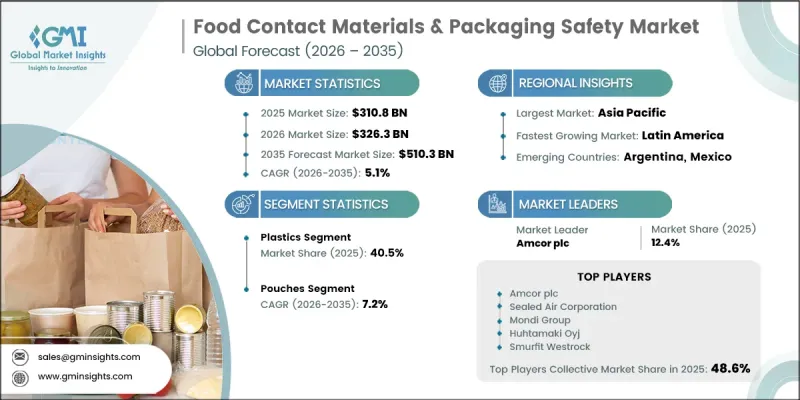
新興經濟體有組織的零售網路和餐飲服務業的持續擴張推動了市場成長,從而對安全且符合規範的食品接觸材料產生了持續的需求。隨著包裝供應鏈日益全球化,製造商面臨來自多個地區更嚴格的法律規範以及不斷變化的安全要求。同時,永續包裝材料和生物基替代品的日益普及也進一步增加了對測試、檢驗和合規性活動的需求。新型包裝基材、再生材料和創新聚合物配方都需要進行全面的安全評估,以確保符合不斷變化的法規。全球監管機構不斷收緊對食品接觸材料的要求,增加了製造商合規流程的複雜性。這種不斷變化的監管環境,加上消費者對食品安全、永續性和包裝透明度的日益關注,持續推動對整個食品接觸材料和包裝安全市場的投資。
| 市場範圍 | |
|---|---|
| 開始年份 | 2025 |
| 預測期 | 2026-2035 |
| 起始金額 | 3108億美元 |
| 預測金額 | 5103億美元 |
| 複合年成長率 | 5.1% |
預計到2025年,塑膠製品將佔據40.5%的市場。隨著各國政府和監管機構對材料成分、化學物質遷移和環境影響提出更嚴格的要求,該領域正面臨監管機構日益嚴格的審查。同時,在食品服務和零售包裝等領域,人們正逐漸轉向使用替代包裝材料,包括紙基、纖維基、再生材料和生物基解決方案。儘管存在這些變化,食品級塑膠材料憑藉其多功能性、耐用性和廣泛的應用範圍,仍然佔據市場主導地位。塑膠材料仍廣泛應用於軟包裝、硬容器、瓶蓋和各種食品包裝,其在整體市場中的重要性預計將保持不變。
預計到2035年,軟包裝袋市場將以7.2%的複合年成長率成長。這一成長主要得益於食品飲料產業對輕便、便利、經濟高效的包裝解決方案的需求不斷成長。軟包裝袋在運輸效率、最佳化儲存和提升消費者便利性方面具有顯著優勢,使其成為製造商和終端用戶越來越青睞的選擇。隨著多層包裝結構在軟包裝袋應用中的日益普及,食品接觸材料的安全評估也變得愈發重要。這是因為由多層材料構成的結構需要進行全面評估,以符合適用的食品安全標準,並在各種使用條件下滿足性能要求。
北美食品接觸材料和包裝安全市場佔據25%的市場佔有率,預計到2035年將以4.1%的複合年成長率成長。該地區受益於高度發展的法規環境,致力於確保食品安全、材料透明度和消費者保護。食品接觸材料的監管要求不斷發展,越來越重視化學成分揭露、產品安全檢驗和供應鏈課責。隨著聯邦和地區層級合規義務的日益增加,製造商、包裝供應商和品牌所有者正在增加對先進測試、認證和監控流程的投資。隨著監管標準的日益嚴格,在北美市場運營的企業正在優先考慮合規策略,以維持市場准入並滿足不斷變化的行業期望。
目錄
第1章:調查方法和範圍
第2章執行摘要
第3章 行業洞察
- 產業生態系分析
- 供應商情況
- 利潤率
- 每個階段增加的價值
- 影響價值鏈的因素
- 中斷
- 影響產業的因素
- 成長促進因素
- 產業潛在風險與挑戰
- 市場機遇
- 成長潛力分析
- 監理情勢
- 北美洲
- 歐洲
- 亞太地區
- 拉丁美洲
- 中東和非洲
- 波特的分析
- PESTLE分析
- 價格趨勢
- 按地區
- 依材料類型
- 未來市場趨勢
- 技術與創新展望
- 最新科技趨勢
- 新興技術
- 專利趨勢
- 貿易統計
- 主要進口國
- 主要出口國
- 永續性和環境方面
- 永續計劃
- 減少廢棄物策略
- 生產中的能源效率
- 具有環保意識的舉措
- 考慮碳足跡
第4章 競爭情勢
- 介紹
- 企業市佔率分析
- 按地區
- 北美洲
- 歐洲
- 亞太地區
- 拉丁美洲
- 中東和非洲
- 按地區
- 企業矩陣分析
- 主要市場公司的競爭分析
- 競爭定位矩陣
- 主要進展
- 併購
- 夥伴關係和聯盟
- 新產品發布
- 業務拓展計劃
第5章 市場估算與預測:依材料類型分類,2022-2035年
- 塑膠
- 軟塑膠
- 硬質塑膠
- 生物基塑膠
- 紙張和紙板
- 紙板
- 折疊盒用紙板
- 牛皮紙
- 塗層紙和紙板
- 金屬
- 玻璃
- 其他
第6章 市場估價與預測:依包裝類型分類,2022-2035年
- 瓶子
- 玻璃瓶
- 塑膠瓶(PET、HDPE)
- 坎
- 鋁罐
- 鋼罐
- 紙盒
- 小袋
- 薄膜包裝
- 其他
第7章 市場估計與預測:依應用領域分類,2022-2035年
- 食物
- 生鮮食品
- 冷凍食品
- 加工食品
- 飲料
- 酒精飲料
- 不含酒精的飲料
第8章 市場估算與預測:依最終用途管道分類,2022-2035年
- 零售
- 食品服務
- 產業
第9章 市場估計與預測:依地區分類,2022-2035年
- 北美洲
- 美國
- 加拿大
- 歐洲
- 德國
- 英國
- 法國
- 西班牙
- 義大利
- 其他歐洲國家
- 亞太地區
- 中國
- 印度
- 日本
- 澳洲
- 韓國
- 其他亞太國家
- 拉丁美洲
- 巴西
- 墨西哥
- 阿根廷
- 其他拉丁美洲國家
- 中東和非洲
- 沙烏地阿拉伯
- 南非
- UAE
- 其他中東和非洲國家
第10章:公司簡介
- Amcor plc
- Coveris Holdings SA
- DS Smith plc
- Eurofins Scientific SE
- Graphic Packaging International, LLC
- Huhtamaki Oyj
- International Paper Company
- Intertek Group plc
- Mondi Group
- Packaging Corporation of America
- Pactiv Evergreen Inc
- ProAmpac LLC
- Sealed Air Corporation
- SGS SA
- Smurfit Westrock
- Sonoco Products Company
The Global Food Contact Materials & Packaging Safety Market was valued at USD 310.8 billion in 2025 and is estimated to grow at a CAGR of 5.1% to reach USD 510.3 billion by 2035.
Market growth is supported by the continued expansion of organized retail networks and foodservice industries across emerging economies, which is generating sustained demand for safe and compliant food contact materials. As packaging supply chains become increasingly globalized, manufacturers are facing stricter regulatory oversight and evolving safety requirements across multiple regions. At the same time, the growing adoption of sustainable packaging materials and bio-based alternatives is creating additional demand for testing, validation, and compliance activities. New packaging substrates, recycled content materials, and innovative polymer formulations require comprehensive safety assessments to ensure compliance with evolving regulations. Regulatory authorities worldwide continue to strengthen requirements surrounding food contact materials, increasing the complexity of compliance processes for manufacturers. This evolving regulatory landscape, combined with growing consumer awareness regarding food safety, sustainability, and packaging transparency, continues to drive investment across the food contact materials & packaging safety market.
| Market Scope | |
|---|---|
| Start Year | 2025 |
| Forecast Year | 2026-2035 |
| Start Value | $310.8 Billion |
| Forecast Value | $510.3 Billion |
| CAGR | 5.1% |
The plastics segment accounted for 40.5% share in 2025. The segment continues to face increasing regulatory scrutiny as governments and regulatory agencies introduce stricter requirements related to material composition, chemical migration, and environmental impact. Simultaneously, the market is witnessing a gradual transition toward alternative packaging materials, including paper-based, fiber-based, recycled, and bio-derived solutions across foodservice and retail packaging applications. Despite these shifts, food-grade plastic materials continue to maintain a dominant presence due to their versatility, durability, and broad application range. Plastic materials remain widely utilized in flexible packaging formats, rigid containers, closures, and various food packaging applications, ensuring their continued importance within the overall market.
The pouches segment is expected to grow at a CAGR of 7.2% through 2035. Growth is being driven by increasing demand for lightweight, convenient, and cost-efficient packaging solutions across multiple food and beverage categories. Flexible pouch formats offer significant advantages in transportation efficiency, storage optimization, and consumer convenience, making them increasingly attractive to both manufacturers and end users. The growing use of multilayer packaging structures within pouch applications has also increased the importance of food contact material safety evaluations, as multiple material layers require comprehensive assessment to ensure compliance with applicable food safety standards and performance requirements under various usage conditions.
North America Food Contact Materials & Packaging Safety Market accounted for 25% share and is expected to grow at a CAGR of 4.1% through 2035. The region benefits from a highly developed regulatory environment focused on ensuring food safety, material transparency, and consumer protection. Regulatory requirements governing food contact materials continue to evolve, placing greater emphasis on chemical disclosure, product safety validation, and supply chain accountability. Increasing compliance obligations across both federal and regional levels are encouraging manufacturers, packaging suppliers, and brand owners to invest in advanced testing, certification, and monitoring processes. As regulatory standards become more stringent, organizations operating within the North American market are prioritizing compliance strategies to maintain market access and meet changing industry expectations.
Key companies operating in the Global Food Contact Materials & Packaging Safety Market include Amcor plc, SGS S.A., Sonoco Products Company, Mondi Group, Eurofins Scientific SE, Smurfit Westrock, Intertek Group plc, Coveris Holdings S.A., DS Smith plc, Packaging Corporation of America, Huhtamaki Oyj, Graphic Packaging International, LLC, Pactiv Evergreen Inc., Sealed Air Corporation, International Paper Company, and ProAmpac LLC. Companies competing in the food contact materials & packaging safety market are focusing on several strategic initiatives to strengthen their market position and expand their global footprint. Product innovation remains a primary area of investment, with organizations developing advanced packaging materials that meet evolving safety, sustainability, and regulatory requirements. Businesses are increasing spending on research and development to enhance material performance while ensuring compliance with changing food contact regulations. Strategic partnerships with food manufacturers, packaging converters, testing laboratories, and regulatory specialists are helping companies improve service offerings and strengthen customer relationships. Many market participants are also pursuing acquisitions and expansion initiatives to broaden geographic reach and increase technical capabilities.
Table of Contents
Chapter 1 Methodology & Scope
- 1.1 Research approach
- 1.2 Quality Commitments
- 1.2.1 GMI AI policy & data integrity commitment
- 1.2.1.1 Source consistency protocol
- 1.2.1 GMI AI policy & data integrity commitment
- 1.3 Research Trail & Confidence Scoring
- 1.3.1 Research Trail Components
- 1.3.2 Scoring Components
- 1.4 Data Collection
- 1.4.1 Partial list of primary sources
- 1.5 Data mining sources
- 1.5.1 Paid sources
- 1.5.1.1 Sources, by region
- 1.5.1 Paid sources
- 1.6 Base estimates and calculations
- 1.6.1 Base year calculation for any one approach
- 1.7 Forecast model
- 1.7.1 Quantified market impact analysis
- 1.7.1.1 Mathematical impact of growth parameters on forecast
- 1.7.1 Quantified market impact analysis
- 1.8 Research transparency addendum
- 1.8.1 Source attribution framework
- 1.8.2 Quality assurance metrics
- 1.8.3 Our commitment to trust
Chapter 2 Executive Summary
- 2.1 Industry 360° synopsis
- 2.2 Key market trends
- 2.2.1 Regional
- 2.2.2 Material type
- 2.2.3 Packaging form
- 2.2.4 Application
- 2.2.5 End-use channel
- 2.3 TAM Analysis, 2026-2035
- 2.4 CXO perspectives: Strategic imperatives
Chapter 3 Industry Insights
- 3.1 Industry ecosystem analysis
- 3.1.1 Supplier landscape
- 3.1.2 Profit margin
- 3.1.3 Value addition at each stage
- 3.1.4 Factor affecting the value chain
- 3.1.5 Disruptions
- 3.2 Industry impact forces
- 3.2.1 Growth drivers
- 3.2.2 Industry pitfalls and challenges
- 3.2.3 Market opportunities
- 3.3 Growth potential analysis
- 3.4 Regulatory landscape
- 3.4.1 North America
- 3.4.2 Europe
- 3.4.3 Asia Pacific
- 3.4.4 Latin America
- 3.4.5 Middle East & Africa
- 3.5 Porter’s analysis
- 3.6 PESTEL analysis
- 3.7 Price trends
- 3.7.1 By region
- 3.7.2 By material type
- 3.8 Future market trends
- 3.9 Technology and Innovation landscape
- 3.9.1 Current technological trends
- 3.9.2 Emerging technologies
- 3.10 Patent Landscape
- 3.11 Trade statistics (HS code)
- 3.11.1 Major importing countries
- 3.11.2 Major exporting countries
- 3.12 Sustainability and environmental aspects
- 3.12.1 Sustainable practices
- 3.12.2 Waste reduction strategies
- 3.12.3 Energy efficiency in production
- 3.12.4 Eco-friendly initiatives
- 3.13 Carbon footprint consideration
Chapter 4 Competitive Landscape, 2025
- 4.1 Introduction
- 4.2 Company market share analysis
- 4.2.1 By region
- 4.2.1.1 North America
- 4.2.1.2 Europe
- 4.2.1.3 Asia Pacific
- 4.2.1.4 LATAM
- 4.2.1.5 MEA
- 4.2.1 By region
- 4.3 Company matrix analysis
- 4.4 Competitive analysis of major market players
- 4.5 Competitive positioning matrix
- 4.6 Key developments
- 4.6.1 Mergers & acquisitions
- 4.6.2 Partnerships & collaborations
- 4.6.3 New Product Launches
- 4.6.4 Expansion Plans
Chapter 5 Market Estimates and Forecast, By Material Type, 2022-2035 (USD Billion) (Kilo Tons)
- 5.1 Key trends
- 5.2 Plastics
- 5.2.1 Flexible plastics
- 5.2.2 Rigid plastics
- 5.2.3 Bio-based plastics
- 5.3 Paper & board
- 5.3.1 Corrugated board
- 5.3.2 Folding boxboard
- 5.3.3 Kraft paper
- 5.3.4 Coated paper & board
- 5.4 Metal
- 5.5 Glass
- 5.6 Others
Chapter 6 Market Estimates and Forecast, By Packaging Form, 2022-2035 (USD Billion) (Kilo Tons)
- 6.1 Key trends
- 6.2 Bottles
- 6.2.1 Glass bottles
- 6.2.2 Plastic bottles (PET, HDPE)
- 6.3 Cans
- 6.3.1 Aluminum cans
- 6.3.2 Steel cans
- 6.4 Cartons
- 6.5 Pouches
- 6.6 Films & wraps
- 6.7 Others
Chapter 7 Market Estimates and Forecast, By Application, 2022-2035 (USD Billion) (Kilo Tons)
- 7.1 Key trends
- 7.2 Food
- 7.2.1 Fresh food
- 7.2.2 Frozen food
- 7.2.3 Processed food
- 7.3 Beverage
- 7.3.1 Alcoholic beverages
- 7.3.2 Non-alcoholic beverages
Chapter 8 Market Estimates and Forecast, By End Use Channel, 2022-2035 (USD Billion) (Kilo Tons)
- 8.1 Key trends
- 8.2 Retail
- 8.3 Foodservice
- 8.4 Industrial
Chapter 9 Market Estimates and Forecast, By Region, 2022-2035 (USD Billion) (Kilo Tons)
- 9.1 Key trends
- 9.2 North America
- 9.2.1 U.S.
- 9.2.2 Canada
- 9.3 Europe
- 9.3.1 Germany
- 9.3.2 UK
- 9.3.3 France
- 9.3.4 Spain
- 9.3.5 Italy
- 9.3.6 Rest of Europe
- 9.4 Asia Pacific
- 9.4.1 China
- 9.4.2 India
- 9.4.3 Japan
- 9.4.4 Australia
- 9.4.5 South Korea
- 9.4.6 Rest of Asia Pacific
- 9.5 Latin America
- 9.5.1 Brazil
- 9.5.2 Mexico
- 9.5.3 Argentina
- 9.5.4 Rest of Latin America
- 9.6 Middle East and Africa
- 9.6.1 Saudi Arabia
- 9.6.2 South Africa
- 9.6.3 UAE
- 9.6.4 Rest of Middle East and Africa
Chapter 10 Company Profiles
- 10.1 Amcor plc
- 10.2 Coveris Holdings S.A.
- 10.3 DS Smith plc
- 10.4 Eurofins Scientific SE
- 10.5 Graphic Packaging International, LLC
- 10.6 Huhtamaki Oyj
- 10.7 International Paper Company
- 10.8 Intertek Group plc
- 10.9 Mondi Group
- 10.10 Packaging Corporation of America
- 10.11 Pactiv Evergreen Inc
- 10.12 ProAmpac LLC
- 10.13 Sealed Air Corporation
- 10.14 SGS S.A.
- 10.15 Smurfit Westrock
- 10.16 Sonoco Products Company

 電子級防護材料市場:全球市場預測,2026-2032年用於醫藥和電子包裝的PET阻隔薄膜市場:全球市場預測,2026-2032年軟木包裝市場:全球市場預測,2026-2032年
 阻隔包裝市場規模、佔有率、成長、全球產業分析、區域趨勢及2026年至2034年預測。
 客製化軟木包裝市場報告:趨勢、預測和競爭分析(至2035年)
 高阻隔食品容器市場規模、佔有率和成長分析:按材料、容器類型、阻隔類型、應用和地區分類-2026-2033年產業預測
 阻隔包裝市場分析及至2035年預測:類型、產品類型、技術、應用、形式、材料類型、製程、最終用戶、功能、解決方案
 阻隔薄膜和包裝材料市場預測至2034年—按薄膜類型、材料類型、包裝形式、應用、最終用戶和地區分類的全球分析
 2026年全球醫藥阻隔包裝材料市場報告
 全球阻隔包裝市場:市場規模、佔有率、成長和行業分析:按材料類型、應用和區域預測