


 |
市場調查報告書
商品編碼
2083110
2026 年至 2035 年香辛料污染檢測市場的成長機會、成長要素、產業趨勢和預測。Spice Adulteration Testing Market Opportunity, Growth Drivers, Industry Trend Analysis, and Forecast 2026 - 2035 |
||||||

全球香辛料污染檢測市場預計到 2025 年將達到 9.3 億美元,年複合成長率為 7%,到 2035 年將達到 18 億美元。
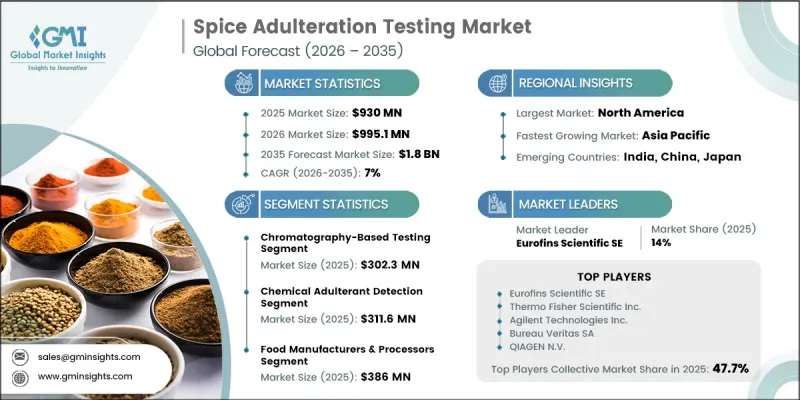
香辛料污染檢測是對香辛料產品進行科學分析,以識別、驗證和檢驗是否存在未經授權的物質、污染物或可能影響產品完整性或法規遵循的劣質物質。檢測程序採用多種先進的分析技術,旨在評估整個供應鏈(從採購和加工到分銷和最終產品化)中產品的真實性、成分和安全性。國際香辛料貿易的擴張以及全球供應鏈中產品篡改行為持續存在的經濟動機,都推動了對檢測服務的需求。隨著產品真實性對製造商、監管機構和消費者而言變得越來越重要,實驗室檢驗已成為品質保證計劃的關鍵要素。技術進步透過提高分析精度、檢測靈敏度和操作效率,進一步加速了市場發展。現代檢測平台能夠更快地提供結果、增強可追溯性並擴大篩檢範圍,使相關人員能夠在應對不斷變化的品質標準的同時,增強對全球香辛料供應網路的信心。
| 市場範圍 | |
|---|---|
| 開始年份 | 2025 |
| 預測期 | 2026-2035 |
| 上市時的市場規模 | 9.3億美元 |
| 預計金額 | 18億美元 |
| 複合年成長率 | 7% |
預計到2025年,基於層析法的檢測市場規模將達到3.023億美元。該調查方法仍然是國際法規結構內檢測和定量化學雜質的標準方法。其高精度、高可靠性、高靈敏度以及良好的監管支援使其廣泛應用,成為合規性檢測項目和綜合污染物分析的首選解決方案。
預計到2025年,食品生產加工產業的市場規模將達到3.86億美元。該行業的主導地位主要得益於嚴格的食品安全義務、廣泛的品質保證要求以及在競爭激烈的市場中維護產品聲譽的必要性。對於從事食品生產和原料採購的公司而言,例行檢查已成為必不可少的業務實踐,以確保其國內外業務運營中產品的真實性、合規性和供應鏈的完整性。
預計到2035年,北美香辛料摻假檢測市場規模將達到5.58億美元。該地區憑藉其完善的食品安全系統、嚴格的執法機制以及食品生產和進口管道中廣泛採用的檢測程序,佔據了最大的市場佔有率。監管要求強制執行廣泛的檢驗和品質評估流程,從而持續推動了對檢測服務的需求。預計在預測期內,食品加工活動的持續擴張、進口監控體系的加強以及法律規範的持續推進將進一步促進北美市場的成長。
目錄
第1章:調查方法和範圍
第2章執行摘要
第3章 行業洞察
- 產業生態系分析
- 供應商情況
- 利潤率
- 每個階段增加的價值
- 影響價值鏈的因素
- 中斷
- 影響產業的因素
- 促進因素
- 人們越來越關注食品安全和詐欺問題。
- 嚴格的食品品質監管標準
- 全球香辛料貿易的擴張和供應鏈日益複雜化。
- 產業潛在風險與挑戰
- 先進測試技術高成本
- 發展中地區的進入限制
- 市場機遇
- 攜帶式檢測設備在生產國市場的普及
- 電子商務的擴張促進了香辛料貿易的發展,也提高了對可追溯性的需求。
- 促進因素
- 成長潛力分析
- 監理情勢
- 波特的分析
- PESTLE分析
- 技術與創新展望
- 最新科技趨勢
- 新興技術
- 價格趨勢
- 按地區
- 依香辛料種類
- 未來市場趨勢
- 專利趨勢
- 貿易統計
- 主要進口國
- 主要出口國
- 永續性和環境方面
- 永續計劃
- 減少廢棄物策略
- 生產中的能源效率
- 具有環保意識的舉措
- 考慮碳足跡
第4章 競爭情勢
- 介紹
- 企業市佔率分析
- 按地區
- 北美洲
- 歐洲
- 亞太地區
- LATAM
- 中東和非洲
- 按地區
- 企業矩陣分析
- 主要市場公司的競爭分析
- 競爭定位矩陣
- 主要進展
- 併購
- 夥伴關係和聯盟
- 新產品發布
- 業務拓展計劃
第5章 市場估算與預測:依測試技術分類,2022-2035年
- 基於層析法的檢測
- 光譜測試
- 分子和DNA檢測
- 基於免疫檢測法的檢測
- 利用感測器和人工智慧進行檢測
- 物理和顯微鏡檢查
- 其他
第6章 市場估算與預測:依污染類型分類,2022-2035年
- 化學雜質的檢測
- 生物/植物污染物的檢測
- 污染物檢測
- 微生物污染檢測
- 其他
第7章 市場估價與預測:依香辛料類型分類,2022-2035年
- 種子香辛料
- 黑胡椒
- 白胡椒
- 孜然
- 香菜
- 豆蔻
- 胡蘆巴
- 芥末
- 茴香
- 其他
- 根莖類香辛料
- 薑黃
- 薑
- 辣根
- 高良薑
- 其他
- 水果和漿果香辛料
- 辣椒/紅辣椒
- 辣椒
- 香辛料
- 啪
- 香草
- 其他
- 花和柱頭香辛料
- 番紅花
- 丁香
- 刺山柑
- 其他
- 樹皮香辛料
- 肉桂
- 決明
- 肉荳蔻/肉荳蔻皮
- 其他
- 香草、香辛料和乾葉
- 牛至
- 月桂葉
- 咖哩葉
- 時間
- 迷迭香
- 其他
- 混合香辛料和調味料
- 瑪薩拉混合物
- 咖哩粉
- 調味料混合物
- 草本混合物產品
- 其他
- 其他
第8章 市場估算與預測:依最終使用者分類,2022-2035年
- 食品生產商和加工商
- 第三方測試機構
- 政府和監管機構
- 研究和學術機構
- 其他
第9章 市場估計與預測:依地區分類,2022-2035年
- 北美洲
- 美國
- 加拿大
- 歐洲
- 德國
- 英國
- 法國
- 西班牙
- 義大利
- 其他歐洲國家
- 亞太地區
- 中國
- 印度
- 日本
- 澳洲
- 韓國
- 其他亞太國家
- 拉丁美洲
- 巴西
- 墨西哥
- 阿根廷
- 其他拉丁美洲國家
- 中東和非洲
- 沙烏地阿拉伯
- 南非
- UAE
- 其他中東和非洲國家
第10章:公司簡介
- Thermo Fisher Scientific Inc.
- Agilent Technologies Inc.
- Eurofins Scientific SE
- Bureau Veritas SA
- QIAGEN NV
- Intertek Group plc
- SGS SA
- TUV Rheinland Group
- Merieux NutriSciences Corporation
- Bio-Rad Laboratories Inc.
- Authen Technologies
- Genon Laboratories Ltd
The Global Spice Adulteration Testing Market was valued at USD 930 million in 2025 and is estimated to grow at a CAGR of 7% to reach USD 1.8 billion by 2035.
Spice adulteration testing involves the scientific analysis of spice products to identify, verify, and quantify the presence of unauthorized materials, contaminants, or quality-compromising substances that may affect product integrity and regulatory compliance. Testing procedures utilize a range of advanced analytical techniques designed to evaluate product authenticity, composition, and safety throughout the supply chain, from sourcing and processing to distribution and final commercialization. Growing international trade in spices, coupled with the persistent economic motivation for product manipulation within global supply chains, continues to support demand for testing services. As product authenticity becomes increasingly important to manufacturers, regulators, and consumers, laboratory-based verification has emerged as a critical component of quality assurance programs. Technological progress has further accelerated market development by improving analytical accuracy, detection sensitivity, and operational efficiency. Modern testing platforms now provide faster turnaround times, enhanced traceability capabilities, and broader screening functionality, enabling stakeholders to address evolving quality standards while strengthening confidence in global spice supply networks.
| Market Scope | |
|---|---|
| Start Year | 2025 |
| Forecast Year | 2026-2035 |
| Start Value | $930 Million |
| Forecast Value | $1.8 Billion |
| CAGR | 7% |
The chromatography-based testing segment generated USD 302.3 million in 2025. This testing approach remains the benchmark analytical methodology for detecting and quantifying chemical adulterants across international regulatory frameworks. Its widespread adoption is supported by its high level of precision, reliability, sensitivity, and acceptance among regulatory authorities, making it a preferred solution for compliance-focused testing programs and comprehensive contaminant analysis.
The food manufacturers and processors segment accounted for USD 386 million in 2025. Their leading position is driven by stringent food safety obligations, extensive quality assurance requirements, and the need to protect product reputation within highly competitive markets. Routine testing has become an essential operational practice for companies involved in food production and ingredient sourcing, ensuring product authenticity, regulatory compliance, and supply chain integrity across domestic and international operations.
North America Spice Adulteration Testing Market is anticipated to reach USD 558 million by 2035. The region maintains the largest market share due to its comprehensive food safety framework, rigorous enforcement mechanisms, and widespread adoption of testing procedures throughout food manufacturing and import channels. Regulatory requirements mandate extensive verification and quality assessment processes, creating sustained demand for laboratory testing services. Continued expansion of food processing activities, increasing import monitoring efforts, and ongoing regulatory oversight are expected to further support market growth across North America during the forecast period.
Key companies operating in the Global Spice Adulteration Testing Market include SGS SA, Thermo Fisher Scientific Inc., Eurofins Scientific SE, Agilent Technologies Inc., Intertek Group plc, Bureau Veritas SA, QIAGEN N.V., TUV Rheinland Group, Merieux NutriSciences Corporation, Bio-Rad Laboratories Inc., Authen Technologies, and Genon Laboratories Ltd. Companies participating in the Spice Adulteration Testing Market are implementing a variety of strategic initiatives to strengthen their competitive position and expand their market presence. Investment in advanced analytical technologies remains a primary focus, enabling laboratories to improve testing accuracy, detection capabilities, and operational efficiency. Many organizations are expanding laboratory networks and increasing geographic coverage to better serve global food manufacturers, importers, and regulatory agencies. Strategic collaborations with food producers, supply chain stakeholders, and research institutions are helping companies enhance service offerings and accelerate innovation.
Table of Contents
Chapter 1 Methodology & Scope
- 1.1 Market scope and definition
- 1.2 Research design
- 1.2.1 Research approach
- 1.2.2 Data collection methods
- 1.3 Data mining sources
- 1.3.1 Global
- 1.3.2 Regional/Country
- 1.4 Base estimates and calculations
- 1.4.1 Base year calculation
- 1.4.2 Key trends for market estimation
- 1.5 Primary research and validation
- 1.5.1 Primary sources
- 1.6 Forecast model
- 1.7 Research assumptions and limitations
Chapter 2 Executive Summary
- 2.1 Industry 360° synopsis
- 2.2 Key market trends
- 2.2.1 Testing Technology
- 2.2.2 Adulteration Type
- 2.2.3 Spice Type
- 2.2.4 End User
- 2.2.5 Regional
- 2.3 TAM Analysis, 2026-2035
- 2.4 CXO perspectives: Strategic imperatives
- 2.5 Future outlook and strategic recommendations
Chapter 3 Industry Insights
- 3.1 Industry ecosystem analysis
- 3.1.1 Supplier landscape
- 3.1.2 Profit margin
- 3.1.3 Value addition at each stage
- 3.1.4 Factor affecting the value chain
- 3.1.5 Disruptions
- 3.2 Industry impact forces
- 3.2.1 Growth drivers
- 3.2.1.1 Rising concerns over food safety and adulteration
- 3.2.1.2 Stringent regulatory standards for food quality
- 3.2.1.3 Growing global spice trade and supply chain complexity
- 3.2.2 Industry pitfalls and challenges
- 3.2.2.1 High cost of advanced testing technologies
- 3.2.2.2 Limited access in developing regions
- 3.2.3 Market opportunities
- 3.2.3.1 Expansion of portable testing devices in producer-country markets
- 3.2.3.2 Growth of e-commerce spice trade increasing traceability demands
- 3.2.1 Growth drivers
- 3.3 Growth potential analysis
- 3.4 Regulatory landscape
- 3.4.1 North America
- 3.4.2 Europe
- 3.4.3 Asia Pacific
- 3.4.4 Latin America
- 3.4.5 Middle East & Africa
- 3.5 Porter's analysis
- 3.6 PESTEL analysis
- 3.7 Technology and innovation landscape
- 3.7.1 Current technological trends
- 3.7.2 Emerging technologies
- 3.8 Price trends
- 3.8.1 By region
- 3.8.2 By spice type
- 3.9 Future market trends
- 3.10 Patent landscape
- 3.11 Trade statistics (HS code)
- 3.11.1 Major importing countries
- 3.11.2 Major exporting countries
- 3.12 Sustainability and environmental aspects
- 3.12.1 Sustainable practices
- 3.12.2 Waste reduction strategies
- 3.12.3 Energy efficiency in production
- 3.12.4 Eco-friendly initiatives
- 3.13 Carbon footprint consideration
Chapter 4 Competitive Landscape, 2025
- 4.1 Introduction
- 4.2 Company market share analysis
- 4.2.1 By region
- 4.2.1.1 North America
- 4.2.1.2 Europe
- 4.2.1.3 Asia Pacific
- 4.2.1.4 LATAM
- 4.2.1.5 MEA
- 4.2.1 By region
- 4.3 Company matrix analysis
- 4.4 Competitive analysis of major market players
- 4.5 Competitive positioning matrix
- 4.6 Key developments
- 4.6.1 Mergers & acquisitions
- 4.6.2 Partnerships & collaborations
- 4.6.3 New product launches
- 4.6.4 Expansion plans
Chapter 5 Market Estimates and Forecast, By Testing Technology, 2022-2035 (USD Million) (Kilo Tons)
- 5.1 Key trends
- 5.2 Chromatography-based testing
- 5.3 Spectroscopy-based testing
- 5.4 Molecular / DNA-based testing
- 5.5 Immunoassay-based testing
- 5.6 Sensor & AI-enabled testing
- 5.7 Physical & microscopy-based testing
- 5.8 Others
Chapter 6 Market Estimates and Forecast, By Adulteration Type, 2022-2035 (USD Million) (Kilo Tons)
- 6.1 Key trends
- 6.2 Chemical adulterant detection
- 6.3 Biological / botanical adulterant detection
- 6.4 Contaminant detection
- 6.5 Microbiological contamination testing
- 6.6 Others
Chapter 7 Market Estimates and Forecast, By Spice Type, 2022-2035 (USD Million) (Kilo Tons)
- 7.1 Key trends
- 7.2 Seed spices
- 7.2.1 Black pepper
- 7.2.2 White pepper
- 7.2.3 Cumin
- 7.2.4 Coriander
- 7.2.5 Cardamom
- 7.2.6 Fenugreek
- 7.2.7 Mustard
- 7.2.8 Fennel
- 7.2.9 Others
- 7.3 Root & rhizome spices
- 7.3.1 Turmeric
- 7.3.2 Ginger
- 7.3.3 Horseradish
- 7.3.4 Galangal
- 7.3.5 Others
- 7.4 Fruit & berry spices
- 7.4.1 Chili / red chili
- 7.4.2 Paprika
- 7.4.3 Allspice
- 7.4.4 Sumac
- 7.4.5 Vanilla
- 7.4.6 Others
- 7.5 Flower & stigma spices
- 7.5.1 Saffron
- 7.5.2 Cloves
- 7.5.3 Capers
- 7.5.4 Others
- 7.6 Bark spices
- 7.6.1 Cinnamon
- 7.6.2 Cassia
- 7.6.3 Nutmeg / mace
- 7.6.4 Others
- 7.7 Herb-based spices & dried leaves
- 7.7.1 Oregano
- 7.7.2 Bay leaf
- 7.7.3 Curry leaf
- 7.7.4 Thyme
- 7.7.5 Rosemary
- 7.7.6 Others
- 7.8 Spice blends & mixed seasonings
- 7.8.1 Masala mixes
- 7.8.2 Curry powders
- 7.8.3 Seasoning blends
- 7.8.4 Mixed herb preparations
- 7.8.5 Others
- 7.9 Others
Chapter 8 Market Estimates and Forecast, By End User, 2022-2035 (USD Million) (Kilo Tons)
- 8.1 Key trends
- 8.2 Food manufacturers & processors
- 8.3 Third-party testing laboratories
- 8.4 Government & regulatory bodies
- 8.5 Research & academic institutions
- 8.6 Others
Chapter 9 Market Estimates and Forecast, By Region, 2022-2035 (USD Million) (Kilo Tons)
- 9.1 Key trends
- 9.2 North America
- 9.2.1 U.S.
- 9.2.2 Canada
- 9.3 Europe
- 9.3.1 Germany
- 9.3.2 UK
- 9.3.3 France
- 9.3.4 Spain
- 9.3.5 Italy
- 9.3.6 Rest of Europe
- 9.4 Asia Pacific
- 9.4.1 China
- 9.4.2 India
- 9.4.3 Japan
- 9.4.4 Australia
- 9.4.5 South Korea
- 9.4.6 Rest of Asia Pacific
- 9.5 Latin America
- 9.5.1 Brazil
- 9.5.2 Mexico
- 9.5.3 Argentina
- 9.5.4 Rest of Latin America
- 9.6 Middle East and Africa
- 9.6.1 Saudi Arabia
- 9.6.2 South Africa
- 9.6.3 UAE
- 9.6.4 Rest of Middle East and Africa
Chapter 10 Company Profiles
- 10.1 Thermo Fisher Scientific Inc.
- 10.2 Agilent Technologies Inc.
- 10.3 Eurofins Scientific SE
- 10.4 Bureau Veritas SA
- 10.5 QIAGEN N.V.
- 10.6 Intertek Group plc
- 10.7 SGS SA
- 10.8 TUV Rheinland Group
- 10.9 Merieux NutriSciences Corporation
- 10.10 Bio-Rad Laboratories Inc.
- 10.11 Authen Technologies
- 10.12 Genon Laboratories Ltd
