


 |
市場調查報告書
商品編碼
2083102
寡核苷酸治療藥物市場:商業機會、成長要素、產業趨勢分析及2026-2035年預測Oligonucleotide Therapeutics Market Opportunity, Growth Drivers, Industry Trend Analysis, and Forecast 2026 - 2035 |
||||||

全球寡核苷酸療法市場預計到 2025 年將達到 77 億美元,並以 23.4% 的複合年成長率成長,到 2035 年將達到 721 億美元。
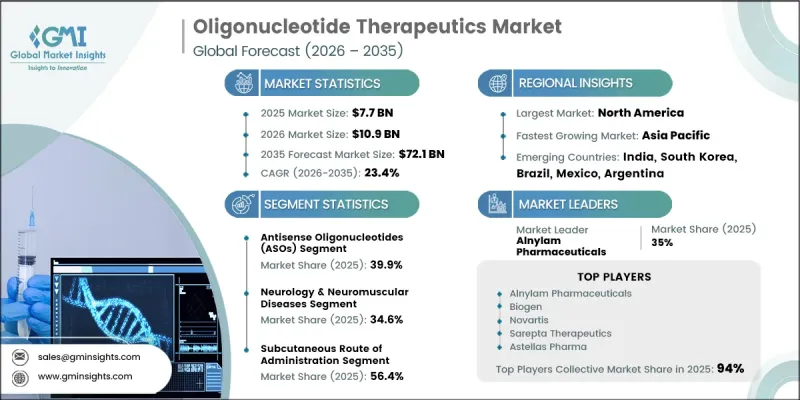
隨著核酸藥物從治療有限的罕見疾病發展成為涵蓋多個臨床領域的更廣泛、更成熟的治療類別,寡核苷酸療法市場正經歷著顯著的結構性轉型。 RNA醫學的加速發展、遞送技術的改進以及臨床療效的提升,正在推動這一市場擴張。先進的偶聯化學技術的引入顯著提高了藥物穩定性、標靶遞送的精準性和給藥的便利性,使更多患者能夠獲得治療。同時,寡核苷酸療法的應用範圍正從罕見遺傳疾病擴展到更常見的慢性病和代謝性疾病,大大拓展了商業性機會。法規核准數量的穩定成長反映出人們對RNA標靶療法的安全性和有效性的信心日益增強。生物製藥研發投入的增加正在加速產品線的擴張,而製藥公司則專注於下一代RNA平台,以提高治療的精準性和永續性。這些因素,加上簡化的劑量形式和延長的給藥間隔提高了患者的依從性,預計將有助於全球寡核苷酸治療市場持續強勁的長期成長。
| 市場範圍 | |
|---|---|
| 開始年份 | 2025 |
| 預測期 | 2026-2035 |
| 上市時的市場規模 | 77億美元 |
| 預計金額 | 721億美元 |
| 複合年成長率 | 23.4% |
預計到2025年,反義寡核苷酸將佔39.9%的市佔率。這一主導地位源自於其已確立的臨床效用以及在多個治療領域的廣泛應用。這些單鏈核酸序列透過與特定的傳訊RNA(mRNA)標靶結合發揮作用,從而透過分解和翻譯干擾機制來調控基因表現表現。分子設計和遞送系統的不斷進步進一步提升了其臨床意義和商業性應用。
預計到2025年,皮下給藥將佔56.4%的市佔率。由於其與最新的RNA藥物相容,皮下給藥途徑日益受到關注,這些藥物能夠實現患者自我給藥,並減少對臨床環境的依賴。皮下給藥途徑正逐漸成為長期治療方案的首選,因為它提高了患者的便利性,增強了治療依從性,並減輕了醫療系統的負擔。長效製劑的日益普及進一步鞏固了其優勢。
預計到2025年,北美寡核苷酸療法市場佔有率將達到57.9%,憑藉生物製藥領域的強勁創新、先進的醫療基礎設施和有利的醫保報銷機制,繼續保持主導地位。該地區受益於RNA療法的早期應用以及完善的法規環境,有利於藥物的快速批准。對罕見疾病研究的大量投入以及高價療法的強勁市場滲透,將繼續鞏固北美市場的主導地位。
目錄
第1章:調查方法和範圍
第2章執行摘要
第3章 行業洞察
- 產業生態系分析
- 影響產業的因素
- 促進因素
- 針對多種疾病適應症的新型寡核苷酸療法獲批數量增加
- 罕見遺傳病患疾病率不斷上升以及診斷技術的進步
- 透過孤兒藥認定和加速核准程序提供強而有力的監管支持。
- 產業潛在風險與挑戰
- 高昂的醫療費用和報銷難題
- 複雜的製造流程和嚴格的品質要求
- 它對特定基因或分子標靶以外的標靶的應用受到限制。
- 市場機遇
- 將寡核苷酸療法的應用範圍擴大到高發生慢性疾病,例如心血管疾病、代謝性疾病和神經退化性疾病。
- 增加對下一代遞送平台和組織靶向寡核苷酸技術的投資。
- 促進因素
- 成長潛力分析
- 監理情勢
- 技術與創新展望
- 最新科技趨勢
- 新興技術
- 價格分析
- 對過去價格趨勢的分析
- 價格分析:依分子類型
- 波特的分析
- PESTLE分析
- 投資與資金籌措分析
- 開發平臺和臨床試驗趨勢
- 未來市場趨勢
- 人工智慧和生成式人工智慧對市場的影響
第4章 競爭情勢
- 介紹
- 企業市佔率分析
- 北美洲
- 歐洲
- 亞太地區
- 企業矩陣分析
- 主要市場公司的競爭分析
- 競爭定位矩陣
- 主要進展
- 併購
- 夥伴關係和聯盟
- 新產品發布
- 業務拓展計劃
第5章 市場估計與預測:依分子類型分類,2022-2035年
- 反義寡核苷酸(ASO)
- 小干擾RNA(siRNA)
- 適體
第6章 市場估計與預測:依適應症分類,2022-2035年
- 神經系統和神經肌肉疾病
- 罕見的遺傳和代謝疾病
- 心血管/血脂異常症
- 血液疾病
- 眼科
- 其他治療領域
第7章 市場估計與預測:依給藥途徑分類,2022-2035年
- 皮下
- 靜脈
- 鞘內腔
- 玻璃體內注射
第8章 市場估算與預測:依最終用途分類,2022-2035年
- 醫院
- 專科診所及門診服務
- 居家醫療
- 研究機構和大學醫院
第9章 市場估計與預測:依地區分類,2022-2035年
- 北美洲
- 美國
- 加拿大
- 歐洲
- 德國
- 英國
- 法國
- 西班牙
- 義大利
- 荷蘭
- 亞太地區
- 中國
- 印度
- 日本
- 澳洲
- 韓國
- 拉丁美洲
- 巴西
- 墨西哥
- 阿根廷
- 中東和非洲
- 南非
- 沙烏地阿拉伯
- UAE
第10章:公司簡介
- Alnylam Pharmaceuticals
- Arrowhead Pharmaceuticals
- Astellas Pharma
- AstraZeneca
- Biogen
- Ionis Pharmaceuticals
- Novartis
- NS Pharma
- Novo Nordisk
- Sarepta Therapeutics
- Sanofi
The Global Oligonucleotide Therapeutics Market was valued at USD 7.7 billion in 2025 and is estimated to grow at a CAGR of 23.4% to reach USD 72.1 billion by 2035.
The oligonucleotide therapeutics market is undergoing a significant structural transformation as nucleic acid-based drug modalities evolve from narrowly focused rare-disease treatments into a broader and more established therapeutic category across multiple clinical areas. Increasing scientific advancements in RNA-based medicine, improved delivery technologies, and growing clinical validation are collectively driving the expansion of this market. The integration of advanced conjugation chemistries has significantly improved drug stability, targeted delivery, and dosing convenience, supporting wider patient adoption. At the same time, the application of oligonucleotide therapies is extending beyond rare genetic disorders into more prevalent chronic and metabolic diseases, substantially broadening the commercial opportunity base. Regulatory approvals have increased steadily, reflecting rising confidence in the safety and efficacy of RNA-targeted treatments. Growing investment in biopharmaceutical research and development is accelerating pipeline expansion, while pharmaceutical companies are focusing on next-generation RNA platforms to enhance therapeutic precision and durability. These factors, combined with improved patient compliance through simplified administration formats and extended dosing intervals, are expected to sustain strong long-term growth across the global oligonucleotide therapeutics market.
| Market Scope | |
|---|---|
| Start Year | 2025 |
| Forecast Year | 2026-2035 |
| Start Value | $7.7 Billion |
| Forecast Value | $72.1 Billion |
| CAGR | 23.4% |
In 2025, antisense oligonucleotides accounted for 39.9% share. This dominance is attributed to their well-established clinical utility and extensive application across multiple therapeutic areas. These single-stranded nucleic acid sequences function by binding to specific messenger RNA targets, enabling gene expression modulation through degradation or translation interference mechanisms. Continued advancements in molecular design and delivery systems are further strengthening their clinical relevance and commercial adoption.
The subcutaneous administration route represented 56.4% share in 2025. Its prominence is driven by its compatibility with modern RNA-based drugs that allow self-administration and reduced dependence on clinical settings. This route improves patient convenience, enhances treatment adherence, and reduces healthcare system burden, making it a preferred option for long-term therapeutic regimens. Expanding use of long-acting formulations continues to reinforce its dominant position.
North America Oligonucleotide Therapeutics Market accounted for 57.9% share in 2025, maintaining its leadership position due to strong biopharmaceutical innovation, advanced healthcare infrastructure, and favorable reimbursement frameworks. The region benefits from early adoption of RNA-based therapies and a well-established regulatory environment that supports accelerated drug approvals. High investment in rare disease research and strong commercial uptake of premium-priced therapies continue to support sustained market dominance across North America.
Major companies operating in the global oligonucleotide therapeutics market include Alnylam Pharmaceuticals, Ionis Pharmaceuticals, Sarepta Therapeutics, Biogen, Astellas Pharma, Novartis, AstraZeneca, Novo Nordisk, Sanofi, Arrowhead Pharmaceuticals, and NS Pharma. Companies operating in the oligonucleotide therapeutics market are strengthening their competitive position through continuous investment in RNA platform technologies, advanced drug delivery systems, and precision medicine approaches. Market participants are expanding clinical pipelines across multiple therapeutic areas while enhancing formulation strategies to improve stability, efficacy, and patient compliance. Strategic collaborations with biotechnology firms, research institutions, and academic organizations are accelerating innovation and shortening development timelines. Companies are also focusing on scalable manufacturing capabilities to support growing commercial demand and ensure consistent product quality.
Table of Contents
Chapter 1 Methodology and Scope
- 1.1 Market scope and definition
- 1.2 Research approach
- 1.3 Quality commitments
- 1.3.1 GMI AI policy & data integrity commitment
- 1.3.1.1 Source consistency protocol
- 1.3.1 GMI AI policy & data integrity commitment
- 1.4 Research trail & confidence scoring
- 1.4.1 Research trail components
- 1.4.2 Scoring components
- 1.5 Data collection
- 1.5.1 Partial list of primary sources
- 1.6 Data mining sources
- 1.6.1 Paid sources
- 1.6.1.1 Sources, by region
- 1.6.1 Paid sources
- 1.7 Base estimates and calculations
- 1.7.1 Base year calculation for any one approach
- 1.8 Forecast model
- 1.8.1 Quantified market impact analysis
- 1.8.1.1 Mathematical impact of growth parameters on forecast
- 1.8.1 Quantified market impact analysis
- 1.9 Research transparency addendum
- 1.9.1 Source attribution framework
- 1.9.2 Quality assurance metrics
- 1.9.3 Our commitment to trust
Chapter 2 Executive Summary
- 2.1 Industry 360° synopsis
- 2.2 Key market trends
- 2.2.1 Regional trends
- 2.2.2 Molecule type trends
- 2.2.3 Indication trends
- 2.2.4 Route of administration trends
- 2.2.5 End use trends
- 2.3 CXO perspectives: Strategic imperatives
Chapter 3 Industry Insights
- 3.1 Industry ecosystem analysis
- 3.2 Industry impact forces
- 3.2.1 Growth drivers
- 3.2.1.1 Increasing approvals of novel oligonucleotide therapeutics across multiple disease indications
- 3.2.1.2 Rising prevalence and improved diagnosis of rare genetic disorders
- 3.2.1.3 Strong regulatory support through orphan drug designation and expedited approval pathways
- 3.2.2 Industry pitfalls and challenges
- 3.2.2.1 High treatment costs and reimbursement challenges
- 3.2.2.2 Complex manufacturing processes and stringent quality requirements
- 3.2.2.3 Limited applicability beyond specific genetic or molecular targets
- 3.2.3 Market opportunities
- 3.2.3.1 Expansion of oligonucleotide therapeutics into high-prevalence chronic diseases such as cardiovascular, metabolic, and neurodegenerative disorders
- 3.2.3.2 Growing investment in next-generation delivery platforms and tissue-targeted oligonucleotide technologies
- 3.2.1 Growth drivers
- 3.3 Growth potential analysis
- 3.4 Regulatory landscape
- 3.4.1 North America
- 3.4.2 Europe
- 3.4.3 Asia Pacific
- 3.4.4 Latin America
- 3.4.5 Middle East and Africa
- 3.5 Technology and innovation landscape
- 3.5.1 Current technological trends
- 3.5.2 Emerging technologies
- 3.6 Pricing analysis (Driven by Primary Research)
- 3.6.1 Historical price trend analysis
- 3.6.2 Pricing analysis, by molecule type
- 3.7 Porter’s analysis
- 3.8 PESTEL analysis
- 3.9 Investment & funding analysis
- 3.10 Pipeline and clinical trial landscape
- 3.11 Future market trends
- 3.12 Impact of AI & Generative AI on the market
Chapter 4 Competitive Landscape, 2025
- 4.1 Introduction
- 4.2 Company market share analysis
- 4.2.1 North America
- 4.2.2 Europe
- 4.2.3 Asia Pacific
- 4.3 Company matrix analysis
- 4.4 Competitive analysis of major market players
- 4.5 Competitive positioning matrix
- 4.6 Key developments
- 4.6.1 Merger and acquisition
- 4.6.2 Partnership and collaboration
- 4.6.3 New product launches
- 4.6.4 Expansion plans
Chapter 5 Market Estimates and Forecast, By Molecule Type, 2022 - 2035 ($ Mn)
- 5.1 Key trends
- 5.2 Antisense oligonucleotides (ASOs)
- 5.3 Small interfering RNA (siRNA)
- 5.4 Aptamers
Chapter 6 Market Estimates and Forecast, By Indication, 2022 - 2035 ($ Mn)
- 6.1 Key trends
- 6.2 Neurology & neuromuscular diseases
- 6.3 Rare hereditary & metabolic diseases
- 6.4 Cardiovascular & lipid disorders
- 6.5 Hematological disorders
- 6.6 Ophthalmology
- 6.7 Other therapeutic areas
Chapter 7 Market Estimates and Forecast, By Route of Administration, 2022 - 2035 ($ Mn)
- 7.1 Key trends
- 7.2 Subcutaneous
- 7.3 Intravenous
- 7.4 Intrathecal
- 7.5 Intravitreal
Chapter 8 Market Estimates and Forecast, By End Use, 2022 - 2035 ($ Mn)
- 8.1 Key trends
- 8.2 Hospitals
- 8.3 Specialty clinics & ambulatory care
- 8.4 Home care settings
- 8.5 Research institutes & academic medical centers
Chapter 9 Market Estimates and Forecast, By Region, 2022 - 2035 ($ Mn)
- 9.1 Key trends
- 9.2 North America
- 9.2.1 U.S.
- 9.2.2 Canada
- 9.3 Europe
- 9.3.1 Germany
- 9.3.2 UK
- 9.3.3 France
- 9.3.4 Spain
- 9.3.5 Italy
- 9.3.6 Netherlands
- 9.4 Asia Pacific
- 9.4.1 China
- 9.4.2 India
- 9.4.3 Japan
- 9.4.4 Australia
- 9.4.5 South Korea
- 9.5 Latin America
- 9.5.1 Brazil
- 9.5.2 Mexico
- 9.5.3 Argentina
- 9.6 Middle East and Africa
- 9.6.1 South Africa
- 9.6.2 Saudi Arabia
- 9.6.3 UAE
Chapter 10 Company Profiles
- 10.1 Alnylam Pharmaceuticals
- 10.2 Arrowhead Pharmaceuticals
- 10.3 Astellas Pharma
- 10.4 AstraZeneca
- 10.5 Biogen
- 10.6 Ionis Pharmaceuticals
- 10.7 Novartis
- 10.8 NS Pharma
- 10.9 Novo Nordisk
- 10.10 Sarepta Therapeutics
- 10.11 Sanofi

 2026-2030年全球寡核苷酸療法市場
 全球寡核苷酸CDMO市場(至2031年):按服務(契約製造(臨床和商業)及研發)、類型(ASO和siRNA)、應用(治療、研究和診斷)、最終用戶(製藥和生物技術)、地區和競爭對手分類
 寡核苷酸治療市場:全球產業分析、市場規模、市佔率及2026年至2033年預測(依寡核苷酸類型、應用、遞送系統、最終用戶、給藥途徑、國家及地區分類)
 全球寡核苷酸CDMO市場規模、佔有率、趨勢和成長分析報告(2026-2034年)
 寡核苷酸 CDMO 市場機會、成長促進因素、產業趨勢分析及 2026-2035 年預測。
 寡核苷酸治療藥物市場規模、佔有率和成長分析:按類型、作用機制、遞送技術、給藥途徑、應用、標靶分子、最終用戶和地區分類-2026-2033年產業預測
 寡核苷酸治療藥物市場規模、佔有率和趨勢分析報告:按寡核苷酸類型、治療領域、給藥途徑、地區和細分市場預測(2026-2033 年)
 2026年長寡核苷酸叢集合成捕獲全球市場報告PNA共軛物市場報告:至2035年的趨勢、預測和競爭分析2026年全球寡核苷酸療法市場報告