


 |
市場調查報告書
商品編碼
2083098
2026 年至 2035 年停經後女性健康補充品市場的商業機會、成長要素、產業趨勢和預測。Postmenopause Womens Health Supplements Market Opportunity, Growth Drivers, Industry Trend Analysis, and Forecast 2026 - 2035 |
||||||

全球停經後女性健康補充品市場預計到 2025 年將達到 128 億美元,年複合成長率為 6.4%,到 2035 年將達到 234 億美元。
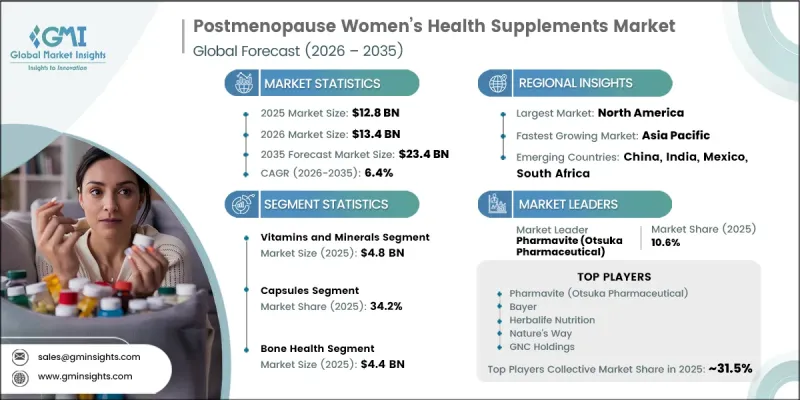
由於停經後後女性健康問題日益普遍,包括荷爾蒙失衡、骨骼密度下降、心血管疾病、認知功能衰退和代謝失調等,停經後女性健康補充劑市場持續擴張。停經後女性數量的成長,使得旨在支持健康老齡化和整體健康的營養產品需求持續旺盛。該市場涵蓋了各種膳食補充劑和營養保健品,旨在滿足停經後女性不斷變化的營養需求。這些產品通常含有維生素、礦物質、益生菌、ω-3脂肪酸和植物來源成分,有助於增強骨骼、改善心血管功能、提升認知功能、促進代謝健康和維持荷爾蒙平衡。人們健康意識的提高、對長期健康的日益關注以及消費者對膳食補充劑偏好的不斷增強,都持續推動著市場成長。此外,透過數位零售管道、直接面對消費者的平台和遠端醫療服務,消費者更容易獲得保健品,這提高了產品的可及性,並進一步加速了停經後女性保健品市場的成長。
| 市場範圍 | |
|---|---|
| 開始年份 | 2025 |
| 預測期 | 2026-2035 |
| 初始市場規模 | 128億美元 |
| 預計金額 | 234億美元 |
| 複合年成長率 | 6.4% |
停經後是指女性連續12個月沒有月經後開始的階段,通常發生在40歲末或50歲末。在這個階段,女性更容易患上骨質疏鬆症、心血管疾病、荷爾蒙失衡和其他與老齡化相關的健康問題,因此她們對預防性營養支持的需求也隨之增加。人們對健康老齡化和積極健康管理的日益重視,持續推動著針對性營養補充劑的需求。透過線上零售平台、直銷通路和遠端醫療服務擴大產品供應,進一步促進了市場成長。停經後女性健康補充品市場的領導者正不斷致力於拓展產品系列,以滿足消費者不斷變化的健康需求。
預計到2025年,維生素和礦物質市場規模將達到48億美元。由於維生素和礦物質在解決營養缺乏和更年期相關的生理變化方面發揮關鍵作用,該細分市場持續佔據主導地位。人們對骨骼健康、心血管健康、免疫功能下降和代謝失衡的日益關注,推動了消費者對微量營養素補充劑的持續需求。微量營養素補充劑已確立的健康益處和廣泛的臨床認可,進一步鞏固了該細分市場的市場地位。
2025年,膠囊劑型佔了34.2%的市佔率。膠囊劑型因其服用方便、劑量精準以及能夠保持活性成分的穩定性和有效性,仍然是最受歡迎的劑型之一。許多消費者偏好膠囊劑型,因為它們服用方便、幾乎沒有味道,而且通常對身體負擔較小。這種劑型廣泛用於補充人體必需的維生素、礦物質、植物萃取物和其他營養物質,這些物質有助於維持骨骼健康、荷爾蒙平衡和心血管健康。
預計到2025年,北美停經後女性健康補充品市場將佔據40%的市場佔有率,並在2035年之前以6%的複合年成長率成長。該地區之所以能保持主導地位,得益於消費者對更年期健康的高認知度、較高的醫療保健支出以及完善的零售和數位分銷網路。除了女性人口老化之外,骨質疏鬆症、心血管疾病和其他更年期相關健康問題的日益普遍也持續推動著該地區對專業營養補充劑的強勁需求。
目錄
第1章:調查方法和範圍
第2章執行摘要
第3章 行業洞察
- 產業生態系分析
- 影響產業的因素
- 促進因素
- 老年女性人數不斷增加
- 人們對停經後健康問題的認知不斷提高
- 人們對醫療保健的興趣日益濃厚
- 膳食補充品配方技術的進步
- 產業潛在風險與挑戰
- 缺乏證據支持某些膳食補充劑的臨床療效
- 嚴格的法律規範
- 市場機遇
- 對植物來源和天然補充劑的需求日益成長
- 與數位健康平台整合
- 促進因素
- 成長潛力分析
- 技術展望
- 目前技術
- 新興技術
- 價格分析
- 監理情勢
- 波特的分析
- PESTLE分析
- 未來市場趨勢
- 消費行為分析
- 人工智慧和生成式人工智慧對市場的影響
- 未來市場趨勢
第4章 競爭情勢
- 介紹
- 企業市佔率分析
- 北美洲
- 歐洲
- 亞太地區
- 企業矩陣分析
- 主要市場公司的競爭分析
- 競爭定位矩陣
- 主要進展
- 併購
- 夥伴關係和聯盟
- 新產品發布
- 業務拓展計劃
第5章 市場估算與預測:依產品類型分類,2022-2035年
- 維生素和礦物質
- 草藥補充劑
- 植物雌激素
- 酵素補充劑
- 其他產品類型
第6章 市場估計與預測:依類型分類,2022-2035年
- 膠囊
- 藥片
- 軟凝膠
- 粉末
- 液體
- 軟糖
第7章 市場估計與預測:依應用領域分類,2022-2035年
- 骨骼健康
- 心血管健康
- 支持情緒和認知功能
- 護膚和護髮
- 其他用途
第8章 市場估算與預測:依通路分類,2022-2035年
- 離線
- 零售藥房
- 健康養生專賣店
- 超級市場和大賣場
- 線上
- 電子商務
- 公司網站
第9章 市場估計與預測:依地區分類,2022-2035年
- 北美洲
- 美國
- 加拿大
- 歐洲
- 德國
- 英國
- 法國
- 西班牙
- 義大利
- 荷蘭
- 亞太地區
- 中國
- 日本
- 印度
- 澳洲
- 韓國
- 拉丁美洲
- 巴西
- 墨西哥
- 阿根廷
- 中東和非洲
- 南非
- 沙烏地阿拉伯
- UAE
第10章:公司簡介
- Amway
- 21st Century HealthCare
- Bayer
- Barlean's Organic Oils
- Carlyle Nutritionals
- DHC
- GNC Holdings
- Herbalife Nutrition
- Haleon(Centrum)
- Lignans for Life
- Nature's Way
- Now Foods
- Nestle Health Science
- Nutricost
- Pharmavite(Otsuka Pharmaceutical)
- Puritan's Pride
- Vitabiotics
The Global Postmenopause Women's Health Supplements Market was valued at USD 12.8 billion in 2025 and is estimated to grow at a CAGR of 6.4% to reach USD 23.4 billion by 2035.
The postmenopause women's health supplements market is experiencing expansion due to the increasing prevalence of health conditions associated with the postmenopausal stage of life, including hormonal changes, reduced bone mineral density, cardiovascular concerns, cognitive decline, and metabolic disorders. The growing population of postmenopausal women is creating sustained demand for nutritional products designed to support healthy aging and overall wellness. This market includes a broad range of dietary supplements and nutraceutical formulations developed to meet the changing nutritional requirements of women after menopause. These products commonly contain vitamins, minerals, probiotics, omega-3 fatty acids, and plant-based ingredients that help promote bone strength, cardiovascular function, cognitive performance, metabolic health, and hormonal well-being. Rising awareness of preventive healthcare, greater focus on long-term wellness, and increasing consumer preference for nutritional supplementation continue to support market growth. In addition, expanding access to health supplements through digital retail channels, direct-to-consumer platforms, and telehealth services is improving product availability and further accelerating the growth of the postmenopause women's health supplements market.
| Market Scope | |
|---|---|
| Start Year | 2025 |
| Forecast Year | 2026-2035 |
| Start Value | $12.8 Billion |
| Forecast Value | $23.4 Billion |
| CAGR | 6.4% |
Postmenopause is the stage that begins after a woman has completed 12 consecutive months without menstruation, generally occurring between the late 40s and late 50s. During this phase, women experience a greater likelihood of developing osteoporosis, cardiovascular conditions, hormonal changes, and other age-related health concerns, increasing the need for preventive nutritional support. Growing awareness regarding healthy aging and proactive wellness management continues to drive demand for targeted dietary supplementation. Expanding product availability through online retail platforms, direct-to-consumer sales channels, and telehealth services is further supporting market growth. Major companies participating in the postmenopause women's health supplements market continue to focus on expanding their product portfolios to address evolving consumer health needs.
The vitamins and minerals segment generated USD 4.8 billion in 2025. This segment continues to lead because vitamins and minerals play a vital role in addressing nutritional deficiencies and physiological changes associated with menopause. Growing concerns related to declining bone health, cardiovascular wellness, immune function, and metabolic balance continue to increase consumer demand for micronutrient-based supplementation. Their well-established health benefits and broad clinical acceptance continue to strengthen the segment's market position.
The capsules segment accounted for 34.2% share in 2025. Capsules remain one of the most widely preferred dosage forms due to their convenience, precise dosing, and ability to maintain the stability and effectiveness of active ingredients. Many consumers favor capsule formulations because they are easy to consume, have minimal taste, and are generally well tolerated. This format is commonly used to deliver essential vitamins, minerals, botanical extracts, and other nutritional ingredients that support bone health, hormonal balance, and cardiovascular wellness.
North America Postmenopause Women's Health Supplements Market accounted for 40% share in 2025 and is projected to grow at a CAGR of 6% throughout 2035. The region maintains its leading position due to strong consumer awareness regarding menopausal health, high healthcare spending, and well-developed retail and digital distribution networks. A growing aging female population, along with the increasing prevalence of osteoporosis, cardiovascular disorders, and other menopause-related health conditions, continues to support strong demand for specialized nutritional supplements across the regional market.
Major companies operating in the global postmenopause women's health supplements market include Nature's Way, Bayer, Amway, NOW Foods, Vitabiotics, Pharmavite (Otsuka Pharmaceutical), DHC, Barlean's Organic Oils, Haleon (Centrum), Puritan's Pride, Herbalife Nutrition, Nutricost, 21st Century HealthCare, Carlyle Nutritionals, Nestle Health Science, GNC Holdings, and Lignans for Life. Companies operating in the postmenopause women's health supplements market are strengthening their competitive position by expanding product portfolios with scientifically formulated supplements that address bone health, cardiovascular wellness, hormonal balance, cognitive function, and overall healthy aging. Many manufacturers are increasing investments in research and development to introduce innovative formulations containing clinically supported ingredients and improved nutrient combinations. Strategic partnerships, acquisitions, and collaborations with healthcare providers and distribution partners are helping companies broaden their market reach. Businesses are also strengthening their presence through e-commerce platforms, direct-to-consumer channels, and personalized wellness solutions to improve customer engagement.
Table of Contents
Chapter 1 Methodology and Scope
- 1.1 Market scope and definition
- 1.2 Research approach
- 1.3 Quality commitments
- 1.3.1 GMI AI policy and data integrity commitment
- 1.3.1.1 Source consistency protocol
- 1.3.1 GMI AI policy and data integrity commitment
- 1.4 Research trail and confidence scoring
- 1.4.1 Research trail components
- 1.4.2 Scoring components
- 1.5 Data collection
- 1.5.1 Partial list of primary sources
- 1.6 Data mining sources
- 1.6.1 Paid sources
- 1.6.1.1 Sources, by region
- 1.6.1 Paid sources
- 1.7 Base estimates and calculations
- 1.7.1 Revenue share analysis
- 1.7.2 Base year calculation
- 1.8 Forecast model
- 1.9 Research transparency addendum
- 1.9.1 Source attribution framework
- 1.9.2 Quality assurance metrics
- 1.9.3 Our commitment to trust
Chapter 2 Executive Summary
- 2.1 Industry 360° synopsis
- 2.2 Key market trends
- 2.2.1 Regional trends
- 2.2.2 Product type trends
- 2.2.3 Form trends
- 2.2.4 Application trends
- 2.2.5 Distribution channel trends
- 2.3 CXO perspectives: Strategic imperatives
Chapter 3 Industry Insights
- 3.1 Industry ecosystem analysis
- 3.2 Industry impact forces
- 3.2.1 Growth drivers
- 3.2.1.1 Growing aging female population
- 3.2.1.2 Rising awareness of postmenopausal health issues
- 3.2.1.3 Increasing preference for preventive healthcare
- 3.2.1.4 Advancements in supplement formulation
- 3.2.2 Industry pitfalls and challenges
- 3.2.2.1 Lack of clinical validation for some supplements
- 3.2.2.2 Stringent regulatory frameworks
- 3.2.3 Market opportunities
- 3.2.3.1 Rising demand for plant-based & natural supplements
- 3.2.3.2 Integration with digital health platforms
- 3.2.1 Growth drivers
- 3.3 Growth potential analysis
- 3.4 Technology landscape
- 3.4.1 Current technology
- 3.4.2 Emerging technologies
- 3.5 Pricing Analysis (Driven by Primary Research)
- 3.6 Regulatory landscape (Driven by Primary Research)
- 3.6.1 North America
- 3.6.2 Europe
- 3.6.3 Asia Pacific
- 3.6.4 Latin America
- 3.6.5 Middle East and Africa
- 3.7 Porter’s analysis
- 3.8 PESTEL analysis
- 3.9 Future market trends
- 3.10 Consumer behaviour analysis
- 3.11 Impact of AI and generative AI on the market (Driven by primary research)
- 3.12 Future market trends (Driven by primary research)
Chapter 4 Competitive Landscape, 2025
- 4.1 Introduction
- 4.2 Company market share analysis
- 4.2.1 North America
- 4.2.2 Europe
- 4.2.3 Asia Pacific
- 4.3 Company matrix analysis
- 4.4 Competitive analysis of major market players
- 4.5 Competitive positioning matrix
- 4.6 Key developments
- 4.6.1 Mergers and acquisitions
- 4.6.2 Partnerships and collaborations
- 4.6.3 New product launches
- 4.6.4 Expansion plans
Chapter 5 Market Estimates and Forecast, By Product Type, 2022-2035 ($ Mn)
- 5.1 Key trends
- 5.2 Vitamins and minerals
- 5.3 Herbal supplements
- 5.4 Phytoestrogen-based supplements
- 5.5 Enzyme supplements
- 5.6 Other product types
Chapter 6 Market Estimates and Forecast, By Form, 2022-2035 ($ Mn)
- 6.1 Key trends
- 6.2 Capsules
- 6.3 Tablets
- 6.4 Softgels
- 6.5 Powders
- 6.6 Liquid formulations
- 6.7 Gummies
Chapter 7 Market Estimates and Forecast, By Application, 2022-2035 ($ Mn)
- 7.1 Key trends
- 7.2 Bone health
- 7.3 Cardiovascular health
- 7.4 Mood and cognitive support
- 7.5 Skin and hair care
- 7.6 Other applications
Chapter 8 Market Estimates and Forecast, By Distribution Channel, 2022-2035 ($ Mn)
- 8.1 Key trends
- 8.2 Offline
- 8.2.1 Retail pharmacies
- 8.2.2 Health and wellness stores
- 8.2.3 Supermarkets and hypermarkets
- 8.3 Online
- 8.3.1 E-commerce
- 8.3.2 Company websites
Chapter 9 Market Estimates and Forecast, By Region, 2022-2035 ($ Mn)
- 9.1 Key trends
- 9.2 North America
- 9.2.1 U.S.
- 9.2.2 Canada
- 9.3 Europe
- 9.3.1 Germany
- 9.3.2 UK
- 9.3.3 France
- 9.3.4 Spain
- 9.3.5 Italy
- 9.3.6 Netherlands
- 9.4 Asia Pacific
- 9.4.1 China
- 9.4.2 Japan
- 9.4.3 India
- 9.4.4 Australia
- 9.4.5 South Korea
- 9.5 Latin America
- 9.5.1 Brazil
- 9.5.2 Mexico
- 9.5.3 Argentina
- 9.6 Middle East and Africa
- 9.6.1 South Africa
- 9.6.2 Saudi Arabia
- 9.6.3 UAE
Chapter 10 Company Profiles
- 10.1 Amway
- 10.2 21st Century HealthCare
- 10.3 Bayer
- 10.4 Barlean's Organic Oils
- 10.5 Carlyle Nutritionals
- 10.6 DHC
- 10.7 GNC Holdings
- 10.8 Herbalife Nutrition
- 10.9 Haleon (Centrum)
- 10.10 Lignans for Life
- 10.11 Nature's Way
- 10.12 Now Foods
- 10.13 Nestle Health Science
- 10.14 Nutricost
- 10.15 Pharmavite (Otsuka Pharmaceutical)
- 10.16 Puritan's Pride
- 10.17 Vitabiotics

 2026-2034年全球停經後女性健康補充劑市場規模、佔有率、趨勢和成長分析報告
 女性功能性荷爾蒙健康市場預測至2034年—按產品類型、功能成分、生命階段、分銷管道、應用、最終用戶和地區分類的全球分析女性荷爾蒙健康補充劑市場預測(至2034年):按產品類型、成分、劑型、分銷管道、應用、最終用戶和地區分類的全球分析
 女性健康治療市場 - 全球市場預測 2026-2032陰道保濕劑和潤滑劑市場-2026-2032年全球市場預測女性健康市場:2026-2032年全球市場預測,依產品、應用、通路、最終用戶和年齡層別分類
 性健康市場:按產品類型、性別、分銷管道和地區分類
 女性健康市場規模、佔有率、趨勢和預測:按年齡層、應用、分銷管道和地區分類,2026-2034 年全球女性健康照護市場規模、佔有率、趨勢和成長分析報告(2026-2034)
 女性健康照護市場分析及預測(至2035年):依類型、產品類型、服務、技術、應用、最終使用者、設備、功能及解決方案分類