

 |
市場調查報告書
商品編碼
2083082
高階護髮市場機會、成長要素、產業趨勢分析及2026-2035年預測Premium Hair Care Market Opportunity, Growth Drivers, Industry Trend Analysis, and Forecast 2026 - 2035 |
||||||

全球高階護髮市場預計到 2025 年價值 371 億美元,年複合成長率為 6.2%,到 2035 年將達到 681 億美元。
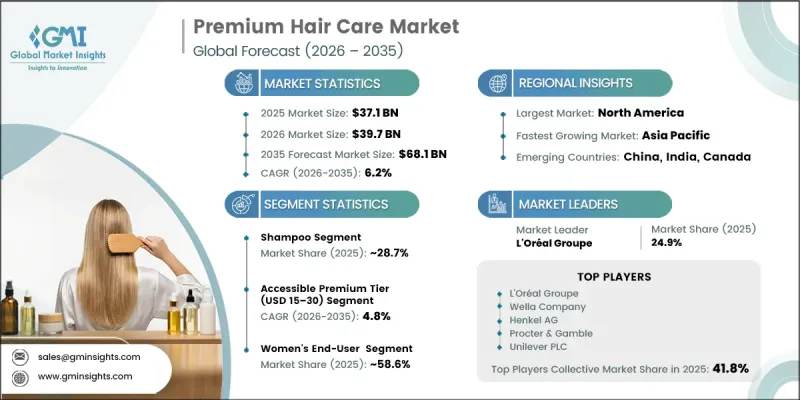
全球高階護髮市場的成長主要受消費者對高效護髮產品需求的不斷成長、可支配收入的增加以及消費者對高階個人保健產品的持續偏好所驅動。消費者越來越追求兼具卓越成分、特定功效和更佳產品性能的產品配方,促使各大品牌在全球市場拓展其高級產品線。 「清潔美容」理念的日益普及、成分透明度的提高以及科學配方產品的興起,進一步加速了市場擴張。此外,電商平台和專業美妝零售商的快速發展,提升了產品的可近性,並使品牌能夠加強與消費者的直接互動。男士護理類別的不斷成長也推動了高階護髮產品需求的成長,製造商正在豐富產品系列。此外,消費者對頭皮健康、專業級配方和個人化護髮方案的日益關注,也持續推動著北美、歐洲、亞太、拉丁美洲和中東地區的市場長期成長。
| 市場範圍 | |
|---|---|
| 開始年份 | 2025 |
| 預測期 | 2026-2035 |
| 上市時的市場規模 | 371億美元 |
| 預測金額 | 681億美元 |
| 複合年成長率 | 6.2% |
至2025年,洗髮精類別將佔28.7%的市佔率。洗髮精作為日常護髮中最常購買的產品,持續引領市場,為品牌帶來持續的銷售機會和穩定的消費者互動。高階洗髮精類別的成長主要得益於消費者對針對頭皮健康、頭髮修復和護色等特殊配方產品的日益成長的需求,這些產品相比傳統產品具有更卓越的性能。
價格在15美元至30美元之間的中高階產品市場預計在2025年將佔據38.1%的市場佔有率,並在2035年之前以4.8%的複合年成長率成長。這一價格區間是消費者從大眾市場產品過渡到高階護髮產品的重要切入點。成熟市場和新興市場對此價格區間的強勁需求支撐著其廣泛的價格範圍,使其成為最大的價格區間,同時持續吸引那些尋求更高品質產品但又不想承擔奢侈品價格的消費者。
預計到2025年,北美高階護髮市場規模將達到1,28億美元,市佔率將達到34.4%。在消費者對個人保健產品的高支出、成熟的專業美容零售網路以及對創新、高品質護髮解決方案的強勁需求的推動下,預計該市場在2035年之前將以4.5%的複合年成長率持續成長。持續的產品創新和消費者對高階品牌日益成長的偏好,進一步鞏固了其在該地區的市場領導地位。
目錄
第1章:調查方法
第2章執行摘要
第3章 行業洞察
- 產業生態系分析
- 影響價值鏈的因素
- 利潤率分析
- 中斷
- 前景
- 製造商
- 中斷
- 供應商情況
- 主要新聞和舉措
- 技術與創新展望
- 監理情勢
- 影響因素
- 促進因素
- 在全球範圍內,可支配收入的成長正在推動對高階護髮產品的需求增加。
- 隨著人們對美的意識不斷提高,高級產品的使用量也顯著增加。
- 美髮沙龍服務的擴張促進了高階護髮產品的使用。
- 產業潛在風險與挑戰
- 高昂的產品價格阻礙了高級產品在全球大眾市場的廣泛普及。
- 激烈的競爭顯著增加了品牌差異化的難度。
- 機會
- 智慧包裝技術為升級先進機械設備創造了機會。
- 永續包裝創新正在推動該地區對環保機械的需求。
- 促進因素
- 波特的分析
- PESTLE分析
- 價格分析
- 價格分析
- 高階、準高階、中高階和尊貴細分市場的定價結構。
- 高階護髮產品的區域定價差異—德語區、中東和亞太地區
- 高階市場的價格彈性與消費者支付意願
- 高階護髮產品市場歷史價格趨勢分析(2019-2025)
- 按業務類型分類的定價策略:天然遺產 vs. 臨床 vs. 高階沙龍 vs. 生物技術
- 貿易數據分析
- 以HS編碼分類的高階護髮產品進出口量與出口額趨勢
- 主要貿易路線和關稅影響-從瑞士到德語區、中東和亞太地區。
- 人工智慧和生成式人工智慧對市場的影響
- 人工智慧驅動的變革——個人化頭皮診斷、頭髮分析工具和數位化諮詢平台。
- 生成式人工智慧的應用案例和實施藍圖—虛擬諮詢、個人化護膚方案提案和成分透明度助手
- 目前分銷基礎設施和通路滲透情況
- 按地區和業務類型分類的銷售管道涵蓋範圍—藥局、美容專賣店、百貨公司、電子商務、美容院、健康和有機產品專賣店
- 高階護髮市場最後一公里基礎設施差異及新興通路變革 [聚焦:購物通路]
- 各市場電子商務及D2C基礎設施滲透率。
- 社交電商的興起和高階護髮平台的準備
- 沙龍和專業頻道作為優質發現和分銷管道。
第4章 競爭情勢
- 介紹
- 企業市佔率分析
- 競爭定位矩陣
- 戰略展望矩陣
- 主要市場公司的競爭分析
- 主要進展
- 併購
- 夥伴關係和聯盟
- 新產品發布
- 業務拓展計劃
第5章 市場估算與預測:依產品類型分類,2022-2035年
- 洗髮精
- 頭皮專用洗髮精
- 生髮洗髮精
- 修復強韌洗髮精
- 污染防治及環境保護洗髮精
- 護髮素、髮膜、護理
- 沖洗型和免洗型
- 深度密集治療
- 顏色保護護理面膜
- 頭皮護理產品
- 頭皮滋養煥活精華液
- 頭皮密集護理液/安瓿
- 頭皮去角質劑
- 髮油/最後加工精華液
- 預洗處理油
- 最後加工亮澤精華液
- 高級美髮造型產品
- 乳霜免沖洗造型劑
- 駝鹿泡沫
- 最後加工及隔熱噴劑
- 防曬隔熱
- 紫外線/陽光護髮素
- 隔熱保溫隔熱產品
第6章 市場估計與預測:依頭髮與頭皮問題分類,2022-2035年
- 掉髮/頭髮稀疏
- 一款以咖啡因和植物來源活性成分為基礎的防脫髮產品。
- 臨床和皮膚科美容防脫髮產品
- 頭皮健康
- 敏感頭皮
- 頭皮
- 頭皮油脂分泌及皮脂控制
- 乾燥缺水的頭皮
- 頭皮微生物群平衡和益生菌護理
- 頭髮損傷及修復
- 頭髮斷裂和脆弱
- 修復頭髮結構,改善頭髮孔隙度。
- 染髮和化學處理護理
- 防止褪色,保持色彩鮮豔。
- 修復漂白劑和化學物質造成的損壞
- 免受環境和污染壓力
- 污染預防和顆粒物屏蔽
- 防止硬水和礦物質沉積
- 防止陽光和紫外線造成的損害
第7章 市場估計與預測:依價格區間分類,2022-2035年
- 價格適中的奢侈品(15-30美元)
- 中高階(30-60美元)
- 尊貴級及超豪華級(60 美元以上)
第8章 市場估價與預測:依配方分類,2022-2035年
- 天然/植物來源
- 專有草藥萃取物製劑
- 純素且不經動物實驗的天然產品
- 採用升級回收和永續來源的原料
- 有機認證
- COSMOS 和 NATRUE 認證的優質配方
- BDIH 及各國同等認證機構
- 臨床和皮膚化妝品
- 頭皮專用臨床配方
- 皮膚美容橋接配方
- 生物技術與先進科學
- 仿生和胜肽基配方
- 生物發酵與包埋技術
第9章 市場估價與預測:依最終用戶分類,2022-2035年
- 女士
- 男性
- 男女通用的
第10章 市場估價與預測:依價格區間分類,2022-2035年
- 價格適中的奢侈品(15-30美元)
- 中高階(30-60美元)
- 尊貴級及超豪華級(60 美元以上)
第11章 市場估價與預測:按地區分類,2022-2035年
- 北美洲
- 美國
- 加拿大
- 歐洲
- 德國
- 英國
- 法國
- 義大利
- 西班牙
- 亞太地區
- 中國
- 印度
- 日本
- 韓國
- 澳洲
- 拉丁美洲
- 巴西
- 墨西哥
- 阿根廷
- 中東和非洲
- UAE
- 沙烏地阿拉伯
- 南非
第12章:公司簡介
- 世界公司
- L'Oreal Groupe
- Procter & Gamble
- Unilever PLC
- Henkel AG
- Wella Company
- Kao Corporation
- Shiseido Company
- 本地公司
- Davines Group
- Weleda AG
- AmorePacific Corporation
- Milbon Co., Ltd.
- Alfaparf Milano
- LG Household & Health Care
- Moroccanoil
- 新興企業
- Act+Acre
- Philip Kingsley Trichological
- Vegamour
- Prose
- Innersense Organic Beauty
- Maria Nila
- Ceremonia
The Global Premium Hair Care Market was valued at USD 37.1 billion in 2025 and is estimated to grow at a CAGR of 6.2% to reach USD 68.1 billion by 2035.
Growth in the global premium hair care market is being fueled by rising consumer demand for high-performance hair care solutions, increasing disposable incomes, and the continued shift toward premium personal care products. Consumers are increasingly seeking formulations that offer superior ingredients, targeted benefits, and enhanced product performance, encouraging brands to expand their premium offerings across global markets. The growing popularity of clean beauty, ingredient transparency, and scientifically formulated products is further accelerating market expansion. In addition, the rapid growth of e-commerce platforms and specialty beauty retail has improved product accessibility while enabling brands to strengthen direct engagement with consumers. The expanding men's grooming category is also contributing to higher demand for premium hair care products, prompting manufacturers to diversify their product portfolios. Furthermore, increasing consumer focus on scalp health, professional-quality formulations, and personalized hair care routines continues to support long-term market growth across North America, Europe, Asia Pacific, Latin America, and the Middle East.
| Market Scope | |
|---|---|
| Start Year | 2025 |
| Forecast Year | 2026-2035 |
| Start Value | $37.1 Billion |
| Forecast Value | $68.1 Billion |
| CAGR | 6.2% |
The shampoo segment accounted for 28.7% share in 2025. Shampoo continues to dominate the market because it is the most frequently purchased product within daily hair care routines, providing brands with recurring sales opportunities and consistent consumer engagement. Growth within the premium shampoo category is being supported by increasing demand for specialized formulations that address scalp health, hair repair, and color protection while delivering enhanced performance compared with conventional products.
The accessible premium price segment, ranging from USD 15 to USD 30, held 38.1% share in 2025 and is expected to grow at a CAGR of 4.8% through 2035. This pricing category serves as the primary entry point for consumers transitioning from mass-market products to premium hair care solutions. Its broad affordability supports strong demand across both mature and emerging markets, making it the largest price segment while continuing to attract consumers seeking higher product quality without entering luxury pricing categories.
North America Premium Hair Care Market held 34.4% share, generating USD 12.8 billion in 2025, and is projected to grow at a CAGR of 4.5% through 2035, supported by high consumer spending on personal care products, a well-established specialty beauty retail network, and strong demand for innovative, premium-quality hair care solutions. Ongoing product innovation and increasing consumer preference for premium brands continue to reinforce the region's market leadership.
Major companies operating in the global premium hair care market include L'Oreal Groupe, Procter & Gamble, Unilever PLC, Henkel AG, Wella Company, Kao Corporation, Shiseido Company, Davines Group, AmorePacific Corporation, Weleda AG, Milbon Co., Ltd., LG Household & Health Care, Alfaparf Milano, Moroccanoil, Philip Kingsley Trichological, Vegamour, Prose, Act+Acre, Innersense Organic Beauty, Maria Nila, and Ceremonia. Companies operating in the premium hair care market are strengthening their market position by expanding premium product portfolios, investing in advanced ingredient research, and introducing innovative formulations that address specific hair and scalp concerns. Manufacturers are focusing on clean-label products, naturally derived ingredients, and scientifically supported formulations to meet evolving consumer preferences. Strategic investments in digital marketing, e-commerce platforms, and direct-to-consumer channels are helping brands improve customer engagement and expand global reach. Businesses are also increasing collaborations with salons, beauty professionals, and retail partners to enhance brand visibility and product credibility.
Table of Contents
Chapter 1 Research Methodology
- 1.1 Research approach
- 1.2 Quality Commitments
- 1.2.1 GMI AI policy & data integrity commitment
- 1.2.1.1 Source consistency protocol
- 1.2.1 GMI AI policy & data integrity commitment
- 1.3 Research Trail & Confidence Scoring
- 1.3.1 Research Trail Components
- 1.3.2 Scoring Components
- 1.4 Data Collection
- 1.4.1 Partial list of primary sources
- 1.5 Data mining sources
- 1.5.1 Paid sources
- 1.5.1.1 Sources, by region
- 1.5.1 Paid sources
- 1.6 Base estimates and calculations
- 1.6.1 Base year calculation for any one approach
- 1.7 Forecast model
- 1.7.1 Quantified market impact analysis
- 1.7.1.1 Mathematical impact of growth parameters on forecast
- 1.7.1 Quantified market impact analysis
- 1.8 Research transparency addendum
- 1.8.1 Source attribution framework
- 1.8.2 Quality assurance metrics
- 1.8.3 Our commitment to trust
Chapter 2 Executive Summary
- 2.1 Industry 360° synopsis, 2022 - 2035
- 2.2 Key market trends
- 2.2.1 Regional
- 2.2.2 Format type
- 2.2.3 Genre
- 2.2.4 End-User
- 2.2.5 Distribution Channel
Chapter 3 Industry Insights
- 3.1 Industry ecosystem analysis
- 3.1.1 Factor affecting the value chain
- 3.1.2 Profit margin analysis
- 3.1.3 Disruptions
- 3.1.4 Future outlook
- 3.1.5 Manufacturers
- 3.1.6 Distributors
- 3.2 Supplier landscape
- 3.3 Key news & initiatives
- 3.4 Technology & Innovation Landscape
- 3.5 Regulatory landscape
- 3.6 Impact on forces
- 3.6.1 Growth drivers
- 3.6.1.1 Rising disposable incomes increase premium hair care demand globally
- 3.6.1.2 Growing beauty consciousness boosts premium product adoption significantly
- 3.6.1.3 Expanding salon services promote premium hair care usage.
- 3.6.2 Industry pitfalls & challenges
- 3.6.2.1 High product pricing limits mass-market premium adoption globally
- 3.6.2.2 Intense competition increases brand differentiation challenges significantly
- 3.6.3 Opportunities
- 3.6.3.1 Smart packaging technologies create advanced machine upgrade opportunities
- 3.6.3.2 Sustainable packaging innovation supports eco-friendly machinery demand regionally.
- 3.6.1 Growth drivers
- 3.7 Porter's analysis
- 3.8 PESTEL analysis
- 3.9 Pricing analysis (driven by primary research)
- 3.9.1 Pricing analysis (driven by primary research)
- 3.9.2 Pricing architecture within the premium tier, accessible premium, mid-premium & prestige
- 3.9.3 Regional price variation for premium hair care - DACH, Middle East & Asia Pacific
- 3.9.4 Price elasticity & consumer willingness-to-pay within the premium tier
- 3.9.5 Historical price trend analysis within premium hair care, 2019-2025 (driven by primary research)
- 3.9.6 Pricing strategy by player type - natural heritage vs. clinical vs. salon prestige vs. biotech (driven by primary research)
- 3.10 Trade data analysis (driven by paid database)
- 3.10.1 Import & export volume & value trends - premium hair care products by HS code (driven by paid database)
- 3.10.2 Key trade corridors & tariff impact - Switzerland to DACH, Middle East & Asia Pacific (driven by paid database)
- 3.11 Impact of AI & generative AI on the market
- 3.11.1 AI-driven disruption - personalized scalp diagnostics, hair analysis tools & digital consultation platforms
- 3.11.2 GenAI use cases & adoption roadmap - virtual consultation, personalized regimen recommendation & ingredient transparency assistants
- 3.12 Distribution infrastructure & channel penetration landscape (driven by primary research)
- 3.12.1 Channel coverage by geography & format - pharmacy, specialty beauty retail, department store, e-commerce, salon & health & organic specialty (driven by primary research)
- 3.12.2 Last-mile infrastructure gaps & emerging channel shifts in premium hair care [focus: shopping channels] (driven by primary research)
- 3.12.3 E-commerce & D2C infrastructure penetration rate by market
- 3.12.4 Social commerce emergence & platform readiness for premium hair care
- 3.12.5 Salon & professional channel as a premium discovery & distribution route
Chapter 4 Competitive Landscape, 2025
- 4.1 Introduction
- 4.2 Company market share analysis
- 4.3 Competitive positioning matrix
- 4.4 Strategic outlook matrix
- 4.5 Competitive analysis of major market players
- 4.6 Key developments
- 4.6.1 Mergers & acquisitions
- 4.6.2 Partnerships & collaborations
- 4.6.3 New product launches
- 4.6.4 Expansion plans
Chapter 5 Market Estimates & Forecast, By Product Type, 2022-2035 (USD Billion) (Million Units)
- 5.1 Key trends
- 5.2 Shampoo
- 5.2.1 Scalp-Specific Shampoo
- 5.2.2 Anti-Hair Loss Shampoo
- 5.2.3 Repair & Strengthening Shampoo
- 5.2.4 Anti-Pollution & Environmental Protection Shampoo
- 5.3 Conditioner, Mask & Treatment
- 5.3.1 Rinse-out & Leave-in
- 5.3.2 Deep & Intensive Treatment
- 5.3.3 Color Protection Treatment Mask
- 5.4 Scalp Care Products
- 5.4.1 Scalp Tonic & Activating Serum
- 5.4.2 Scalp Intensive Fluid & Ampoule
- 5.4.3 Scalp Peel & Exfoliant
- 5.5 Hair Oil & Finishing Serum
- 5.5.1 Pre-Wash Treatment Oil
- 5.5.2 Finishing & Shine Serum
- 5.6 Premium Hair Styling Products
- 5.6.1 Cream & Leave-In Styler
- 5.6.2 Mousse & Foam
- 5.6.3 Finishing & Heat Protection Spray
- 5.7 Sun & Heat Protection
- 5.7.1 UV & Solar Hair Protector
- 5.7.2 Heat Defense & Thermal Protection Products
Chapter 6 Market Estimates & Forecast, By Hair & Scalp Concern, 2022-2035 (USD Billion) (Million Units)
- 6.1 Key trends
- 6.2 Hair Loss & Thinning
- 6.2.1 Caffeine & Botanical Actives-Based Anti-Hair Loss
- 6.2.2 Clinical & Dermo-Cosmetic Anti-Hair Loss
- 6.3 Scalp Health
- 6.3.1 Sensitive Scalp
- 6.3.2 Dandruff
- 6.3.3 Scalp Oiliness & Sebum Control
- 6.3.4 Scalp Dryness & Dehydration
- 6.3.5 Scalp Microbiome Balance & Probiotic-Enriched Care
- 6.4 Hair Damage & Repair
- 6.4.1 Breakage & Brittleness
- 6.4.2 Structural Restoration & Porosity Correction
- 6.5 Color & Chemical Treatment Care
- 6.5.1 Color Fade Prevention & Vibrancy Maintenance
- 6.5.2 Bleach & Chemical Damage Recovery
- 6.6 Environmental & Pollution Stress Protection
- 6.6.1 Anti-Pollution & Particulate Shield
- 6.6.2 Hard Water & Mineral Buildup Protection
- 6.7 Sun & UV Damage Protection
Chapter 7 Market Estimates & Forecast, By Price Tier, 2022-2035 (USD Billion) (Million Units)
- 7.1 Key trends
- 7.2 Accessible Premium (USD 15-30)
- 7.3 Mid-Premium (USD 30-60)
- 7.4 Prestige & Ultra-Luxury (Above USD 60)
Chapter 8 Market Estimates & Forecast, By Formulation, 2022-2035 (USD Billion) (Million Units)
- 8.1 Key trends
- 8.2 Natural and Botanical
- 8.2.1 Proprietary Herbal Extract Formulations
- 8.2.2 Vegan & Cruelty-Free Natural Formulations
- 8.2.3 Upcycled & Sustainably Sourced Ingredient Formulations
- 8.3 Certified Organic
- 8.3.1 COSMOS & NATRUE Certified Premium Formulations
- 8.3.2 BDIH & National Certification Body Equivalents
- 8.4 Clinical and Dermo-Cosmetic
- 8.4.1 Scalp-Specialist Clinical Formulations
- 8.4.2 Dermo-Cosmetic Bridge Formulations
- 8.5 Biotech & Advanced Science
- 8.5.1 Biomimetic & Peptide-Based Formulations
- 8.5.2 Biofermentation & Encapsulation Technology
Chapter 9 Market Estimates & Forecast, By End User, 2022-2035 (USD Billion) (Million Units)
- 9.1 Key trends
- 9.2 Women
- 9.3 Men
- 9.4 Unisex
Chapter 10 Market Estimates & Forecast, By Price Tier, 2022-2035 (USD Billion) (Million Units)
- 10.1 Key trends
- 10.2 Accessible Premium (USD 15-30)
- 10.3 Mid-Premium (USD 30-60)
- 10.4 Prestige & Ultra-Luxury (Above USD 60)
Chapter 11 Market Estimates & Forecast, By Region, 2022 - 2035, (USD Billion) (Million Units)
- 11.1 Key trends
- 11.2 North America
- 11.2.1 U.S.
- 11.2.2 Canada
- 11.3 Europe
- 11.3.1 Germany
- 11.3.2 U.K.
- 11.3.3 France
- 11.3.4 Italy
- 11.3.5 Spain
- 11.4 Asia Pacific
- 11.4.1 China
- 11.4.2 India
- 11.4.3 Japan
- 11.4.4 South Korea
- 11.4.5 Australia
- 11.5 Latin America
- 11.5.1 Brazil
- 11.5.2 Mexico
- 11.5.3 Argentina
- 11.6 MEA
- 11.6.1 UAE
- 11.6.2 Saudi Arabia
- 11.6.3 South Africa
Chapter 12 Company Profiles
- 12.1 Global players
- 12.1.1 L'Oreal Groupe
- 12.1.2 Procter & Gamble
- 12.1.3 Unilever PLC
- 12.1.4 Henkel AG
- 12.1.5 Wella Company
- 12.1.6 Kao Corporation
- 12.1.7 Shiseido Company
- 12.2 Regional players
- 12.2.1 Davines Group
- 12.2.2 Weleda AG
- 12.2.3 AmorePacific Corporation
- 12.2.4 Milbon Co., Ltd.
- 12.2.5 Alfaparf Milano
- 12.2.6 LG Household & Health Care
- 12.2.7 Moroccanoil
- 12.3 Emerging players
- 12.3.1 Act+Acre
- 12.3.2 Philip Kingsley Trichological
- 12.3.3 Vegamour
- 12.3.4 Prose
- 12.3.5 Innersense Organic Beauty
- 12.3.6 Maria Nila
- 12.3.7 Ceremonia


