


 |
市場調查報告書
商品編碼
2083077
溫室通風系統市場:商機、成長要素、產業趨勢分析及2026-2035年預測Greenhouse Ventilation Systems Market Opportunity, Growth Drivers, Industry Trend Analysis, and Forecast 2026 - 2035 |
||||||

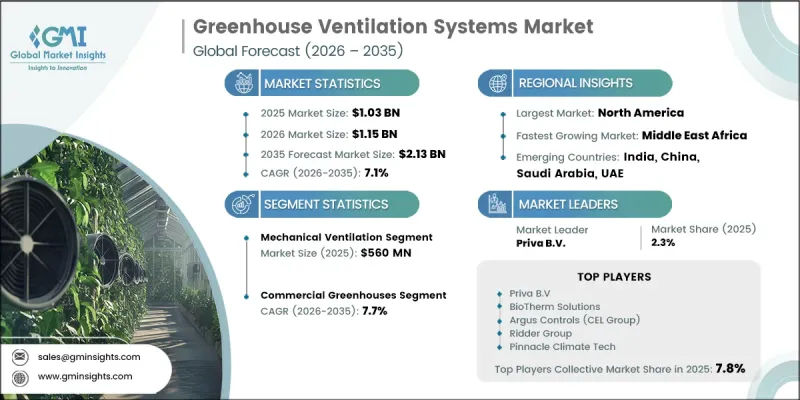
全球溫室通風系統市場預計到 2025 年將達到 10.3 億美元,年複合成長率為 7.1%,到 2035 年將達到 21.3 億美元。
市場擴張的驅動力在於人們對提高溫室生產力、最佳化資源利用以及透過先進的環境管理系統改善作物品質的日益關注。通風技術在維持理想的生長條件方面發揮著至關重要的作用,它能夠調節溫室結構內的溫度、濕度、空氣循環和大氣平衡。對永續農業實踐、食品品質標準和氣候適應型栽培方法的日益重視,進一步強化了對現代化溫室基礎設施的需求。技術進步極大地改變了溫室運營,實現了更高的自動化程度、更強大的監測能力和更精準的氣候控制。政府對農業現代化和永續性耕作計畫的支持也促進了市場成長。儘管安裝成本仍然是小規模生產者面臨的挑戰,但對大規模溫室項目、保護性栽培系統和先進農業設施的投資不斷增加,持續為整個溫室通風系統市場創造巨大的成長機會。
| 市場範圍 | |
|---|---|
| 開始年份 | 2025 |
| 預測期 | 2026-2035 |
| 初始市場規模 | 10.3億美元 |
| 預計金額 | 21.3億美元 |
| 複合年成長率 | 7.1% |
預計到2025年,機械通風市場規模將達到5.6億美元,並在2026年至2035年間以7.1%的複合年成長率成長。該市場之所以能保持主導地位,是因為其能夠在各種生長條件下提供穩定的性能、精確的環境控制和可靠的運作。與被動式氣流系統不同,機械通風系統能夠主動調節溫室環境,使種植者能夠保持穩定的溫度、濕度和大氣條件,不受外部天氣波動的影響。機械通風系統能夠支援受控環境農業(CEA)運營,並與先進的溫室基礎設施無縫整合,因此成為尋求提高產量和保證作物品質的商業種植者的首選。預計在整個預測期內,對自動化和氣候控制技術的持續投資將進一步推動對機械通風解決方案的需求。
預計到2025年,商業溫室市場將佔據56.86%的市場佔有率,並在2035年之前以7.7%的複合年成長率成長。商業溫室致力於最大限度地提高生產效率、維持作物品質並實現穩健的財務業績,因此正推動著市場需求的成長。為了實現這些目標,營運商越來越依賴先進的通風技術,以便精確控制環境條件。推動該市場佔據主導地位的一個主要因素是全球大規模商業溫室的營運。這些溫室需要複雜的配套設施來維持最佳的生長環境。與小規模溫室相比,商業營運商擁有更雄厚的財力,因此更有動力投資先進的通風系統,以提高生產力、營運可靠性和資源利用效率。
預計到2025年,北美溫室通風系統市場規模將達到2.1億美元,並在2035年之前以5.8%的複合年成長率成長。這一區域成長的驅動力來自持續的技術創新、可控環境農業的日益普及以及消費者對高品質農產品日益成長的需求。智慧監控技術、數據驅動的氣候管理和自動化通風解決方案的整合,使農民能夠在減少勞動力依賴和提高作物整體產量的同時,最佳化生產效率。
目錄
第1章:調查方法和範圍
第2章執行摘要
第3章 行業洞察
- 產業生態系分析
- 供應鏈分析
- 採購必需的原料(馬達、型材、PVC零件)
- 製造業集中和區域供應風險
- 評估供應鏈中斷的影響(新冠疫情後的關稅風險)
- 近岸外包和供應商多元化趨勢
- 影響產業的因素
- 市場促進因素
- 全球對糧食安全的日益關注正在加速控制環境農業(CEA)的採用。
- 政府補貼和優惠的農業政策促進溫室基礎設施投資
- 能源效率法規推動了對智慧自動化通風系統的需求。
- 垂直農業的擴張以及全年作物生產的要求
- 市場限制因素
- 高昂的初始投資阻礙了中小溫室經營者的發展。
- 將先進通風系統整合到現有溫室結構中的技術複雜性
- 市場機遇
- 透過整合物聯網、人工智慧和感測器,建構下一代智慧通風系統。
- 歐洲和北美對老舊溫室基礎設施維修的需求
- 亞太和中東地區保護性農業擴張的巨大成長潛力
- 市場促進因素
- 成長潛力分析
- 技術與創新展望
- 智慧通風和物聯網空調系統
- 變頻驅動(VSD)風扇技術
- 溫室中的能源回收通風(ERV)
- 人工智慧與預測性空調控制的融合
- 風扇和通風組件設計中的新材料
- 監理框架
- 區域農業和環境法規
- 工業風扇和鼓風機的能源效率標準(歐盟生態設計,美國能源局)
- 建築規範與溫室建造標準
- 有關碳排放和永續性的合規要求
- 關鍵市場趨勢與顛覆性因素
- 未來市場趨勢
- 價格分析
- 對過去價格趨勢的分析
- 依球員類型分類的定價策略(高級球員、超值球員、成本加成球員)
- 以通風方式(自然通風、機械通風、混合通風)分類的價格波動
- 區域定價(價格差異和進口關稅的影響)
- 貿易數據分析
- 按HS編碼(841459 - 工業風扇和鼓風機)分類的進出口量和進口額趨勢
- 主要貿易路線及關稅影響(中國-歐盟、荷蘭-世界園藝作物出口)
- 人工智慧和生成式人工智慧對市場的影響
- 利用人工智慧改造現有的溫室氣候控制經營模式
- Genai按細分市場(商業溫室和科研溫室)分類的應用案例和實施藍圖
- 人工智慧在農業領域的風險、限制與監管考量
- 投資與資金籌措分析
- 私募股權和創業投資對受控環境農業(CEA)的投資
- 政府補貼和農業補貼用於支持溫室基礎建設
- 併購活動對市場整合的影響
- 波特的分析
- PESTLE分析
第4章 競爭情勢
- 介紹
- 企業市佔率分析
- 按地區
- 企業矩陣分析
- 主要市場公司的競爭分析
- 競爭定位矩陣
- 主要進展
- 併購
- 夥伴關係和聯盟
- 新產品發布
- 業務拓展計劃
第5章 市場估價與預測:依通風方式分類,2022-2035年
- 主要趨勢
- 自然通風系統
- 屋頂通風系統
- 側壁通風系統
- 屋脊通風系統
- 機械通風系統
- 排氣扇系統
- 水平循環風扇系統
- 垂直循環風扇系統
- 濕簾風扇式蒸發冷卻系統
- 混合通風系統
- 被動式和機械式組合系統
- 具有智慧控制功能的自動混合動力系統
第6章 市場估計與預測:依組件分類,2022-2035年
- 主要趨勢
- 風扇和鼓風機
- 排氣扇和循環扇
- 離心式鼓風機
- 變頻驅動(VSD)風扇
- 百葉窗和通風口
- 屋頂/屋脊百葉窗
- 側壁通風口
- 電動百葉窗
- 阻尼器
- 電動阻尼器
- 手動蝶形阻尼器
- 控制器和控制系統
- 恆溫器式控制器
- 濕度連動控制設備
- 物聯網智慧空調控制器
- 綜合環境管理系統(EMS)
- 其他(螢幕、執行器、管道和安裝硬體)
第7章 市場估計與預測:依安裝類型分類,2022-2035年
- 主要趨勢
- 新推出
- 待開發區型溫室建設項目
- 大規模商業和農業業務擴張
- 改裝
- 升級舊式風扇和通風基礎設施
- 將智慧控制器整合到現有系統中
- 能源效率維修計劃
第8章 市場估計與預測:依應用領域分類,2022-2035年
- 主要趨勢
- 商業溫室
- 用於水果和蔬菜生產的溫室
- 用於鮮切花和觀賞作物的溫室
- 大型農產品和公司化農業綜合體
- 園藝溫室
- 幼苗培育和繁殖設施
- 園林綠化與花園中心的溫室
- 用於科學研究和教育的溫室
- 大學和農業研究機構
- 政府和公共部門研究機構
- 住宅溫室
- 嗜好/個人溫室
- 小規模家庭花園設施
第9章 市場估計與預測:依地區分類,2022-2035年
- 北美洲
- 美國
- 加拿大
- 歐洲
- 德國
- 英國
- 法國
- 義大利
- 西班牙
- 亞太地區
- 中國
- 印度
- 日本
- 韓國
- 澳洲
- 拉丁美洲
- 巴西
- 墨西哥
- 阿根廷
- 中東和非洲
- UAE
- 沙烏地阿拉伯
- 南非
第10章:公司簡介
- Munters Group AB
- Vostermans Ventilation BV
- Van der Valk Horti Systems
- Enerdes(Reinders Corporation)
- Pinnacle Climate Tech(Schaefer)
- Gigola & Riccardi SpA
- Ridder Group
- J&D Manufacturing
- Dalsem BV
- Harnois Greenhouses
- Agra Tech Inc.
- GGS Structures Inc.
- Richel Group
- Link4 Greenhouse Controls
- Alumat Parts(fmr. Alumat Zeeman)
- Prospiant(fmr. Nexus+Rough Bros)
- Priva BV
- Argus Controls(CEL Group)
- BioTherm Solutions
- Certhon
- ULMA Agricola S.Coop.
The Global Greenhouse Ventilation Systems Market was valued at USD 1.03 billion in 2025 and is estimated to grow at a CAGR of 7.1% to reach USD 2.13 billion by 2035.
Market expansion is driven by the growing focus on maximizing greenhouse productivity, optimizing resource utilization, and improving crop quality through advanced environmental management systems. Ventilation technologies play a critical role in maintaining ideal growing conditions by regulating temperature, humidity, air circulation, and atmospheric balance within greenhouse structures. Increasing emphasis on sustainable agricultural practices, food quality standards, and climate-resilient cultivation methods is further strengthening demand for modern greenhouse infrastructure. Technological advancements have significantly transformed greenhouse operations, enabling greater automation, enhanced monitoring capabilities, and more precise climate management. Government support for agricultural modernization initiatives and sustainability-focused cultivation programs is also contributing to market growth. Although installation costs remain a challenge for smaller growers, increasing investments in large-scale greenhouse projects, protected cultivation systems, and advanced agricultural facilities continue to create significant growth opportunities across the Greenhouse Ventilation Systems Market.
| Market Scope | |
|---|---|
| Start Year | 2025 |
| Forecast Year | 2026-2035 |
| Start Value | $1.03 Billion |
| Forecast Value | $2.13 Billion |
| CAGR | 7.1% |
The mechanical ventilation segment generated USD 560 million in 2025 and is expected to grow at a CAGR of 7.1% between 2026 and 2035. This segment maintains a leading position due to its ability to deliver consistent performance, accurate environmental control, and dependable operation under varying cultivation conditions. Unlike passive airflow methods, mechanical systems actively regulate internal greenhouse environments, enabling growers to maintain stable temperature, humidity, and atmospheric conditions regardless of external weather fluctuations. Their ability to support controlled environment agriculture operations and integrate seamlessly with advanced greenhouse infrastructure has made them a preferred choice among commercial producers seeking greater productivity and crop consistency. Continued investments in automation and climate control technologies are expected to further strengthen demand for mechanical ventilation solutions throughout the forecast period.
The commercial segment accounted for 56.86% share in 2025 and is projected to grow at a CAGR of 7.7% through 2035. Commercial cultivation facilities dominate market demand due to their focus on maximizing production efficiency, maintaining crop quality, and achieving strong financial performance. To support these objectives, operators increasingly rely on advanced ventilation technologies capable of regulating environmental conditions with high precision. The segment's leadership position is primarily attributed to the extensive scale of commercial greenhouse operations worldwide, which require sophisticated infrastructure to maintain optimal growing environments. Compared with smaller cultivation setups, commercial operators possess greater financial resources and stronger incentives to invest in advanced ventilation systems that improve productivity, operational reliability, and resource efficiency.
North America Greenhouse Ventilation Systems Market generated USD 210 million in 2025 and is anticipated to grow at a CAGR of 5.8% through 2035. Regional growth is supported by ongoing technological innovation, increasing adoption of controlled environment agriculture, and rising consumer demand for high-quality agricultural products. The integration of intelligent monitoring technologies, data-driven climate management, and automated ventilation solutions is enabling agricultural operators to optimize productivity while reducing labor dependency and improving overall cultivation performance.
Major companies operating in the Global Greenhouse Ventilation Systems Market include Ridder Group, Priva B.V., Munters Group AB, Certhon, Harnois Greenhouses, Vostermans Ventilation B.V., J&D Manufacturing, ULMA Agricola S.Coop., Agra Tech Inc., Dalsem B.V., Argus Controls (CEL Group), Van der Valk Horti Systems, Link4 Greenhouse Controls, Pinnacle Climate Tech (Schaefer), Richel Group, Enerdes (Reinders Corporation), BioTherm Solutions, Prospiant (fmr. Nexus + Rough Bros), Alumat Parts (fmr. Alumat Zeeman), Gigola & Riccardi SpA, and GGS Structures Inc. Companies operating in the Greenhouse Ventilation Systems Market are focusing on technological innovation, product customization, and strategic collaborations to strengthen their market position. Manufacturers are investing in advanced climate-control solutions that improve energy efficiency, environmental regulation, and overall greenhouse productivity. The integration of automation technologies, smart sensors, data analytics, and intelligent control platforms has become a key strategy for enhancing system performance and differentiating product offerings. Many companies are expanding partnerships with greenhouse operators, agricultural technology providers, and infrastructure developers to increase market reach and accelerate adoption.
Table of Contents
Chapter 1 Methodology & Scope
- 1.1 Research approach
- 1.2 Quality Commitments
- 1.2.1 GMI AI policy & data integrity commitment
- 1.2.1.1 Source consistency protocol
- 1.2.1 GMI AI policy & data integrity commitment
- 1.3 Research Trail & Confidence Scoring
- 1.3.1 Research Trail Components
- 1.3.2 Scoring Components
- 1.4 Data Collection
- 1.4.1 Partial list of primary sources
- 1.5 Data mining sources
- 1.5.1 Paid sources
- 1.5.1.1 Sources, by region
- 1.5.1 Paid sources
- 1.6 Base estimates and calculations
- 1.6.1 Base year calculation for any one approach
- 1.7 Forecast model
- 1.7.1 Quantified market impact analysis
- 1.7.1.1 Mathematical impact of growth parameters on forecast
- 1.7.1 Quantified market impact analysis
- 1.8 Research transparency addendum
- 1.8.1 Source attribution framework
- 1.8.2 Quality assurance metrics
- 1.8.2.1 Our commitment to trust
Chapter 2 Executive Summary
- 2.1 Industry 360° synopsis, 2022 - 2035
- 2.2 Key market trends
- 2.2.1 Region
- 2.2.2 Ventilation Type
- 2.2.3 Component
- 2.2.4 Installation Type
- 2.2.5 Application
Chapter 3 Industry Insights
- 3.1 Industry ecosystem analysis
- 3.2 Supply chain analysis
- 3.2.1 Critical raw material sourcing (motors, aluminum profiles, PVC components)
- 3.2.2 Manufacturing concentration & geographic supply risks
- 3.2.3 Supply chain disruption impact assessment (post-covid, tariff exposure)
- 3.2.4 Near-shoring & supplier diversification trends
- 3.3 Industry impact forces
- 3.3.1 Market drivers
- 3.3.1.1 Rising global food security concerns accelerating controlled environment agriculture (CEA) adoption
- 3.3.1.2 Government subsidies & favorable agricultural policies promoting greenhouse infrastructure investment
- 3.3.1.3 Energy efficiency mandates driving demand for smart & automated ventilation systems
- 3.3.1.4 Expansion of vertical farming & year-round crop production requirements
- 3.3.2 Market restraints
- 3.3.2.1 High initial capital expenditure deterring small & medium-scale greenhouse operators
- 3.3.2.2 Technical complexity of advanced ventilation integration in existing greenhouse structures
- 3.3.3 Market opportunities
- 3.3.3.1 IoT, AI & Sensor Integration Creating Next-Generation Smart Ventilation Systems
- 3.3.3.2 Retrofit Demand in Aging Greenhouse Infrastructure Across Europe & North America
- 3.3.3.3 Untapped Growth Potential in Asia Pacific & Middle East Protected Agriculture Expansion
- 3.3.1 Market drivers
- 3.4 Growth potential analysis
- 3.5 Technology & innovation landscape
- 3.5.1 Smart ventilation & IoT-enabled climate control systems
- 3.5.2 Variable speed drive (VSD) fan technology
- 3.5.3 Energy recovery ventilation (ERV) in greenhouse applications
- 3.5.4 Ai & predictive climate control integration
- 3.5.5 Emerging materials in fan & vent component design
- 3.6 Regulatory framework
- 3.6.1 Agricultural & environmental regulations by region
- 3.6.2 Energy efficiency standards for industrial fans & blowers (EU Ecodesign, US DOE)
- 3.6.3 Building codes & greenhouse construction standards
- 3.6.4 Carbon emission & sustainability compliance requirements
- 3.7 Major market trends and disruptions
- 3.8 Future market trends
- 3.9 Pricing analysis (driven by primary research)
- 3.9.1 Historical price trend analysis (driven by primary research)
- 3.9.2 pricing strategy by player type (premium / value / cost-plus) (driven by primary research)
- 3.9.3 price variance by ventilation type (natural vs. Mechanical vs. Hybrid)
- 3.9.4 regional price (differentials & import duty impact)
- 3.10 Trade data analysis (driven by primary research)
- 3.10.1 Import/export volume & value trends by HS code (841459 - industrial fans & blowers) (driven by primary research)
- 3.10.2 Key trade corridors & tariff impact (China-EU, Netherlands-global horticulture exports) (driven by primary research)
- 3.11 Impact of AI & generative AI on the market
- 3.11.1 AI-driven disruption of existing greenhouse climate control business models
- 3.11.2 Genai use cases & adoption roadmap by segment (commercial vs. Research greenhouses)
- 3.11.3 Risks, limitations & regulatory considerations for AI in agricultural environments
- 3.12 Investment & funding analysis
- 3.12.1 Private equity & venture capital investment in controlled environment agriculture (CEA)
- 3.12.2 Government grants & agricultural subsidies supporting greenhouse infrastructure
- 3.12.3 M&A activity impact on market consolidation
- 3.13 Porter's analysis
- 3.14 Pestel analysis
Chapter 4 Competitive Landscape, 2025
- 4.1 Introduction
- 4.2 Company market share analysis
- 4.2.1 By Region
- 4.2.1.1 North America
- 4.2.1.2 Europe
- 4.2.1.3 Asia Pacific
- 4.2.1.4 Latin America
- 4.2.1.5 Middle East and Africa
- 4.2.1 By Region
- 4.3 Company matrix analysis
- 4.4 Competitive analysis of major market players
- 4.5 Competitive positioning matrix
- 4.6 Key developments
- 4.6.1 Mergers & acquisitions
- 4.6.2 Partnerships & collaborations
- 4.6.3 New product launches
- 4.6.4 Expansion plans
Chapter 5 Market Estimates and Forecast, By Ventilation Type, 2022 - 2035 (USD Billion) (Thousand Units)
- 5.1 Key Trends
- 5.2 Natural Ventilation Systems
- 5.2.1 Roof Vent Systems
- 5.2.2 Side Wall Vent Systems
- 5.2.3 Ridge Vent Systems
- 5.3 Mechanical Ventilation Systems
- 5.3.1 Exhaust Fan Systems
- 5.3.2 Horizontal Circulation Fan Systems
- 5.3.3 Vertical Circulation Fan Systems
- 5.3.4 Pad-And-Fan Evaporative Cooling Systems
- 5.4 Hybrid Ventilation Systems
- 5.4.1 Passive-Mechanical Combined Systems
- 5.4.2 Automated Hybrid Systems With Smart Controls
Chapter 6 Market Estimates and Forecast, By component, 2022 - 2035 (USD Billion) (Thousand Units)
- 6.1 Key Trends
- 6.2 Fans & Blowers
- 6.2.1 Exhaust & Circulation Fans
- 6.2.2 Centrifugal Blowers
- 6.2.3 Variable Speed Drive (VSD) Fans
- 6.3 Louvers & Vents
- 6.3.1 Roof/Ridge Louvers
- 6.3.2 Side Wall Vents
- 6.3.3 Motorized Louvered Panels
- 6.4 Dampers
- 6.4.1 Motorized Dampers
- 6.4.2 Manual Butterfly Dampers
- 6.5 Controllers & Control Systems
- 6.5.1 Thermostatic Controllers
- 6.5.2 Humidity-Based Automated Controllers
- 6.5.3 Iot-Enabled Smart Climate Controllers
- 6.5.4 Integrated Environmental Management Systems (EMS)
- 6.6 Others (Screens, Actuators, Ducting & Ancillary Hardware)
Chapter 7 Market Estimates and Forecast, By Installation Type, 2022 - 2035 (USD Billion) (Thousand Units)
- 7.1 Key Trends
- 7.2 New Installation
- 7.2.1 Greenfield Greenhouse Construction Projects
- 7.2.2 Large-Scale Commercial & Agribusiness Expansions
- 7.3 Retrofit
- 7.3.1 Upgrade Of Legacy Fan & Vent Infrastructure
- 7.3.2 Integration Of Smart Controllers Into Existing Systems
- 7.3.3 Energy Efficiency Retrofit Programs
Chapter 8 Market Estimates and Forecast, By Application, 2022 - 2035 (USD Billion) (Thousand Units)
- 8.1 Key Trends
- 8.2 Commercial Greenhouses
- 8.2.1 Fruit & Vegetable Production Greenhouses
- 8.2.2 Cut Flower & Ornamental Crop Greenhouses
- 8.2.3 Large-Scale Agribusiness & Corporate Farming Complexes
- 8.3 Horticulture Greenhouses
- 8.3.1 Nursery & Propagation Facilities
- 8.3.2 Landscaping & Garden Center Greenhouses
- 8.4 Research & Educational Greenhouses
- 8.4.1 University & Agricultural Research Institutions
- 8.4.2 Government & Public Sector Research Facilities
- 8.5 Residential Greenhouses
- 8.5.1 Hobby & Private Greenhouses
- 8.5.2 Small-Scale Home Farming Setups
Chapter 9 Market Estimates & Forecast, By Region, 2022 - 2035, (USD Billion) (Thousand Units)
- 9.1 Key trends
- 9.2 North America
- 9.2.1 U.S.
- 9.2.2 Canada
- 9.3 Europe
- 9.3.1 Germany
- 9.3.2 U.K.
- 9.3.3 France
- 9.3.4 Italy
- 9.3.5 Spain
- 9.4 Asia Pacific
- 9.4.1 China
- 9.4.2 India
- 9.4.3 Japan
- 9.4.4 South Korea
- 9.4.5 Australia
- 9.5 Latin America
- 9.5.1 Brazil
- 9.5.2 Mexico
- 9.5.3 Argentina
- 9.6 MEA
- 9.6.1 UAE
- 9.6.2 Saudi Arabia
- 9.6.3 South Africa
Chapter 10 Company Profiles
- 10.1 Munters Group AB
- 10.2 Vostermans Ventilation B.V.
- 10.3 Van der Valk Horti Systems
- 10.4 Enerdes (Reinders Corporation)
- 10.5 Pinnacle Climate Tech (Schaefer)
- 10.6 Gigola & Riccardi SpA
- 10.7 Ridder Group
- 10.8 J&D Manufacturing
- 10.9 Dalsem B.V.
- 10.10 Harnois Greenhouses
- 10.11 Agra Tech Inc.
- 10.12 GGS Structures Inc.
- 10.13 Richel Group
- 10.14 Link4 Greenhouse Controls
- 10.15 Alumat Parts (fmr. Alumat Zeeman)
- 10.16 Prospiant (fmr. Nexus + Rough Bros)
- 10.17 Priva B.V.
- 10.18 Argus Controls (CEL Group)
- 10.19 BioTherm Solutions
- 10.20 Certhon
- 10.21 ULMA Agricola S.Coop.

 溫室灌溉系統市場:全球市場預測,2026-2032年
 溫室加熱器市場預測至2034年—按類型、系統、應用、分銷管道、最終用戶和地區分類的全球分析自主溫室市場預測至2034年—按組件、作物類型、技術、應用、最終用戶和地區分類的全球分析
 溫室灌溉系統市場規模、佔有率和趨勢分析報告:按組件、類型、應用、作物、最終用途、地區和細分市場預測(2026-2033 年)
 2026年全球溫室灌溉系統市場報告
 自主溫室半導體控制系統市場分析與預測(至2035年):類型、產品、服務、技術、組件、應用、部署、最終用戶、功能、安裝類型
 溫室加熱器市場 - 全球產業規模、佔有率、趨勢、機會、預測:按加熱器類型、應用、溫室規模、地區和競爭格局分類,2021-2031年
 溫室灌溉系統市場規模、佔有率和成長分析(按類型、農場規模、動力來源、應用、最終用戶和地區分類)—2026-2033年產業預測2025年全球溫室加熱和冷卻系統市場報告自主溫室系統市場分析及預測至 2033 年:依類型、產品、服務、技術、組件、應用、功能、設備、解決方案、最終用戶