


 |
市場調查報告書
商品編碼
2083075
2026 年至 2035 年材料加工設備的市場機會、成長要素、產業趨勢與預測。Material Processing Equipment Market Opportunity, Growth Drivers, Industry Trend Analysis, and Forecast 2026 - 2035 |
||||||

預計到 2025 年,全球材料加工設備市場價值將達到 765 億美元,年複合成長率為 5.3%,到 2035 年將達到 1,287 億美元。
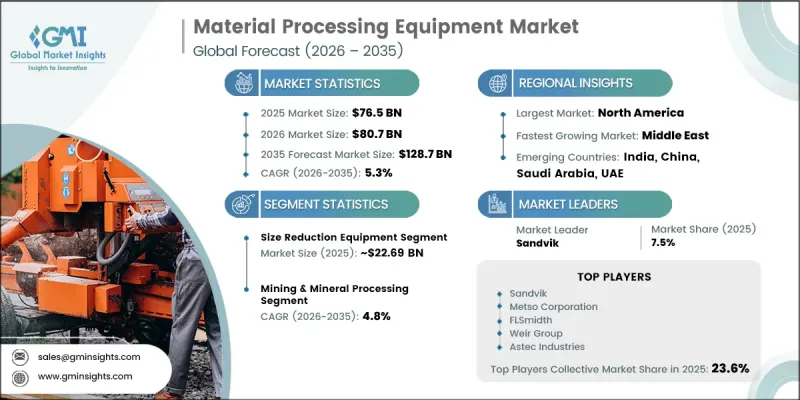
市場擴張的驅動力來自工業自動化技術的進步、快速的數位轉型以及智慧技術在所有材料加工操作中的應用。採礦、製造、骨材和工業生產行業的企業正擴大採用配備互聯技術、即時監控功能和數據驅動流程最佳化工具的先進設備。人工智慧、自動化系統和工業IoT(IIoT) 解決方案的整合,使企業能夠提高營運效率、減少停機時間並提升設備整體效能。隨著企業尋求延長設備使用壽命並最大限度地減少意外中斷,以先進分析技術為支撐的預測性維護策略變得日益重要。此外,虛擬建模和模擬技術使操作人員能夠在不中斷實際操作的情況下評估效能方案並最佳化生產環境。這些進步在生產力、營運效率和成本控制直接影響盈利的行業中尤其重要。對職場安全和員工保障日益成長的關注也進一步加速了自動化的普及。這是因為企業在努力降低員工暴露於危險工作環境風險的同時,也要維持高生產力。預計在整個預測期內,這些技術進步將繼續成為材料加工設備市場的主要成長要素。
| 市場範圍 | |
|---|---|
| 開始年份 | 2025 |
| 預測期 | 2026-2035 |
| 上市時的市場規模 | 765億美元 |
| 預計金額 | 1287億美元 |
| 複合年成長率 | 5.3% |
預計到2025年,採礦和礦物加工領域將佔據35.5%的市場佔有率,並在2026年至2035年間以4.8%的複合年成長率成長。該領域持續推動市場發展,因為它在為包括建築、能源、製造和基礎設施建設在內的眾多行業提供所需原料方面發揮著至關重要的作用。大規模的採礦和加工活動需要先進的材料加工設備,這些設備能夠處理龐大的產量,同時保持效率和運作可靠性。預計未來幾年,對資源開發和工業擴張的持續投資將維持該領域對加工設備的需求。
預計到2025年,破碎和研磨設備市場規模將達到226.9億美元,並在2035年之前以4.9%的複合年成長率成長。這個類別仍然是材料加工設備市場中最大的細分市場,因為它是工業加工步驟中的基礎組成部分。用於破碎和研磨物料的設備在為下游加工和製造製程準備散裝物料方面發揮著至關重要的作用。工業設施對高效物料預處理的廣泛需求持續支撐著對這些系統的強勁需求。其在材料加工的早期和後續階段的重要性進一步鞏固了該細分市場在整個市場中的主導地位。
預計到2025年,北美材料加工設備市佔率將達到24.29%。這主要得益於先進的工業活動、成熟的建築業以及自動化技術的廣泛應用。該地區受益於資源開採、工業現代化和基礎設施建設舉措的大量投資。對關鍵原料的持續需求,以及在建設項目和工業設施升級方面的持續投入,為設備製造商創造了穩固的商機。此外,該地區的企業正不斷增加對先進加工技術的投資,以提高生產效率、提升營運效率並實現長期永續性目標。這些因素進一步鞏固了北美作為材料加工設備領先市場的地位。
目錄
第1章:調查方法和範圍
第2章執行摘要
第3章 行業洞察
- 產業生態系分析
- 供應鏈分析
- 對主要原料(鐵、錳、稀土元素)的依賴
- 供應商集中度風險與單一供應來源帶來的脆弱性
- 近岸外包和區域供應鏈重組的趨勢
- 售後市場零件和MRO供應鏈的發展趨勢
- 影響產業的因素
- 市場促進因素
- 關鍵礦物(鋰、鈷和銅)開採量的激增正在推動對破碎設備的需求。
- 基礎設施投資和建設活動正在推動對骨材加工設施的需求。
- 循環經濟計劃正在加速引入回收和廢棄物處理設施。
- 自動化和預測性維護的日益普及正在延長設備的投資報酬率。
- 市場限制因素
- 設備需要大量資本投資和較長的投資回收期
- 原物料價格(鋼鐵、合金)波動會影響製造成本。
- 設備操作、維護和現場服務的技術純熟勞工短缺。
- 市場機遇
- 為實現脫碳目標,對高效設備維修和升級。
- 新興市場設備即服務 (EAAS) 和租賃模式的擴展
- 透過整合數位雙胞胎和物聯網技術,為附加價值服務創造新的收入來源。
- 藥品和特種化學品的粉末加工—一個尚未開發的細分市場
- 市場促進因素
- 成長潛力分析
- 技術與創新展望
- 互聯健身與物聯網的融合
- 穿戴式EMS技術的演變
- 智慧電阻器和自適應負載技術
- 健身器材的應用程式和平台生態系統
- 監理框架
- 區域消費品安全標準
- 標籤和行銷標籤合規性(FTC、ASA、歐盟)
- 進出口合規及關稅概述
- 關鍵市場趨勢與顛覆性因素
- 未來市場趨勢
- 價格分析
- 2022-2025年歷史價格趨勢分析
- 依球員類型分類的定價策略(高級球員、超值球員、成本加成球員)
- 貿易數據分析
- 按設備類別分類的進出口量和進口額趨勢
- 主要貿易路線及關稅影響(美國、歐盟、中國、澳洲、印度)
- 人工智慧和生成式人工智慧對市場的影響
- 利用人工智慧改造現有經營模式(預測性維護、自主營運)
- Genai按設備細分市場的應用案例和部署藍圖
- 人工智慧在工業環境中的風險、限制和監管考量
- 投資與資金籌措分析
- 採礦和建設產業資本投資趨勢(2022-2025 年)
- 設備製造業的私募股權和併購活動
- 政府基礎設施投資正在推動設備採購。
- 產業重組
- 波特的分析
- PESTLE分析
第4章 競爭情勢
- 介紹
- 企業市佔率分析
- 按地區
- 企業矩陣分析
- 主要市場公司的競爭分析
- 競爭定位矩陣
- 主要進展
- 併購
- 夥伴關係和聯盟
- 新產品發布
- 業務拓展計劃
第5章 市場估算與預測:依設備類型分類,2022-2035年
- 主要趨勢
- 研磨裝置
- 輸送和物料輸送
- 混合/攪拌
- 分離設備
- 熱處理
- 篩檢和分類
- 其他
第6章 市場估計與預測:依材料分類,2022-2035年
- 主要趨勢
- 金屬和礦石
- 非金屬礦物和骨材
- 化工/石油化學材料
- 食品藥品原料
- 回收材料和廢棄物
- 生質能和有機材料
第7章 市場估計與預測:依最終用戶分類,2022-2035年
- 主要趨勢
- 採礦和礦物加工
- 建築和基礎設施
- 化工/石油化工
- 食品/飲料
- 回收和廢棄物管理
- 製藥和生物技術
- 能源與電力
- 其他
第8章 市場估計與預測:依地區分類,2022-2035年
- 北美洲
- 美國
- 加拿大
- 歐洲
- 德國
- 英國
- 法國
- 義大利
- 西班牙
- 亞太地區
- 中國
- 印度
- 日本
- 韓國
- 澳洲
- 拉丁美洲
- 巴西
- 墨西哥
- 阿根廷
- 中東和非洲
- UAE
- 沙烏地阿拉伯
- 南非
第9章:公司簡介
- 世界公司
- Loesche, KHD Humboldt Wedag
- CITIC HIC
- Astec Industries
- McLanahan
- TAKRAF Group
- Hosokawa Micron/Alpine
- 本地公司
- McCloskey International
- Qlar
- Haver & Boecker Niagara
- BHS-Sonthofen
- Fuller Technologies
- NHI Group
- Sinoma International
- JOEST Group
- Superior Industries
- Bruks Siwertell
- 新興企業
- Rubble Master
- General Kinematics
- Derrick Corporation
- Eriez
- HAZEMAG
- Shandong Xinhai
- NEPEAN Mining
- Allmineral
- Eagle Crusher
The Global Material Processing Equipment Market was valued at USD 76.5 billion in 2025 and is estimated to grow at a CAGR of 5.3% to reach USD 128.7 billion by 2035.
Market expansion is driven by increasing industrial automation, rapid digital transformation, and the growing integration of intelligent technologies across material processing operations. Companies operating in mining, manufacturing, aggregates, and industrial production are increasingly adopting advanced equipment equipped with connected technologies, real-time monitoring capabilities, and data-driven process optimization tools. The integration of artificial intelligence, automation systems, and Industrial Internet of Things (IIoT) solutions is helping businesses improve operational efficiency, reduce downtime, and enhance overall equipment performance. Predictive maintenance strategies supported by advanced analytics are becoming increasingly important as organizations seek to extend equipment life cycles and minimize unexpected operational disruptions. Additionally, virtual modeling and simulation technologies are enabling operators to evaluate performance scenarios and optimize production environments without interrupting actual operations. These advancements are particularly valuable in industries where productivity, operational efficiency, and cost control have a direct impact on profitability. Growing concerns regarding workplace safety and labor availability are further accelerating automation adoption, as organizations seek to reduce workforce exposure to hazardous operating conditions while maintaining high production output. These technological developments are expected to remain key growth drivers for the material processing equipment market throughout the forecast period.
| Market Scope | |
|---|---|
| Start Year | 2025 |
| Forecast Year | 2026-2035 |
| Start Value | $76.5 Billion |
| Forecast Value | $128.7 Billion |
| CAGR | 5.3% |
The mining and mineral processing segment accounted for 35.5% share in 2025 and is projected to grow at a CAGR of 4.8% between 2026 and 2035. This segment continues to dominate the market due to its essential role in supplying raw materials required across numerous industries, including construction, energy, manufacturing, and infrastructure development. Large-scale extraction and processing activities require advanced material processing equipment capable of handling substantial production volumes while maintaining efficiency and operational reliability. Continued investment in resource development and industrial expansion is expected to sustain demand for processing equipment within this segment over the coming years.
The size reduction equipment segment generated USD 22.69 billion in 2025 and is anticipated to grow at a CAGR of 4.9% through 2035. This category remains the largest equipment segment within the material processing equipment market because it serves as a fundamental component of industrial processing operations. Equipment designed for material size reduction plays a critical role in preparing bulk materials for downstream processing and manufacturing activities. The widespread need for efficient material preparation across industrial facilities continues to support strong demand for these systems. Their importance in both initial and subsequent stages of material processing reinforces their leading position within the overall market.
North America Material Processing Equipment Market accounted for 24.29% share in 2025, supported by advanced industrial operations, a well-established construction sector, and widespread adoption of automation technologies. The region benefits from significant investments in resource extraction, industrial modernization, and infrastructure development initiatives. Ongoing demand for critical raw materials, combined with continued spending on construction projects and industrial facility upgrades, is creating consistent opportunities for equipment manufacturers. Furthermore, companies throughout the region are increasingly investing in advanced processing technologies to improve productivity, enhance operational efficiency, and support long-term sustainability objectives. These factors continue to strengthen North America's position as a major market for material processing equipment.
Major companies operating in the global material processing equipment market include Loesche, KHD Humboldt Wedag, CITIC HIC, Astec Industries, McLanahan, TAKRAF Group, Hosokawa Micron/Alpine, McCloskey International, Qlar, Haver & Boecker Niagara, BHS-Sonthofen, Fuller Technologies, NHI Group, Sinoma International, JOEST Group, Superior Industries, Bruks Siwertell, Rubble Master, General Kinematics, Derrick Corporation, Eriez, HAZEMAG, IFE Aufbereitungstechnik, Shandong Xinhai, NEPEAN Mining, Allmineral, Eagle Crusher, and thyssenkrupp Polysius. Companies operating in the material processing equipment market are focusing on technological innovation, digitalization, and strategic expansion initiatives to strengthen their market position. Significant investments in research and development are enabling manufacturers to introduce advanced equipment featuring automation, artificial intelligence, predictive maintenance capabilities, and real-time monitoring technologies. Businesses are also expanding their product portfolios to address evolving customer requirements across mining, construction, manufacturing, and industrial processing applications. Strategic partnerships, acquisitions, and collaborations with technology providers are helping companies accelerate innovation and broaden their market reach. In addition, manufacturers are enhancing after-sales services, maintenance programs, and remote support capabilities to improve customer retention.
Table of Contents
Chapter 1 Methodology & Scope
- 1.1 Research approach
- 1.2 Quality Commitments
- 1.2.1 GMI AI policy & data integrity commitment
- 1.2.1.1 Source consistency protocol
- 1.2.1 GMI AI policy & data integrity commitment
- 1.3 Research Trail & Confidence Scoring
- 1.3.1 Research Trail Components
- 1.3.2 Scoring Components
- 1.4 Data Collection
- 1.4.1 Partial list of primary sources
- 1.5 Data mining sources
- 1.5.1 Paid sources
- 1.5.1.1 Sources, by region
- 1.5.1 Paid sources
- 1.6 Base estimates and calculations
- 1.6.1 Base year calculation for any one approach
- 1.7 Forecast model
- 1.7.1 Quantified market impact analysis
- 1.7.1.1 Mathematical impact of growth parameters on forecast
- 1.7.1 Quantified market impact analysis
- 1.8 Research transparency addendum
- 1.8.1 Source attribution framework
- 1.8.2 Quality assurance metrics
- 1.8.2.1 Our commitment to trust
Chapter 2 Executive Summary
- 2.1 Industry 360° synopsis, 2022 - 2035
- 2.2 Key market trends
- 2.2.1 Region
- 2.2.2 Equipment type
- 2.2.3 Material
- 2.2.4 End-user
Chapter 3 Industry Insights
- 3.1 Industry ecosystem analysis
- 3.2 Supply chain analysis
- 3.2.1 Key raw material dependencies (steel, manganese, rare earth components)
- 3.2.2 Supplier concentration risks & single-source vulnerabilities
- 3.2.3 Nearshoring & regional supply chain restructuring trends
- 3.2.4 Aftermarket parts & mro supply chain dynamics
- 3.3 Industry impact forces
- 3.3.1 Market drivers
- 3.3.1.1 Surge in critical mineral mining (lithium, cobalt, copper) driving size-reduction equipment demand
- 3.3.1.2 Infrastructure investment & construction activity boosting aggregate processing equipment
- 3.3.1.3 Circular economy mandates accelerating recycling & waste processing equipment adoption
- 3.3.1.4 Rising adoption of automation & predictive maintenance extending equipment ROI
- 3.3.2 Market restraints
- 3.3.2.1 High capital expenditure & long equipment payback periods
- 3.3.2.2 Volatility in raw material prices (steel, alloys) impacting manufacturing cost
- 3.3.2.3 Skilled labor shortage for equipment operation, maintenance & field service
- 3.3.3 Market opportunities
- 3.3.3.1 Energy-Efficient Equipment Retrofit & Replacement Driven by Decarbonization Targets
- 3.3.3.2 Equipment-as-a-Service (EAAS) & Rental Model Expansion in Emerging Markets
- 3.3.3.3 Digital Twin & IoT Integration Creating New Value-Added Service Revenue Streams
- 3.3.3.4 Pharmaceutical & Specialty Chemical Powder Processing - Underpenetrated Niche
- 3.3.1 Market drivers
- 3.4 Growth potential analysis
- 3.5 Technology & innovation landscape
- 3.5.1 Connected fitness & IoT integration
- 3.5.2 Wearable EMS technology evolution
- 3.5.3 Smart resistance & adaptive load technologies
- 3.5.4 App & platform ecosystems in fitness devices
- 3.6 Regulatory framework
- 3.6.1 Consumer product safety standards by region
- 3.6.2 Labeling & marketing claims compliance (FTC, ASA, EU)
- 3.6.3 Import/export compliance & tariff landscape
- 3.7 Major market trends and disruptions
- 3.8 Future market trends
- 3.9 Pricing analysis (driven by primary research)
- 3.9.1 Historical Price Trend Analysis (2022-2025) (Driven by Primary Research)
- 3.9.2 Pricing Strategy by Player Type (Premium / Value / Cost-plus) (Driven by Primary Research)
- 3.10 Trade data analysis (driven by primary research)
- 3.10.1 Import/Export Volume & Value Trends by Equipment Category (Driven by Primary Research)
- 3.10.2 Key Trade Corridors & Tariff Impact (US, EU, China, Australia, India) (Driven by Primary Research)
- 3.11 Impact of AI & generative AI on the market
- 3.11.1 AI-Driven Disruption of Existing Business Models (Predictive Maintenance, Autonomous Operations)
- 3.11.2 Genai Use Cases & Adoption Roadmap by Equipment Segment
- 3.11.3 Risks, Limitations & Regulatory Considerations for AI in Industrial Environments
- 3.12 Investment & funding analysis
- 3.12.1 Capital expenditure trends in mining & construction (2022-2025)
- 3.12.2 Private equity & M&A activity in equipment manufacturing
- 3.12.3 Government infrastructure investment driving equipment procurement
- 3.12.4 consolidation
- 3.13 Porter's analysis
- 3.14 Pestel analysis
Chapter 4 Competitive Landscape, 2025
- 4.1 Introduction
- 4.2 Company market share analysis
- 4.2.1 By Region
- 4.2.1.1 North America
- 4.2.1.2 Europe
- 4.2.1.3 Asia Pacific
- 4.2.1.4 Latin America
- 4.2.1.5 Middle East and Africa
- 4.2.1 By Region
- 4.3 Company matrix analysis
- 4.4 Competitive analysis of major market players
- 4.5 Competitive positioning matrix
- 4.6 Key developments
- 4.6.1 Mergers & acquisitions
- 4.6.2 Partnerships & collaborations
- 4.6.3 New product launches
- 4.6.4 Expansion plans
Chapter 5 Market Estimates and Forecast, By Equipment Type, 2022 - 2035 (USD Billion) (Thousand Units)
- 5.1 Key Trends
- 5.2 Size Reduction Equipment
- 5.3 Conveying & Material Handling
- 5.4 Mixing & Blending
- 5.5 Separation Equipment
- 5.6 Thermal Processing
- 5.7 Screening & Classification
- 5.8 Others
Chapter 6 Market Estimates and Forecast, By Material, 2022 - 2035 (USD Billion) (Thousand Units)
- 6.1 Key Trends
- 6.2 Metals & Ores
- 6.3 Non-Metallic Minerals & Aggregates
- 6.4 Chemical & Petrochemical Materials
- 6.5 Food & Pharmaceutical Materials
- 6.6 Recycled & Waste Materials
- 6.7 Biomass & Organic Materials
Chapter 7 Market Estimates and Forecast, By End-User, 2022 - 2035 (USD Billion) (Thousand Units)
- 7.1 Key Trends
- 7.2 Mining & Mineral Processing
- 7.3 Construction & Infrastructure
- 7.4 Chemical & Petrochemical
- 7.5 Food & Beverage
- 7.6 Recycling & Waste Management
- 7.7 Pharmaceutical & Biotech
- 7.8 Energy & Power
- 7.9 Others
Chapter 8 Market Estimates & Forecast, By Region, 2022 - 2035, (USD Billion) (Thousand Units)
- 8.1 Key trends
- 8.2 North America
- 8.2.1 U.S.
- 8.2.2 Canada
- 8.3 Europe
- 8.3.1 Germany
- 8.3.2 U.K.
- 8.3.3 France
- 8.3.4 Italy
- 8.3.5 Spain
- 8.4 Asia Pacific
- 8.4.1 China
- 8.4.2 India
- 8.4.3 Japan
- 8.4.4 South Korea
- 8.4.5 Australia
- 8.5 Latin America
- 8.5.1 Brazil
- 8.5.2 Mexico
- 8.5.3 Argentina
- 8.6 MEA
- 8.6.1 UAE
- 8.6.2 Saudi Arabia
- 8.6.3 South Africa
Chapter 9 Company Profiles
- 9.1 Global Companies
- 9.1.1 Loesche, KHD Humboldt Wedag
- 9.1.2 CITIC HIC
- 9.1.3 Astec Industries
- 9.1.4 McLanahan
- 9.1.5 TAKRAF Group
- 9.1.6 Hosokawa Micron/Alpine
- 9.2 Regional Companies
- 9.2.1 McCloskey International
- 9.2.2 Qlar
- 9.2.3 Haver & Boecker Niagara
- 9.2.4 BHS-Sonthofen
- 9.2.5 Fuller Technologies
- 9.2.6 NHI Group
- 9.2.7 Sinoma International
- 9.2.8 JOEST Group
- 9.2.9 Superior Industries
- 9.2.10 Bruks Siwertell
- 9.3 Emerging Companies
- 9.3.1 Rubble Master
- 9.3.2 General Kinematics
- 9.3.3 Derrick Corporation
- 9.3.4 Eriez
- 9.3.5 HAZEMAG
- 9.3.6 Shandong Xinhai
- 9.3.7 NEPEAN Mining
- 9.3.8 Allmineral
- 9.3.9 Eagle Crusher

 2026年全球製程設備市場報告
 2034年材料加工技術市場預測-按製程類型、材料類型、自動化程度、應用、產業和地區分類的全球分析
 多種運動科技:市場機會、成長要素、產業趨勢分析及2026-2035年預測
 全球製程設備市場規模(按類型、產業、地區、範圍和預測)