


 |
市場調查報告書
商品編碼
2083073
食品和包裝用冷電漿滅菌市場:商業機會、成長要素、產業趨勢分析及 2026-2035 年預測。Cold Plasma Decontamination for Food and Packaging Market Opportunity, Growth Drivers, Industry Trend Analysis, and Forecast 2026 - 2035 |
||||||

預計到 2025 年,全球食品和包裝用冷電漿滅菌市場價值將達到 2.9 億美元,年複合成長率為 13.7%,到 2035 年將達到 10 億美元。
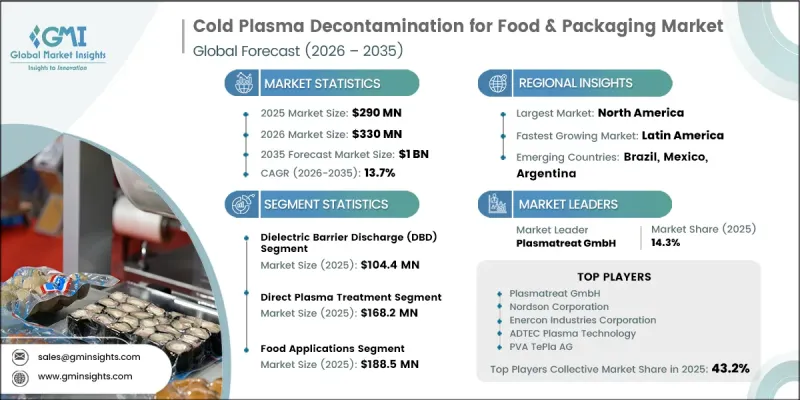
冷電漿滅菌技術利用高活性氧和氮物種,在接近室溫的條件下去除食品和包裝材料中的微生物污染。與傳統滅菌方法不同,這種非熱處理過程能夠有效減少微生物,且不會留下化學殘留物,也不會使產品暴露於過高溫度下。因此,產品的營養價值、風味、香氣和包裝完整性等品質特性基本上不受影響。由於該技術既能滿足現代食品安全要求,又能滿足消費者對加工最少的產品的偏好,因此正日益被認可為具有商業性可行性的傳統滅菌方法替代方案。食品和包裝製造商對無殘留加工解決方案的需求不斷成長,進一步加速了該技術的市場普及。產業相關人員越來越重視那些能夠支援潔淨標示、提升食品安全性能和提高營運效率的技術。此外,由於擴充性、環境友善性和高效的滅菌能力,冷電漿系統在各種食品加工和包裝應用領域也備受關注。這些優勢有望在整個預測期內支持強勁的市場擴張,並增強全球食品和包裝用冷電漿滅菌市場的長期成長潛力。
| 市場範圍 | |
|---|---|
| 開始年份 | 2025 |
| 預測期 | 2026-2035 |
| 初始市場規模 | 2.9億美元 |
| 預測金額 | 10億美元 |
| 複合年成長率 | 13.7% |
預計到2025年,介質阻擋放電(DBD)技術的銷售額將達到1.044億美元。 DBD系統之所以廣泛應用,主要原因在於其能夠產生適用於大規模工業環境的各種等離子體場。與現有製造流程的兼容性使其能夠在保持商業性吸引力的同時,實現高效加工。此外,這些系統還具有可靠的滅菌能力,能夠滿足食品和包裝加工的各種需求,使其成為工業規模應用的理想解決方案。
預計到2025年,食品相關應用領域的市場規模將達到1.885億美元。該領域的需求主要受日益嚴格的食品安全標準以及消費者和食品零售商對無殘留加工技術的偏好不斷成長的驅動。食品製造商正在採用先進的滅菌解決方案,以提高產品安全性、延長保存期限並在不影響加工效率的前提下保持產品品質。隨著監管要求的不斷變化和消費者食品安全意識的提高,預計食品生產設施對冷電漿技術的投資將保持強勁勢頭。
預計2035年,北美食品和包裝用冷電漿滅菌市場規模將達2.863億美元。由於食品安全監管力度不斷增加、消費者對潔淨標示產品的需求日益成長以及無殘留加工技術的廣泛應用,北美繼續保持主導地位。該地區的食品製造商正積極投資先進的消毒系統,以滿足不斷變化的消費者期望並提升產品品質標準。消費者對低加工食品和永續加工解決方案的日益關注,進一步推動了等離子體技術在食品生產和包裝過程中的應用。這些因素將繼續鞏固該地區的主導地位,並推動其市場長期成長。
目錄
第1章:調查方法和範圍
第2章執行摘要
第3章 行業洞察
- 產業生態系分析
- 供應商情況
- 利潤率
- 每個階段增加的價值
- 影響價值鏈的因素
- 中斷
- 影響產業的因素
- 促進因素
- 對非熱處理食品保藏技術的需求日益成長
- 人們越來越關注食品安全和延長保存期限
- 監理機關應鼓勵採用不使用化學品的加工方法。
- 產業潛在風險與挑戰
- 高昂的資本成本和設備成本
- 缺乏標準化的法規結構
- 市場機遇
- 整合到永續活性包裝生產線中
- 適用於中型企業的模組化等離子系統
- 促進因素
- 成長潛力分析
- 監理情勢
- 北美洲
- 歐洲
- 亞太地區
- 拉丁美洲
- 中東和非洲
- 波特的分析
- PESTLE分析
- 技術與創新展望
- 最新科技趨勢
- 新興技術
- 價格趨勢
- 按地區
- 透過技術
- 未來市場趨勢
- 專利趨勢
- 貿易統計
- 主要進口國
- 主要出口國
- 永續性和環境方面
- 永續計劃
- 減少廢棄物策略
- 生產中的能源效率
- 具有環保意識的舉措
- 考慮碳足跡
第4章 競爭情勢
- 介紹
- 企業市佔率分析
- 按地區
- 北美洲
- 歐洲
- 亞太地區
- LATAM
- 中東和非洲
- 按地區
- 企業矩陣分析
- 主要市場公司的競爭分析
- 競爭定位矩陣
- 主要進展
- 併購
- 夥伴關係和聯盟
- 新產品發布
- 業務拓展計劃
第5章 市場估計與預測:依技術分類,2022-2035年
- 介質阻擋放電(DBD)
- 大氣壓力等離子體噴流(APPJ)
- 冠狀病毒出院
- 滑動電弧放電
- 射頻(RF)等離子體
- 其他
第6章 市場估計與預測:依處理方式分類,2022-2035年
- 直接血漿治療
- 間接法/等離子活化介質(PAM)處理
- 其他
第7章 市場估計與預測:依應用領域分類,2022-2035年
- 食品應用
- 生鮮食品的衛生管理
- 肉類和水產品的消毒
- 乳製品表面保護
- 乾貨的滅菌
- 即食食品的安全性
- 其他
- 包裝應用
- 無菌包裝材料
- 無菌包裝材料
- 預滅菌包裝材料
- 高性能/功能性包裝材料
- 其他
第8章 市場估計與預測:依地區分類,2022-2035年
- 北美洲
- 美國
- 加拿大
- 歐洲
- 德國
- 英國
- 法國
- 西班牙
- 義大利
- 其他歐洲國家
- 亞太地區
- 中國
- 印度
- 日本
- 澳洲
- 韓國
- 其他亞太國家
- 拉丁美洲
- 巴西
- 墨西哥
- 阿根廷
- 其他拉丁美洲國家
- 中東和非洲
- 沙烏地阿拉伯
- 南非
- UAE
- 其他中東和非洲國家
第9章:公司簡介
- Plasmatreat GmbH
- Nordson Corporation
- Enercon Industries Corporation
- ADTEC Plasma Technology
- PVA TePla AG
- Europlasma NV
- Tantec A/S
- Henniker Plasma
- Vetaphone A/S
- AcXys Technologies
- PlasmaLeap Technologies
- Relyon Plasma GmbH(TDK)
- Neoplas Tools GmbH
The Global Cold Plasma Decontamination for Food & Packaging Market was valued at USD 290 million in 2025 and is estimated to grow at a CAGR of 13.7% to reach USD 1 billion by 2035.
Cold plasma decontamination technology utilizes reactive oxygen and nitrogen species to eliminate microbial contamination from food products and packaging materials at near-ambient temperatures. Unlike conventional decontamination methods, this non-thermal process achieves effective microbial reduction without leaving chemical residues or exposing products to significant heat. As a result, product quality attributes, including nutritional value, flavor, aroma, and packaging integrity, remain largely unaffected. The technology is increasingly being recognized as a commercially viable alternative to traditional decontamination approaches due to its ability to support modern food safety requirements while aligning with consumer preferences for minimally processed products. Growing demand for residue-free processing solutions among food manufacturers and packaging producers continues to accelerate market adoption. Industry participants are placing greater emphasis on technologies that support clean-label initiatives, enhance food safety performance, and improve operational efficiency. In addition, cold plasma systems are gaining traction across a broad range of food processing and packaging applications because they offer scalable, environmentally responsible, and highly effective decontamination capabilities. These advantages are expected to support strong market expansion throughout the forecast period and reinforce the long-term growth potential of the global cold plasma decontamination for food & packaging market.
| Market Scope | |
|---|---|
| Start Year | 2025 |
| Forecast Year | 2026-2035 |
| Start Value | $290 Million |
| Forecast Value | $1 Billion |
| CAGR | 13.7% |
The dielectric barrier discharge (DBD) segment generated USD 104.4 million in 2025. The widespread adoption of DBD systems is primarily attributed to their ability to produce large-area plasma fields suitable for integration into high-volume industrial production environments. Their compatibility with existing manufacturing operations enables efficient processing while maintaining commercially attractive throughput rates. In addition, these systems provide reliable decontamination performance and support a wide variety of food and packaging treatment requirements, making them a preferred solution for industrial-scale applications.
The food-related applications segment accounted for USD 188.5 million in 2025. Demand within this segment is largely driven by increasingly stringent food safety standards and the growing preference for residue-free processing technologies among consumers and food retailers. Food manufacturers are adopting advanced decontamination solutions to improve product safety, extend shelf life, and maintain product quality without compromising processing efficiency. As regulatory expectations continue to evolve and consumer awareness regarding food safety increases, investment in cold plasma technologies across food production facilities is expected to remain strong.
North America Cold Plasma Decontamination for Food & Packaging Market is anticipated to reach USD 286.3 million by 2035. North America continues to hold a leading position in the global market due to heightened regulatory focus on food safety, increasing demand for clean-label products, and rising adoption of residue-free processing technologies. Food manufacturers throughout the region are actively investing in advanced decontamination systems to address evolving consumer expectations and strengthen product quality standards. Growing interest in minimally processed food products and sustainable processing solutions is further encouraging the deployment of plasma-based technologies across food production and packaging operations. These factors continue to support the region's leadership position and long-term market growth.
Major companies operating in the global cold plasma decontamination for food & packaging market include Plasmatreat GmbH, Nordson Corporation, Enercon Industries Corporation, ADTEC Plasma Technology, PVA TePla AG, Europlasma NV, Tantec A/S, Henniker Plasma, Vetaphone A/S, AcXys Technologies, PlasmaLeap Technologies, Relyon Plasma GmbH (TDK), and Neoplas Tools GmbH. Companies participating in the cold plasma decontamination for food & packaging market are focusing on innovation, strategic collaborations, and technology advancement to strengthen their competitive position. Leading market participants are investing heavily in research and development to improve plasma generation efficiency, system reliability, and processing scalability. Partnerships with food manufacturers, packaging companies, and industrial automation providers are helping accelerate commercialization and expand market reach. Many organizations are also enhancing their product portfolios by developing customized solutions tailored to specific processing requirements. Expanding regional distribution networks and strengthening after-sales support services remain important strategies for improving customer engagement and retention.
Table of Contents
Chapter 1 Methodology & Scope
- 1.1 Market scope and definition
- 1.2 Research design
- 1.2.1 Research approach
- 1.2.2 Data collection methods
- 1.3 Data mining sources
- 1.3.1 Global
- 1.3.2 Regional/Country
- 1.4 Base estimates and calculations
- 1.4.1 Base year calculation
- 1.4.2 Key trends for market estimation
- 1.5 Primary research and validation
- 1.5.1 Primary sources
- 1.6 Forecast model
- 1.7 Research assumptions and limitations
Chapter 2 Executive Summary
- 2.1 Industry 360° synopsis
- 2.2 Key market trends
- 2.2.1 Technology
- 2.2.2 Treatment Mode
- 2.2.3 Application
- 2.2.4 Regional
- 2.3 TAM Analysis, 2026-2035
- 2.4 CXO perspectives: Strategic imperatives
- 2.5 Future outlook and strategic recommendations
Chapter 3 Industry Insights
- 3.1 Industry ecosystem analysis
- 3.1.1 Supplier landscape
- 3.1.2 Profit margin
- 3.1.3 Value addition at each stage
- 3.1.4 Factor affecting the value chain
- 3.1.5 Disruptions
- 3.2 Industry impact forces
- 3.2.1 Growth drivers
- 3.2.1.1 Rising demand for non-thermal food preservation technologies
- 3.2.1.2 Increasing focus on food safety and shelf-life extension
- 3.2.1.3 Regulatory push toward chemical-free processing methods
- 3.2.2 Industry pitfalls and challenges
- 3.2.2.1 High capital and equipment cost
- 3.2.2.2 Lack of standardized regulatory frameworks
- 3.2.3 Market opportunities
- 3.2.3.1 Integration into sustainable active packaging lines
- 3.2.3.2 Modular plasma systems for mid-tier operators
- 3.2.1 Growth drivers
- 3.3 Growth potential analysis
- 3.4 Regulatory landscape
- 3.4.1 North America
- 3.4.2 Europe
- 3.4.3 Asia Pacific
- 3.4.4 Latin America
- 3.4.5 Middle East & Africa
- 3.5 Porter’s analysis
- 3.6 PESTEL analysis
- 3.7 Technology and innovation landscape
- 3.7.1 Current technological trends
- 3.7.2 Emerging technologies
- 3.8 Price trends
- 3.8.1 By region
- 3.8.2 By technology
- 3.9 Future market trends
- 3.10 Patent landscape
- 3.11 Trade statistics (HS code)
- 3.11.1 Major importing countries
- 3.11.2 Major exporting countries
- 3.12 Sustainability and environmental aspects
- 3.12.1 Sustainable practices
- 3.12.2 Waste reduction strategies
- 3.12.3 Energy efficiency in production
- 3.12.4 Eco-friendly initiatives
- 3.13 Carbon footprint consideration
Chapter 4 Competitive Landscape, 2025
- 4.1 Introduction
- 4.2 Company market share analysis
- 4.2.1 By region
- 4.2.1.1 North America
- 4.2.1.2 Europe
- 4.2.1.3 Asia Pacific
- 4.2.1.4 LATAM
- 4.2.1.5 MEA
- 4.2.1 By region
- 4.3 Company matrix analysis
- 4.4 Competitive analysis of major market players
- 4.5 Competitive positioning matrix
- 4.6 Key developments
- 4.6.1 Mergers & acquisitions
- 4.6.2 Partnerships & collaborations
- 4.6.3 New product launches
- 4.6.4 Expansion plans
Chapter 5 Market Estimates and Forecast, By Technology, 2022-2035 (USD Million) (Kilo Tons)
- 5.1 Key trends
- 5.2 Dielectric barrier discharge (DBD)
- 5.3 Atmospheric pressure plasma jet (APPJ)
- 5.4 Corona discharge
- 5.5 Gliding arc discharge
- 5.6 Radio frequency (RF) plasma
- 5.7 Others
Chapter 6 Market Estimates and Forecast, By Treatment Mode, 2022-2035 (USD Million) (Kilo Tons)
- 6.1 Key trends
- 6.2 Direct plasma treatment
- 6.3 Indirect / plasma-activated medium (PAM) treatment
- 6.4 Others
Chapter 7 Market Estimates and Forecast, By Application, 2022-2035 (USD Million) (Kilo Tons)
- 7.1 Key trends
- 7.2 Food applications
- 7.2.1 Fresh produce sanitation
- 7.2.2 Meat & seafood decontamination
- 7.2.3 Dairy surface protection
- 7.2.4 Dry food sterilization
- 7.2.5 Ready-to-eat food safety
- 7.2.6 Others
- 7.3 Packaging applications
- 7.3.1 Sterile packaging materials
- 7.3.2 Aseptic packaging materials
- 7.3.3 Pre-sterilized packaging materials
- 7.3.4 High-performance / functional packaging materials
- 7.3.5 Others
Chapter 8 Market Estimates and Forecast, By Region, 2022-2035 (USD Million) (Kilo Tons)
- 8.1 Key trends
- 8.2 North America
- 8.2.1 U.S.
- 8.2.2 Canada
- 8.3 Europe
- 8.3.1 Germany
- 8.3.2 UK
- 8.3.3 France
- 8.3.4 Spain
- 8.3.5 Italy
- 8.3.6 Rest of Europe
- 8.4 Asia Pacific
- 8.4.1 China
- 8.4.2 India
- 8.4.3 Japan
- 8.4.4 Australia
- 8.4.5 South Korea
- 8.4.6 Rest of Asia Pacific
- 8.5 Latin America
- 8.5.1 Brazil
- 8.5.2 Mexico
- 8.5.3 Argentina
- 8.5.4 Rest of Latin America
- 8.6 Middle East and Africa
- 8.6.1 Saudi Arabia
- 8.6.2 South Africa
- 8.6.3 UAE
- 8.6.4 Rest of Middle East and Africa
Chapter 9 Company Profiles
- 9.1 Plasmatreat GmbH
- 9.2 Nordson Corporation
- 9.3 Enercon Industries Corporation
- 9.4 ADTEC Plasma Technology
- 9.5 PVA TePla AG
- 9.6 Europlasma NV
- 9.7 Tantec A/S
- 9.8 Henniker Plasma
- 9.9 Vetaphone A/S
- 9.10 AcXys Technologies
- 9.11 PlasmaLeap Technologies
- 9.12 Relyon Plasma GmbH (TDK)
- 9.13 Neoplas Tools GmbH

 全球冷電漿市場:依產業、應用、制度和地區分類-預測至2031年
 冷電漿市場:全球預測,2026-2032年
 醫療領域冷等離子體市場-全球產業規模、佔有率、趨勢、機會和預測:按應用、地區和競爭格局分類,2021-2031年
 冷等離子市場:依方法、應用、最終用戶和地區分類
 全球低溫等離子體技術市場:市場規模、佔有率和趨勢分析(按應用、技術、最終用途和地區分類),細分市場預測(2026-2033 年)
 冷等離子市場規模、佔有率和成長分析(按類型、應用、最終用戶和地區分類)—2026-2033年產業預測
 冷等離子設備市場
 冷等離子市場:預測(2025-2030)全球冷等離子市場規模:按應用、產業、制度、地區、範圍和預測
 冷等離子體市場,規模,佔有率,趨勢,產業分析報告:制度,各用途,各最終用途,各地區-2025-2034年市場預測