


 |
市場調查報告書
商品編碼
2083066
動態農藥市場機會、成長要素、產業趨勢分析及2026-2035年預測。Photodynamic Pesticides Market Opportunity, Growth Drivers, Industry Trend Analysis, and Forecast 2026 - 2035 |
||||||

預計到 2025 年,全球動態農藥市場價值將達到 3,230 萬美元,預計到 2035 年將以 15.9% 的複合年成長率成長至 1.421 億美元。
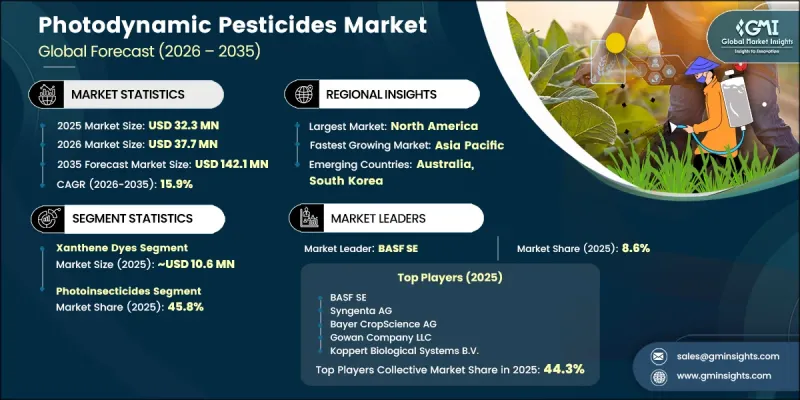
市場成長的驅動力主要來自永續作物保護解決方案的日益普及、生物基農藥投資的增加以及光敏劑研發技術的加速進步。產業重組也發揮重要作用,大型農藥公司積極收購生技公司並授權先進的動態技術,以加速產品創新並應對專利到期帶來的挑戰。對環保農藥替代品的需求不斷成長,進一步推動了市場滲透。特別是,植物和藻類來源的光敏劑正在提高其與有機農業系統的兼容性,並擴大其在高階農業市場的覆蓋範圍。智慧光活化系統的進步,包括基於LED的解決方案以及改進的給藥機制,進一步提高了加工效率,並擴大了其在保護性栽培系統中的應用。此外,動態劑在公共衛生害蟲防治計畫中的廣泛應用也促進了其普及。總體而言,生物技術開發商和成熟農藥生產商之間的密切合作推動了市場的持續發展,從而縮短了產品上市週期,並提高了產品供應。
| 市場範圍 | |
|---|---|
| 開始年份 | 2025 |
| 預測期 | 2026-2035 |
| 上市時的市場規模 | 3230萬美元 |
| 預計金額 | 1.421億美元 |
| 複合年成長率 | 15.9% |
呫噸顏料市佔率佔32.8%,累計達1,060萬美元,預計到2035年將以13.6%的複合年成長率成長。該細分市場持續保持高普及率,這得益於其成熟的用戶基礎、與現有農業噴灑系統的兼容性以及在園藝生產環境中的廣泛應用。卟啉和氯類顏料是另一個關鍵細分市場,與其他替代品相比,它們具有更高的光敏化效率和更低的面積所需劑量。
預計到2025年,光催化殺蟲劑市佔率將達到45.8%。這一主導地位歸功於其對多種農業害蟲的顯著有效性,以及其在綜合蟲害管理(IPM)計畫中日益廣泛的應用。此外,種植者對永續蟲害防治方案的接受度不斷提高,這些方案既能維持作物產量,又能減少對化學品的依賴,這也進一步增強了其商業性可行性。
到2025年,北美光動力農藥市佔率將達到36.2%。該地區市場的擴張得益於法規環境的簡化,這加速了包括光敏劑在內的生物製藥產品的核准和商業化進程。監管的簡化促進了多種光動力製劑的上市,提高了產品的可及性,並推動了農業領域的廣泛應用。
目錄
第1章:調查方法和範圍
第2章執行摘要
第3章 行業洞察
- 產業生態系分析
- 供應商情況
- 利潤率
- 每個階段增加的價值
- 影響價值鏈的因素
- 中斷
- 影響產業的因素
- 促進因素
- 人們越來越難以對傳統化學農藥產生抗藥性,促使人們採用新的替代方法。
- 全球對零殘留、環保作物保護解決方案的需求日益成長。
- 擴大對生物農藥和綠色化學產品的法規核准範圍,並提供政府獎勵措施。
- 產業潛在風險與挑戰
- 在光線較暗的條件下以及夜間使用時,其有效性會受到光照強度的限制。
- 缺乏擴大商業規模所需的基礎設施以及精製光敏劑的高製造成本
- 市場機遇
- 收穫後後處理和食品安全方面仍有未開發的潛力。
- 與奈米遞送系統整合,實現靶向、可控和持續釋放。
- 促進因素
- 成長潛力分析
- 監理情勢
- 北美洲
- 歐洲
- 亞太地區
- 拉丁美洲
- 中東和非洲
- 波特的分析
- PESTLE分析
- 價格趨勢
- 按地區
- 依原料類型
- 未來市場趨勢
- 技術與創新展望
- 最新科技趨勢
- 新興技術
- 專利趨勢
- 貿易統計
- 主要進口國
- 主要出口國
- 永續性和環境方面
- 永續計劃
- 減少廢棄物策略
- 生產中的能源效率
- 具有環保意識的舉措
- 考慮碳足跡
第4章 競爭情勢
- 介紹
- 企業市佔率分析
- 按地區
- 北美洲
- 歐洲
- 亞太地區
- LATAM
- 中東和非洲
- 按地區
- 主要市場公司的競爭分析
- 競爭定位矩陣
- 主要進展
- 併購
- 夥伴關係和聯盟
- 新產品發布
- 業務拓展計劃
第5章 市場估算與預測:依光敏劑類型分類,2022-2035年
- 卟啉和氯
- 吩噻嗪顏料
- 呫噸顏料
- 酞菁
- 天然和生物來源的光敏劑
- 其他
第6章 市場估計與預測:依應用領域分類,2022-2035年
- 光敏殺蟲劑
- 光殺菌劑
- 光抗菌劑
- 光化學除草劑
- 其他
第7章 市場估計與預測:依最終用戶分類,2022-2035年
- 商業農業
- 園藝及保育性栽培
- 林業和草皮
- 公共衛生和病媒控制
- 其他
第8章 市場估計與預測:依地區分類,2022-2035年
- 北美洲
- 美國
- 加拿大
- 歐洲
- 德國
- 英國
- 法國
- 西班牙
- 義大利
- 其他歐洲國家
- 亞太地區
- 中國
- 印度
- 日本
- 澳洲
- 韓國
- 其他亞太國家
- 拉丁美洲
- 巴西
- 墨西哥
- 阿根廷
- 其他拉丁美洲國家
- 中東和非洲
- 沙烏地阿拉伯
- 南非
- UAE
- 其他中東和非洲國家
第9章:公司簡介
- BASF SE
- AgriTitan LLC
- Andermatt Group AG
- Bayer CropScience AG
- Certis USA LLC
- Gowan Company LLC
- Koppert Biological Systems BV
- Syngenta AG
- Vestaron Corporation
The Global Photodynamic Pesticides Market was valued at USD 32.3 million in 2025 and is estimated to grow at a CAGR of 15.9% to reach USD 142.1 million by 2035.
Market growth is driven by increasing adoption of sustainable crop protection solutions, expanding investment in bio-based agrochemicals, and accelerating technological advancements in photosensitizer development. Industry consolidation is also playing a major role, as leading agrochemical firms actively acquire biotechnology companies and license advanced photodynamic technologies to accelerate product innovation and offset challenges related to patent expirations. Growing demand for environmentally safe pesticide alternatives is further supporting market penetration, particularly as plant- and algae-derived photosensitizers improve compatibility with organic farming systems and enhance access to premium agricultural markets. Advancements in smart light activation systems, including LED-based solutions combined with improved delivery mechanisms, are further increasing treatment efficiency and extending application potential across protected cultivation systems. Additionally, expanding use of photodynamic agents in public health pest control programs is contributing to broader adoption. Overall, the market continues to evolve through strong collaboration between biotechnology developers and established agrochemical players, resulting in faster commercialization cycles and broader product availability.
| Market Scope | |
|---|---|
| Start Year | 2025 |
| Forecast Year | 2026-2035 |
| Start Value | $32.3 Million |
| Forecast Value | $142.1 Million |
| CAGR | 15.9% |
Xanthene dyes segment held a 32.8% share, generating USD 10.6 million, and is expected to grow at a CAGR of 13.6% through 2035. This segment maintains strong adoption due to its established use base, compatibility with existing agricultural spraying systems, and widespread application in horticultural production environments. Porphyrins and chlorins represent another key segment, supported by their higher photosensitizing efficiency and lower dosage requirements per application area compared to other alternatives.
The photoinsecticides segment accounted for 45.8% share in 2025. This dominance is attributed to their proven effectiveness against a broad range of agricultural pests and their increasing adoption as part of integrated pest management programs. Their commercial viability has been reinforced by growing acceptance among growers seeking sustainable pest control solutions that reduce chemical dependency while maintaining crop productivity.
North America Photodynamic Pesticides Market represented 36.2% share in 2025. Regional expansion is supported by a streamlined regulatory environment that accelerates the approval and commercialization of biopesticide products containing photosensitizing compounds. This regulatory efficiency has encouraged the introduction of multiple photodynamic formulations, strengthening product availability and driving adoption across agricultural applications.
Key companies operating in the Global Photodynamic Pesticides Market include Syngenta AG, BASF SE, Bayer CropScience AG, Koppert Biological Systems B.V., Gowan Company LLC, Certis USA LLC, AgriTitan LLC, Andermatt Group AG, and Vestaron Corporation. Companies operating in the Photodynamic Pesticides Market are focusing on strategic acquisitions, technology partnerships, and product innovation to strengthen their competitive position. A key strategy involves acquiring biotechnology firms and licensing proprietary photosensitizer technologies to accelerate research and shorten product development cycles. Manufacturers are also investing heavily in sustainable formulation development, emphasizing plant- and algae-based inputs to align with organic farming requirements and regulatory expectations. Expanding collaborations between agrochemical leaders and biotech innovators are enabling faster commercialization and broader technology integration. Companies are further enhancing product efficiency through advancements in light-activation systems and precision delivery mechanisms that improve field performance.
Table of Contents
Chapter 1 Methodology & Scope
- 1.1 Research approach
- 1.2 Quality Commitments
- 1.2.1 GMI AI policy & data integrity commitment
- 1.2.1.1 Source consistency protocol
- 1.2.1 GMI AI policy & data integrity commitment
- 1.3 Research Trail & Confidence Scoring
- 1.3.1 Research Trail Components
- 1.3.2 Scoring Components
- 1.4 Data Collection
- 1.4.1 Partial list of primary sources
- 1.5 Data mining sources
- 1.5.1 Paid sources
- 1.5.1.1 Sources, by region
- 1.5.1 Paid sources
- 1.6 Base estimates and calculations
- 1.6.1 Base year calculation for any one approach
- 1.7 Forecast model
- 1.7.1 Quantified market impact analysis
- 1.7.1.1 Mathematical impact of growth parameters on forecast
- 1.7.1 Quantified market impact analysis
- 1.8 Research transparency addendum
- 1.8.1 Source attribution framework
- 1.8.2 Quality assurance metrics
- 1.8.3 Our commitment to trust
Chapter 2 Executive Summary
- 2.1 Industry 360° synopsis
- 2.2 Key market trends
- 2.2.1 Regional
- 2.2.2 Photosensitizer type
- 2.2.3 Application
- 2.2.4 End-user
Chapter 3 Industry Insights
- 3.1 Industry ecosystem analysis
- 3.1.1 Supplier landscape
- 3.1.2 Profit margin
- 3.1.3 Value addition at each stage
- 3.1.4 Factor affecting the value chain
- 3.1.5 Disruptions
- 3.2 Industry impact forces
- 3.2.1 Growth drivers
- 3.2.1.1 Rising resistance to conventional chemical pesticides driving adoption of novel alternatives
- 3.2.1.2 Growing global demand for residue-free & environmentally benign crop protection solutions
- 3.2.1.3 Expanding regulatory approvals & government incentives for biopesticides & green chemistry
- 3.2.2 Industry pitfalls and challenges
- 3.2.2.1 Light dependency limiting efficacy under low-irradiance conditions & night-time applications
- 3.2.2.2 Limited commercial scale-up infrastructure & high production costs of purified photosensitizers
- 3.2.3 Market opportunities
- 3.2.3.1 Untapped potential in post-harvest treatment & food safety applications
- 3.2.3.2 Integration with nano-delivery systems for targeted, controlled & sustained release
- 3.2.1 Growth drivers
- 3.3 Growth potential analysis
- 3.4 Regulatory landscape
- 3.4.1 North America
- 3.4.2 Europe
- 3.4.3 Asia Pacific
- 3.4.4 Latin America
- 3.4.5 Middle East & Africa
- 3.5 Porter’s analysis
- 3.6 PESTEL analysis
- 3.7 Price trends
- 3.7.1 By region
- 3.7.2 By feedstock type
- 3.8 Future market trends
- 3.9 Technology and innovation landscape
- 3.9.1 Current technological trends
- 3.9.2 Emerging technologies
- 3.10 Patent Landscape
- 3.11 Trade statistics (HS code)
- 3.11.1 Major importing countries
- 3.11.2 Major exporting countries
- 3.12 Sustainability and environmental aspects
- 3.12.1 Sustainable practices
- 3.12.2 Waste reduction strategies
- 3.12.3 Energy efficiency in production
- 3.12.4 Eco-friendly initiatives
- 3.13 Carbon footprint consideration
Chapter 4 Competitive Landscape, 2025
- 4.1 Introduction
- 4.2 Company market share analysis
- 4.2.1 By region
- 4.2.1.1 North America
- 4.2.1.2 Europe
- 4.2.1.3 Asia Pacific
- 4.2.1.4 LATAM
- 4.2.1.5 MEA
- 4.2.1 By region
- 4.3 Competitive analysis of major market players
- 4.4 Competitive positioning matrix
- 4.5 Key developments
- 4.5.1 Mergers & acquisitions
- 4.5.2 Partnerships & collaborations
- 4.5.3 New Product Launches
- 4.5.4 Expansion Plans
Chapter 5 Market Estimates and Forecast, By Photosensitizer Type, 2022-2035 (USD Million) (Kilo Tons)
- 5.1 Key trends
- 5.2 Porphyrins & chlorins
- 5.3 Phenothiazinium dyes
- 5.4 Xanthene dyes
- 5.5 Phthalocyanines
- 5.6 Natural/bio-derived photosensitizers
- 5.7 Others
Chapter 6 Market Estimates and Forecast, By Application, 2022-2035 (USD Million) (Kilo Tons)
- 6.1 Key trends
- 6.2 Photoinsecticides
- 6.3 Photofungicides
- 6.4 Photobactericides
- 6.5 Photoherbicides
- 6.6 Others
Chapter 7 Market Estimates and Forecast, By End-User, 2022-2035 (USD Million) (Kilo Tons)
- 7.1 Key trends
- 7.2 Commercial agriculture
- 7.3 Horticulture & protected cultivation
- 7.4 Forestry & turfgrass
- 7.5 Public health & vector control
- 7.6 Others
Chapter 8 Market Estimates and Forecast, By Region, 2022-2035 (USD Million) (Kilo Tons)
- 8.1 Key trends
- 8.2 North America
- 8.2.1 U.S.
- 8.2.2 Canada
- 8.3 Europe
- 8.3.1 Germany
- 8.3.2 UK
- 8.3.3 France
- 8.3.4 Spain
- 8.3.5 Italy
- 8.3.6 Rest of Europe
- 8.4 Asia Pacific
- 8.4.1 China
- 8.4.2 India
- 8.4.3 Japan
- 8.4.4 Australia
- 8.4.5 South Korea
- 8.4.6 Rest of Asia Pacific
- 8.5 Latin America
- 8.5.1 Brazil
- 8.5.2 Mexico
- 8.5.3 Argentina
- 8.5.4 Rest of Latin America
- 8.6 Middle East and Africa
- 8.6.1 Saudi Arabia
- 8.6.2 South Africa
- 8.6.3 UAE
- 8.6.4 Rest of Middle East and Africa
Chapter 9 Company Profiles
- 9.1 BASF SE
- 9.2 AgriTitan LLC
- 9.3 Andermatt Group AG
- 9.4 Bayer CropScience AG
- 9.5 Certis USA LLC
- 9.6 Gowan Company LLC
- 9.7 Koppert Biological Systems B.V.
- 9.8 Syngenta AG
- 9.9 Vestaron Corporation

 動態療法市場(第二版):按目標疾病、治療領域和主要地區分類的趨勢和預測(至2035年)
 動態療法市場:按產品類型、光源、應用、最終用戶和地區分類
 動態療法(PDT)市場規模、佔有率、成長及全球產業分析:按類型、應用和地區分類,並預測至2026-2034年
 2026年全球動態療法市場報告全球動態療法設備市場規模、佔有率、趨勢和成長分析報告(2026-2034年)
 動態雷射治療市場(按雷射類型、技術、應用和最終用戶分類)—2026-2032年全球預測紅藍光動態療法設備市場(按光源、技術、波長、應用、最終用戶和分銷管道分類)—全球預測(2026-2032 年)
 動態療法 (PDT) 市場規模、佔有率和成長分析(按作用機制、類別、治療方法、軟體、服務、應用可及性、應用和地區分類)— 2026-2033 年產業預測
 全球動態治療設備市場
 動態治療設備市場分析及預測(至 2034 年):類型、產品、技術、應用、最終用戶、組件、設備、功能、安裝類型、服務