


 |
市場調查報告書
商品編碼
2083053
隨車起重機市場機會、成長要素、產業趨勢分析及2026-2035年預測Pick-and-Carry Crane Market Opportunity, Growth Drivers, Industry Trend Analysis, and Forecast 2026 - 2035 |
||||||

全球隨車起重機市場預計到 2025 年將達到 7.875 億美元,年複合成長率為 8.1%,到 2035 年將達到 18 億美元。
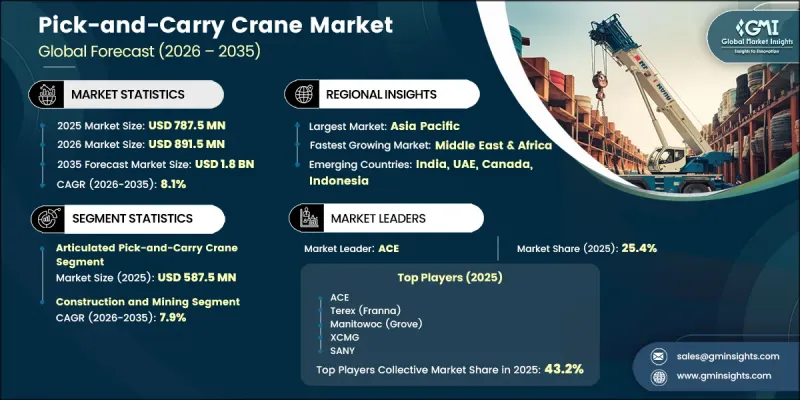
受主要經濟體基礎設施建設、工業擴張和建設活動投資增加的推動,全球移動式起重機市場正在蓬勃發展。隨著承包商尋求無需額外搬運機械或耗時設定程序即可運輸和定位重物的多功能起重設備,市場需求持續成長。這種操作柔軟性使移動式起重機成為工業建設、工廠維護、基礎設施開發、製造工廠以及涉及物料輸送作業的專案中的高效解決方案。政府對交通、能源和公共基礎設施的投資進一步促進了設備採購,為製造商創造了長期商機。同時,對勞動效率日益成長的需求以及模組化施工方法的日益普及也持續推動高移動性起重設備的使用。然而,先進型號(尤其是高容量和電動型號)相對較高的初始投資和維護成本仍然是中小型建築公司和本地設備租賃公司面臨的挑戰,有時會延緩設備升級或新購買。
| 市場範圍 | |
|---|---|
| 開始年份 | 2025 |
| 預測期 | 2026-2035 |
| 上市時的市場規模 | 7.875億美元 |
| 預計金額 | 18億美元 |
| 複合年成長率 | 8.1% |
預計到2025年,建築與採礦業務部門的銷售額將達到3.15億美元。該板塊涵蓋商業建築、交通基礎設施、工業開發、採礦、大規模土木工程項目和土地開發等應用領域。對基礎設施現代化和工業擴張的持續投資預計將在整個預測期內維持對多功能起重設備的需求。
美國攜帶式起重機市場預計到2025年將達到1.01億美元,並在2035年之前以9.1%的複合年成長率成長。市場擴張的驅動力主要來自對交通基礎設施、能源項目、工業建設和公共產業發展的持續投資。對大規模基礎建設的持續投入正促使建築公司擴充設備,從而為全美攜帶式起重機市場創造了機會。
目錄
第1章:調查方法和範圍
第2章執行摘要
第3章 行業洞察
- 產業生態系分析
- 供應商情況
- 成本結構
- 利潤率
- 每個階段增加的價值
- 垂直整合趨勢
- 顛覆者
- 影響產業的因素
- 促進因素
- 基礎設施和建設活動的擴張
- 採礦和能源項目的成長
- 對多用途行動起重設備的需求日益成長
- 起重機租賃公司需求不斷成長
- 產業潛在風險與挑戰
- 高昂的初始設定和維修成本
- 與其他升降設備的競爭
- 熟練操作人員短缺和安全合規要求
- 市場機遇
- 電動和混合動力起重機平台
- 智慧遠端資訊處理與預測性維護服務
- 用於城市基礎設施的緊湊型鉸接式起重機
- 新興市場的租賃車輛滲透率
- 促進因素
- 成長潛力分析
- 技術與創新展望
- 最新技術
- 新興技術
- 價格分析
- 對過去價格趨勢的分析
- 依球員類型分類的定價策略(高級球員、超值球員、成本加成球員)
- 監理情勢
- 北美洲
- 起重機和吊運設備的 OSHA 標準
- ASME B30.5 - 移動式和機車起重機
- NCCCO起重機操作員認證
- CSA Z150 - 移動式起重機安全標準
- 歐洲
- 歐盟機械法規
- 歐盟第五階段排放氣體標準
- EN 13000 - 起重機安全標準
- LOLER-起重設備相關法規
- 亞太地區
- GB/T 14560-起重機安全標準(中國)
- CCMA起重機型式認可(中國)
- JCMA安全標準(日本)
- DGFASLI起重機安全規章(印度)
- AS 2550.5 - 起重機操作安全(澳洲)
- 拉丁美洲
- NR-11 和 NR-12 機械安全法規(巴西)
- NOM-009-STPS 起重設備法規(墨西哥)
- 中東和非洲
- OSHAD起重作業規格(阿拉伯聯合大公國)
- 沙烏地阿美起重設備標準
- 南非起重設備法規(SANS)
- 北美洲
- 波特的分析
- PESTLE分析
- 專利分析
- 貿易數據分析
- 進出口量及進口額趨勢
- 主要貿易路線及關稅的影響
- 成本細分分析
- 人工智慧和生成式人工智慧對市場的影響
- 利用人工智慧改造現有經營模式
- 設計最佳化自動化
- 用於需求預測的供應鏈人工智慧
- 按細分市場分類的生成式人工智慧用例和部署藍圖
- 風險、限制和監管考量
- 生產能力和生產情況
- 設備產能:按地區和主要生產商分類
- 運轉率和擴張計劃
- 永續性和環境方面
- 永續計劃
- 減少廢棄物策略
- 生產中的能源效率
- 具有環保意識的舉措
- 考慮碳足跡
- 預測假設和情境分析
- 基本案例:驅動複合年成長率的關鍵宏觀經濟與產業變量
- 樂觀情境:宏觀經濟與產業的順風
- 悲觀情景:宏觀經濟放緩或產業逆風
第4章 競爭情勢
- 介紹
- 企業市佔率分析
- 北美洲
- 歐洲
- 亞太地區
- 拉丁美洲
- 中東和非洲
- 競爭定位矩陣
- 主要進展
- 併購
- 夥伴關係和聯盟
- 新產品發布
- 業務拓展計劃及資金籌措
- 按公司規模進行基準測試
- 排名分類標準與遴選標準
- 按銷售額、地區和創新能力分類的層級定位矩陣。
第5章 市場估價與預測:依起重機類型分類,2022-2035年
- 鉸接式吊掛起重機
- 剛性框架式搬運起重機
第6章 市場估算與預測:依繁榮類型分類,2022-2035年
- 伸縮臂
- 不可伸縮/固定臂
第7章 市場估價與預測:依裝載能力分類,2022-2035年
- 10噸或以下
- 10-25噸
- 超過25噸
第8章 市場估算與預測:依促進因素分類,2022-2035年
- 柴油/內燃機(ICE)驅動
- 電的
- 混合
第9章 市場估計與預測:依應用領域分類,2022-2035年
- 建築和採礦
- 公用事業
- 製造業
- 運輸/航運
- 石油和天然氣/能源
- 其他
第10章 市場估價與預測:依最終用戶分類,2022-2035年
- 基礎建設公司
- 工業和製造設施
- 能源和公共產業公司
- 起重機租賃服務公司
- 其他
第11章 市場估價與預測:按地區分類,2022-2035年
- 北美洲
- 美國
- 加拿大
- 歐洲
- 英國
- 德國
- 法國
- 義大利
- 西班牙
- 比利時
- 荷蘭
- 瑞典
- 俄羅斯
- 亞太地區
- 中國
- 印度
- 日本
- 澳洲
- 新加坡
- 韓國
- 越南
- 印尼
- 泰國
- 拉丁美洲
- 巴西
- 墨西哥
- 阿根廷
- 中東和非洲
- 南非
- 沙烏地阿拉伯
- UAE
- 土耳其
第12章:公司簡介
- 世界公司
- ACE
- Liebherr
- Manitowoc(Grove)
- SANY
- Tadano
- Terex(Franna)
- XCMG
- 當地公司
- Broderson Manufacturing
- Escorts Construction Equipment
- JMG Cranes
- Kato Works
- LiuGong
- Maeda Mini Cranes
- Valla Cranes
- Zoomlion
- 新興企業/顛覆者
- Anupam Industries
- Hyva
- Manitex International
- Palfinger
- TIL
The Global Pick-and-Carry Crane Market was valued at USD 787.5 million in 2025 and is estimated to grow at a CAGR of 8.1% to reach USD 1.8 billion by 2035.
Growth in the global pick-and-carry crane market is driven by rising investments in infrastructure development, industrial expansion, and construction activities across major economies. Demand continues to increase as contractors seek versatile lifting equipment capable of transporting and positioning loads without requiring additional handling machinery or lengthy setup procedures. This operational flexibility makes pick-and-carry cranes an efficient solution for projects involving industrial construction, plant maintenance, infrastructure development, manufacturing facilities, and material handling operations. Government investment in transportation, energy, and public infrastructure is further supporting equipment procurement, creating long-term opportunities for manufacturers. At the same time, increasing labor efficiency requirements and the growing adoption of modular construction practices continue to encourage the use of highly mobile lifting equipment. However, the relatively high initial investment and maintenance costs associated with advanced models, particularly larger-capacity and electric variants, remain a challenge for smaller contractors and regional equipment rental companies, occasionally delaying fleet replacement and new equipment purchases.
| Market Scope | |
|---|---|
| Start Year | 2025 |
| Forecast Year | 2026-2035 |
| Start Value | $787.5 Million |
| Forecast Value | $1.8 Billion |
| CAGR | 8.1% |
The construction and mining segment generated USD 315 million in 2025. This segment includes applications across commercial construction, transportation infrastructure, industrial development, mining operations, large-scale engineering projects, and site preparation activities. Continued investments in infrastructure modernization and industrial expansion are expected to sustain demand for versatile lifting equipment throughout the forecast period.
United States Pick-and-Carry Crane Market generated USD 101 million in 2025 and is projected to grow at a CAGR of 9.1% through 2035. Market expansion is being supported by ongoing investments in transportation infrastructure, energy projects, industrial construction, and public utility development. Continued funding for large-scale infrastructure improvements is encouraging contractors to expand equipment fleets, creating favorable opportunities for the pick-and-carry crane market across the country.
Major companies operating in the global pick-and-carry crane market include Liebherr, Tadano, Manitowoc, SANY, XCMG, Terex, Zoomlion, ACE (Action Construction Equipment Ltd.), Escorts Construction, Broderson Manufacturing, JMG Cranes, Kato Works, LiuGong, Maeda Mini, Valla Cranes, Anupam Industries, Hyva, Manitex International, Palfinger, and TIL (Tractors India Limited). Companies operating in the pick-and-carry crane market are strengthening their competitive position by expanding product portfolios, improving lifting performance, and investing in advanced equipment technologies. Manufacturers continue to develop cranes with higher load capacities, enhanced mobility, improved fuel efficiency, and greater operational safety to meet evolving customer requirements. Investments in electric and low-emission crane technologies are also increasing as sustainability becomes a key purchasing consideration. Strategic partnerships with equipment dealers, rental companies, and construction firms are helping manufacturers expand their geographic presence and strengthen customer relationships.
Table of Contents
Chapter 1 Methodology & Scope
- 1.1 Research approach
- 1.2 Quality Commitments
- 1.2.1 GMI AI policy & data integrity commitment
- 1.2.1.1 Source consistency protocol
- 1.2.1 GMI AI policy & data integrity commitment
- 1.3 Research Trail & Confidence Scoring
- 1.3.1 Research Trail Components
- 1.3.2 Scoring Components
- 1.4 Data Collection
- 1.4.1 Partial list of primary sources
- 1.5 Data mining sources
- 1.5.1 Paid sources
- 1.5.1.1 Sources, by region
- 1.5.1 Paid sources
- 1.6 Base estimates and calculations
- 1.6.1 Base year calculation
- 1.7 Forecast model
- 1.7.1 Quantified market impact analysis
- 1.7.1.1 Mathematical impact of growth parameters on forecast
- 1.7.1 Quantified market impact analysis
- 1.8 Research transparency addendum
- 1.8.1 Source attribution framework
- 1.8.2 Quality assurance metrics
- 1.8.3 Our commitment to trust
Chapter 2 Executive Summary
- 2.1 Industry 360° synopsis
- 2.2 Key market trends
- 2.2.1 Crane Type
- 2.2.2 Boom Type
- 2.2.3 Lifting Capacity
- 2.2.4 Propulsion
- 2.2.5 Application
- 2.2.6 End-User
- 2.3 TAM Analysis, 2026-2035
- 2.4 CXO perspectives: Strategic imperatives
Chapter 3 Industry Insights
- 3.1 Industry ecosystem analysis
- 3.1.1 Supplier landscape
- 3.1.2 Cost structure
- 3.1.3 Profit margin
- 3.1.4 Value addition at each stage
- 3.1.5 Vertical integration trends
- 3.1.6 Disruptors
- 3.2 Industry impact forces
- 3.2.1 Growth drivers
- 3.2.1.1 Expansion of Infrastructure and Construction Activities
- 3.2.1.2 Growth of Mining and Energy Projects
- 3.2.1.3 Increasing Preference for Multi-Purpose Mobile Lifting Equipment
- 3.2.1.4 Rising Demand from Crane Rental Companies
- 3.2.2 Industry pitfalls & challenges
- 3.2.2.1 High Initial Acquisition and Maintenance Costs
- 3.2.2.2 Competition from Alternative Lifting Equipment
- 3.2.2.3 Skilled Operator Shortage and Safety Compliance Requirements
- 3.2.3 Market opportunities
- 3.2.3.1 Electrified and Hybrid Crane Platforms
- 3.2.3.2 Smart Telematics and Predictive Maintenance Services
- 3.2.3.3 Compact Articulated Cranes for Urban Infrastructure
- 3.2.3.4 Rental Fleet Penetration Across Emerging Markets
- 3.2.1 Growth drivers
- 3.3 Growth potential analysis
- 3.4 Technology and Innovation landscape
- 3.4.1 Current technologies
- 3.4.2 Emerging technologies
- 3.5 Pricing Analysis (Driven by Primary Research)
- 3.5.1 Historical Price Trend Analysis
- 3.5.2 Pricing Strategy by Player Type (Premium / Value / Cost-plus)
- 3.6 Regulatory landscape
- 3.6.1 North America
- 3.6.1.1 OSHA Crane & Derrick Standards
- 3.6.1.2 ASME B30.5 - Mobile & Locomotive Cranes
- 3.6.1.3 NCCCO Crane Operator Certification
- 3.6.1.4 CSA Z150 - Safety Code on Mobile Cranes
- 3.6.2 Europe
- 3.6.2.1 EU Machinery Regulation
- 3.6.2.2 EU Stage V Emission Standards
- 3.6.2.3 EN 13000 - Crane Safety Standard
- 3.6.2.4 LOLER - Lifting Equipment Regulations
- 3.6.3 Asia-Pacific
- 3.6.3.1 GB/T 14560 -Crane Safety Standard (China)
- 3.6.3.2 CCMA Crane Type Certification (China)
- 3.6.3.3 JCMA Safety Standards (Japan)
- 3.6.3.4 DGFASLI Crane Safety Regulations (India)
- 3.6.3.5 AS 2550.5 - Cranes Safety in Use (Australia)
- 3.6.4 Latin America
- 3.6.4.1 NR-11 & NR-12 Machinery Safety Regulations (Brazil)
- 3.6.4.2 NOM-009-STPS Lifting Equipment Regulations (Mexico)
- 3.6.5 Middle East & Africa
- 3.6.5.1 OSHAD Lifting Operations Code (UAE)
- 3.6.5.2 Saudi Aramco Lifting Equipment Standards
- 3.6.5.3 South Africa Lifting Machinery Regulations (SANS)
- 3.6.1 North America
- 3.7 Porter's analysis
- 3.8 PESTEL analysis
- 3.9 Patent analysis (Driven by Primary Research)
- 3.10 Trade Data Analysis (Driven by paid database)
- 3.10.1 Import/export volume & value trends
- 3.10.2 Key trade corridors & tariff impact
- 3.11 Cost breakdown analysis
- 3.12 Impact of AI & generative AI on the market
- 3.12.1 AI-Driven Disruption of Existing Business Models
- 3.12.2 Automated design optimization
- 3.12.3 Supply chain AI for demand forecasting
- 3.12.4 GenAI use cases & adoption roadmap by segment
- 3.12.5 Risks, Limitations & Regulatory Considerations
- 3.13 Capacity & Production Landscape (Driven by Primary Research)
- 3.13.1 Installed Capacity by Region & Key Producer
- 3.13.2 Capacity Utilization Rates & Expansion Pipelines
- 3.14 Sustainability and environmental aspects
- 3.14.1 Sustainable practices
- 3.14.2 Waste reduction strategies
- 3.14.3 Energy efficiency in production
- 3.14.4 Eco-friendly Initiatives
- 3.14.5 Carbon footprint considerations
- 3.15 Forecast assumptions & scenario analysis (Driven by Primary Research)
- 3.15.1 Base Case - key macro & industry variables driving CAGR
- 3.15.2 Optimistic Scenarios - Favorable Macro and Industry Tailwinds
- 3.15.3 Pessimistic Scenario - Macroeconomic slowdown or industry headwinds
Chapter 4 Competitive Landscape, 2025
- 4.1 Introduction
- 4.2 Company market share analysis
- 4.2.1 North America
- 4.2.2 Europe
- 4.2.3 Asia-Pacific
- 4.2.4 Latin America
- 4.2.5 Middle East & Africa
- 4.3 Competitive positioning matrix
- 4.4 Key developments
- 4.4.1 Mergers & acquisitions
- 4.4.2 Partnerships & collaborations
- 4.4.3 New product launches
- 4.4.4 Expansion plans and funding
- 4.5 Company tier benchmarking
- 4.5.1 Tier classification criteria & qualifying thresholds
- 4.5.2 Tier positioning matrix by revenue, geography & innovation
Chapter 5 Market Estimates & Forecast, By Crane Type, 2022 - 2035 ($Mn, Units)
- 5.1 Key trends
- 5.2 Articulated Pick-and-Carry Cranes
- 5.3 Rigid Frame Pick-and-Carry Cranes
Chapter 6 Market Estimates & Forecast, By Boom Type, 2022 - 2035 ($Mn, Units)
- 6.1 Key trends
- 6.2 Telescopic Boom
- 6.3 Non-Telescopic / Fixed Boom
Chapter 7 Market Estimates & Forecast, By Lifting Capacity, 2022 - 2035 ($Mn, Units)
- 7.1 Key trends
- 7.2 Up to 10 Tons
- 7.3 10-25 Tons
- 7.4 Above 25 Tons
Chapter 8 Market Estimates & Forecast, By Propulsion, 2022 - 2035 ($Mn, Units)
- 8.1 Key trends
- 8.2 Diesel/ICE-Powered
- 8.3 Electric
- 8.4 Hybrid
Chapter 9 Market Estimates & Forecast, By Application, 2022 - 2035 ($Mn, Units)
- 9.1 Key trends
- 9.2 Construction & Mining
- 9.3 Utility
- 9.4 Manufacturing
- 9.5 Transport/Shipping
- 9.6 Oil & Gas/Energy
- 9.7 Others
Chapter 10 Market Estimates & Forecast, By End-User, 2022 - 2035 ($Mn, Units)
- 10.1 Key trends
- 10.2 Infrastructure Contractors
- 10.3 Industrial & Manufacturing Facilities
- 10.4 Energy & Utilities Companies
- 10.5 Crane Rental & Service Companies
- 10.6 Others
Chapter 11 Market Estimates & Forecast, By Region, 2022 - 2035 ($Mn, Units)
- 11.1 North America
- 11.1.1 US
- 11.1.2 Canada
- 11.2 Europe
- 11.2.1 UK
- 11.2.2 Germany
- 11.2.3 France
- 11.2.4 Italy
- 11.2.5 Spain
- 11.2.6 Belgium
- 11.2.7 Netherlands
- 11.2.8 Sweden
- 11.2.9 Russia
- 11.3 Asia Pacific
- 11.3.1 China
- 11.3.2 India
- 11.3.3 Japan
- 11.3.4 Australia
- 11.3.5 Singapore
- 11.3.6 South Korea
- 11.3.7 Vietnam
- 11.3.8 Indonesia
- 11.3.9 Thailand
- 11.4 Latin America
- 11.4.1 Brazil
- 11.4.2 Mexico
- 11.4.3 Argentina
- 11.5 MEA
- 11.5.1 South Africa
- 11.5.2 Saudi Arabia
- 11.5.3 UAE
- 11.5.4 Turkey
Chapter 12 Company Profiles
- 12.1 Global Players
- 12.1.1 ACE
- 12.1.2 Liebherr
- 12.1.3 Manitowoc (Grove)
- 12.1.4 SANY
- 12.1.5 Tadano
- 12.1.6 Terex (Franna)
- 12.1.7 XCMG
- 12.2 Regional Players
- 12.2.1 Broderson Manufacturing
- 12.2.2 Escorts Construction Equipment
- 12.2.3 JMG Cranes
- 12.2.4 Kato Works
- 12.2.5 LiuGong
- 12.2.6 Maeda Mini Cranes
- 12.2.7 Valla Cranes
- 12.2.8 Zoomlion
- 12.3 Emerging Players / Disruptors
- 12.3.1 Anupam Industries
- 12.3.2 Hyva
- 12.3.3 Manitex International
- 12.3.4 Palfinger
- 12.3.5 TIL

 2026-2030年全球起重機市場
 剛性腿起重機市場規模、佔有率和成長分析:按類型、容量、應用、最終用戶、通路和地區分類-2026-2033年產業預測
 越野起重機市場:市場機會、成長促進因素、產業趨勢分析及未來預測(2026-2035)
 起重機售後市場規模、佔有率和成長分析(按產品類型、起重機類型、服務類型、銷售管道、最終用戶產業和地區分類):產業預測(2026-2033 年)2026 年至 2035 年全地形起重機的市場機會、成長要素、產業趨勢分析與預測。
 起重機市場規模、佔有率和趨勢分析報告:按產品、應用、地區和細分市場分類(2026-2033 年)
 輪式起重機市場:依產品類型、起重能力、最終用途產業、驅動系統、設計及地區分類
 全地形起重機市場:2026-2032年全球市場預測(依起重能力、技術、燃料類型、應用和經營模式)
 全球固定式起重機市場規模、佔有率、趨勢和成長分析報告(2026-2034年)全球折臂起重機市場規模、佔有率、趨勢和成長分析報告(2026-2034)