


 |
市場調查報告書
商品編碼
2083049
室內藏紅花種植市場:商業機會、成長要素、產業趨勢分析及2026-2035年預測Indoor Saffron Cultivation Market Opportunity, Growth Drivers, Industry Trend Analysis, and Forecast 2026 - 2035 |
||||||

全球室內番紅花種植市場預計到 2025 年將達到 4,680 萬美元,到 2035 年將以 21.8% 的複合年成長率成長至 3.357 億美元。
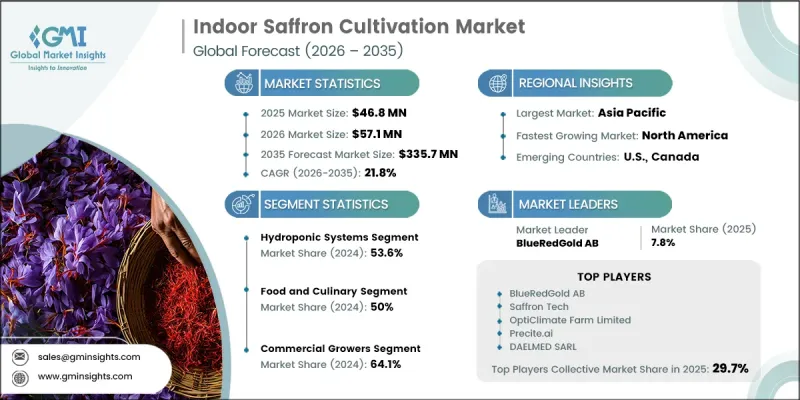
環境可控農業正在改變藏紅花生產方式,使其不再受季節和地理條件的限制,而是成為一項可靠的全年農業活動,從而為市場注入強勁動力。室內種植技術使種植者能夠在保持產量穩定的同時,減少對以往限制生產的傳統農業環境的依賴。這種轉變提高了供應可靠性,改善了作物品質的一致性,並拓展了多個地區的商業性機會。製藥公司對標準化生物活性化合物的需求日益成長,加上對高品質室內農業投資的增加,持續推動市場擴張。此外,先進的種植系統提高了可追溯性、品管和生產效率,使室內種植的藏紅花在商業應用中更具吸引力。隨著種植者專注於擴充性的種植方法和技術主導的農業運營,在創新、投資和對品質穩定、優質藏紅花日益成長的需求的推動下,室內藏紅花種植市場正在發展成為一個高價值細分市場。
| 市場範圍 | |
|---|---|
| 開始年份 | 2025 |
| 預測期 | 2026-2035 |
| 上市時的市場規模 | 4680萬美元 |
| 預計金額 | 3.357億美元 |
| 複合年成長率 | 21.8% |
傳統藏紅花生產長期以來依賴高度特定的環境條件、短暫的收穫期和有限的種植區域,導致產量均勻性和供應穩定性方面一直面臨挑戰。室內栽培系統透過在可控設施內全年複製開花和作物生長所需的精確環境條件,克服了這些限制。這種方法能夠實現連續的收穫週期,同時最大限度地減少天氣干擾、資源限制和其他外部生產風險的影響。因此,種植者無需依賴自然氣候模式,即可將商業性種植業務擴展到更廣泛的區域,從而顯著提升室內藏紅花種植市場的長期成長潛力。
到2025年,水耕技術將佔據53.6%的市場。其市場主導地位得益於成熟的商業性擴充性、與現代溫室基礎設施的無縫銜接,以及成熟的番紅花營養管理栽培方法。商業生產商持續採用先進的水耕技術,例如營養液膜技術(NFT)和深水栽培(DWC),並將其應用於垂直堆疊式生產系統。與傳統的露天種植相比,這些配置能夠顯著提高球莖的種植密度,並提升空間利用率、生產效率和操作穩定性。
到2025年,食品和烹飪應用領域將佔據50%的市場。需求主要由高階食品製造商、特色零售商和高檔餐飲公司驅動,這些企業優先考慮穩定的產品供應、產地檢驗和一致的品質。室內種植增強了產品的可追溯性,並最大限度地減少了摻假風險,從而提高了整個價值鏈的可靠性。能夠根據可靠的生產標準供應經認證的高品質藏紅花,進一步提升了其在高檔餐飲應用中的價值。
預計到2025年,北美室內藏紅花種植市佔率將達到10.9%。美國仍然是該地區市場擴張的主要驅動力,這得益於其對環境控制農業的持續投資、活性化的研究活動以及先進室內種植技術的商業化。預計在預測期內,持續的技術發展、強勁的投資趨勢以及不斷擴大的商業生產能力將進一步鞏固該地區的市場地位。
目錄
第1章:調查方法和範圍
第2章執行摘要
第3章 行業洞察
- 產業生態系分析
- 供應商情況
- 利潤率
- 每個階段增加的價值
- 影響價值鏈的因素
- 中斷
- 影響產業的因素
- 促進因素
- 產業潛在風險與挑戰
- 市場機遇
- 成長潛力分析
- 監理情勢
- 波特的分析
- PESTLE分析
- 價格趨勢
- 按地區
- 按類型
- 未來市場趨勢
- 技術與創新展望
- 最新科技趨勢
- 新興技術
- 專利趨勢
- 貿易統計
- 主要進口國
- 主要出口國
- 永續性和環境方面
- 永續計劃
- 減少廢棄物策略
- 生產中的能源效率
- 具有環保意識的舉措
- 考慮碳足跡
第4章 競爭情勢
- 介紹
- 企業市佔率分析
- 按地區
- 北美洲
- 歐洲
- 亞太地區
- LATAM
- 中東和非洲
- 按地區
- 企業矩陣分析
- 主要市場公司的競爭分析
- 競爭定位矩陣
- 主要進展
- 併購
- 夥伴關係和聯盟
- 新產品發布
- 業務拓展計劃
第5章 市場估算與預測:依種植技術類型分類,2022-2035年
- 水耕栽培系統
- 氣培系統
- 恆溫恆濕箱系統
第6章 市場估計與預測:依應用領域分類,2022-2035年
- 食物與烹飪
- 烹飪調味料和香辛料
- 食品加工/原料供應
- 飲料應用
- 麵包糖果甜點
- 藥品和治療藥物
- 黃斑部病變的治療
- 神經保護藥物製劑
- 抗發炎藥
- 用於臨床研究目的
- 營養保健品和膳食補充劑
- 保健品
- 機能性食品
- 生物活性化合物萃取物
- 化妝品和個人護理
- 護膚品
- 抗衰老製劑
- 化妝品和美容原料
- 芳香療法和精油
第7章 市場估計與預測:依最終用戶分類,2022-2035年
- 商業生產者
- 家庭和都市區種植者
- 研究與發展機構
第8章 市場估計與預測:依地區分類,2022-2035年
- 北美洲
- 美國
- 加拿大
- 歐洲
- 德國
- 英國
- 法國
- 西班牙
- 義大利
- 其他歐洲國家
- 亞太地區
- 中國
- 印度
- 日本
- 澳洲
- 韓國
- 其他亞太國家
- 拉丁美洲
- 巴西
- 墨西哥
- 阿根廷
- 其他拉丁美洲國家
- 中東和非洲
- 沙烏地阿拉伯
- 南非
- UAE
- 其他中東和非洲國家
第9章:公司簡介
- BlueRedGold AB
- Saffron Tech
- OptiClimate Farm Limited
- Precite.ai
- DAELMED SARL
- Arima Climate Technologies
- Neras Tech(Neweras Enercon)
- Beeroots
- Jayant Enterprises
- Refricon
- Rootious Organics
- Ecoence(Saffronice)
- Novin Javane
- Saffranova Farms
- Zedusk Farming
The Global Indoor Saffron Cultivation Market was valued at USD 46.8 million in 2025 and is estimated to grow at a CAGR of 21.8% to reach USD 335.7 million by 2035.
The market is gaining strong momentum as controlled-environment farming transforms saffron production into a reliable, year-round agricultural activity rather than one limited by seasonal cycles and geographic conditions. Indoor cultivation technologies are enabling producers to maintain stable output while reducing dependence on traditional farming environments that have historically constrained production. This shift is strengthening supply reliability, improving crop consistency, and expanding commercial opportunities across multiple regions. Growing interest from pharmaceutical manufacturers seeking standardized bioactive compounds, along with increasing investment in premium indoor agriculture, continues to support market expansion. Advanced cultivation systems also provide improved traceability, greater quality control, and enhanced production efficiency, making indoor-grown saffron increasingly attractive across commercial applications. As producers focus on scalable cultivation methods and technology-driven farming operations, the indoor saffron cultivation market is evolving into a high-value segment supported by innovation, investment, and rising demand for premium saffron with consistent quality standards.
| Market Scope | |
|---|---|
| Start Year | 2025 |
| Forecast Year | 2026-2035 |
| Start Value | $46.8 Million |
| Forecast Value | $335.7 Million |
| CAGR | 21.8% |
Conventional saffron production has long depended on highly specific environmental conditions, narrow seasonal harvesting periods, and limited agricultural regions, creating ongoing challenges related to production consistency and supply stability. Indoor cultivation systems overcome these limitations by recreating the precise environmental conditions required for flowering and crop development year-round in controlled facilities. This approach minimizes exposure to weather-related disruptions, resource limitations, and other external production risks while allowing continuous harvesting cycles. As a result, producers can establish commercial cultivation operations across a much broader range of locations without relying on natural climate patterns, significantly expanding the long-term growth potential of the indoor saffron cultivation market.
The hydroponic cultivation segment held 53.6% share in 2025. Its market leadership is supported by proven commercial scalability, seamless integration with modern greenhouse infrastructure, and well-established cultivation practices for managing nutrient delivery in Crocus sativus. Commercial producers continue to use advanced hydroponic techniques, including the nutrient film technique (NFT) and deep water culture (DWC), in vertically stacked production systems. These configurations enable significantly higher corm planting densities than conventional field cultivation while improving space utilization, production efficiency, and operational consistency.
The food and culinary applications segment accounted for 50% share in 2025. Demand is primarily driven by premium food manufacturers, specialty retailers, and high-end food service businesses that prioritize dependable product availability, verified origin, and consistent quality. Indoor cultivation also strengthens product traceability and minimizes concerns associated with adulteration, supporting greater confidence throughout the supply chain. The ability to deliver certified, high-quality saffron with reliable production standards continues to reinforce its value across premium culinary applications.
North America Indoor Saffron Cultivation Market held 10.9% share in 2025. The United States remains the primary contributor to regional expansion, supported by continued investment in controlled-environment agriculture, increasing research activities, and the commercialization of advanced indoor farming technologies. Ongoing technological development, favorable investment trends, and expanding commercial production capacity are expected to further strengthen the region's position during the forecast period.
Major companies operating in the global indoor saffron cultivation market include BlueRedGold AB, Saffron Tech, OptiClimate Farm Limited, Precite.ai, DAELMED SARL, Arima Climate Technologies, Neras Tech (Neweras Enercon), Beeroots, Jayant Enterprises, Refricon, Rootious Organics, Ecoence (Saffronice), Novin Javane, Saffranova Farms, and Zedusk Farming. Companies in the indoor saffron cultivation market are strengthening their competitive position by investing in advanced controlled-environment farming technologies, hydroponic production systems, and automated climate management solutions to improve productivity and crop consistency. Many market participants are expanding commercial-scale production facilities to increase output while maintaining premium quality standards. Strategic investments in research and development are helping optimize cultivation protocols, improve resource efficiency, and enhance yield performance. Businesses are also emphasizing product traceability, quality certification, and standardized production processes to meet the requirements of pharmaceutical and premium food industries.
Table of Contents
Chapter 1 Methodology & Scope
- 1.1 Market scope and definition
- 1.2 Research design
- 1.2.1 Research approach
- 1.2.2 Data collection methods
- 1.3 Data mining sources
- 1.3.1 Global
- 1.3.2 Regional/Country
- 1.4 Base estimates and calculations
- 1.4.1 Base year calculation
- 1.4.2 Key trends for market estimation
- 1.5 Primary research and validation
- 1.5.1 Primary sources
- 1.6 Forecast model
- 1.7 Research assumptions and limitations
Chapter 2 Executive Summary
- 2.1 Industry 360° synopsis
- 2.2 Key market trends
- 2.2.1 Cultivation technology type
- 2.2.2 Application
- 2.2.3 End user
- 2.2.4 Regional
- 2.3 TAM Analysis, 2026-2035
- 2.4 CXO perspectives: Strategic imperatives
- 2.4.1 Executive decision points
Chapter 3 Industry Insights
- 3.1 Industry ecosystem analysis
- 3.1.1 Supplier landscape
- 3.1.2 Profit margin
- 3.1.3 Value addition at each stage
- 3.1.4 Factor affecting the value chain
- 3.1.5 Disruptions
- 3.2 Industry impact forces
- 3.2.1 Growth drivers
- 3.2.2 Industry pitfalls and challenges
- 3.2.3 Market opportunities
- 3.3 Growth potential analysis
- 3.4 Regulatory landscape
- 3.4.1 North America
- 3.4.2 Europe
- 3.4.3 Asia Pacific
- 3.4.4 Latin America
- 3.4.5 Middle East & Africa
- 3.5 Porter's analysis
- 3.6 PESTEL analysis
- 3.7 Price trends
- 3.7.1 By region
- 3.7.2 By type
- 3.8 Future market trends
- 3.9 Technology and Innovation landscape
- 3.9.1 Current technological trends
- 3.9.2 Emerging technologies
- 3.10 Patent Landscape
- 3.11 Trade statistics (HS code)
- 3.11.1 Major importing countries
- 3.11.2 Major exporting countries
- 3.12 Sustainability and environmental aspects
- 3.12.1 Sustainable practices
- 3.12.2 Waste reduction strategies
- 3.12.3 Energy efficiency in production
- 3.12.4 Eco-friendly initiatives
- 3.13 Carbon footprint consideration
Chapter 4 Competitive Landscape, 2025
- 4.1 Introduction
- 4.2 Company market share analysis
- 4.2.1 By region
- 4.2.1.1 North America
- 4.2.1.2 Europe
- 4.2.1.3 Asia Pacific
- 4.2.1.4 LATAM
- 4.2.1.5 MEA
- 4.2.1 By region
- 4.3 Company matrix analysis
- 4.4 Competitive analysis of major market players
- 4.5 Competitive positioning matrix
- 4.6 Key developments
- 4.6.1 Mergers & acquisitions
- 4.6.2 Partnerships & collaborations
- 4.6.3 New Product Launches
- 4.6.4 Expansion Plans
Chapter 5 Market Estimates and Forecast, By Cultivation Technology Type, 2022-2035 (USD Million) (Kilo Tons)
- 5.1 Key trends
- 5.2 Hydroponic systems
- 5.3 Aeroponic systems
- 5.4 Climate-controlled chamber systems
Chapter 6 Market Estimates and Forecast, By Application, 2022-2035 (USD Million) (Kilo Tons)
- 6.1 Key trends
- 6.2 Food & culinary
- 6.2.1 Culinary seasoning & spices
- 6.2.2 Food processing & ingredient supply
- 6.2.3 Beverage applications
- 6.2.4 Bakery & confectionery
- 6.3 Pharmaceutical & therapeutic
- 6.3.1 Macular degeneration treatment
- 6.3.2 Neuroprotective drug formulations
- 6.3.3 Anti-inflammatory therapeutics
- 6.3.4 Clinical research applications
- 6.4 Nutraceuticals & dietary supplements
- 6.4.1 Health supplements
- 6.4.2 Functional foods
- 6.4.3 Bioactive compound extracts
- 6.5 Cosmetics & personal care
- 6.5.1 Skincare products
- 6.5.2 Anti-aging formulations
- 6.5.3 Beauty & cosmetic ingredients
- 6.5.4 Aromatherapy & essential oils
Chapter 7 Market Estimates and Forecast, By End User, 2022-2035 (USD Million) (Kilo Tons)
- 7.1 Key trends
- 7.2 Commercial growers
- 7.3 Home & urban growers
- 7.4 Research & development institutions
Chapter 8 Market Estimates and Forecast, By Region, 2022-2035 (USD Million) (Kilo Tons)
- 8.1 Key trends
- 8.2 North America
- 8.2.1 U.S.
- 8.2.2 Canada
- 8.3 Europe
- 8.3.1 Germany
- 8.3.2 UK
- 8.3.3 France
- 8.3.4 Spain
- 8.3.5 Italy
- 8.3.6 Rest of Europe
- 8.4 Asia Pacific
- 8.4.1 China
- 8.4.2 India
- 8.4.3 Japan
- 8.4.4 Australia
- 8.4.5 South Korea
- 8.4.6 Rest of Asia Pacific
- 8.5 Latin America
- 8.5.1 Brazil
- 8.5.2 Mexico
- 8.5.3 Argentina
- 8.5.4 Rest of Latin America
- 8.6 Middle East and Africa
- 8.6.1 Saudi Arabia
- 8.6.2 South Africa
- 8.6.3 UAE
- 8.6.4 Rest of Middle East and Africa
Chapter 9 Company Profiles
- 9.1 BlueRedGold AB
- 9.2 Saffron Tech
- 9.3 OptiClimate Farm Limited
- 9.4 Precite.ai
- 9.5 DAELMED SARL
- 9.6 Arima Climate Technologies
- 9.7 Neras Tech (Neweras Enercon)
- 9.8 Beeroots
- 9.9 Jayant Enterprises
- 9.10 Refricon
- 9.11 Rootious Organics
- 9.12 Ecoence (Saffronice)
- 9.13 Novin Javane
- 9.14 Saffranova Farms
- 9.15 Zedusk Farming

