


 |
市場調查報告書
商品編碼
2083046
空對地飛彈市場機會、成長要素、產業趨勢分析及2026-2035年預測。Air-to-Ground Missile (AGM) Market Opportunity, Growth Drivers, Industry Trend Analysis, and Forecast 2026 - 2035 |
||||||

全球空對地飛彈市場預計在 2025 年達到 82 億美元,預計到 2035 年將以 7.1% 的複合年成長率成長至 165 億美元。
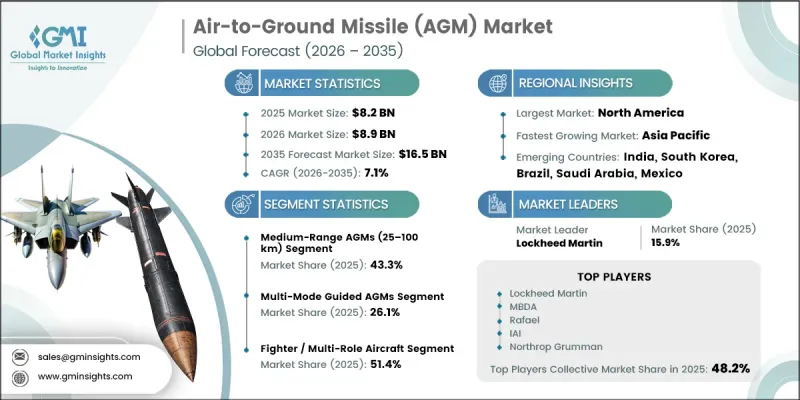
推動市場成長的因素包括:軍方對先進精確打擊能力的需求不斷成長、無人機在作戰行動中的部署範圍擴大、國防現代化力度活性化以及持續推進的飛機強化項目。新一代戰鬥機和多用途飛機平台的推出進一步提升了對先進空對地飛彈系統的需求。飛彈導引技術、推進系統和探求者性能的不斷改進也促進了市場擴張。世界各國的國防機構都在優先考慮精準、可靠且柔軟性的打擊解決方案,以提升作戰效能,同時滿足不斷變化的戰場需求。
| 市場範圍 | |
|---|---|
| 開始年份 | 2025 |
| 預測期 | 2026-2035 |
| 上市時的市場規模 | 82億美元 |
| 預測金額 | 165億美元 |
| 複合年成長率 | 7.1% |
由於現代軍事行動整體對精確打擊解決方案的防禦需求不斷成長,空對地飛彈市場正經歷強勁成長。日益緊張的地緣政治局勢和複雜的作戰環境,使得能夠完成任務目標並最大限度減少意外損害的高精度武器變得愈發重要。這些因素促使各國國防部隊縮短採購週期並增加飛彈儲備。此外,無人作戰飛行器(UCAV)的日益普及也為輕型、精確導引的空對地飛彈系統創造了更多機會。無人平台正擴大被整合到各種作戰環境下的攻擊任務中,其角色已不再局限於簡單的偵察。與有人駕駛飛機相比,其成本效益、作戰柔軟性和更低的風險,正促使越來越多的國家投資於基於無人作戰飛行器的攻擊能力。
預計到2025年,中程空地飛彈(射程25-100公里)將佔據43.3%的市佔率。該細分市場的主導地位源於其能夠在近距離空中支援、戰場封鎖以及對抗一體化防空系統等應用場景中,有效平衡飛機生存能力和任務柔軟性。這些飛彈既可部署在有人駕駛多用途飛機上,也可部署在新興的無人平台上,並相容於多種導引技術和有效載荷選項。其作戰多功能性促使先進軍隊以及採用成本籌資策略的國防項目紛紛採用,從而支撐了不同市場的持續需求。
預計到2025年,多模式空地飛彈市佔率將達到26.1%。這主要歸功於其能夠在單一飛彈平台上整合多種導引方式,例如GPS/INS、紅外線成像和半主動雷射導引系統。這種先進的導引方式即使在電子戰環境、惡劣天氣和複雜戰場地形等嚴苛條件下,也能確保目標的可靠捕捉和攻擊。無需為每次任務更換系統即可打擊固定和移動目標的能力,正促使其在時間緊迫的高優先級防禦作戰行動中得到更廣泛的應用。
到2025年,北美將佔據空對地飛彈市場34%的佔有率,成為最大的區域市場佔有率。其在該地區主導的地位主要得益於美國巨額的國防費用以及在各種作戰環境下持續維護先進精確打擊能力的努力。美國空軍和海軍的採購活動仍然是全球對先進空對地飛彈系統需求的主要驅動力。此外,與國際安全援助項目相關的持續庫存補充需求也進一步推動了對先進導彈解決方案的需求,並促進了區域市場的成長。
目錄
第1章:調查方法和範圍
第2章執行摘要
第3章 行業洞察
- 產業生態系分析
- 供應商情況
- 利潤率
- 成本結構
- 每個階段增加的價值
- 影響價值鏈的因素
- 中斷
- 影響產業的因素
- 促進因素
- 現代戰爭中對精確打擊能力的需求日益成長
- 下一代戰鬥機和多用途平台的擴建
- 擴大國防現代化和艦隊更新計劃
- 擴大無人機在作戰任務的使用
- 導引系統、推進系統和探求者系統的技術進步
- 產業潛在風險與挑戰
- 研發和購買先進飛彈系統成本高昂。
- 嚴格的法律規範與出口管制限制
- 市場機遇
- 將人工智慧整合到任務規劃和目標定位系統中
- 高超音速和遠程打擊能力計劃的擴展
- 促進因素
- 成長潛力分析
- 監理情勢
- 波特的分析
- PESTLE分析
- 技術與創新展望
- 最新科技趨勢
- 新興技術
- 價格趨勢
- 按地區
- 依產品
- 定價策略
- 新興經營模式
- 合規要求
- 專利和智慧財產權分析
第4章 競爭情勢
- 介紹
- 企業市佔率分析
- 按地區
- 市場集中度分析
- 主要公司的競爭標竿分析
- 財務績效比較
- 收入
- 利潤率
- R&D
- 產品系列比較
- 產品線寬度
- 科技
- 創新
- 區域擴張比較
- 全球擴張分析
- 服務網路覆蓋
- 按地區分類的市場滲透率
- 競爭定位矩陣
- 領導者
- 挑戰者
- 追蹤者
- 小眾玩家
- 戰略展望矩陣
- 財務績效比較
- 主要進展
- 併購
- 夥伴關係和聯盟
- 技術進步
- 擴張和投資策略
- 數位轉型計劃
- 新興企業競爭公司和新創企業的發展趨勢
第5章 市場估價與預測:以飛彈射程分類,2022-2035年
- 短距離AGM(小於25公里)
- 中程AGM(25-100公里)
- 遠程/遠距型AGM(超過100公里)
第6章 市場估算與預測:技術導向,2022-2035年
- 雷射導引AGM
- 紅外線/光電感應式AGM
- 雷達導引空地飛彈(抗輻射型/主動雷達歸向型)
- GPS/INS引導的AGM
第7章 市場估價與預測:依發布平台分類,2022-2035年
- 戰鬥機/多用途飛機
- 攻擊直升機
- 無人駕駛飛行器(UAV)
- 轟炸機
- 特種作戰砲艇
- 海上巡邏機
第8章 市場估計與預測:依應用領域分類,2022-2035年
- 近距離空中支援(CAS)
- 空中攔截
- 針對固定基礎設施的精確攻擊
- 壓制/摧毀敵方防空系統(SEAD/DEAD)
- 海軍攻擊
第9章 市場估計與預測:依地區分類,2022-2035年
- 北美洲
- 美國
- 加拿大
- 歐洲
- 德國
- 英國
- 法國
- 西班牙
- 義大利
- 俄羅斯
- 亞太地區
- 中國
- 印度
- 日本
- 澳洲
- 韓國
- 拉丁美洲
- 巴西
- 墨西哥
- 阿根廷
- 中東和非洲
- 南非
- 沙烏地阿拉伯
- UAE
第10章:公司簡介
- 全球主要公司
- Lockheed Martin
- MBDA
- Rafael
- IAI
- Northrop Grumman
- 該地區的主要公司
- 北美洲
- Boeing
- RTX/Raytheon
- 亞太地區
- Hanwha Aerospace
- LIG Nex1
- BrahMos
- MHI
- 歐洲
- BAE Systems
- Saab AB
- KONGSBERG
- Middle East & Africa
- Elbit Systems
- Roketsan
- Denel Dynamics
- 北美洲
The Global Air-To-Ground Missile Market was valued at USD 8.2 billion in 2025 and is estimated to grow at a CAGR of 7.1% to reach USD 16.5 billion by 2035.
The market growth is driven by increasing military demand for advanced precision strike capabilities, expanding deployment of unmanned aerial vehicles in combat operations, rising defense modernization initiatives, and ongoing aircraft fleet enhancement programs. The adoption of next-generation fighter aircraft and multi-role aviation platforms is further strengthening demand for advanced air-to-ground missile systems. Continuous improvements in missile guidance technologies, propulsion systems, and seeker capabilities are also contributing to market expansion. Defense organizations worldwide are prioritizing accurate, reliable, and flexible strike solutions to enhance operational effectiveness while addressing evolving battlefield requirements.
| Market Scope | |
|---|---|
| Start Year | 2025 |
| Forecast Year | 2026-2035 |
| Start Value | $8.2 Billion |
| Forecast Value | $16.5 Billion |
| CAGR | 7.1% |
The air-to-ground missile market is experiencing strong growth due to increasing defense requirements for precision engagement solutions across modern military operations. Rising geopolitical tensions and complex combat environments have increased the importance of high-accuracy weapons capable of minimizing unintended damage while achieving mission objectives. These factors encourage faster procurement cycles and increased missile inventory development among defense forces. Furthermore, the expanding use of unmanned combat aerial vehicles is creating additional opportunities for lightweight and precision-guided air-to-ground missile systems. Unmanned platforms have progressed beyond surveillance roles and are increasingly being integrated into strike missions across different operational environments. Their cost efficiency, operational flexibility, and reduced risk compared with manned aircraft are encouraging more countries to invest in UCAV-based strike capabilities.
Medium-range air-to-ground missiles (25-100 km) segment held a 43.3% share in 2025. The segment's dominance is supported by its ability to provide an effective balance between aircraft survivability and mission flexibility across applications such as close air support, battlefield interdiction, and counter-integrated air defense system operations. These missiles can be deployed on both manned multi-role aircraft and emerging unmanned platforms, allowing compatibility with various guidance technologies and payload options. Their operational versatility enables adoption by advanced military forces as well as defense programs with cost-sensitive procurement strategies, supporting consistent demand across diverse markets.
The multi-mode guided air-to-ground missiles segment accounted for 26.1% share in 2025, attributed to the ability to combine multiple guidance methods, including GPS/INS, imaging infrared, and semi-active laser systems, within a single missile platform. This advanced guidance approach enables reliable target acquisition and engagement in challenging conditions such as electronic warfare environments, unfavorable weather situations, and complex battlefield terrain. The capability to engage both stationary and moving targets without requiring mission-specific system changes has increased their adoption for high-priority and time-sensitive defense operations.
North America Air-To-Ground Missile Market accounted for 34% share in 2025, representing the largest regional share. The region's leadership is primarily supported by significant defense spending in the United States and continued efforts to maintain advanced precision strike capabilities across multiple operational environments. Procurement activities by the US Air Force and Navy remain major contributors to global demand for sophisticated air-to-ground missile systems. In addition, ongoing inventory replenishment requirements associated with international security assistance programs have further increased demand for advanced missile solutions and supported regional market growth.
Prominent players operating in the global air-to-ground missile industry include Lockheed Martin, RTX / Raytheon, MBDA, BAE Systems, Boeing, IAI, Rafael, KONGSBERG, BrahMos, Roketsan, Hanwha Aerospace, LIG Nex1, Elbit Systems, Denel Dynamics, Saab AB, Northrop Grumman, and MHI. Companies operating in the air-to-ground missile market are strengthening their market positions through continuous research and development, strategic defense contracts, technology upgrades, and expansion of advanced missile portfolios. Leading manufacturers are focusing on improving guidance accuracy, extending operational range, enhancing propulsion efficiency, and integrating advanced seeker technologies to meet evolving military requirements. Companies are also pursuing international partnerships, localization initiatives, and long-term supply agreements with defense organizations to expand their global presence.
Table of Contents
Chapter 1 Methodology and Scope
- 1.1 Market scope and definition
- 1.2 Research design
- 1.2.1 Research approach
- 1.2.2 Data collection methods
- 1.3 Data mining sources
- 1.3.1 Global
- 1.3.2 Regional/Country
- 1.4 Base estimates and calculations
- 1.4.1 Base year calculation
- 1.4.2 Key trends for market estimation
- 1.5 Primary research and validation
- 1.5.1 Primary sources
- 1.6 Forecast model
- 1.7 Research assumptions and limitations
Chapter 2 Executive Summary
- 2.1 Industry 360° synopsis, 2022 - 2035
- 2.2 Key market trends
- 2.2.1 Missile range trends
- 2.2.2 Guidance technology trends
- 2.2.3 Launch platform trends
- 2.2.4 Application trends
- 2.2.5 Regional trends
- 2.3 TAM Analysis, 2026-2035
- 2.4 CXO perspectives: Strategic imperatives
Chapter 3 Industry Insights
- 3.1 Industry ecosystem analysis
- 3.1.1 Supplier Landscape
- 3.1.2 Profit Margin
- 3.1.3 Cost structure
- 3.1.4 Value addition at each stage
- 3.1.5 Factor affecting the value chain
- 3.1.6 Disruptions
- 3.2 Industry impact forces
- 3.2.1 Growth drivers
- 3.2.1.1 Rising demand for precision strike capabilities in modern warfare
- 3.2.1.2 Expansion of next-generation combat aircraft and multi-role platforms
- 3.2.1.3 Increasing defense modernization and fleet upgrade programs
- 3.2.1.4 Rising use of unmanned aerial vehicles for combat missions
- 3.2.1.5 Technological advancements in guidance, propulsion, and seeker systems
- 3.2.2 Industry pitfalls and challenges
- 3.2.2.1 High development and procurement costs of advanced missile systems
- 3.2.2.2 Stringent regulatory frameworks and export control restrictions
- 3.2.3 Market opportunities
- 3.2.3.1 Integration of artificial intelligence in mission planning and targeting systems
- 3.2.3.2 Expansion of hypersonic and long-range strike capability programs
- 3.2.1 Growth drivers
- 3.3 Growth potential analysis
- 3.4 Regulatory landscape
- 3.4.1 North America
- 3.4.2 Europe
- 3.4.3 Asia Pacific
- 3.4.4 Latin America
- 3.4.5 Middle East & Africa
- 3.5 Porter's analysis
- 3.6 PESTEL analysis
- 3.7 Technology and Innovation landscape
- 3.7.1 Current technological trends
- 3.7.2 Emerging technologies
- 3.8 Price trends
- 3.8.1 By region
- 3.8.2 By product
- 3.9 Pricing Strategies
- 3.10 Emerging Business Models
- 3.11 Compliance Requirements
- 3.12 Patent and IP analysis
Chapter 4 Competitive Landscape, 2025
- 4.1 Introduction
- 4.2 Company market share analysis
- 4.2.1 By region
- 4.2.1.1 North America
- 4.2.1.2 Europe
- 4.2.1.3 Asia Pacific
- 4.2.1.4 Latin America
- 4.2.1.5 Middle East & Africa
- 4.2.2 Market concentration analysis
- 4.2.1 By region
- 4.3 Competitive benchmarking of key players
- 4.3.1 Financial performance comparison
- 4.3.1.1 Revenue
- 4.3.1.2 Profit margin
- 4.3.1.3 R&D
- 4.3.2 Product portfolio comparison
- 4.3.2.1 Product range breadth
- 4.3.2.2 Technology
- 4.3.2.3 Innovation
- 4.3.3 Geographic presence comparison
- 4.3.3.1 Global footprint analysis
- 4.3.3.2 Service network coverage
- 4.3.3.3 Market penetration by region
- 4.3.4 Competitive positioning matrix
- 4.3.4.1 Leaders
- 4.3.4.2 Challengers
- 4.3.4.3 Followers
- 4.3.4.4 Niche players
- 4.3.5 Strategic outlook matrix
- 4.3.1 Financial performance comparison
- 4.4 Key developments
- 4.4.1 Mergers and acquisitions
- 4.4.2 Partnerships and collaborations
- 4.4.3 Technological advancements
- 4.4.4 Expansion and investment strategies
- 4.4.5 Digital transformation initiatives
- 4.5 Emerging/ startup competitors landscape
Chapter 5 Market Estimates and Forecast, By Missile Range, 2022 - 2035 (USD Million & Units)
- 5.1 Key trends
- 5.2 Short-range AGMs (< 25 km)
- 5.3 Medium-range AGMs (25-100 km)
- 5.4 Long-range / stand-off AGMs (> 100 km)
Chapter 6 Market Estimates and Forecast, By Guidance Technology, 2022 - 2035 (USD Million & Units)
- 6.1 Key trends
- 6.2 Laser-guided AGMs
- 6.3 Infrared (IR) / electro-optical (EO) guided AGMs
- 6.4 Radar-guided AGMs (anti-radiation / active radar homing)
- 6.5 GPS / INS guided AGMs
Chapter 7 Market Estimates and Forecast, By Launch Platform, 2022 - 2035 (USD Million & Units)
- 7.1 Key trends
- 7.2 Fighter / multi-role aircraft
- 7.3 Attack helicopters
- 7.4 Unmanned aerial vehicles (UAVs)
- 7.5 Bombers
- 7.6 Special operations / gunship aircraft
- 7.7 Maritime patrol aircraft
Chapter 8 Market Estimates and Forecast, By Application, 2022 - 2035 (USD Million & Units)
- 8.1 Key trends
- 8.2 Close air support (CAS)
- 8.3 Air interdiction
- 8.4 Precision strike against fixed infrastructure
- 8.5 Suppression & destruction of enemy air defenses (SEAD/DEAD)
- 8.6 Maritime strike
Chapter 9 Market Estimates and Forecast, By Region, 2022 - 2035 (USD Million & Units)
- 9.1 Key trends
- 9.2 North America
- 9.2.1 U.S.
- 9.2.2 Canada
- 9.3 Europe
- 9.3.1 Germany
- 9.3.2 UK
- 9.3.3 France
- 9.3.4 Spain
- 9.3.5 Italy
- 9.3.6 Russia
- 9.4 Asia Pacific
- 9.4.1 China
- 9.4.2 India
- 9.4.3 Japan
- 9.4.4 Australia
- 9.4.5 South Korea
- 9.5 Latin America
- 9.5.1 Brazil
- 9.5.2 Mexico
- 9.5.3 Argentina
- 9.6 Middle East and Africa
- 9.6.1 South Africa
- 9.6.2 Saudi Arabia
- 9.6.3 UAE
Chapter 10 Company Profiles
- 10.1 Global Key Players
- 10.1.1 Lockheed Martin
- 10.1.2 MBDA
- 10.1.3 Rafael
- 10.1.4 IAI
- 10.1.5 Northrop Grumman
- 10.2 Regional key players
- 10.2.1 North America
- 10.2.1.1 Boeing
- 10.2.1.2 RTX / Raytheon
- 10.2.2 Asia Pacific
- 10.2.2.1 Hanwha Aerospace
- 10.2.2.2 LIG Nex1
- 10.2.2.3 BrahMos
- 10.2.2.4 MHI
- 10.2.3 Europe
- 10.2.3.1 BAE Systems
- 10.2.3.2 Saab AB
- 10.2.3.3 KONGSBERG
- 10.2.4 Middle East & Africa
- 10.2.4.1 Elbit Systems
- 10.2.4.2 Roketsan
- 10.2.4.3 Denel Dynamics
- 10.2.1 North America

