


 |
市場調查報告書
商品編碼
2071418
微電網市場機會、成長要素、產業趨勢分析及2026-2035年預測。Microgrid Market Opportunity, Growth Drivers, Industry Trend Analysis, and Forecast 2026 - 2035 |
||||||

全球微電網市場預計到 2025 年將價值 289 億美元,並將以 18.3% 的複合年成長率成長,到 2035 年達到 1,661 億美元。
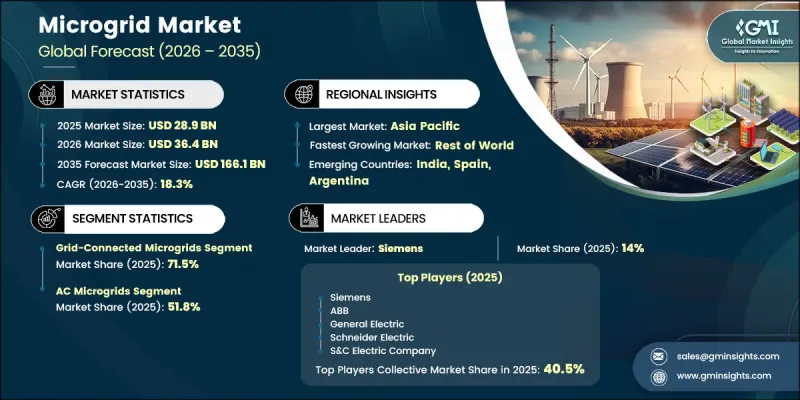
市場成長的驅動力來自對能源可靠性、電網韌性和分散化日益成長的需求,以及全球可再生能源的加速普及和日益嚴格的環境標準。隨著氣候變遷、基礎設施壓力和安全威脅導致的停電風險不斷增加,各國政府、公用事業公司和企業都在優先考慮能夠根據需要獨立運作的本地化電力系統。微電網被定義為具有明確運行邊界的自給自足能源網路,既可在併網模式下運行,也可在獨立模式下運行。這些系統透過結合分散式發電、儲能和智慧控制軟體來最佳化性能和穩定性。微電網的部署正在工業區、園區和社區中不斷增加,以提高可靠性、減少對集中式電網的依賴並實現永續性目標。公共和私人對清潔能源項目的投資增加降低了初始成本並提高了項目的可行性。同時,智慧電網軟體、電力電子和儲能技術的進步正在提高系統效率、擴充性和長期運行性能,從而促進其在不同地區和應用領域的更廣泛部署。
| 市場範圍 | |
|---|---|
| 開始年份 | 2025 |
| 預測期 | 2026-2035 |
| 上市時的市場規模 | 289億美元 |
| 預測金額 | 1661億美元 |
| 複合年成長率 | 18.3% |
預計到2025年,併網微電網市佔率將達到71.5%,並將以18.5%的複合年成長率持續成長至2035年。這一成長主要得益於商業和工業企業、教育機構、醫療機構以及公用事業公司等尋求增強能源韌性並同時保持對集中式電網接入的機構的投資增加。併網微電網的一項關鍵優勢在於其能夠在併網模式和獨立模式之間無縫切換,切換時間通常不到100毫秒。這一特性使其成為需要不間斷運作和高電力可靠性的設施的理想選擇。因此,對於那些優先考慮能源安全、營運連續性和靈活電力管理的機構而言,併網系統正逐漸成為首選的部署模式。
預計到2025年,直流微電網市佔率將達到34.1%,並在2035年之前以18.2%的複合年成長率成長。直流微電網在直流負載占主導地位且最大限度降低電力轉換損耗至關重要的領域,例如資料中心、電信網路、電動車充電基礎設施和半導體製造工廠,應用尤為廣泛。透過減少交流到直流的轉換環節,直流微電網架構可以顯著提高整體能源效率,從而為大型電力消耗量企業節省大量成本。這種在提高系統性能的同時降低能耗的能力,持續推動高耗能產業採用直流微電網技術。
預計到2025年,歐洲微電網市佔率將達到31.9%,並在2035年之前以9.9%的複合年成長率成長。市場發展主要得益於該地區對可再生能源併網和能源安全措施的重視。德國憑藉其雄心勃勃的清潔能源目標和對分散式能源基礎設施的持續投資,繼續保持其作為歐洲主要市場的地位。隨著各組織尋求提高電網柔軟性、最佳化可再生能源利用並增強應對能源中斷的能力,微電網部署正在工業、商業和社區能源專案中不斷擴展。
目錄
第1章:調查方法和範圍
第2章執行摘要
第3章 行業洞察
- 產業生態系統
- 原物料供應及採購分析
- 生產能力評估
- 供應鏈韌性與風險因素
- 配電網路分析
- 監理情勢
- 影響產業的因素
- 促進因素
- 產業潛在風險與挑戰
- 成長潛力分析
- 波特的分析
- PESTLE分析
- 成本結構分析:微電網
- 價格趨勢分析
- 按網格類型
- 依球員類型分類的定價策略(高級球員、超值球員、成本加成球員)
- 貿易數據分析
- 進出口量及進口額趨勢
- 主要貿易路線及關稅的影響
- 生產能力和運轉率
- 各地區的生產能力
- 運轉率
- 人工智慧和生成式人工智慧對微電網市場的影響
- 利用人工智慧改造現有經營模式
- 按細分市場分類的生成式人工智慧用例和部署藍圖
- 風險、限制和監管考量
- 新機會和趨勢
- 數位化和物聯網整合
- 進入新興市場
- 投資分析及未來展望
第4章 競爭情勢
- 介紹
- 企業市佔率分析:按地區分類
- 北美洲
- 歐洲
- 亞太地區
- 拉丁美洲
- 中東和非洲
- 主要市場公司的競爭分析
- 競爭定位矩陣
- 主要進展
- 併購
- 夥伴關係和聯盟
- 新產品發布
- 業務拓展計劃及資金籌措
- 按公司規模進行基準測試
- 排名分類標準與遴選標準
- 按銷售額、地區和創新能力分類的層級定位矩陣。
第5章 市場規模及預測:依電網類型分類,2022-2035年
- 交流微電網
- 直流微電網
- 混合
第6章 市場規模與預測:以性別分類的互聯互通情況,2022-2035年
- 並網型
- 離網
第7章 市場規模及預測:依動力來源分類,2022-2035年
- 柴油發電機
- 天然氣
- 太陽能光電發電(光電發電)
- CHP
- 其他
第8章 市場規模及預測:依儲存設備分類,2022-2035年
- 鋰離子
- 鉛酸電池
- 液流電池
- 飛輪
- 其他
第9章 市場規模及預測:依應用領域分類,2022-2035年
- 衛生保健
- 教育機構
- 軍隊
- 公用事業
- 工商
- 資料中心和通訊
- 偏僻的
- 其他
第10章 市場規模及預測:依地區分類,2022-2035年
- 北美洲
- 美國
- 加拿大
- 墨西哥
- 歐洲
- 德國
- 法國
- 英國
- 俄羅斯
- 西班牙
- 亞太地區
- 中國
- 日本
- 韓國
- 印度
- 澳洲
- 中東和非洲
- 沙烏地阿拉伯
- UAE
- 南非
- 拉丁美洲
- 巴西
- 阿根廷
- 智利
第11章:公司簡介
- ABB
- Advanced Microgrid Systems
- Ameresco
- Bloom Energy Corporation
- BoxPower
- Caterpillar
- Delta Electronics
- Exelon Corporation
- Eaton
- General Electric
- General Microgrids
- Heila Technologies
- Honeywell International
- Hitachi Energy
- Lockheed Martin Corporation
- PowerSecure
- Power Analytics Global Corporation
- Schneider Electric
- S&C Electric Company
- Siemens
- Toshiba Corporation
The Global Microgrid Market was valued at USD 28.9 billion in 2025 and is estimated to grow at a CAGR of 18.3% to reach USD 166.1 billion by 2035.
Market growth is supported by the rising need for energy reliability, grid resilience, and decentralization, along with accelerating renewable energy adoption and stricter environmental standards worldwide. Increasing exposure to power disruptions caused by climate volatility, infrastructure strain, and security threats has pushed governments, utilities, and enterprises to prioritize localized power systems that can operate independently when required. Microgrids are defined as self-sufficient energy networks with clear operational boundaries that can function in both connected and isolated modes. These systems combine distributed generation, energy storage, and intelligent control software to optimize performance and stability. They are increasingly deployed across industrial sites, campuses, and communities to improve reliability, reduce dependence on centralized grids, and align with sustainability objectives. Growing public and private investment in clean energy programs is improving project feasibility by lowering upfront costs. At the same time, advances in smart grid software, power electronics, and storage technologies are improving system efficiency, scalability, and long-term operational performance, supporting broader adoption across regions and applications.
| Market Scope | |
|---|---|
| Start Year | 2025 |
| Forecast Year | 2026-2035 |
| Start Value | $28.9 Billion |
| Forecast Value | $166.1 Billion |
| CAGR | 18.3% |
The grid-connected microgrids segment accounted for 71.5% share in 2025 and is forecast to register a CAGR of 18.5% through 2035. Growth is being supported by rising investments from commercial and industrial enterprises, educational institutions, healthcare organizations, and utility operators seeking enhanced energy resilience while maintaining access to the centralized power grid. The key benefit of grid-connected microgrids lies in their ability to switch seamlessly between grid-connected and islanded modes, often within less than 100 milliseconds. This capability makes them particularly attractive for facilities that require uninterrupted operations and high levels of power reliability. As a result, grid-connected systems continue to emerge as the preferred deployment model for organizations prioritizing energy security, operational continuity, and flexible power management.
The DC microgrids segment captured 34.1% share in 2025 and is anticipated to grow at a CAGR of 18.2% through 2035. Adoption is particularly strong across data centers, telecommunications networks, electric vehicle charging infrastructure, and semiconductor manufacturing facilities, where direct current loads dominate and minimizing power conversion losses is critical. By reducing the number of AC-to-DC conversion stages, DC microgrid architectures can significantly improve overall energy efficiency, resulting in meaningful cost savings for large-scale, power-intensive operations. Their ability to enhance system performance while lowering energy consumption continues to drive deployment across industries with substantial electricity requirements.
Europe Microgrid Market held a 31.9% share in 2025 and is projected to grow at a CAGR of 9.9% through 2035. Market development is being influenced by the region's strong focus on renewable energy integration and energy security initiatives. Germany remains a leading market within Europe, supported by ambitious clean energy targets and ongoing investments in distributed energy infrastructure. The adoption of microgrids is expanding across industrial facilities, commercial complexes, and community energy projects as organizations seek to improve grid flexibility, optimize renewable energy utilization, and strengthen resilience against energy supply disruptions.
Key companies active in the Global Microgrid Market include Siemens, Schneider Electric, ABB, Eaton, General Electric, Honeywell International, Hitachi Energy, Caterpillar, Toshiba Corporation, Ameresco, Bloom Energy Corporation, Lockheed Martin Corporation, S&C Electric Company, PowerSecure, Exelon Corporation, Delta Electronics, BoxPower, Heila Technologies, Power Analytics Global Corporation, General Microgrids, and Advanced Microgrid Systems. Companies operating in the microgrid market are strengthening their market position by investing heavily in research and development to enhance system intelligence, automation, and storage integration. Strategic partnerships with utilities, technology providers, and infrastructure developers are helping expand deployment capabilities and accelerate commercialization.
Table of Contents
Chapter 1 Methodology & Scope
- 1.1 Research design
- 1.1.1 Research approach
- 1.1.2 Data collection methods
- 1.2 Base estimates and calculations
- 1.2.1 Base year calculation
- 1.2.2 Market estimates & forecast parameters
- 1.3 Forecast
- 1.3.1 Key trends for market estimates
- 1.3.1.1 Quantified market impact analysis
- 1.3.2 Mathematical impact of growth parameters on forecast
- 1.3.3 Scenario analysis framework
- 1.3.1 Key trends for market estimates
- 1.4 Primary research and validation
- 1.4.1 Some of the primary sources (but not limited to)
- 1.5 Data mining sources
- 1.5.1 Paid Sources
- 1.5.2 Sources, by region
- 1.6 Research trail & scoring components
- 1.6.1 Research trail components
- 1.6.2 Scoring components
- 1.7 Research transparency addendum
- 1.7.1 Source attribution framework
- 1.7.2 Quality assurance metrics
- 1.7.3 Our commitment to trust
- 1.8 Market definitions
Chapter 2 Executive Summary
- 2.1 Industry synopsis, 2022 - 2035
- 2.2 Business trends
- 2.3 Connectivity trends
- 2.4 Grid type trends
- 2.5 Power source trends
- 2.6 Storage device trends
- 2.7 Application trends
- 2.8 Regional trends
Chapter 3 Industry Insights
- 3.1 Industry ecosystem
- 3.1.1 Raw material availability & sourcing analysis
- 3.1.2 Manufacturing capacity assessment
- 3.1.3 Supply chain resilience & risk factors
- 3.1.4 Distribution network analysis
- 3.2 Regulatory landscape
- 3.3 Industry impact forces
- 3.3.1 Growth drivers
- 3.3.2 Industry pitfalls & challenges
- 3.4 Growth potential analysis
- 3.5 Porter's analysis
- 3.5.1 Bargaining power of suppliers
- 3.5.2 Bargaining power of buyers
- 3.5.3 Threat of new entrants
- 3.5.4 Threat of substitutes
- 3.6 PESTEL analysis
- 3.6.1 Political factors
- 3.6.2 Economic factors
- 3.6.3 Social factors
- 3.6.4 Technological factors
- 3.6.5 Legal factors
- 3.6.6 Environmental factors
- 3.7 Cost structure analysis of microgrid
- 3.8 Price trend analysis (Driven by Primary Research)
- 3.8.1 By grid type (USD/MW) (Driven by Primary Research)
- 3.8.2 Pricing strategy by player type (Premium / Value / Cost-plus) (Driven by Primary Research)
- 3.9 Trade data analysis (Driven by Primary Research)
- 3.9.1 Import/export volume & value trends (Driven by Primary Research)
- 3.9.2 Key trade corridors & tariff impact (Driven by Primary Research)
- 3.10 Production capacity & utilization (Driven by Primary Research)
- 3.10.1 Production capacity by region (Driven by Primary Research)
- 3.10.2 Utilization rates (Driven by Primary Research)
- 3.11 Impact of AI & generative AI on the microgrid market
- 3.11.1 AI-driven disruption of existing business models
- 3.11.2 GenAI use cases & adoption roadmap by segment
- 3.11.3 Risks, limitations & regulatory considerations
- 3.12 Emerging opportunities & trends
- 3.12.1 Digitalization & IoT integration
- 3.12.2 Emerging market penetration
- 3.13 Investment analysis and future outlook
Chapter 4 Competitive landscape, 2026
- 4.1 Introduction
- 4.2 Company market share analysis, by region, 2025
- 4.2.1 North America
- 4.2.2 Europe
- 4.2.3 Asia Pacific
- 4.2.4 Latin America
- 4.2.5 Middle East & Africa
- 4.3 Competitive analysis of major market players
- 4.4 Competitive positioning matrix
- 4.5 Key developments
- 4.5.1 Mergers & acquisitions
- 4.5.2 Partnerships & collaborations
- 4.5.3 New product launches
- 4.5.4 Expansion plans & funding
- 4.6 Company tier benchmarking
- 4.6.1 Tier classification criteria & qualifying thresholds
- 4.6.2 Tier positioning matrix by revenue, geography & innovation
Chapter 5 Market Size and Forecast, By Grid Type, 2022 - 2035 (USD Billion & MW)
- 5.1 Key trends
- 5.2 AC microgrid
- 5.3 DC microgrid
- 5.4 Hybrid
Chapter 6 Market Size and Forecast, By Connectivity, 2022 - 2035 (USD Billion & MW)
- 6.1 Key trends
- 6.2 Grid connected
- 6.3 Off grid
Chapter 7 Market Size and Forecast, By Power Source, 2022 - 2035 (USD Billion & MW)
- 7.1 Key trends
- 7.2 Diesel generators
- 7.3 Natural gas
- 7.4 Solar PV
- 7.5 CHP
- 7.6 Others
Chapter 8 Market Size and Forecast, By Storage Device, 2022 - 2035 (USD Billion & MW)
- 8.1 Key trends
- 8.2 Lithium-ion
- 8.3 Lead acid
- 8.4 Flow battery
- 8.5 Flywheels
- 8.6 Others
Chapter 9 Market Size and Forecast, By Application, 2022 - 2035 (USD Billion & MW)
- 9.1 Key trends
- 9.2 Healthcare
- 9.3 Educational institutes
- 9.4 Military
- 9.5 Utility
- 9.6 Industrial & commercial
- 9.7 Data centers & telecom
- 9.8 Remote
- 9.9 Others
Chapter 10 Market Size and Forecast, By Region, 2022 - 2035 (USD Billion & MW)
- 10.1 Key trends
- 10.2 North America
- 10.2.1 U.S.
- 10.2.2 Canada
- 10.2.3 Mexico
- 10.3 Europe
- 10.3.1 Germany
- 10.3.2 France
- 10.3.3 UK
- 10.3.4 Russia
- 10.3.5 Spain
- 10.4 Asia Pacific
- 10.4.1 China
- 10.4.2 Japan
- 10.4.3 South Korea
- 10.4.4 India
- 10.4.5 Australia
- 10.5 Middle East and Africa
- 10.5.1 Saudi Arabia
- 10.5.2 UAE
- 10.5.3 South Africa
- 10.6 Latin America
- 10.6.1 Brazil
- 10.6.2 Argentina
- 10.6.3 Chile
Chapter 11 Company Profiles
- 11.1 ABB
- 11.2 Advanced Microgrid Systems
- 11.3 Ameresco
- 11.4 Bloom Energy Corporation
- 11.5 BoxPower
- 11.6 Caterpillar
- 11.7 Delta Electronics
- 11.8 Exelon Corporation
- 11.9 Eaton
- 11.10 General Electric
- 11.11 General Microgrids
- 11.12 Heila Technologies
- 11.13 Honeywell International
- 11.14 Hitachi Energy
- 11.15 Lockheed Martin Corporation
- 11.16 PowerSecure
- 11.17 Power Analytics Global Corporation
- 11.18 Schneider Electric
- 11.19 S&C Electric Company
- 11.20 Siemens
- 11.21 Toshiba Corporation

 虛擬微電網市場規模、佔有率和趨勢分析報告:按組件、能源來源、應用、地區和細分市場分類(2026-2033 年)
 2026-2030年全球遠端微電網市場
 微電網市場預測至2034年-按電網類型、連接方式、服務內容、電源供應、額定輸出、應用和區域分類的全球分析
 微電網市場:按組件、技術、動力來源、額定功率、自有型號和應用分類-2026-2032年全球市場預測
 微電網市場-全球產業規模、佔有率、趨勢、機會、預測:按類型、消費模式、電源、終端用戶產業、地區、競爭格局分類,2021-2031年直流微電網市場-全球產業規模、佔有率、趨勢、機會與預測:依連接方式、電源、儲能設備、應用、地區、競爭格局分類,2021-2031年
 微電網市場分析及預測(至2035年):類型、服務、技術、組件、應用、部署、最終用戶、功能、解決方案
 微電網市場分析:按能源來源、應用和地區分類(2026-2034 年)
 2026年全球並聯型安裝市場報告2026年全球微電網控制器軟體市場報告