


 |
市場調查報告書
商品編碼
2071415
電網級固定式電池儲能市場機會、成長促進因素、產業趨勢分析及2026-2035年預測Grid Scale Stationary Battery Storage Market Opportunity, Growth Drivers, Industry Trend Analysis, and Forecast 2026 - 2035 |
||||||

預計到 2025 年,全球電網級固定式電池儲能市場規模將達到 1,198 億美元,年複合成長率為 22.8%,到 2035 年將達到 9,965 億美元。
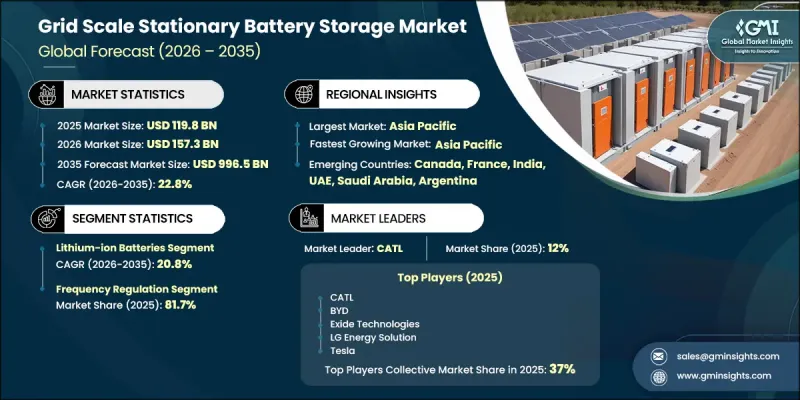
市場擴張日益受到長期儲能系統從試點階段轉變為多區域商業規模採購項目的推動。電網營運商正從短期平衡系統轉向能夠應對可再生能源長期間歇性並支援晚間高峰需求的8-12小時儲能設施。經濟最佳化也是競爭激烈的電力市場中的關鍵促進因素,因為儲能設施可以透過多種收入來源產生收益,包括頻率調節服務、套利和容量支付。與單一用途應用相比,這種多元化的收入能力顯著提高了專案的可行性。此外,在大型設施過熱事故發生後,安全問題已成為監管重點,導致系統設計、防火措施和設施工程的標準更加嚴格。隨著可再生能源採用率的提高,電池儲能正成為電網現代化策略的核心,推動電力系統的柔軟性、穩定性和脫碳進程。
| 市場範圍 | |
|---|---|
| 開始年份 | 2025 |
| 預測期 | 2026-2035 |
| 起始金額 | 1198億美元 |
| 預測金額 | 9965億美元 |
| 複合年成長率 | 22.8% |
預計到2025年,鋰離子電池技術將佔據75.5%的市場佔有率,並在2035年之前以20.8%的複合年成長率成長。其中,磷酸鋰鐵(LFP)電池憑藉其成本效益、3000至6000次以上的高循環壽命以及在部分充電條件下的穩定性能,約佔新建公用事業規模儲能部署的90%。成熟的供應鏈和大規模生產能力進一步鞏固了其在電網儲能應用領域的領先地位。
預計到2025年,頻率調節領域將佔81.7%的市場佔有率,並預計在2035年之前以22.7%的複合年成長率成長。電池儲能系統幾乎可以瞬間響應電網頻率波動,其性能顯著優於傳統的火力和水力調節資源。這種快速響應能力使其對於維持高可再生能源採用率系統中的電網穩定性至關重要。
預計到 2025 年,北美電網級固定式電池儲能市場將佔據 29.4% 的市場佔有率,並將在 2035 年前以 16.6% 的複合年成長率成長。該地區的成長主要得益於聯邦政策框架,特別是美國《通膨控制法案》,該法案為獨立儲能計畫提供 30% 的投資稅額扣抵,顯著提高了計畫的經濟可行性,並加速了其在公用事業規模應用中的普及。
目錄
第1章:調查方法和範圍
第2章執行摘要
第3章 行業洞察
- 產業生態系分析
- 原物料供應及採購分析
- 生產能力評估
- 供應鏈韌性與風險因素
- 配電網路分析
- 監理情勢
- 影響產業的因素
- 成長促進因素
- 產業潛在風險與挑戰
- 成長潛力分析
- 波特的分析
- PESTLE分析
- 價格趨勢分析
- 電池需另購
- 按地區
- 生產能力和生產情況
- 主要製造商的生產能力
- 運轉率和擴張計劃
- 人工智慧和生成式人工智慧對市場(核心解決方案)的影響
- 人工智慧驅動的生產最佳化(核心解決方案)
- 預測性維護和故障檢測(核心解決方案)
- 新機會與趨勢
- 投資分析及未來展望
- 永續發展措施與工業4.0的融合
第4章 競爭情勢
- 介紹
- 企業市佔率分析:按地區分類
- 北美洲
- 歐洲
- 亞太地區
- 中東和非洲
- 拉丁美洲
- 主要進展
- 重要合作夥伴關係和合作
- 主要併購活動
- 產品創新和新產品發布
- 市場擴大策略
- 競爭定位矩陣
第5章 市場規模及預測:依電池類型分類,2022-2035年
- 鋰離子
- LFP
- NMC
- 其他
- 硫鈉
- 鉛酸電池
- 液流電池
- 其他
第6章 市場規模與預測:依應用領域分類,2022-2035年
- 頻率限制
- 靈活坡道
- 駭啟動服務
- 能源轉型和設備安裝延期
- 緩解輸配電網路堵塞
- 容量穩定
- 減少可再生能源輸出的棄用
- 減少對柴油發電機的依賴
第7章 市場規模及預測:依地區分類,2022-2035年
- 北美洲
- 美國
- 加拿大
- 墨西哥
- 歐洲
- 英國
- 法國
- 德國
- 義大利
- 俄羅斯
- 西班牙
- 亞太地區
- 中國
- 澳洲
- 印度
- 日本
- 韓國
- 中東和非洲
- 沙烏地阿拉伯
- UAE
- 南非
- 拉丁美洲
- 巴西
- 阿根廷
第8章:公司簡介
- BYD Company
- Contemporary Amperex Technology Co. Limited(CATL)
- Eos Energy Enterprises
- Exide Technologies
- Fluence Energy
- Form Energy
- GS Yuasa International
- Hitachi Energy
- HOPPECKE Batterien
- Invinity Energy Systems
- Johnson Controls
- LG Energy Solution
- Panasonic Corporation
- Powin Energy
- Samsung SDI
- Siemens Energy
- SK Innovation
- Tesla
- Toshiba Corporation
- Wartsila
The Global Grid Scale Stationary Battery Storage Market was valued at USD 119.8 billion in 2025 and is estimated to grow at a CAGR of 22.8% to reach USD 996.5 billion by 2035.
Market expansion is increasingly influenced by the transition of long-duration storage from pilot deployments into commercial-scale procurement programs across multiple regions. Grid operators are shifting away from short-duration balancing systems toward 8-12 hour storage assets capable of managing extended renewable intermittency and sustaining peak evening demand periods. Economic optimization is also a key driver, as storage assets in competitive power markets generate revenue through stacked revenue streams including frequency services, arbitrage, and capacity payments. This multi-revenue functionality significantly improves project viability compared to single-use applications. Safety considerations have also gained regulatory prominence following thermal incidents in large-scale installations, prompting stricter standards for system design, fire mitigation, and facility engineering. As renewable penetration increases, battery storage is becoming a central pillar of grid modernization strategies, enabling greater flexibility, stability, and decarbonization of electricity systems.
| Market Scope | |
|---|---|
| Start Year | 2025 |
| Forecast Year | 2026-2035 |
| Start Value | $119.8 Billion |
| Forecast Value | $996.5 Billion |
| CAGR | 22.8% |
Lithium-ion technology accounted for 75.5% share in 2025 and is projected to grow at a CAGR of 20.8% through 2035. Within this category, lithium iron phosphate (LFP) chemistry represents around 90% of new utility-scale deployments due to its cost efficiency, strong cycle durability ranging from 3,000 to over 6,000 cycles, and stable performance under partial charge conditions. Established supply chains and large-scale manufacturing capacity further reinforce its dominant position in grid storage applications.
The frequency regulation segment held an 81.7% share in 2025 and is expected to grow at a CAGR of 22.7% through 2035. Battery storage systems provide near-instantaneous response to grid frequency fluctuations, significantly outperforming conventional thermal and hydro-based balancing resources. This rapid response capability makes them essential for maintaining grid stability in systems with high renewable energy penetration.
North America Grid Scale Stationary Battery Storage Market accounted for 29.4% share in 2025 and is projected to grow at a CAGR of 16.6% through 2035. Growth in the region is strongly supported by federal policy frameworks, particularly the U.S. Inflation Reduction Act, which provides an independent 30% Investment Tax Credit for standalone energy storage projects, significantly improving project economics and accelerating deployment across utility-scale applications.
Major companies operating in the global grid scale stationary battery storage market include Tesla, CATL (Contemporary Amperex Technology Co. Limited), BYD Company, LG Energy Solution, Siemens Energy, Samsung SDI, Hitachi Energy, Fluence Energy, Panasonic Corporation, SK Innovation, Wartsila, Johnson Controls, Powin Energy, Eos Energy Enterprises, Form Energy, Toshiba Corporation, Invinity Energy Systems, GS Yuasa International, Exide Technologies, and HOPPECKE Batterien. Companies in the grid scale stationary battery storage market are focusing on scaling high-capacity energy storage projects through long-term utility partnerships and independent power producer collaborations. Many players are investing heavily in advanced battery chemistries such as LFP and next-generation solid-state technologies to improve safety, efficiency, and lifecycle performance. Vertical integration strategies, including in-house cell manufacturing and system integration, are being adopted to reduce costs and strengthen supply chain control. Firms are also enhancing revenue optimization platforms that enable energy storage assets to participate in multiple grid services simultaneously, improving project profitability.
Table of Contents
Chapter 1 Methodology & Scope
- 1.1 Research approach
- 1.2 Quality commitments
- 1.2.1 GMI AI policy & data integrity commitment
- 1.2.1.1 Source consistency protocol
- 1.2.1 GMI AI policy & data integrity commitment
- 1.3 Research trail & confidence scoring
- 1.3.1 Research trail components
- 1.3.2 Scoring components
- 1.4 Data collection
- 1.4.1 Partial list of primary sources
- 1.5 Data mining sources
- 1.5.1 Paid sources
- 1.5.1.1 Sources, by region
- 1.5.1 Paid sources
- 1.6 Base estimates and calculations
- 1.6.1 Base year calculation for any one approach
- 1.7 Market estimates & forecasts parameters
- 1.8 Forecast model
- 1.8.1 Quantified market impact analysis
- 1.8.1.1 Mathematical impact of growth parameters on forecast
- 1.8.1 Quantified market impact analysis
- 1.9 Research transparency addendum
- 1.9.1 Source attribution framework
- 1.9.2 Quality assurance metrics
- 1.9.3 Our commitment to trust
- 1.10 Market definitions
Chapter 2 Executive Summary
- 2.1 Industry synopsis, 2022 - 2035
- 2.1.1 Business trends
- 2.1.2 Battery trends
- 2.1.3 Application trends
- 2.1.4 Regional trends
Chapter 3 Industry Insights
- 3.1 Industry ecosystem analysis
- 3.1.1 Raw material availability & sourcing analysis
- 3.1.2 Manufacturing capacity assessment
- 3.1.3 Supply chain resilience & risk factors
- 3.1.4 Distribution network analysis
- 3.2 Regulatory landscape
- 3.3 Industry impact forces
- 3.3.1 Growth drivers
- 3.3.2 Industry pitfalls & challenges
- 3.4 Growth potential analysis
- 3.5 Porter's analysis
- 3.5.1 Bargaining power of suppliers
- 3.5.2 Bargaining power of buyers
- 3.5.3 Threat of new entrants
- 3.5.4 Threat of substitutes
- 3.6 PESTEL analysis
- 3.6.1 Political factors
- 3.6.2 Economic factors
- 3.6.3 Social factors
- 3.6.4 Technological factors
- 3.6.5 Legal factors
- 3.6.6 Environmental factors
- 3.7 Price trend analysis (USD/MW)
- 3.7.1 By Battery
- 3.7.2 By Region
- 3.8 Capacity & production landscape (Driven by Primary Research)
- 3.8.1 Capacity by key producer (Driven by Primary Research)
- 3.8.2 Capacity utilization rates & expansion pipelines (Driven by Primary Research)
- 3.9 Impact of AI & Generative AI on the market (Core Solution)
- 3.9.1 AI-Driven production optimization (Core Solution)
- 3.9.2 Predictive maintenance & fault detection (Core Solution)
- 3.10 Emerging opportunities & trends
- 3.11 Investment analysis & future prospects
- 3.12 Sustainability initiatives & industry 4.0 integration
Chapter 4 Competitive Landscape, 2026
- 4.1 Introduction
- 4.2 Company market share analysis, by region, 2025
- 4.2.1 North America
- 4.2.2 Europe
- 4.2.3 Asia Pacific
- 4.2.4 Middle East & Africa
- 4.2.5 Latin America
- 4.3 Key developments
- 4.3.1 Key partnerships & collaborations
- 4.3.2 Major M&A activities
- 4.3.3 Product innovations & launches
- 4.3.4 Market expansion strategies
- 4.4 Competitive positioning matrix
Chapter 5 Market Size and Forecast, By Battery, 2022 - 2035 (MW & USD Million)
- 5.1 Key trends
- 5.2 Lithium ion
- 5.2.1 LFP
- 5.2.2 NMC
- 5.2.3 Others
- 5.3 Sodium sulphur
- 5.4 Lead acid
- 5.5 Flow battery
- 5.6 Others
Chapter 6 Market Size and Forecast, By Application, 2022 - 2035 (MW & USD Million)
- 6.1 Key trends
- 6.2 Frequency regulation
- 6.3 Flexible ramping
- 6.4 Black start services
- 6.5 Energy shifting & capacity deferral
- 6.6 T & D congestion relief
- 6.7 Capacity firming
- 6.8 Reduced RE curtailment
- 6.9 Reduced reliance on diesel gensets
Chapter 7 Market Size and Forecast, By Region, 2022 - 2035 (MW & USD Million)
- 7.1 Key trends
- 7.2 North America
- 7.2.1 U.S.
- 7.2.2 Canada
- 7.2.3 Mexico
- 7.3 Europe
- 7.3.1 UK
- 7.3.2 France
- 7.3.3 Germany
- 7.3.4 Italy
- 7.3.5 Russia
- 7.3.6 Spain
- 7.4 Asia Pacific
- 7.4.1 China
- 7.4.2 Australia
- 7.4.3 India
- 7.4.4 Japan
- 7.4.5 South Korea
- 7.5 Middle East & Africa
- 7.5.1 Saudi Arabia
- 7.5.2 UAE
- 7.5.3 South Africa
- 7.6 Latin America
- 7.6.1 Brazil
- 7.6.2 Argentina
Chapter 8 Company Profiles
- 8.1 BYD Company
- 8.2 Contemporary Amperex Technology Co. Limited (CATL)
- 8.3 Eos Energy Enterprises
- 8.4 Exide Technologies
- 8.5 Fluence Energy
- 8.6 Form Energy
- 8.7 GS Yuasa International
- 8.8 Hitachi Energy
- 8.9 HOPPECKE Batterien
- 8.10 Invinity Energy Systems
- 8.11 Johnson Controls
- 8.12 LG Energy Solution
- 8.13 Panasonic Corporation
- 8.14 Powin Energy
- 8.15 Samsung SDI
- 8.16 Siemens Energy
- 8.17 SK Innovation
- 8.18 Tesla
- 8.19 Toshiba Corporation
- 8.20 Wartsila

 2026-2034年全球鋰離子固定式電池市場規模、佔有率、趨勢和成長分析報告
 全球固定式電池儲能系統市場全球電網級固定式電池儲能市場規模、佔有率、趨勢及成長分析報告(2026-2034年)
 2026年全球固定式電池市場報告
 固定式電池市場規模、佔有率和成長分析(按電池類型、能量容量、應用、最終用戶和地區分類)—產業預測(2026-2033 年)
 電網級固定式電池儲能市場規模、佔有率和成長分析(按電池類型、應用和地區分類)-2026-2033年產業預測
 全球固定式鋰離子電池市場全球電網規模固定電池儲能市場全球固定電池市場:2034 年市場機會與策略
 電網規模固定電池儲存市場,按電池技術、按容量、按應用、按最終用戶、按國家和地區分類 - 2025 年至 2032 年全球行業分析、市場規模、市場佔有率和預測