


 |
市場調查報告書
商品編碼
2071406
護理師呼叫系統市場機會、成長要素、產業趨勢分析及2026-2035年預測。Nurse Call Systems Market Opportunity, Growth Drivers, Industry Trend Analysis, and Forecast 2026 - 2035 |
||||||

全球護理師呼叫系統市場預計到 2025 年將價值 29 億美元,預計到 2035 年將以 9.5% 的複合年成長率成長至 72 億美元。
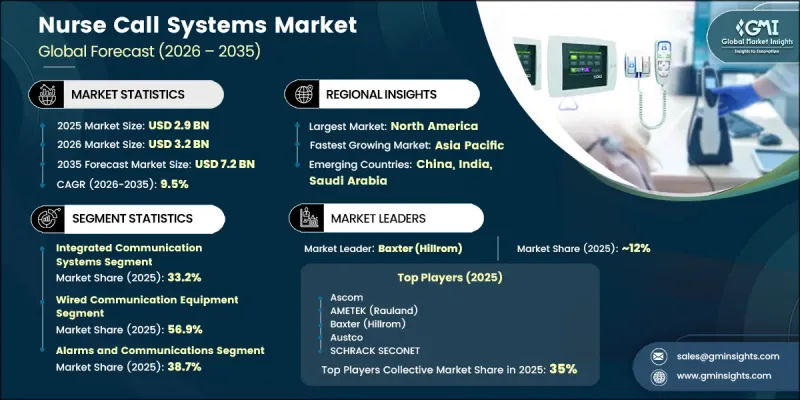
市場成長受多種因素共同驅動:人口老化、醫療服務使用量增加、護理人員和護理人員短缺,以及醫療數位化進程的持續推進。護理師呼叫系統已從基本的病患警報功能發展成為支援即時臨床工作流程和病患安全措施的高級通訊平台。推動市場發展的關鍵因素之一是將護理人員呼叫技術與更廣泛的醫療資訊系統(包括病患管理平台、員工協調工具和基於位置的監控解決方案)整合。這種轉變在提升系統功能的同時,也提高了整個醫療環境的反應效率。隨著醫療機構管理的複雜疾病患者數量不斷增加,對可靠通訊基礎設施的需求也持續成長。如今,關注點不僅在於患者數量,還在於確保快速響應、簡化升級流程以及提高危重患者群體的護理質量,這使得護士呼叫系統成為現代醫療基礎設施的重要組成部分。
| 市場範圍 | |
|---|---|
| 開始年份 | 2025 |
| 預測期 | 2026-2035 |
| 初始市場規模 | 29億美元 |
| 預測金額 | 72億美元 |
| 複合年成長率 | 9.5% |
到2025年,整合式通訊系統市佔率將達到33.2%。這些解決方案將多種通訊功能整合到單一平台,使醫療機構能夠改善警報管理、看護者溝通、病患監測和工作流程協調。隨著醫療機構尋求標準化的通訊基礎設施來支援其整個機構的運營,對整合系統的需求持續成長。大規模醫療網路越來越傾向於採用整合平台,因為這些平台能夠簡化技術管理、提高互通性、降低維護複雜性並提升長期營運效率。向整合通訊生態系統的轉變顯著推動了該細分市場的成長,並拓展了護理師呼叫系統的功能,使其超越了傳統的床邊通訊功能。
預計到2025年,醫院領域將佔據62.2%的市場。由於患者數量龐大、臨床環境複雜且營運需求嚴格,急診機構仍是主要需求來源。全球眾多醫院為市場成長奠定了穩定的基礎,這得益於病患溝通和照護品質的必要標準。日益成長的合規性要求、病患安全措施以及高效的員工協調,持續推動對先進護理師呼叫系統基礎設施的投資。隨著醫療機構將臨床效率和以患者為中心的護理放在首位,預計在整個預測期內,醫院仍將是護理人員呼叫技術的主要採用者。
到2025年,北美護理師呼叫系統市佔率將達到42.1%,其中美國在銷售額和系統部署量方面均佔最大佔有率。該地區受益於高額的醫療保健支出、先進的醫療基礎設施以及數位醫療技術的廣泛應用。持續加大對醫院現代化、病人安全措施和通訊系統升級的投資,也為市場擴張提供了持續的支撐。有關病患溝通和護理品質的監管要求,也為護理人員呼叫解決方案創造了穩定的需求環境。此外,該地區的醫療服務提供者越來越重視能夠提高工作流程效率、支持臨床決策並改善患者預後的整合通訊技術,這進一步鞏固了北美在全球市場的主導地位。
目錄
第1章:調查方法和範圍
第2章執行摘要
第3章 行業洞察
- 產業生態系分析
- 影響產業的因素
- 促進因素
- 老年人口增加和慢性病盛行率上升。
- 護士呼叫系統的技術進步
- 政府在醫療保健領域的支出激增
- 合格且訓練有素的護士短缺以及護士呼叫系統的多樣化使用。
- 產業潛在風險與挑戰
- 引入護士呼叫系統會帶來高成本。
- 針對隱私侵權行為的嚴格監管政策
- 市場機遇
- 對智慧醫院和物聯網解決方案的需求日益成長
- 在醫療基礎設施正在發展的新興市場拓展業務。
- 促進因素
- 成長潛力分析
- 監理情勢
- 技術展望
- 最新科技趨勢
- 新興技術
- 價格趨勢分析
- 未來市場趨勢
- 波特的分析
- PESTLE分析
- 人工智慧和生成式人工智慧對市場的影響
- 價值鏈分析
- 投資與資金籌措分析
第4章 競爭情勢
- 介紹
- 企業市佔率分析:按地區分類
- 北美洲
- 歐洲
- 亞太地區
- 中東和非洲
- 拉丁美洲
- 主要進展
- 重要合作夥伴關係和合作
- 主要併購活動
- 產品創新和新產品發布
- 市場擴大策略
- 競爭定位矩陣
第5章 市場規模及預測:依產品分類,2022-2035年
- 整合通訊系統
- 按鈕系統
- 移動系統
- 對講系統
第6章 市場規模及預測:依技術分類,2022-2035年
- 有線通訊設備
- 無線通訊設備
第7章 市場規模及預測:依應用領域分類,2022-2035年
- 警報和通訊
- 工作流程支持
- 流浪者管理
- 跌倒偵測與預防
第8章 市場規模及預測:依最終用途分類,2022-2035年
- 醫院
- 護理機構及維生設施
- 居家照護環境
- 其他最終用途
第9章 市場規模及預測:依地區分類,2022-2035年
- 北美洲
- 美國
- 加拿大
- 歐洲
- 德國
- 法國
- 英國
- 荷蘭
- 西班牙
- 義大利
- 亞太地區
- 中國
- 日本
- 韓國
- 印度
- 澳洲
- 中東和非洲
- 沙烏地阿拉伯
- UAE
- 南非
- 拉丁美洲
- 巴西
- 墨西哥
- 阿根廷
第10章:公司簡介
- AMETEK(Rauland)
- Ascom
- Austco
- Baxter(Hillrom)
- Caretronic
- CORNELL TECHNOLOGIES
- FORBIX SEMICON
- Honeywell
- Jeron Electronics Systems
- Johnson Controls
- MEEYI
- SCHRACK SECONET
- Securitas Healthcare
- TekTone
- West-Com Nurse Call Systems
The Global Nurse Call Systems Market was valued at USD 2.9 billion in 2025 and is estimated to grow at a CAGR of 9.5% to reach USD 7.2 billion by 2035.
Market growth is fueled by the combined impact of aging populations, rising healthcare service utilization, workforce shortages across nursing and caregiving professions, and ongoing healthcare digitalization initiatives. Nurse call systems have evolved considerably from basic patient-alert mechanisms into sophisticated communication platforms that support real-time clinical workflows and patient safety initiatives. A key factor shaping market development is the growing integration of nurse call technologies with broader healthcare information systems, including patient management platforms, workforce coordination tools, and location-based monitoring solutions. This transformation is increasing system functionality while enhancing response efficiency across healthcare environments. As healthcare facilities manage larger numbers of patients with complex medical conditions, the demand for dependable communication infrastructure continues to rise. The focus is no longer solely on patient volume but on ensuring rapid response times, streamlined escalation procedures, and improved quality of care for high-acuity patient populations, making nurse call systems a critical component of modern healthcare infrastructure.
| Market Scope | |
|---|---|
| Start Year | 2025 |
| Forecast Year | 2026-2035 |
| Start Value | $2.9 Billion |
| Forecast Value | $7.2 Billion |
| CAGR | 9.5% |
The integrated communication systems segment held a 33.2% share in 2025. These solutions combine multiple communication functions into a single platform, enabling healthcare facilities to improve alarm management, caregiver communication, patient monitoring, and workflow coordination. Demand for integrated systems continues to increase as healthcare organizations seek standardized communication infrastructures that can support facility-wide operations. Large healthcare networks increasingly favor unified platform deployments that simplify technology management, improve interoperability, reduce maintenance complexity, and deliver long-term operational efficiencies. This shift toward consolidated communication ecosystems is contributing significantly to segment growth and expanding the role of nurse call systems beyond traditional bedside communication functions.
The hospitals segment captured 62.2% share in 2025. Acute care facilities continue to represent the primary source of demand due to their extensive patient volumes, complex clinical environments, and stringent operational requirements. The substantial number of hospitals operating worldwide creates a stable foundation for market growth, supported by mandatory patient communication standards and healthcare quality requirements. Compliance obligations, patient safety initiatives, and the increasing need for efficient staff coordination continue to drive investment in advanced nurse call infrastructure. As healthcare facilities prioritize clinical efficiency and patient-centered care, hospitals are expected to remain the dominant adopters of nurse call technologies throughout the forecast period.
North America Nurse Call Systems Market accounted for 42.1% share in 2025, with the United States representing the largest contributor in terms of both revenue and system installations. The region benefits from substantial healthcare spending, advanced healthcare infrastructure, and widespread adoption of digital health technologies. Ongoing investments in hospital modernization, patient safety initiatives, and communication system upgrades continue to support market expansion. Regulatory requirements related to patient communication and care quality also create a consistent demand environment for nurse call solutions. In addition, healthcare providers across the region are increasingly prioritizing integrated communication technologies that improve workflow efficiency, support clinical decision-making, and enhance patient outcomes, reinforcing North America's leadership position within the global market.
Major companies operating in the global nurse call systems market include West-Com Nurse Call Systems, Caretronic, AMETEK (Rauland), Honeywell, Jeron Electronics Systems, Johnson Controls, Austco, TekTone, Baxter (Hillrom), CORNELL TECHNOLOGIES, MEEYI, FORBIX SEMICON, SCHRACK SECONET, Securitas Healthcare, and Ascom. Companies operating in the nurse call systems market are adopting several strategic initiatives to strengthen their market presence and enhance competitive positioning. A primary focus is being placed on developing integrated communication platforms that connect seamlessly with healthcare information systems, patient monitoring technologies, and workforce management solutions. Vendors are investing heavily in software innovation, cloud-based capabilities, interoperability features, and mobile communication tools to improve clinical workflow efficiency. Strategic partnerships with healthcare providers, technology firms, and system integrators are helping companies expand deployment opportunities and improve solution capabilities. In addition, organizations are enhancing service offerings through customization, remote support, predictive maintenance, and long-term service agreements.
Table of Contents
Chapter 1 Methodology & Scope
- 1.1 Research approach
- 1.2 Quality commitments
- 1.2.1 GMI AI policy & data integrity commitment
- 1.2.1.1 Source consistency protocol
- 1.2.1 GMI AI policy & data integrity commitment
- 1.3 Research trail & confidence scoring
- 1.3.1 Research trail components
- 1.3.2 Scoring components
- 1.4 Data collection
- 1.4.1 Partial list of primary sources
- 1.5 Data mining sources
- 1.5.1 Paid sources
- 1.5.1.1 Sources, by region
- 1.5.1 Paid sources
- 1.6 Base estimates and calculations
- 1.6.1 Base year calculation for any one approach
- 1.7 Market estimates & forecasts parameters
- 1.8 Forecast model
- 1.8.1 Quantified market impact analysis
- 1.8.1.1 Mathematical impact of growth parameters on forecast
- 1.8.1 Quantified market impact analysis
- 1.9 Research transparency addendum
- 1.9.1 Source attribution framework
- 1.9.2 Quality assurance metrics
- 1.9.3 Our commitment to trust
- 1.10 Market definitions
Chapter 2 Executive Summary
- 2.1 Industry synopsis, 2022 - 2035
- 2.1.1 Business trends
- 2.1.2 Product trends
- 2.1.3 Technology trends
- 2.1.4 Application trends
- 2.1.5 End use trends
- 2.1.6 Regional trends
Chapter 3 Industry Insights
- 3.1 Industry ecosystem analysis
- 3.2 Industry impact forces
- 3.2.1 Growth drivers
- 3.2.1.1 Rising geriatric population and chronic disease prevalence
- 3.2.1.2 Technological advancements in nurse call systems
- 3.2.1.3 Surging government expenditure in the healthcare sector
- 3.2.1.4 Shortage of qualified/trained nurses coupled with diverse applications of nurse call systems
- 3.2.2 Industry pitfalls and challenges
- 3.2.2.1 High costs involved in the implementation of nurse call systems
- 3.2.2.2 Stringent regulatory policies related to privacy breach
- 3.2.3 Market opportunities
- 3.2.3.1 Growing demand for smart hospitals and IoT-enabled solutions
- 3.2.3.2 Expansion in emerging markets with improving healthcare infrastructure
- 3.2.1 Growth drivers
- 3.3 Growth potential analysis
- 3.4 Regulatory landscape (Driven by primary research)
- 3.4.1 North America
- 3.4.2 Europe
- 3.4.3 Asia Pacific
- 3.4.4 Latin America
- 3.4.5 MEA
- 3.5 Technology landscape
- 3.5.1 Current technological trends
- 3.5.2 Emerging technologies
- 3.6 Pricing trend analysis (Driven by primary research)
- 3.7 Future market trends
- 3.8 Porter's analysis
- 3.9 PESTEL analysis
- 3.10 Impact of AI and Generative AI on the market (Driven by primary research)
- 3.11 Value chain analysis (Driven by primary research)
- 3.12 Investment & funding analysis (Driven by primary research)
Chapter 4 Competitive Landscape, 2026
- 4.1 Introduction
- 4.2 Company market share analysis, by region, 2025
- 4.2.1 North America
- 4.2.2 Europe
- 4.2.3 Asia Pacific
- 4.2.4 Middle East & Africa
- 4.2.5 Latin America
- 4.3 Key developments
- 4.3.1 Key partnerships & collaborations
- 4.3.2 Major M&A activities
- 4.3.3 Product innovations & launches
- 4.3.4 Market expansion strategies
- 4.4 Competitive positioning matrix
Chapter 5 Market Size and Forecast, By Product, 2022 - 2035 (USD Million)
- 5.1 Key trends
- 5.2 Integrated communication systems
- 5.3 Button systems
- 5.4 Mobile systems
- 5.5 Intercom systems
Chapter 6 Market Size and Forecast, By Technology, 2022 - 2035 (USD Million)
- 6.1 Key trends
- 6.2 Wired communication equipment
- 6.3 Wireless communication equipment
Chapter 7 Market Size and Forecast, By Application, 2022 - 2035 (USD Million)
- 7.1 Key trends
- 7.2 Alarms and communications
- 7.3 Workflow support
- 7.4 Wanderer control
- 7.5 Fall detection and prevention
Chapter 8 Market Size and Forecast, By End Use, 2022 - 2035 (USD Million)
- 8.1 Key trends
- 8.2 Hospitals
- 8.3 Nursing and assisted living centers
- 8.4 Homecare settings
- 8.5 Other end use
Chapter 9 Market Size and Forecast, By Region, 2022 - 2035 (USD Million)
- 9.1 Key trends
- 9.2 North America
- 9.2.1 U.S.
- 9.2.2 Canada
- 9.3 Europe
- 9.3.1 Germany
- 9.3.2 France
- 9.3.3 UK
- 9.3.4 Netherlands
- 9.3.5 Spain
- 9.3.6 Italy
- 9.4 Asia Pacific
- 9.4.1 China
- 9.4.2 Japan
- 9.4.3 South Korea
- 9.4.4 India
- 9.4.5 Australia
- 9.5 Middle East & Africa
- 9.5.1 Saudi Arabia
- 9.5.2 UAE
- 9.5.3 South Africa
- 9.6 Latin America
- 9.6.1 Brazil
- 9.6.2 Mexico
- 9.6.3 Argentina
Chapter 10 Company Profiles
- 10.1 AMETEK (Rauland)
- 10.2 Ascom
- 10.3 Austco
- 10.4 Baxter (Hillrom)
- 10.5 Caretronic
- 10.6 CORNELL TECHNOLOGIES
- 10.7 FORBIX SEMICON
- 10.8 Honeywell
- 10.9 Jeron Electronics Systems
- 10.10 Johnson Controls
- 10.11 MEEYI
- 10.12 SCHRACK SECONET
- 10.13 Securitas Healthcare
- 10.14 TekTone
- 10.15 West-Com Nurse Call Systems

 2026年全球智慧護理師呼叫或尋呼系統市場報告
 2026-2030年全球護理呼叫系統市場
 護士呼叫系統市場-策略分析與預測(2026-2031)
 視覺化護理師呼叫系統市場規模、佔有率和成長分析:按組件、部署類型、最終用戶、應用、安裝類型和地區分類-2026-2033年產業預測
 護士呼叫系統市場-全球市場預測(2026-2032年)
 護理師呼叫系統市場規模、佔有率、趨勢和預測:按技術、設備、應用、最終用戶和地區分類,2026-2034 年
 護理人員呼叫系統市場:依服務模式、類型、最終使用者和地區分類。全球護理師呼叫系統市場規模、佔有率、趨勢和成長分析報告(2026-2034年)
 護理師呼叫系統市場 - 全球產業規模、佔有率、趨勢、機會及預測(按技術、應用、類型、最終用戶、地區和競爭格局分類,2021-2031年)日本護士呼叫系統市場報告(按技術、設備、應用、最終用戶和地區分類,2026-2034年)