


 |
市場調查報告書
商品編碼
2071405
2026 年至 2035 年單純皰疹病毒治療的市場機會、成長要素、產業趨勢分析與預測。Herpes Simplex Virus Treatment Market Opportunity, Growth Drivers, Industry Trend Analysis, and Forecast 2026 - 2035 |
||||||

預計到 2025 年,全球單純皰疹病毒治療市場價值將達到 31 億美元,並有望以 4.2% 的複合年成長率成長,到 2035 年達到 47 億美元。
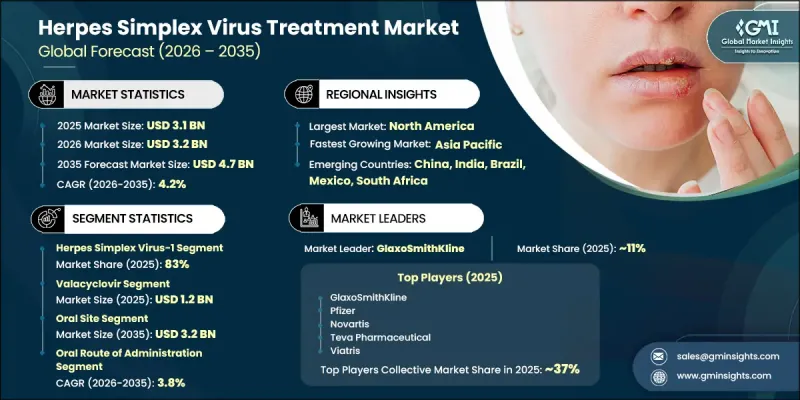
全球單純皰疹病毒感染疾病上升、藥物研發投入增加、政府主導的宣傳活動增加以及國際旅行增加加速了疾病傳播,這些因素共同推動了市場擴張。此外,已開發市場和新興市場醫療保健支出的成長也持續刺激著對有效抗病毒療法的需求。單純皰疹病毒(HSV)感染疾病的持續負擔仍然是市場成長的主要結構性促進因素。單純皰疹病毒的治療重點在於控制HSV-1和HSV-2感染疾病,減輕症狀,降低復發率,並最大限度地減少病毒傳播的風險。目前的標準治療主要基於抗病毒藥物,例如阿昔洛韋、伐昔洛韋和泛昔洛韋,這些藥物可以抑制病毒複製並減少復發。長期抑制療法正被擴大採用,以降低復發頻率和病毒排放,並改善患者預後。此外,使用長效口服製劑的趨勢日益明顯,這種製劑更便於患者使用,旨在提高藥物依從性,增強慢性 HSV 患者的生活品質 (QOL)。
| 市場範圍 | |
|---|---|
| 開始年份 | 2025 |
| 預測期 | 2026-2035 |
| 初始市場規模 | 31億美元 |
| 預計金額 | 47億美元 |
| 複合年成長率 | 4.2% |
預計到2025年,HSV-1將佔據83%的市場。雖然HSV-1主要引起口腔皰疹感染疾病,但在某些地區,它也導致了生殖器皰疹病例的增加。其廣泛的流行使得對抗病毒藥物、診斷測試和長期疾病管理方案的需求持續成長。 HSV-1反覆發作的特性進一步確保了患者群體對治療的持續需求。口服抗病毒藥物、局部用藥和症狀治療的普及,以及人們對早期發現和及時干預重要性的認知不斷提高,都支撐了該細分市場的成長。
預計到2035年,口腔健康市場規模將達到32億美元,主要促進因素是與HSV-1相關的口腔皰疹在全球範圍內的高發生率。口腔感染疾病引起的可見病變往往會導致外觀上的困擾和社交上的不適,因此與其他感染部位相比,患者會更早就診和接受治療。公眾意識的提高、健康教育的改善以及對疾病管理實踐的更深入了解,都進一步提高了該領域的診斷率和治療接受度。
預計到2025年,北美單純皰疹病毒治療市場將佔43.5%的佔有率。該地區的市場主導地位得益於HSV-1和HSV-2感染疾病的高盛行率,從而形成了一個龐大且持續接受治療的患者群體。完善的醫療保健體系、先進的診斷基礎設施、強大的藥品生產能力以及有利的保險報銷機制,持續推動市場擴張。此外,對感染疾病研究的持續投入、高額的醫療費用支出以及人們對性行為感染感染日益成長的認知,也鞏固了該地區的市場地位。
目錄
第1章:調查方法和範圍
第2章執行摘要
第3章 行業洞察
- 產業生態系分析
- 影響產業的因素
- 促進因素
- 皰疹感染疾病上升
- 研發活性化
- 政府資助和公眾意識的提高
- 遠端醫療和數位醫療平台的廣泛應用。
- 產業潛在風險與挑戰
- 產品召回事件增多
- 疫苗取得困難
- 市場機遇
- 開發長效型新型抗病毒藥物
- 拓展新興市場與低度開發市場
- 促進因素
- 成長潛力分析
- 監理情勢
- 技術與創新展望
- 最新科技趨勢
- 新興技術
- 人工智慧和生成式人工智慧對市場的影響
- 未來市場趨勢
- 價格分析
- 投資和資金籌措趨勢
- 波特的分析
- PESTLE分析
第4章 競爭情勢
- 介紹
- 企業市佔率分析
- 北美洲
- 歐洲
- 亞太地區
- 企業矩陣分析
- 主要市場公司的競爭分析
- 競爭定位矩陣
- 主要進展
- 併購
- 夥伴關係和聯盟
- 新產品發布
- 業務拓展計劃
第5章 市場估算與預測:依病毒類型分類,2022-2035年
- 單純皰疹病毒1型
- 單純皰疹病毒2型
第6章 市場估計與預測:依藥物類型分類,2022-2035年
- 阿昔洛韋
- 伐昔洛韋
- 泛昔洛韋
- 其他藥物類型
第7章 市場估計與預測:依地點分類,2022-2035年
- 口服
- 生殖器
- 其他網站
第8章 市場估計與預測:依給藥途徑分類,2022-2035年
- 口服
- 注射藥物
- 外用
第9章 市場估價與預測:依通路分類,2022-2035年
- 醫院藥房
- 零售藥房
- 網路藥房
第10章 市場估價與預測:依地區分類,2022-2035年
- 北美洲
- 美國
- 加拿大
- 歐洲
- 德國
- 英國
- 法國
- 西班牙
- 義大利
- 荷蘭
- 亞太地區
- 中國
- 印度
- 日本
- 澳洲
- 韓國
- 拉丁美洲
- 巴西
- 墨西哥
- 阿根廷
- 中東和非洲
- 南非
- 海灣合作理事會國家
- 以色列
第11章:公司簡介
- Abbott Laboratories
- Amneal Pharmaceuticals
- Aurobindo Pharma
- Cipla
- Dr. Reddy's Laboratories
- Emcure Pharmaceuticals
- Fresenius Kabi
- GlaxoSmithKline
- Glenmark Pharmaceuticals
- Novartis
- Pfizer
- Sun Pharmaceutical
- Teva Pharmaceutical
- Viatris
- Zydus Lifesciences
The Global Herpes Simplex Virus Treatment Market was valued at USD 3.1 billion in 2025 and is estimated to grow at a CAGR of 4.2% to reach USD 4.7 billion by 2035.
Market expansion is supported by the rising global incidence of herpes simplex virus infections, higher investments in pharmaceutical research and development, increasing government-led awareness initiatives, and growing international mobility that contributes to faster disease transmission. In addition, expanding healthcare expenditure across both developed and emerging economies continues to reinforce demand for effective antiviral therapies. The persistent burden of HSV infections remains a key structural driver of market growth. Herpes simplex virus treatment focuses on managing HSV-1 and HSV-2 infections, reducing the intensity of symptoms, lowering recurrence rates, and minimizing viral transmission risk. Current therapeutic standards are largely based on antiviral agents such as acyclovir, valacyclovir, and famciclovir, which suppress viral replication and control episodic flare-ups. Long-term suppressive therapy is increasingly being adopted to reduce outbreak frequency and viral shedding, while improving patient outcomes. There is also a growing shift toward patient-friendly and long-acting oral formulations designed to improve adherence and enhance quality of life in chronic HSV management.
| Market Scope | |
|---|---|
| Start Year | 2025 |
| Forecast Year | 2026-2035 |
| Start Value | $3.1 Billion |
| Forecast Value | $4.7 Billion |
| CAGR | 4.2% |
The HSV-1 segment accounted for an 83% share in 2025. HSV-1 is mainly linked to oral herpes infections, although it is also contributing to a rising number of genital cases in several regions. Its widespread prevalence creates sustained demand for antiviral medications, diagnostic testing, and long-term disease control solutions. The recurring nature of HSV-1 outbreaks further ensures continuous treatment usage across patient populations. Market growth in this segment is also supported by the availability of oral antivirals, topical therapies, and symptom-relief options, along with increasing awareness regarding early detection and timely intervention.
The oral site segment is projected to reach USD 3.2 billion by 2035, driven largely by the high global incidence of HSV-1-related oral herpes. Visible lesions associated with oral infections often lead to cosmetic concerns and social discomfort, encouraging earlier medical consultation and treatment adoption compared to other infection sites. Rising public awareness, improved health education, and better understanding of disease management practices are further strengthening diagnosis rates and treatment uptake within this segment.
North America Herpes Simplex Virus Treatment Market held a 43.5% share in 2025. The region's dominance is supported by a high prevalence of HSV-1 and HSV-2 infections, creating a large and consistently treated patient base. A well-established healthcare system, advanced diagnostic infrastructure, strong pharmaceutical manufacturing capabilities, and favorable reimbursement structures continue to support market expansion. In addition, sustained investment in infectious disease research, high healthcare spending, and growing awareness of sexually transmitted infections contribute to the region's strong market position.
Major players operating in the global herpes simplex virus treatment market include Pfizer, AbbVie, Novartis, GlaxoSmithKline, Cipla, Sun Pharmaceutical, Viatris, Teva Pharmaceutical, Amneal Pharmaceuticals, Aurobindo Pharma, Dr. Reddy's Laboratories, Glenmark Pharmaceuticals, Zydus Lifesciences, Emcure Pharmaceuticals, Abbott Laboratories, Fresenius Kabi, and Takeda Pharmaceutical. Companies in the herpes simplex virus treatment market are focusing on expanding antiviral drug pipelines through sustained R&D investment in next-generation therapies with improved efficacy and reduced resistance potential. Many players are strengthening their presence by developing long-acting and patient-friendly formulations that improve adherence and treatment convenience. Strategic collaborations with research institutions and biotech firms are accelerating innovation in antiviral mechanisms and delivery systems. Firms are also pursuing geographic expansion into emerging healthcare markets through partnerships and distribution agreements. In addition, competitive strategies include lifecycle management of existing antiviral drugs, introduction of combination therapies, and regulatory filings for broader treatment indications. Companies are also investing in awareness initiatives and physician education programs to improve early diagnosis rates and expand treatment adoption globally.
Table of Contents
Chapter 1 Methodology and Scope
- 1.1 Market scope and definition
- 1.2 Research approach
- 1.3 Quality commitments
- 1.3.1 GMI AI policy and data integrity commitment
- 1.3.1.1 Source consistency protocol
- 1.3.1 GMI AI policy and data integrity commitment
- 1.4 Research trail and confidence scoring
- 1.4.1 Research trail components
- 1.4.2 Scoring components
- 1.5 Data collection
- 1.5.1 Partial list of primary sources
- 1.6 Data mining sources
- 1.6.1 Paid sources
- 1.6.1.1 Sources, by region
- 1.6.1 Paid sources
- 1.7 Base estimates and calculations
- 1.7.1 Revenue share analysis
- 1.7.2 Base year calculation
- 1.8 Forecast model
- 1.9 Research transparency addendum
- 1.9.1 Source attribution framework
- 1.9.2 Quality assurance metrics
- 1.9.3 Our commitment to trust
Chapter 2 Executive Summary
- 2.1 Industry 360° synopsis
- 2.2 Key market trends
- 2.2.1 Regional trends
- 2.2.2 Virus type trends
- 2.2.3 Drug type trends
- 2.2.4 Site trends
- 2.2.5 Route of administration trends
- 2.2.6 Distribution channel trends
- 2.3 CXO perspectives: Strategic imperatives
Chapter 3 Industry Insights
- 3.1 Industry ecosystem analysis
- 3.2 Industry impact forces
- 3.2.1 Growth drivers
- 3.2.1.1 Increasing prevalence of herpes infection
- 3.2.1.2 Rising research and development
- 3.2.1.3 Increasing government funding and awareness
- 3.2.1.4 Growing adoption of telemedicine and digital healthcare platforms
- 3.2.2 Industry pitfalls and challenges
- 3.2.2.1 Increasing product recalls
- 3.2.2.2 Unavailability of vaccines
- 3.2.3 Market opportunities
- 3.2.3.1 Development of long-acting and novel antiviral formulations
- 3.2.3.2 Expansion in emerging and underserved markets
- 3.2.1 Growth drivers
- 3.3 Growth potential analysis
- 3.4 Regulatory landscape (Driven by Primary Research)
- 3.4.1 North America
- 3.4.2 Europe
- 3.4.3 Asia Pacific
- 3.4.4 Latin America
- 3.4.5 MEA
- 3.5 Technological and innovation landscape
- 3.5.1 Current technological trends
- 3.5.2 Emerging technologies (Driven by Primary Research)
- 3.6 Impact of AI and generative AI on the market (Driven by Primary Research)
- 3.7 Future market trends (Driven by Primary Research)
- 3.8 Pricing analysis (Driven by Primary Research)
- 3.9 Investment and funding landscape (Driven by Primary Research)
- 3.10 Porter's analysis
- 3.11 PESTEL analysis
Chapter 4 Competitive Landscape, 2025
- 4.1 Introduction
- 4.2 Company market share analysis
- 4.2.1 North America
- 4.2.2 Europe
- 4.2.3 Asia Pacific
- 4.3 Company matrix analysis
- 4.4 Competitive analysis of major market players
- 4.5 Competitive positioning matrix
- 4.6 Key developments
- 4.6.1 Merger and acquisition
- 4.6.2 Partnership and collaboration
- 4.6.3 New product launches
- 4.6.4 Expansion plans
Chapter 5 Market Estimates and Forecast, By Virus Type, 2022 - 2035 ($ Mn)
- 5.1 Key trends
- 5.2 Herpes simplex virus 1
- 5.3 Herpes simplex virus 2
Chapter 6 Market Estimates and Forecast, By Drug Type, 2022 - 2035 ($ Mn)
- 6.1 Key trends
- 6.2 Acyclovir
- 6.3 Valacyclovir
- 6.4 Famciclovir
- 6.5 Other drug types
Chapter 7 Market Estimates and Forecast, By Site, 2022 - 2035 ($ Mn)
- 7.1 Key trends
- 7.2 Oral
- 7.3 Genital
- 7.4 Other sites
Chapter 8 Market Estimates and Forecast, By Route of Administration, 2022 - 2035 ($ Mn)
- 8.1 Key trends
- 8.2 Oral
- 8.3 Injectable
- 8.4 Topical
Chapter 9 Market Estimates and Forecast, By Distribution Channel, 2022 - 2035 ($ Mn)
- 9.1 Key trends
- 9.2 Hospital pharmacies
- 9.3 Retail pharmacies
- 9.4 Online pharmacies
Chapter 10 Market Estimates and Forecast, By Region, 2022 - 2035 ($ Mn)
- 10.1 Key trends
- 10.2 North America
- 10.2.1 U.S.
- 10.2.2 Canada
- 10.3 Europe
- 10.3.1 Germany
- 10.3.2 UK
- 10.3.3 France
- 10.3.4 Spain
- 10.3.5 Italy
- 10.3.6 Netherlands
- 10.4 Asia Pacific
- 10.4.1 China
- 10.4.2 India
- 10.4.3 Japan
- 10.4.4 Australia
- 10.4.5 South Korea
- 10.5 Latin America
- 10.5.1 Brazil
- 10.5.2 Mexico
- 10.5.3 Argentina
- 10.6 Middle East and Africa
- 10.6.1 South Africa
- 10.6.2 GCC Countries
- 10.6.3 Israel
Chapter 11 Company Profiles
- 11.1 Abbott Laboratories
- 11.2 Amneal Pharmaceuticals
- 11.3 Aurobindo Pharma
- 11.4 Cipla
- 11.5 Dr. Reddy’s Laboratories
- 11.6 Emcure Pharmaceuticals
- 11.7 Fresenius Kabi
- 11.8 GlaxoSmithKline
- 11.9 Glenmark Pharmaceuticals
- 11.10 Novartis
- 11.11 Pfizer
- 11.12 Sun Pharmaceutical
- 11.13 Teva Pharmaceutical
- 11.14 Viatris
- 11.15 Zydus Lifesciences

 單純皰疹病毒治療市場規模、佔有率和成長分析:按病毒類型、藥物類型、給藥途徑、治療方法、分銷管道、最終用戶和地區分類-2026-2033年產業預測
 單純皰疹病毒治療市場規模、佔有率、趨勢和預測:按類型、藥物類型、給藥途徑、分銷管道和地區分類,2026-2034年
 皰疹性角膜炎(HK):市場展望、流行病學、競爭格局、市場預測報告(2025-2035)
 單純皰疹病毒治療市場-全球產業規模、佔有率、趨勢、機會和預測,按病毒類型、治療方法、給藥途徑、配銷通路、地區和競爭細分,2020-2030 年
 全球單純皰疹市場:按地區和國家分析和預測(2025-2035 年)