


 |
市場調查報告書
商品編碼
2071396
2026 年至 2035 年關節重組醫療設備的市場機會、成長要素、產業趨勢與預測。Joint Reconstruction Devices Market Opportunity, Growth Drivers, Industry Trend Analysis, and Forecast 2026 - 2035 |
||||||

預計到 2025 年,全球關節重組醫療設備市場價值將達到 245 億美元,並預計以 5.4% 的複合年成長率成長,到 2035 年達到 406 億美元。
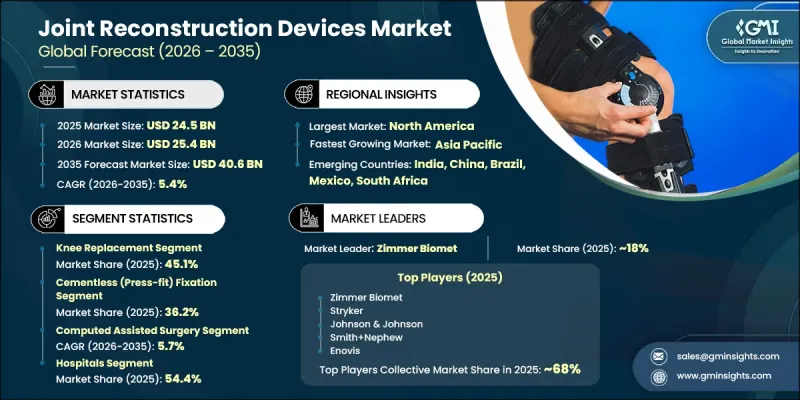
市場擴張的促進因素包括肌肉骨骼疾病盛行率的上升、人口快速老化以及人們對微創手術日益成長的偏好。植入技術和手術技術的不斷進步正在改善治療效果,進一步推動市場成長。預期壽命的延長導致與老齡化相關的關節退化性疾病盛行率上升,這持續推動著對關節關節重建手術的需求。此外,肥胖率上升和身體活動增加等生活方式相關因素也導致關節損傷增多,從而增加了對關節重組解決方案的需求。市場持續受益於對改善活動能力、緩解疼痛和全面提升患者生活品質的手術的穩定需求。
| 市場範圍 | |
|---|---|
| 開始年份 | 2025 |
| 預測期 | 2026-2035 |
| 上市時的市場規模 | 245億美元 |
| 預計金額 | 406億美元 |
| 複合年成長率 | 5.4% |
關節重組裝置是用於修復或取代受損關節(主要包括膝關節、髖關節、肩關節和踝關節)的整形外科植入。這些裝置廣泛用於治療退化性關節疾病、創傷性損傷和其他整形外科疾病。關節劣化和創傷相關疾病病例的不斷增加,推動了全球對這些植入持續的需求。預期壽命的延長和慢性關節疾病負擔的加重是促使重組手術日益普及的主要因素。
預計到2025年,全膝關節關節重建(TPR)市佔率將達到45.1%,並在2026年至2035年間以5.6%的複合年成長率成長。膝關節相關疾病,尤其是退化性疾病的高發生率,持續推動關節重建的需求。由於該手術在恢復活動能力和減少長期不適方面比其他關節重組治療方法更有效,因此廣泛使用。
預計到2025年,無骨水泥固定市佔率將達到36.2%。此細分市場的成長主要得益於促進自然骨整合的先進固定技術的日益普及。這些植入旨在增強長期穩定性並減少與傳統固定方法相關的併發症,使其成為現代整形外科手術的首選。材料科學和植入設計的不斷進步也進一步推動了該細分市場的成長。
預計2025年,北美關節重組醫療設備市佔率將達到43.3%。該地區強勁的需求主要得益於關節相關疾病的高發生率和完善的醫療保健基礎設施。慢性整形外科疾病負擔的加重,以及先進治療方案的普及,將繼續推動該地區市場的成長。
目錄
第1章:調查方法
第2章執行摘要
第3章 行業洞察
- 產業生態系分析
- 影響產業的因素
- 促進因素
- 老年人口增加
- 運動相關傷害發生率增加
- 技術進步
- 個性化、患者客製化植入的必要性
- 產業潛在風險與挑戰
- 設備高成本
- FDA的嚴格規定
- 術後併發症
- 市場機遇
- 個性化和3D列印植入的應用正在迅速增加。
- 加大對醫療基礎建設的投資
- 促進因素
- 成長潛力分析
- 監理情勢
- 技術展望
- 最新科技趨勢
- 新興技術
- 價格趨勢分析
- 未來市場趨勢
- 波特的分析
- PESTLE分析
- 人工智慧和生成式人工智慧對市場的影響
- 價值鏈分析
- 投資與資金籌措分析
- 消費者洞察
- 治療基礎設施和臨床實施的現狀
- 差距分析
第4章 競爭情勢
- 介紹
- 企業矩陣分析
- 企業市佔率分析
- 世界
- 北美洲
- 歐洲
- 亞太地區
- 競爭定位矩陣
- 主要市場公司的競爭分析
- 主要進展
- 併購
- 夥伴關係和聯盟
- 新產品發布
- 業務拓展計劃
第5章 市場估算與預測:依產品類型分類,2022-2035年
- 人工膝關節關節重建植入
- 初始膝關節關節重建系統
- 部分膝關節關節重建系統
- 膝關節重新置換系統
- 人工髖關節置換植入
- 全髖置換術(THR)植入
- 用於部分髖關節置換術(半髖關節成形術)的植入
- 髖關節表面置換植入
- 人工修正髖關節置換植入物
- 肩關節關節重建植入
- 全肩關節關節重建(TSA)植入
- 反向肩關節關節重建(RSA)植入
- 肩關節部分關節重建植入
- 踝關節重建植入
- 雙分量固定軸承
- 三分量可移動軸承
- 手肘關節關節重建植入
- 全肘關節置換術
- 手肘關節部分置換術
- 手肘關節重新置換關節重建手術
- 其他產品類型
第6章 市場估計與預測:依固定利率法,2022-2035年
- 水泥固定法
- 無骨水泥(壓入式)固定方法
- 混合固定方法
- 反向雜交固定法
第7章 市場估計與預測:依外科手術類型分類,2022-2035年
- 傳統手術
- 微創手術
- 電腦輔助手術
第8章 市場估算與預測:依最終用途分類,2022-2035年
- 醫院
- 整形外科手術專科中心
- 門診手術中心
- 其他最終用戶
第9章 市場估計與預測:依地區分類,2022-2035年
- 北美洲
- 美國
- 加拿大
- 歐洲
- 德國
- 英國
- 法國
- 西班牙
- 義大利
- 荷蘭
- 亞太地區
- 中國
- 日本
- 印度
- 澳洲
- 韓國
- 拉丁美洲
- 巴西
- 墨西哥
- 阿根廷
- 中東和非洲
- 南非
- 沙烏地阿拉伯
- UAE
第10章:公司簡介
- Auxein
- B. Braun
- Conformis
- Enovis
- Exactech
- Globus Medical
- GPC Medical
- Johnson &Johnson
- Medacta International
- Meril Life Sciences
- MicroPort Scientific
- NextStep Arthropedix
- Smith+Nephew
- Stryker
- Zimmer Biomet
The Global Joint Reconstruction Devices Market was valued at USD 24.5 billion in 2025 and is estimated to grow at a CAGR of 5.4% to reach USD 40.6 billion by 2035.
Market expansion is driven by the increasing incidence of musculoskeletal conditions, a rapidly aging population, and the growing preference for minimally invasive surgical approaches. Continuous advancements in implant technologies and surgical procedures are also enhancing treatment outcomes, further supporting market growth. Rising life expectancy has led to a higher prevalence of age-related joint degeneration, which continues to fuel demand for joint replacement procedures. Additionally, lifestyle-related factors, including rising obesity levels and increased physical activity, are contributing to a growing number of joint injuries, thereby boosting the need for reconstruction solutions. The market continues to benefit from consistent demand for procedures that improve mobility, alleviate pain, and enhance overall patient quality of life.
| Market Scope | |
|---|---|
| Start Year | 2025 |
| Forecast Year | 2026-2035 |
| Start Value | $24.5 Billion |
| Forecast Value | $40.6 Billion |
| CAGR | 5.4% |
Joint reconstruction devices are orthopedic implants designed to repair or replace damaged joints, commonly involving the knee, hip, shoulder, and ankle. These devices are widely used in the treatment of degenerative joint conditions, injury-related damage, and other orthopedic disorders. Growing cases of joint deterioration and trauma-related conditions continue to accelerate global demand for these implants. Increased longevity and the rising burden of chronic joint disorders are key factors contributing to higher adoption rates of reconstruction procedures.
The knee replacement segment held a 45.1% share in 2025 and is expected to grow at a CAGR of 5.6% during 2026-2035. The high occurrence of knee-related conditions, particularly degenerative disorders, continues to drive demand for knee replacement procedures. These procedures are widely performed due to their effectiveness in restoring mobility and reducing long-term discomfort compared to other joint reconstruction treatments.
The cementless fixation segment held a share of 36.2% in 2025. Growth in this segment is supported by the increasing adoption of advanced fixation techniques that promote natural bone integration. These implants are designed to enhance long-term stability and reduce complications associated with traditional fixation methods, making them a preferred choice in modern orthopedic procedures. Continuous improvements in material science and implant design are further strengthening segment growth.
North America Joint Reconstruction Devices Market accounted for 43.3% share in 2025. Strong demand in this region is driven by the high prevalence of joint-related disorders and well-established healthcare infrastructure. The growing burden of chronic orthopedic conditions, combined with increased access to advanced treatment options, continues to support regional market expansion.
Key players in the global joint reconstruction devices market include Auxein, B. Braun, Conformis, Enovis, Exactech, Globus Medical, GPC Medical, Johnson & Johnson, Medacta International, Meril Life Sciences, MicroPort Scientific, NextStep Arthropedix, Smith+Nephew, Stryker, and Zimmer Biomet. Companies operating in the joint reconstruction devices industry are focusing on innovation, strategic partnerships, and product development to strengthen their competitive position. Investments in advanced implant technologies, including personalized and minimally invasive solutions, are helping improve surgical outcomes and patient satisfaction. Many players are expanding their global footprint through collaborations and distribution network enhancements. Additionally, companies are emphasizing research and development to introduce next-generation implants with improved durability and performance. Digital integration, including robotic-assisted surgeries and data-driven treatment planning, is also gaining traction. These strategies collectively enable companies to enhance their market presence and maintain long-term growth in a highly competitive environment.
Table of Contents
Chapter 1 Research Methodology
- 1.1 Research approach
- 1.2 Quality commitments
- 1.2.1 GMI AI policy & data integrity commitment
- 1.2.1.1 Source consistency protocol
- 1.2.1 GMI AI policy & data integrity commitment
- 1.3 Research trail & confidence scoring
- 1.3.1 Research trail components
- 1.3.2 Scoring components
- 1.4 Data collection
- 1.4.1 Partial list of primary sources
- 1.5 Data mining sources
- 1.5.1 Paid sources
- 1.5.1.1 Sources, by region
- 1.5.1 Paid sources
- 1.6 Base estimates and calculations
- 1.6.1 Base year calculation for any one approach
- 1.7 Forecast model
- 1.7.1 Quantified market impact analysis
- 1.7.1.1 Mathematical impact of growth parameters on forecast
- 1.7.1 Quantified market impact analysis
- 1.8 Research transparency addendum
- 1.8.1 Source attribution framework
- 1.8.2 Quality assurance metrics
- 1.8.3 Our commitment to trust
Chapter 2 Executive Summary
- 2.1 Industry 3600 synopsis
- 2.2 Key market trends
- 2.2.1 Regional trends
- 2.2.2 Product type trends
- 2.2.3 Fixation type trends
- 2.2.4 Surgery type trends
- 2.2.5 End use trends
- 2.3 CXO perspectives: Strategic imperatives
Chapter 3 Industry Insights
- 3.1 Industry ecosystem analysis
- 3.2 Industry impact forces
- 3.2.1 Growth drivers
- 3.2.1.1 Growing geriatric population
- 3.2.1.2 Rising incidence of sports-related injuries
- 3.2.1.3 Technological advancements
- 3.2.1.4 Need for personalized and patient specific implants
- 3.2.2 Industry pitfalls and challenges
- 3.2.2.1 High cost of the devices
- 3.2.2.2 Stringent FDA regulations
- 3.2.2.3 Post-surgical complications
- 3.2.3 Market opportunities
- 3.2.3.1 Surging adoption of patient-specific and 3D-printed implants
- 3.2.3.2 Growing healthcare infrastructure investment
- 3.2.1 Growth drivers
- 3.3 Growth potential analysis
- 3.4 Regulatory landscape (Driven by primary research)
- 3.4.1 North America
- 3.4.2 Europe
- 3.4.3 Asia Pacific
- 3.4.4 Latin America
- 3.4.5 Middle East and Africa
- 3.5 Technology landscape
- 3.5.1 Current technological trends
- 3.5.2 Emerging technologies
- 3.6 Pricing trend analysis (Driven by primary research)
- 3.7 Future market trends
- 3.8 Porter's analysis
- 3.9 PESTEL analysis
- 3.10 Impact of AI and Generative AI on the market (Driven by primary research)
- 3.11 Value chain analysis (Driven by primary research)
- 3.12 Investment & funding analysis (Driven by primary research)
- 3.13 Consumer insights (Driven by primary research)
- 3.14 Treatment infrastructure & clinical adoption landscape
- 3.15 Gap analysis
Chapter 4 Competitive Landscape, 2025
- 4.1 Introduction
- 4.2 Company matrix analysis
- 4.3 Company market share analysis (Driven by primary research)
- 4.3.1 Global
- 4.3.2 North America
- 4.3.3 Europe
- 4.3.4 Asia Pacific
- 4.4 Competitive positioning matrix
- 4.5 Competitive analysis of major market players
- 4.6 Key developments
- 4.6.1 Mergers & acquisitions
- 4.6.2 Partnerships & collaborations
- 4.6.3 New product launches
- 4.6.4 Expansion plans
Chapter 5 Market Estimates and Forecast, By Product Type, 2022 - 2035 ($ Mn)
- 5.1 Key trends
- 5.2 Knee replacement devices
- 5.2.1 Primary knee systems
- 5.2.2 Partial knee systems
- 5.2.3 Revision knee systems
- 5.3 Hip replacement devices
- 5.3.1 Total hip replacement (THR) implants
- 5.3.2 Partial hip replacement (Hemiarthroplasty) implants
- 5.3.3 Hip resurfacing implants
- 5.3.4 Revision hip implants
- 5.4 Shoulder replacement devices
- 5.4.1 Total shoulder arthroplasty (TSA) implants
- 5.4.2 Reverse shoulder arthroplasty (RSA) implants
- 5.4.3 Partial shoulder replacement implants
- 5.5 Ankle replacement devices
- 5.5.1 Two-component fixed bearing
- 5.5.2 Three-component mobile bearing
- 5.6 Elbow replacement devices
- 5.6.1 Total elbow replacement
- 5.6.2 Partial elbow replacement
- 5.6.3 Revision elbow replacement
- 5.7 Other product types
Chapter 6 Market Estimates and Forecast, By Fixation Type, 2022 - 2035 ($ Mn)
- 6.1 Key trends
- 6.2 Cemented fixation
- 6.3 Cementless (Press-Fit) fixation
- 6.4 Hybrid fixation
- 6.5 Reverse hybrid fixation
Chapter 7 Market Estimates and Forecast, By Surgery Type, 2022 - 2035 ($ Mn)
- 7.1 Key trends
- 7.2 Traditional surgery
- 7.3 Minimally invasive Surgery
- 7.4 Computed assisted surgery
Chapter 8 Market Estimates and Forecast, By End Use, 2022 - 2035 ($ Mn)
- 8.1 Key trends
- 8.2 Hospitals
- 8.3 Orthopedic specialty centers
- 8.4 Ambulatory surgical centers
- 8.5 Other end users
Chapter 9 Market Estimates and Forecast, By Region, 2022 - 2035 ($ Mn)
- 9.1 Key trends
- 9.2 North America
- 9.2.1 U.S.
- 9.2.2 Canada
- 9.3 Europe
- 9.3.1 Germany
- 9.3.2 UK
- 9.3.3 France
- 9.3.4 Spain
- 9.3.5 Italy
- 9.3.6 Netherlands
- 9.4 Asia Pacific
- 9.4.1 China
- 9.4.2 Japan
- 9.4.3 India
- 9.4.4 Australia
- 9.4.5 South Korea
- 9.5 Latin America
- 9.5.1 Brazil
- 9.5.2 Mexico
- 9.5.3 Argentina
- 9.6 Middle East and Africa
- 9.6.1 South Africa
- 9.6.2 Saudi Arabia
- 9.6.3 UAE
Chapter 10 Company Profiles
- 10.1 Auxein
- 10.2 B. Braun
- 10.3 Conformis
- 10.4 Enovis
- 10.5 Exactech
- 10.6 Globus Medical
- 10.7 GPC Medical
- 10.8 Johnson & Johnson
- 10.9 Medacta International
- 10.10 Meril Life Sciences
- 10.11 MicroPort Scientific
- 10.12 NextStep Arthropedix
- 10.13 Smith+Nephew
- 10.14 Stryker
- 10.15 Zimmer Biomet

 肩胛骨重組市場規模、佔有率和成長分析:按產品類型、材料、應用、最終用戶、手術方法和地區分類-2026-2033年產業預測
 關節重組器材市場:2026-2032年全球市場預測(依產品類型、材料、手術方法、技術、應用、最終用戶和銷售管道)
 關節重組器材市場規模、佔有率和成長分析:按關節解剖類型、手術方法、醫療機構和地區分類-2026-2033年產業預測
 2026年全球地板接縫修復系統市場報告
 關節重組器材市場規模、佔有率、趨勢和預測:按技術、關節類型、最終用戶和地區分類,2026-2034 年肘關節修復器材市場:植入類型、手術類型、產品類型、應用、最終用戶和通路分類-2026-2032年全球市場預測2026年全球乳房重組植入市場報告2026年全球關節重組器材及設備市場報告
 關節重組器材市場規模、佔有率和趨勢分析報告:按技術、關節類型、地區和細分市場預測(2025-2033 年)
 全球肘關節修復器材市場:市場規模、佔有率和趨勢分析(2025-2031 年)