

 |
市場調查報告書
商品編碼
2071371
環保玩具市場機會、成長促進因素、產業趨勢分析及2026-2035年預測。Eco-Friendly Toys Market Opportunity, Growth Drivers, Industry Trend Analysis, and Forecast 2026 - 2035 |
||||||

預計到 2025 年,全球環保玩具市場價值將達到 45 億美元,年複合成長率為 7.2%,到 2035 年將達到 91 億美元。
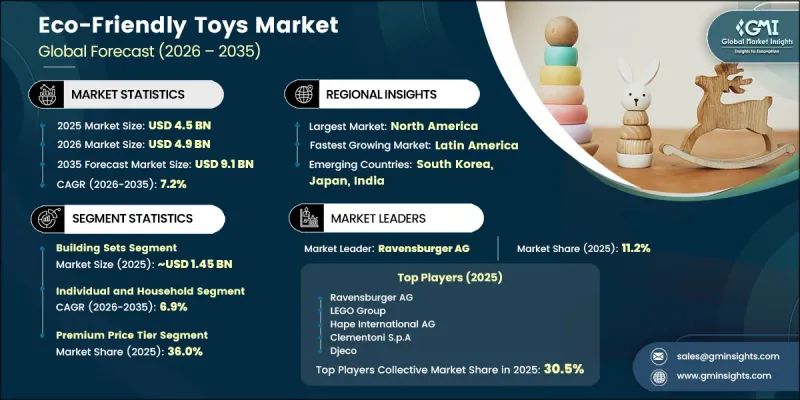
這一成長主要得益於生物基材料的日益普及、直銷管道的擴張以及生態認證標準的廣泛應用,這些因素共同擴大了產品的供應範圍,並增強了消費者的覆蓋範圍。與純粹由偏好驅動的市場不同,該細分市場的需求日益受到監管要求和機構採購標準的推動,從而為更穩定和長期的成長奠定了基礎。北美地區繼續主導市場,這得益於其嚴格的化學品安全法規以及消費者對無毒產品標準的日益成長的認知。千禧世代的父母是市場的核心消費群體,他們始終更願意為經過認證的環保玩具支付更高的價格,而非傳統玩具。這種行為源於他們對化學品暴露風險和永續性問題的日益關注,以及與環保消費理念相契合的價值觀。已開發地區的教育機構也在教室和托幼機構中採用經過認證的無毒玩具標準,進一步增強了需求的穩定性。隨著零售和機構採購系統對永續性的期望不斷提高,環保玩具不再只是小眾消費者的選擇,而逐漸成為基本需求。
| 市場範圍 | |
|---|---|
| 開始年份 | 2025 |
| 預測期 | 2026-2035 |
| 初始市場規模 | 45億美元 |
| 預計金額 | 91億美元 |
| 複合年成長率 | 7.2% |
到2025年,積木玩具市佔率將達到32.2%,市場規模達14.5億美元。預計到2035年,該細分市場將以7.4%的複合年成長率成長。積木玩具持續推動市場成長的原因在於其與永續原料的兼容性,以及注重耐用性和可重複使用的模組化玩具設計。消費者對系統化、寓教於樂且符合環保生產方式的遊戲模式的日益偏好,也進一步刺激了市場需求。此外,木質和生物基聚合物等材料的創新也提升了產品性能,並拓展了該品類的設計可能性。
預計到2025年,35美元以上的高階市場規模將達到16.2億美元,佔市場佔有率的36%,並將以8.2%的複合年成長率持續成長至2035年。由於消費者在購買決策中高度關注永續性,該細分市場的表現優於低價位市場。該細分市場的消費者往往對品牌忠誠度較高,對價格波動較不敏感。此外,該細分市場的重複購買行為也更為顯著,尤其是在送禮週期中,這進一步提升了其對銷售額的貢獻,並推動了其長期成長。
北美環保玩具市場佔據36.8%的市場佔有率,市場規模達16.6億美元,預計到2035年將以6.9%的複合年成長率成長。該地區的市場領先地位得益於嚴格的產品安全法規和完善的化學品合規框架,這些法規和框架對玩具的生產和分銷標準產生了顯著影響。消費者對產品安全性和永續性的日益關注也進一步推動了市場的穩定擴張。教育機構和托幼機構的積極採用也對提升全部區域的市場需求起到了至關重要的作用。
目錄
第1章:調查方法和範圍
第2章執行摘要
第3章 行業洞察
- 產業生態系分析
- 影響產業的因素
- 促進因素
- 消費者對永續性和環保意識的日益增強
- 環保材質創新(竹子、有機棉、再生PET、生物基塑膠)
- 政府對兒童產品中的有害物質制定了嚴格的法規。
- 全球送禮文化的擴展和兒童產品的優質化。
- 產業潛在風險與挑戰
- 取得經認證的永續原料難度高、成本高。
- 來自傳統玩具製造商和低成本傳統玩具製造商的激烈競爭。
- 市場機遇
- 新興經濟體(亞太地區、拉丁美洲)電子商務的擴張
- 在環保玩具領域中,訂閱模式和玩具租賃模式越來越受歡迎。
- 促進因素
- 成長潛力分析
- 監理情勢
- 技術展望
- 最新科技趨勢
- 新興技術
- 價格趨勢分析
- 未來市場趨勢
- 專利分析
- 波特的分析
- PESTLE分析
- 人工智慧和生成式人工智慧對市場的影響
- 價值鏈分析
- 投資與資金籌措分析
- 消費者洞察
第4章 競爭情勢
- 介紹
- 企業市佔率分析:按地區分類
- 北美洲
- 歐洲
- 亞太地區
- 中東和非洲
- 拉丁美洲
- 主要進展
- 重要合作夥伴關係和合作
- 併購主要趨勢
- 產品創新和新產品發布
- 市場擴大策略
- 競爭定位矩陣
第5章 市場規模及預測:依產品類型分類,2022-2035年
- 組裝套件
- 經典積木套裝
- 連接和組裝套件
- 磁性積木套裝
- 動作玩偶和人偶
- 遊戲和謎題
- 圖板遊戲
- 生態拼圖
- STEM學習遊戲與科學實驗套裝
- 運動和戶外玩具
- 其他
第6章 市場規模及預測:依材料分類,2022-2035年
- 樹
- 經認證的未使用木材
- 再生木材,升級再造木材
- 竹子
- 紙張和紙板
- 再生紙板
- 維珍永續
- 羊毛和棉花
- 天然橡膠
- 再生塑膠
- 生物基塑膠
- 其他
第7章 市場規模及預測:依年齡層別分類,2022-2035年
- 嬰兒
- 學齡前兒童
- 學齡兒童
- 青少年
- 成人
第8章 市場規模與預測:依價格區間分類,2022-2035年
- 低價
- 中階
- 優質的
第9章 市場規模及預測:依最終用戶分類,2022-2035年
- 個人和家庭購買
- 商業
- 學校和教育機構
- 日托及兒童保育設施
- 醫院和兒童治療中心
- 送給企業的禮物
第10章 市場規模及預測:依通路分類,2022-2035年
- 線上
- 電子商務平台
- 我們自己的直接面對消費者的網站
- 社群電商及網主導銷售管道
- 離線
- 超級市場和大賣場
- 玩具專賣連鎖店及獨立玩具店
- 天然、有機、生態健康零售店
- 其他
第11章 市場規模及預測:依地區分類,2022-2035年
- 北美洲
- 美國
- 加拿大
- 歐洲
- 德國
- 法國
- 英國
- 荷蘭
- 西班牙
- 義大利
- 亞太地區
- 中國
- 日本
- 韓國
- 印度
- 澳洲
- 中東和非洲
- 沙烏地阿拉伯
- UAE
- 南非
- 拉丁美洲
- 巴西
- 阿根廷
- 墨西哥
第12章:公司簡介
- 世界公司
- Lego Group
- Clementoni SpA
- Djeco(Editions du Jouet SA)
- Hape International AG
- Vilac SA
- Ravensburger AG
- EverEarth International GmbH
- 當地公司
- Green Toys Inc.
- Ostheimer GmbH
- PlanToys Co., Ltd.
- Dantoy A/S
- Le Toy Van Ltd.
- Bajo(Bajo Wojciech Bajor)
- Tikiri Toys(DSL Toys Pvt. Ltd.)
- 利基和專業公司
- Bannor Toys
- BeginAgain Toys
- Goki/Gollnest &Kiesel GmbH
- BiOBUDDi Group BV
- Plasticant Mobilo GmbH
- Grimm's Spiel und Holz Design
- Lanka Kade(UK)Ltd.
- Ypsomed Holding
The Global Eco-Friendly Toys Market was valued at USD 4.5 billion in 2025 and is estimated to grow at a CAGR of 7.2% to reach USD 9.1 billion by 2035.
Growth is shaped by the wider adoption of bio-based materials, expansion of direct-to-consumer distribution channels, and increased use of eco-certification standards, all of which are broadening product availability and strengthening consumer reach. Unlike purely preference-driven markets, demand in this segment is increasingly reinforced by regulatory requirements and institutional sourcing standards, creating a more stable long-term growth foundation. North America continues to dominate the market, supported by strict chemical safety regulations and heightened awareness of non-toxic product standards. Millennial parents represent the core consumer base, showing consistently higher willingness to pay for certified eco-friendly toys compared to conventional alternatives. This behavior is driven by increased awareness of chemical exposure risks, sustainability concerns, and value alignment with environmentally responsible consumption. Educational institutions across developed regions are also adopting certified non-toxic toy standards for classrooms and childcare environments, further reinforcing demand stability. As sustainability expectations deepen across retail and institutional procurement systems, eco-friendly toys are becoming an embedded requirement rather than a niche consumer choice.
| Market Scope | |
|---|---|
| Start Year | 2025 |
| Forecast Year | 2026-2035 |
| Start Value | $4.5 Billion |
| Forecast Value | $9.1 Billion |
| CAGR | 7.2% |
The building sets segment held a 32.2% share in 2025, equivalent to USD 1.45 billion, and is expected to grow at a CAGR of 7.4% through 2035. This segment continues to lead due to strong compatibility between sustainable raw materials and modular toy designs that emphasize durability and reuse. Demand is further supported by increasing preference for structured, educational play formats that align with environmentally responsible production methods. Material innovation in wood-based and bio-derived polymers is also strengthening product performance and expanding design possibilities across this category.
The premium price segment above USD 35 accounted for 36% share in 2025, at a USD 1.62 billion, and is projected to grow at the fastest CAGR of 8.2% through 2035. This segment is outperforming lower price tiers due to strong consumer commitment to sustainability-driven purchases, with buyers demonstrating higher brand loyalty and reduced sensitivity to price changes. Repeat purchasing behavior is also stronger in this segment, particularly in gifting-driven consumption cycles, which continues to reinforce its revenue contribution and long-term growth trajectory.
North America Eco-Friendly Toys Market held a 36.8% share, representing USD 1.66 billion, and is expected to grow at a CAGR of 6.9% through 2035. The region's leadership is supported by stringent product safety regulations and well-established chemical compliance frameworks that strongly influence toy manufacturing and distribution standards. High consumer awareness regarding product safety and sustainability further supports steady market expansion. Institutional adoption across educational and childcare settings also plays a significant role in reinforcing demand across the region.
Major companies operating in the global eco-friendly toys market include Lego Group, Clementoni S.p.A., Djeco (Editions du Jouet SA), Hape International AG, Vilac SA, Ravensburger AG, EverEarth International GmbH, Green Toys Inc., Ostheimer GmbH, PlanToys Co., Ltd., Dantoy A/S, Le Toy Van Ltd., Bajo (Bajo Wojciech Bajor), Tikiri Toys (DSL Toys Pvt. Ltd.), Bannor Toys, BeginAgain Toys, Goki / Gollnest & Kiesel GmbH, BiOBUDDI Group B.V., Plasticant Mobilo GmbH, Grimm's Spiel und Holz Design, and Lanka Kade (UK) Ltd. Companies operating in the eco-friendly toys market are adopting several strategic approaches to strengthen their competitive position and expand market share. A key focus area is product innovation, with manufacturers investing in bio-based materials, non-toxic formulations, and recyclable packaging to meet evolving sustainability standards. Firms are also expanding certification compliance to align with global eco-label requirements, enhancing brand credibility and consumer trust. Direct-to-consumer channel expansion and digital retail strategies are being used to improve market access and customer engagement. Strategic collaborations with educational institutions and institutional buyers are helping companies secure stable demand streams.
Table of Contents
Chapter 1 Methodology & Scope
- 1.1 Research approach
- 1.2 Quality commitments
- 1.2.1 GMI AI policy & data integrity commitment
- 1.2.1.1 Source consistency protocol
- 1.2.1 GMI AI policy & data integrity commitment
- 1.3 Research trail & confidence scoring
- 1.3.1 Research trail components
- 1.3.2 Scoring components
- 1.4 Data collection
- 1.4.1 Partial list of primary sources
- 1.5 Data mining sources
- 1.5.1 Paid sources
- 1.5.1.1 Sources, by region
- 1.5.1 Paid sources
- 1.6 Base estimates and calculations
- 1.6.1 Base year calculation for any one approach
- 1.7 Market estimates & forecasts parameters
- 1.8 Forecast model
- 1.8.1 Quantified market impact analysis
- 1.8.1.1 Mathematical impact of growth parameters on forecast
- 1.8.1 Quantified market impact analysis
- 1.9 Research transparency addendum
- 1.9.1 Source attribution framework
- 1.9.2 Quality assurance metrics
- 1.9.3 Our commitment to trust
- 1.10 Market definitions
Chapter 2 Executive Summary
- 2.1 Industry synopsis, 2022 - 2035
- 2.1.1 Business trends
- 2.1.2 Product type trends
- 2.1.3 Material trends
- 2.1.4 Age group trends
- 2.1.5 Price range trends
- 2.1.6 End user trends
- 2.1.7 Distribution channel trends
- 2.1.8 Regional trends
Chapter 3 Industry Insights
- 3.1 Industry ecosystem analysis
- 3.2 Industry impact forces
- 3.2.1 Growth drivers
- 3.2.1.1 Rising Consumer Awareness of Sustainability & Environmental Consciousness
- 3.2.1.2 Innovations in Eco-Friendly Materials (Bamboo, Organic Cotton, Recycled PET, Bio-based Plastics)
- 3.2.1.3 Stringent Government Regulations Restricting Toxic Materials in Children's Products
- 3.2.1.4 Growing Gifting Culture & Premiumization in Children's Products Globally
- 3.2.2 Industry pitfalls and challenges
- 3.2.2.1 Limited Availability & Higher Cost of Certified Sustainable Raw Materials
- 3.2.2.2 Intense Competition from Conventional & Low-Cost Traditional Toy Manufacturers
- 3.2.3 Market opportunities
- 3.2.3.1 Expanding E-Commerce Penetration in Emerging Economies (Asia Pacific, Latin America)
- 3.2.3. 2 Growing Adoption of Subscription-Based & Toy Rental Models for Eco-Toys
- 3.2.1 Growth drivers
- 3.3 Growth potential analysis
- 3.4 Regulatory landscape (Driven by primary research)
- 3.4.1 North America
- 3.4.2 Europe
- 3.4.3 Asia Pacific
- 3.4.4 Latin America
- 3.4.5 MEA
- 3.5 Technology landscape
- 3.5.1 Current technological trends
- 3.5.2 Emerging technologies
- 3.6 Pricing trend analysis (Driven by primary research)
- 3.7 Future market trends
- 3.8 Patent analysis
- 3.9 Porter's analysis
- 3.10 PESTEL analysis
- 3.11 Impact of AI and Generative AI on the market (Driven by primary research)
- 3.12 Value chain analysis (Driven by primary research)
- 3.13 Investment & funding analysis (Driven by primary research)
- 3.14 Consumer insights (Driven by primary research)
Chapter 4 Competitive Landscape, 2025
- 4.1 Introduction
- 4.2 Company market share analysis, by region, 2025
- 4.2.1 North America
- 4.2.2 Europe
- 4.2.3 Asia Pacific
- 4.2.4 Middle East & Africa
- 4.2.5 Latin America
- 4.3 Key developments
- 4.3.1 Key partnerships & collaborations
- 4.3.2 Major M&A activities
- 4.3.3 Product innovations & launches
- 4.3.4 Market expansion strategies
- 4.4 Competitive positioning matrix
Chapter 5 Market Size and Forecast, By Product Type, 2022 - 2035 (USD Million)
- 5.1 Key trends
- 5.1.1 Building sets
- 5.1.1.1 Classic stacking & block sets
- 5.1.1.2 Interlocking & construction sets
- 5.1.1.3 Magnetic building sets
- 5.1.2 Action figures & figurines
- 5.1.3 Games & puzzles
- 5.1.3.1 Board games
- 5.1.3.2 Eco-puzzles
- 5.1.3.3 STEM learning games & science kits
- 5.1.4 Sports & outdoor toys
- 5.1.5 Others
- 5.1.1 Building sets
Chapter 6 Market Size and Forecast, By Material, 2022 - 2035 (USD Million)
- 6.1 Key trends
- 6.2 Wood
- 6.2.1 Virgin certified wood
- 6.2.2 Reclaimed, recycled & upcycled wood
- 6.3 Bamboo
- 6.4 Paper & cardboard
- 6.4.1 Recycled cardboard
- 6.4.2 Virgin sustainable paper
- 6.5 Wool & cotton
- 6.6 Natural rubber
- 6.7 Recycled plastics
- 6.8 Bio-based plastics
- 6.9 Others
Chapter 7 Market Size and Forecast, By Age Group, 2022 - 2035 (USD Million)
- 7.1 Key trends
- 7.2 Toddlers
- 7.3 Preschoolers
- 7.4 School-age children
- 7.5 Teens
- 7.6 Adults
Chapter 8 Market Size and Forecast, By Price Range, 2022 - 2035 (USD Million)
- 8.1 Key trends
- 8.2 Budget
- 8.3 Mid-range
- 8.4 Premium
Chapter 9 Market Size and Forecast, By End User, 2022 - 2035 (USD Million)
- 9.1 Key trends
- 9.2 Individual / household purchase
- 9.3 Commercial
- 9.4 Schools & educational institutions
- 9.5 Daycare & childcare centers
- 9.6 Hospitals & child therapy centers
- 9.7 Corporate gifting
Chapter 10 Market Size and Forecast, By Distribution Channel, 2022 - 2035 (USD Million)
- 10.1 Key trends
- 10.2 Online
- 10.2.1 E-commerce platforms
- 10.2.2 Company-owned direct-to-consumer websites
- 10.3 Social commerce & influencer-driven sales channels
- 10.4 Offline
- 10.4.1 Supermarkets & hypermarkets
- 10.4.2 Specialty toy chains & independent toy stores
- 10.4.3 Natural, organic & eco-wellness retail stores
- 10.4.4 Others
Chapter 11 Market Size and Forecast, By Region, 2022 - 2035 (USD Million)
- 11.1 Key trends
- 11.2 North America
- 11.2.1 U.S.
- 11.2.2 Canada
- 11.3 Europe
- 11.3.1 Germany
- 11.3.2 France
- 11.3.3 UK
- 11.3.4 Netherlands
- 11.3.5 Spain
- 11.3.6 Italy
- 11.4 Asia Pacific
- 11.4.1 China
- 11.4.2 Japan
- 11.4.3 South Korea
- 11.4.4 India
- 11.4.5 Australia
- 11.5 Middle East & Africa
- 11.5.1 Saudi Arabia
- 11.5.2 UAE
- 11.5.3 South Africa
- 11.6 Latin America
- 11.6.1 Brazil
- 11.6.2 Argentina
- 11.6.3 Mexico
Chapter 12 Company Profiles
- 12.1 Global Players
- 12.1.1 Lego Group
- 12.1.2 Clementoni S.p.A.
- 12.1.3 Djeco (Editions du Jouet SA)
- 12.1.4 Hape International AG
- 12.1.5 Vilac SA
- 12.1.6 Ravensburger AG
- 12.1.7 EverEarth International GmbH
- 12.2 Regional Players
- 12.2.1 Green Toys Inc.
- 12.2.2 Ostheimer GmbH
- 12.2.3 PlanToys Co., Ltd.
- 12.2.4 Dantoy A/S
- 12.2.5 Le Toy Van Ltd.
- 12.2.6 Bajo (Bajo Wojciech Bajor)
- 12.2.7 Tikiri Toys (DSL Toys Pvt. Ltd.)
- 12.3 Niche & Specialist Players
- 12.3.1 Bannor Toys
- 12.3.2 BeginAgain Toys
- 12.3.3 Goki / Gollnest & Kiesel GmbH
- 12.3.4 BiOBUDDi Group B.V.
- 12.3.5 Plasticant Mobilo GmbH
- 12.3.6 Grimm's Spiel und Holz Design
- 12.3.7 Lanka Kade (UK) Ltd.
- 12.3.8 Ypsomed Holding


