

 |
市場調查報告書
商品編碼
2071368
零轉彎割草機市場機會、成長要素、產業趨勢分析及2026-2035年預測Zero Turn Mower Market Opportunity, Growth Drivers, Industry Trend Analysis, and Forecast 2026 - 2035 |
||||||

全球零轉彎割草機市場預計到 2025 年將達到 28.1 億美元,到 2035 年將以 6.3% 的複合年成長率成長至 49.8 億美元。
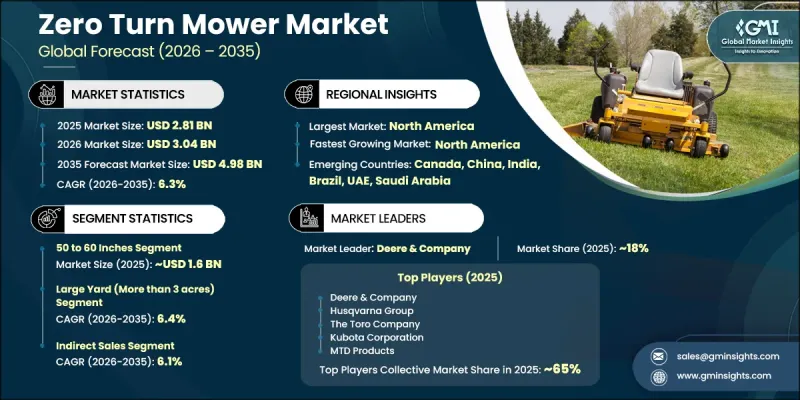
由於住宅、商業和公共場所對高效、省時的草坪護理解決方案的需求日益成長,該市場持續擴張。零轉彎割草機因其操作速度更快、操控性更好、切割精度更高(與傳統割草機相比)而越來越受歡迎。這些優勢使用戶能夠更有效率地管理大面積綠地,同時獲得一致的高品質修剪效果。對專業景觀美化和場地管理服務的需求不斷成長,進一步加速了零轉彎割草機在多個終端用戶領域的應用。城市發展趨勢、可支配收入的增加以及人們對戶外空間美學的日益關注,也推動了設備需求的成長。此外,技術進步正透過整合智慧功能(例如GPS導航、半自動駕駛、遠端資訊處理解決方案和基於行動應用程式的控制)來推動產業轉型。隨著終端用戶越來越重視草坪護理操作的性能、便利性和永續性,向電動化和智慧化戶外設備的轉變進一步促進了市場成長。
| 市場範圍 | |
|---|---|
| 開始年份 | 2025 |
| 預測期 | 2026-2035 |
| 初始市場規模 | 28.1億美元 |
| 預測金額 | 49.8億美元 |
| 複合年成長率 | 6.3% |
零轉彎割草機市場受益於商業園林綠化服務的擴張以及人們對維護美觀戶外環境日益成長的興趣。包括住宅、商業設施、公共空間和休閒設施在內的所有領域對高效高性能割草機的需求都在成長。技術融合在市場發展中持續發揮關鍵作用,製造商不斷推出先進系統,以提高操作效率和使用者體驗。對機械化草坪護理解決方案日益成長的需求減輕了人工勞動負擔,同時提高了生產效率。這些因素共同推動著全球市場的穩定擴張。
預計到2025年,50-60吋割草機市場規模將達到16億美元,並在2026年至2035年間以6.7%的複合年成長率成長。該細分市場之所以被廣泛採用,是因為其均衡的切割寬度使其適用於中型草坪、商業景觀、公共綠地和公共設施。它有效地兼顧了生產效率和操控性,使操作人員能夠在複雜地形中靈活移動,同時保持高效的割草性能。專業園林綠化師更青睞這一細分市場,因為與小型機器相比,它能提供更快的割草速度,同時確保在障礙物和複雜的景觀佈局周圍實現精準修剪。擁有大型戶外空間的業主擴大採用這一細分市場,也推動了市場需求,因為用戶正在轉向更有效率的割草解決方案,以減少運作並提高草坪的整體品質。
間接銷售管道佔68%的市場佔有率,預計2026年至2035年將以6.1%的複合年成長率成長。該通路包括專賣店、大型連鎖零售店和線上銷售平台,使製造商能夠觸及更廣泛的都市區客戶群。間接通路對於高價設備尤其有效,因為它們為客戶提供融資方案、豐富的產品選擇和完善的售後服務支援。買家往往更傾向於選擇授權經銷商,因為他們可以獲得產品展示、專家諮詢、安裝協助和維護服務。所有這些因素都有助於增強購買信心,並提升客戶的長期滿意度。
美國零轉彎割草機市場預計到2025年將達到9億美元,並在2026年至2035年間以6.4%的複合年成長率成長。美國市場成長的主要驅動力是大量擁有大片面積的住宅,尤其是在郊區,這支撐了對高性能割草機的穩定需求。收入水準的提高和人們對戶外空間美觀度的日益關注也促使人們更加依賴專業的園林綠化服務,進一步推動了產品的普及。公共綠色基礎設施的擴建,包括休閒公園、運動場和城市綠地,也增強了市場需求。美國成熟的園林綠化產業以及消費者對先進、高效設備的偏好,將持續支持市場擴張。
目錄
第1章:調查方法和範圍
第2章執行摘要
第3章 行業洞察
- 產業生態系分析
- 供應商情況
- 利潤率
- 每個階段增加的價值
- 影響價值鏈的因素
- 影響產業的因素
- 促進因素
- 對快速高效的草坪護理設備的需求日益成長
- 擴大專業景觀美化和場地管理服務的使用
- 高爾夫球場、公園、體育設施和公共綠地的開發建設正在不斷擴大。
- 產業潛在風險與挑戰
- 與傳統割草機相比,其初始購買成本更高。
- 尤其是最新的車型,會產生大量的維護和維修費用。
- 機會
- 受永續性趨勢的推動,電動和電池驅動的零轉彎割草機的需求日益成長。
- 城市綠色基礎設施和智慧城市計畫的擴展
- 技術進步,例如人工智慧導航和物聯網整合。
- 促進因素
- 成長潛力分析
- 未來市場趨勢
- 技術與創新展望
- 最新科技趨勢
- 新興技術
- 監理情勢
- 標準和合規要求
- 區域監理框架
- 認證標準
- 貿易數據分析
- 進出口量及進口額趨勢
- 主要貿易路線及關稅的影響
- 價格分析
- 對過去價格趨勢的分析
- 按業務類型(高階/低階/大眾市場)分類的定價策略
- 技術產品和傳統產品的價格定位
- 區域價格波動
- 人工智慧和生成式人工智慧對市場的影響
- 利用人工智慧改造現有經營模式
- 按細分市場分類的生成式人工智慧用例和部署藍圖
- 風險、限制和監管考量
- 波特的分析
- PESTLE分析
第4章 競爭情勢
- 介紹
- 企業市佔率分析
- 按地區
- 企業矩陣分析
- 主要市場公司的競爭分析
- 競爭定位矩陣
- 主要進展
- 併購
- 夥伴關係和聯盟
- 新產品發布
- 業務拓展計劃
第5章 市場估算與預測:依燃料種類與動力來源分類,2022-2035年
- 汽油
- 電的
- 混合
- 丙烷
第6章 市場估計與預測:依截斷寬度分類,2022-2035年
- 小於50英寸
- 50-60英寸
- 超過60英寸
第7章 市場估計與預測:以碼數計算,2022-2035年
- 小規模花園(少於1英畝)
- 中型花園(1-3英畝)
- 一個廣闊的院子(超過3英畝)
第8章 市場估算與預測:依最終使用者分類,2022-2035年
- 住宅
- 商業
- 高爾夫球場中心
- 操場
第9章 市場估價與預測:依通路分類,2022-2035年
- 直銷
- 間接銷售
第10章 市場估價與預測:依地區分類,2022-2035年
- 北美洲
- 美國
- 加拿大
- 歐洲
- 德國
- 英國
- 法國
- 義大利
- 西班牙
- 亞太地區
- 中國
- 印度
- 日本
- 韓國
- 澳洲
- 印尼
- 馬來西亞
- 拉丁美洲
- 巴西
- 墨西哥
- 阿根廷
- 中東和非洲
- 沙烏地阿拉伯
- UAE
- 南非
第11章:公司簡介
- 世界頂尖公司
- The Toro Company
- Deere & Company(John Deere)
- Husqvarna Group
- Kubota Corporation
- Textron Inc.(Bad Boy Mowers, EZ-GO)
- Briggs & Stratton LLC
- The Stanley Black & Decker(Cub Cadet)
- 該地區的領先企業
- Scag Power Equipment
- Exmark Manufacturing
- Hustler Turf Equipment
- Wright Manufacturing
- STIGA Group
- AL-KO Gardentech
- EGO Power+(Chervon)
- 新興企業
- Bad Boy Mowers
- Spartan Mowers
- Altoz
- Mean Green Mowers
- Raymo
- Country Clipper
- Greenworks Commercial
The Global Zero Turn Mower Market was valued at USD 2.81 billion in 2025 and is estimated to grow at a CAGR of 6.3% to reach USD 4.98 billion by 2035.
The market is witnessing expansion due to the rising need for efficient and time-saving lawn maintenance solutions across residential, commercial, and institutional applications. Zero turn mowers are increasingly preferred over conventional mowing equipment because they deliver higher operational speed, improved maneuverability, and greater cutting precision. These advantages allow users to manage large green spaces more efficiently while achieving consistent and high-quality results. The growing demand for professional landscaping and grounds maintenance services is further accelerating adoption across multiple end-use sectors. Urban development trends, rising disposable incomes, and increasing focus on outdoor aesthetics are also contributing to higher equipment demand. Additionally, technological advancements are reshaping the industry through the integration of smart features such as GPS-enabled navigation, semi-autonomous operation, telematics solutions, and mobile application-based controls. The shift toward electrified and intelligent outdoor equipment is further strengthening market growth as end users increasingly prioritize performance, convenience, and sustainability in lawn care operations.
| Market Scope | |
|---|---|
| Start Year | 2025 |
| Forecast Year | 2026-2035 |
| Start Value | $2.81 Billion |
| Forecast Value | $4.98 Billion |
| CAGR | 6.3% |
The zero turn mower market is also benefiting from the expansion of commercial landscaping services and the increasing emphasis on maintaining well-designed outdoor environments. Demand is rising across residential communities, commercial properties, municipal spaces, and recreational facilities, all of which require efficient and high-performance mowing solutions. Technological integration continues to play a key role in market evolution, with manufacturers introducing advanced systems that enhance operational efficiency and user experience. The increasing preference for mechanized lawn care solutions is reducing manual labor requirements while improving productivity. These combined factors are contributing to steady market expansion across global regions.
The 50 to 60 inches segment accounted for USD 1.6 billion in 2025 and is expected to grow at a CAGR of 6.7% from 2026 to 2035. This segment is widely adopted due to its balanced cutting width, which makes it suitable for moderately large lawns, commercial landscapes, public green spaces, and institutional properties. It offers an effective combination of productivity and maneuverability, allowing operators to navigate complex landscapes while maintaining efficient mowing performance. Professional landscaping providers frequently prefer this category because it delivers faster cutting capability compared to smaller machines while still ensuring precision around obstacles and detailed landscape layouts. Growing adoption among property owners with larger outdoor spaces is also supporting demand as users transition toward more efficient mowing solutions that reduce operating time and improve overall lawn quality.
The indirect sales channel segment held a 68% share and is projected to grow at a CAGR of 6.1% from 2026 to 2035. This channel includes specialty retailers, large-format retail networks, and online distribution platforms that enable manufacturers to reach a broader customer base across both urban and rural regions. Indirect channels are particularly effective for high-value equipment as they provide customers with financing options, extensive product availability, and after-sales service support. Buyers often prefer authorized distributors due to the availability of product demonstrations, expert consultation, installation assistance, and maintenance services, all of which enhance purchasing confidence and long-term customer satisfaction.
United States Zero Turn Mower Market generated USD 900 million in 2025 and is anticipated to grow at a CAGR of 6.4% from 2026 to 2035. Market growth in the country is driven by a large base of residential users with expansive lawn areas, particularly in suburban locations, which supports consistent demand for high-performance mowing equipment. Increasing reliance on professional landscaping services, supported by rising income levels and growing emphasis on outdoor aesthetics, continues to boost product adoption. Expansion of public green infrastructure, including recreational parks, sports fields, and landscaped urban spaces, further strengthens demand. The country's well-established landscaping industry and preference for advanced, time-efficient equipment continue to reinforce market expansion.
Key companies operating in the Global Zero Turn Mower Market include Deere & Company (John Deere), The Toro Company, Husqvarna Group, Kubota Corporation, Textron Inc. (Bad Boy Mowers, E-Z-GO), Stanley Black & Decker (Cub Cadet), Briggs & Stratton LLC, Exmark Manufacturing, Scag Power Equipment, Hustler Turf Equipment, Wright Manufacturing, STIGA Group, AL-KO Gardentech, EGO Power+ (Chervon), Bad Boy Mowers, Spartan Mowers, Altoz, Mean Green Mowers, Raymo (robotic mowers), Country Clipper, and Greenworks Commercial. Companies operating in the zero turn mower market are focusing on product innovation, electrification, and smart technology integration to strengthen their competitive position. Manufacturers are investing in research and development to enhance cutting efficiency, fuel or battery performance, and overall durability of equipment. The adoption of GPS-enabled systems, telematics, and semi-autonomous capabilities is helping companies differentiate their offerings in a competitive landscape. Strategic partnerships with distributors and service providers are improving market penetration and customer support capabilities. Firms are also expanding their product portfolios to include electric and hybrid models in response to rising sustainability concerns. Strengthening after-sales services, improving financing options, and expanding digital sales channels are further helping companies enhance customer accessibility.
Table of Contents
Chapter 1 Methodology & Scope
- 1.1 Market scope and definition
- 1.2 Research design
- 1.2.1 Research approach
- 1.2.2 Data collection methods
- 1.3 Data mining sources
- 1.3.1 Global
- 1.3.2 Regional/Country
- 1.4 Base estimates and calculations
- 1.4.1 Base year calculation
- 1.4.2 Key trends for market estimation
- 1.5 Primary research and validation
- 1.5.1 Primary sources
- 1.6 Forecast model
- 1.7 Research assumptions and limitations
Chapter 2 Executive Summary
- 2.1 Industry 360° synopsis
- 2.2 Key market trends
- 2.2.1 Regional
- 2.2.2 Fuel type/power source
- 2.2.3 Cutting width
- 2.2.4 Yard space
- 2.2.5 End user
- 2.2.6 Distribution channel
Chapter 3 Industry Insights
- 3.1 Industry ecosystem analysis
- 3.1.1 Supplier landscape
- 3.1.2 Profit margin
- 3.1.3 Value addition at each stage
- 3.1.4 Factor affecting the value chain
- 3.2 Industry impact forces
- 3.2.1 Growth drivers
- 3.2.1.1 Increasing demand for fast and efficient lawn maintenance equipment
- 3.2.1.2 Rising adoption of professional landscaping and grounds maintenance services
- 3.2.1.3 Growing development of golf courses, parks, sports fields, and public green spaces
- 3.2.2 Industry pitfalls & challenges
- 3.2.2.1 High initial purchase cost compared to traditional lawn mowers
- 3.2.2.2 Significant maintenance and repair expenses, especially for advanced models
- 3.2.3 Opportunities
- 3.2.3.1 Growing demand for electric and battery-powered zero-turn mowers driven by sustainability trends
- 3.2.3.2 Expansion of urban green infrastructure and smart city projects
- 3.2.3.3 Technological advancements such as AI-based navigation and IoT integration
- 3.2.1 Growth drivers
- 3.3 Growth potential analysis
- 3.4 Future market trends
- 3.5 Technology and innovation landscape
- 3.5.1 Current technological trends
- 3.5.2 Emerging technologies
- 3.6 Regulatory landscape
- 3.6.1 Standards and compliance requirements
- 3.6.2 Regional regulatory frameworks
- 3.6.3 Certification standards
- 3.7 Trade data analysis (HS Code 8433.11)
- 3.7.1 Import/export volume & value trends
- 3.7.2 Key trade corridors & tariff impact
- 3.8 Pricing analysis
- 3.8.1 Historical price trend analysis (driven by primary research)
- 3.8.2 Pricing strategy by player type (premium / value / mass market)
- 3.8.3 Price positioning of technology vs traditional products
- 3.8.4 Regional price variations
- 3.9 Impact of AI & generative AI on the market
- 3.9.1 AI-driven disruption of existing business models
- 3.9.2 GenAI use cases & adoption roadmap by segment
- 3.9.3 Risks, limitations & regulatory considerations
- 3.10 Porter's analysis
- 3.11 PESTEL analysis
Chapter 4 Competitive Landscape, 2025
- 4.1 Introduction
- 4.2 Company market share analysis
- 4.2.1 By Region
- 4.2.1.1 North America
- 4.2.1.2 Europe
- 4.2.1.3 Asia Pacific
- 4.2.1.4 Latin America
- 4.2.1.5 Middle East & Africa
- 4.2.1 By Region
- 4.3 Company matrix analysis
- 4.4 Competitive analysis of major market players
- 4.5 Competitive positioning matrix
- 4.6 Key developments
- 4.6.1 Mergers & acquisitions
- 4.6.2 Partnerships & collaborations
- 4.6.3 New product launches
- 4.6.4 Expansion plans
Chapter 5 Market Estimates & Forecast, By Fuel Type/Power Source, 2022 - 2035, (USD Billion) (Million Units)
- 5.1 Key trends
- 5.2 Gasoline
- 5.3 Electric
- 5.4 Hybrid
- 5.5 Propane
Chapter 6 Market Estimates & Forecast, By Cutting Width, 2022 - 2035, (USD Billion) (Million Units)
- 6.1 Key trends
- 6.2 Less than 50 inches
- 6.3 50 to 60 inches
- 6.4 More than 60 inches
Chapter 7 Market Estimates & Forecast, By Yard Space, 2022 - 2035, (USD Billion) (Million Units)
- 7.1 Key trends
- 7.2 Small yard (less than 1 acre)
- 7.3 Medium yard (1 to 3 acres)
- 7.4 Large yard (More than 3 acres)
Chapter 8 Market Estimates & Forecast, By End User, 2022 - 2035, (USD Billion) (Million Units)
- 8.1 Key trends
- 8.2 Residential
- 8.3 Commercial
- 8.3.1 Golf course centers
- 8.3.2 Playgrounds
Chapter 9 Market Estimates & Forecast, By Distribution Channel, 2022 - 2035, (USD Billion) (Million Units)
- 9.1 Key trends
- 9.2 Direct sales
- 9.3 Indirect sales
Chapter 10 Market Estimates & Forecast, By Region, 2022 - 2035, (USD Billion) (Million Units)
- 10.1 Key trends
- 10.2 North America
- 10.2.1 U.S.
- 10.2.2 Canada
- 10.3 Europe
- 10.3.1 Germany
- 10.3.2 UK
- 10.3.3 France
- 10.3.4 Italy
- 10.3.5 Spain
- 10.4 Asia Pacific
- 10.4.1 China
- 10.4.2 India
- 10.4.3 Japan
- 10.4.4 South Korea
- 10.4.5 Australia
- 10.4.6 Indonesia
- 10.4.7 Malaysia
- 10.5 Latin America
- 10.5.1 Brazil
- 10.5.2 Mexico
- 10.5.3 Argentina
- 10.6 MEA
- 10.6.1 Saudi Arabia
- 10.6.2 UAE
- 10.6.3 South Africa
Chapter 11 Company Profiles
- 11.1 Top Global Players
- 11.1.1 The Toro Company
- 11.1.2 Deere & Company (John Deere)
- 11.1.3 Husqvarna Group
- 11.1.4 Kubota Corporation
- 11.1.5 Textron Inc. (Bad Boy Mowers, E-Z-GO)
- 11.1.6 Briggs & Stratton LLC
- 11.1.7 The Stanley Black & Decker (Cub Cadet)
- 11.2 Regional Champions
- 11.2.1 Scag Power Equipment
- 11.2.2 Exmark Manufacturing
- 11.2.3 Hustler Turf Equipment
- 11.2.4 Wright Manufacturing
- 11.2.5 STIGA Group
- 11.2.6 AL-KO Gardentech
- 11.2.7 EGO Power+ (Chervon)
- 11.3 Emerging Players
- 11.3.1 Bad Boy Mowers
- 11.3.2 Spartan Mowers
- 11.3.3 Altoz
- 11.3.4 Mean Green Mowers
- 11.3.5 Raymo
- 11.3.6 Country Clipper
- 11.3.7 Greenworks Commercial

 零轉彎割草機市場-2026-2032年全球市場預測
 全球零轉彎割草機市場規模、佔有率、趨勢和成長分析報告(2026-2034)
 零轉彎割草機市場 - 全球產業規模、佔有率、趨勢、機會、預測:按產品類型、馬力、應用、地區和競爭格局分類,2021-2031年零轉彎割草機市場規模、佔有率、成長及全球產業分析:依類型、應用和地區劃分的洞察與未來預測(2026-2034)
 零轉彎割草機市場規模、佔有率和成長分析(按割草寬度、動力來源、馬力、院子麵積、應用、分銷管道和地區)—2025-2032 年行業預測
 全球零轉向割草機市場(2024-2028)