

 |
市場調查報告書
商品編碼
2071357
可攜式洗碗機市場:商機、成長要素、產業趨勢分析及2026-2035年預測Portable Dishwasher Market Opportunity, Growth Drivers, Industry Trend Analysis, and Forecast 2026 - 2035 |
||||||

全球可攜式洗碗機市場預計到 2025 年將達到 25 億美元,年複合成長率為 7.6%,到 2035 年將達到 52 億美元。
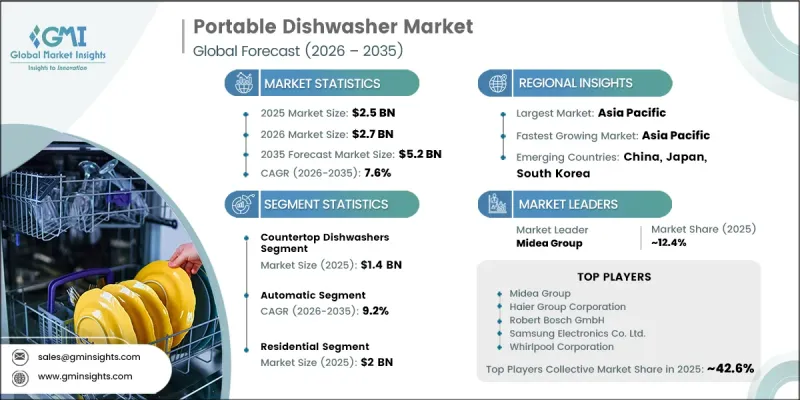
可攜式洗碗機市場正穩步成長,這主要得益於消費者對緊湊、節省空間且符合現代生活環境的廚房電器的需求不斷成長。隨著越來越多的家庭居住在公寓、小規模住宅和租賃住宅中,無需永久安裝的可攜式洗碗解決方案的需求也日益旺盛。這些電器不僅柔軟性便捷,而且清潔高效,同時還能最大限度地節省廚房空間。製造商正致力於開發緊湊、節能且功能豐富的產品,以吸引更廣泛的消費群體。都市化、家庭生活方式的改變以及對便捷家電日益成長的需求,都在持續推動市場擴張。智慧廚房技術的日益普及,以及消費者對具備自動洗滌程序、數位控制和節水功能的電器的偏好,進一步促進了市場需求。具備先進清潔功能和靜音運作的可攜式洗碗機在住宅和商業場所都越來越受歡迎。人們對節能和永續用水意識的提高也促進了市場成長。這些電器有助於減少用水量,同時保持穩定的清潔性能和易用性。
| 市場範圍 | |
|---|---|
| 開始年份 | 2025 |
| 預測期 | 2026-2035 |
| 上市時的市場規模 | 25億美元 |
| 預測金額 | 52億美元 |
| 複合年成長率 | 7.6% |
預計到2025年,桌上型洗碗機市場規模將達14億美元。其優勢在於面積小、安裝簡便,且適合廚房空間有限的家庭。桌上型洗碗機清潔效果出色,且只需對管道進行少量改造,因此對都市區和住宅居住者極具吸引力。價格實惠和便於攜帶也進一步推動了其在住宅環境中的普及。
預計到2025年,自動化洗碗機將佔據70.3%的市場佔有率,市場規模將達到18億美元。這主要得益於消費者對便利性強、能夠簡化日常家務的廚房電器的偏好日益成長。與傳統產品相比,自動化可攜式洗碗機具有更先進的洗衣程序、更高的用水效率和更佳的運作性能。無論是住宅用戶或商用用戶,都越來越傾向於選擇自動化型號,因為它們既能減輕人工勞動負擔,又能提供可靠且穩定的清潔效果。
預計到2025年,中國可攜式洗碗機市場規模將達到5.753億美元,並在2035年之前以8.8%的複合年成長率成長。中國仍然是亞太地區最大的可攜式洗碗機市場,這得益於快速的城市化進程、不斷壯大的中產階級以及小型家用電器的普及。對自動化洗碗解決方案的需求不斷成長、生活水準的提高以及人們對衛生和節能型家用電器意識的增強,都將繼續推動市場成長。製造商正在拓展產品線,增加價格親民的桌上型和自動化可攜式洗碗機,這些產品配備智慧控制功能和節能技術,以更好地服務都市區消費者。
目錄
第1章:調查方法和範圍
第2章執行摘要
第3章 行業洞察
- 產業生態系分析
- 供應商情況
- 利潤率
- 每個階段增加的價值
- 影響價值鏈的因素
- 影響產業的因素
- 促進因素
- 對緊湊型、節省空間的廚房電器的需求日益成長。
- 人們越來越偏好自動化和智慧家庭設備
- 人們對節水節能型家用電器的興趣日益濃厚。
- 潛在風險和挑戰
- 與手洗碗相比,該產品的價格更高。
- 與嵌入式洗碗機系統相比,容量有限
- 機會
- 租賃住宅和緊湊型居住空間對可攜式家用電器的需求日益成長。
- 智慧廚房電器生態系統的擴展
- 促進因素
- 成長潛力分析
- 未來市場趨勢
- 技術與創新展望
- 最新科技趨勢
- 新興技術
- 監理情勢
- 標準和合規要求
- 區域監理框架
- 認證標準
- 波特的分析
- PESTLE分析
- 價格分析
- 2018-2025年歷史價格趨勢分析
- 按運營商類型(高階/中階/經濟型)分類的定價策略
- 區域價格波動分析
- 貿易數據分析
- 按地區分類的進出口數量和價值趨勢
- 主要貿易路線和關稅的影響分析
- 區域間貿易依存關係及變化
- 人工智慧和生成式人工智慧對市場的影響
- 人工智慧正在改變傳統的洗碗方式。
- 按細分市場分類的生成式人工智慧用例和部署藍圖
- 風險、限制和監管考量
- 目前分銷基礎設施和通路滲透情況
- 按地區與業態(現代零售與傳統零售)分類的通路覆蓋率
- 缺乏最後一公里基礎設施和不斷變化的管道
第4章 競爭情勢
- 介紹
- 企業市佔率分析
- 按地區
- 企業矩陣分析
- 主要市場公司的競爭分析
- 競爭定位矩陣
- 主要進展
- 併購
- 夥伴關係和聯盟
- 新產品發布
- 業務拓展計劃
第5章 市場估算與預測:依產品類型分類,2022-2035年
- 固定式/可攜式洗碗機
- 桌上型洗碗機
- 桌上型洗碗機
第6章 市場估計與預測:依產能分類,2022-2035年
- 可供 6 人食用
- 可供 7-10 人食用
- 可供 10 人以上使用
第7章 市場估計與預測:依營運模式分類,2022-2035年
- 手動的
- 自動的
第8章 市場估算與預測:依價格區間分類,2022-2035年
- 經濟
- 中階
- 優質的
第9章 市場估價與預測:依最終用戶分類,2022-2035年
- 住宅
- 商業
第10章 市場估價與預測:依通路分類,2022-2035年
- 線上
- 離線
第11章 市場估價與預測:按地區分類,2022-2035年
- 北美洲
- 美國
- 加拿大
- 歐洲
- 德國
- 英國
- 法國
- 義大利
- 西班牙
- 亞太地區
- 中國
- 印度
- 日本
- 韓國
- 澳洲
- 拉丁美洲
- 巴西
- 墨西哥
- 阿根廷
- 中東和非洲
- 沙烏地阿拉伯
- UAE
- 南非
第12章:公司簡介
- 世界頂尖公司
- Whirlpool Corporation
- Electrolux AB
- LG Electronics Inc.
- Samsung Electronics Co. Ltd.
- Robert Bosch GmbH
- Panasonic Holdings Corporation
- Haier Group Corporation
- 該地區的領先企業
- Danby Products Inc.
- Smeg SpA
- ASKO Appliances AB
- Havells India Limited
- Arcelik/Beko
- Toshiba Lifestyle Products & Services Corporation
- Vestel
- 新興企業和專業公司
- Midea Group
- Sunpentown Inc.
- Sharp Corporation
- Magic Chef
- Curtis International(RCA Brand)
- Galanz
- Black+Decker
The Global Portable Dishwasher Market was valued at USD 2.5 billion in 2025 and is estimated to grow at a CAGR of 7.6% to reach USD 5.2 billion by 2035.
The portable dishwasher market is experiencing steady growth as consumers increasingly seek compact and space-saving kitchen appliances that fit modern living environments. The growing number of households residing in apartments, smaller homes, and rental accommodations is creating strong demand for portable dishwashing solutions that do not require permanent installation. These appliances offer flexibility, convenience, and efficient cleaning performance while occupying minimal kitchen space. Manufacturers are focusing on developing compact, energy-efficient, and feature-rich products to attract a broader consumer base. Rising urbanization, evolving household lifestyles, and increasing demand for convenient home appliances continue to support market expansion. The growing adoption of smart kitchen technologies is further driving demand, as consumers increasingly prefer appliances equipped with automated wash programs, digital controls, and water-saving capabilities. Portable dishwashers featuring advanced cleaning functions and quieter operation are gaining popularity across residential and commercial environments. Increasing awareness regarding energy conservation and sustainable water usage is also contributing to market growth, as these appliances help reduce water consumption while delivering consistent cleaning performance and greater operational convenience.
| Market Scope | |
|---|---|
| Start Year | 2025 |
| Forecast Year | 2026-2035 |
| Start Value | $2.5 Billion |
| Forecast Value | $5.2 Billion |
| CAGR | 7.6% |
The countertop dishwasher segment generated USD 1.4 billion in 2025. Its dominance is attributed to its compact footprint, simple installation process, and suitability for households with limited kitchen space. Countertop units provide effective dishwashing performance while requiring minimal plumbing adjustments, making them an attractive choice among urban residents and renters. Their affordability and portability further encourage widespread adoption across residential applications.
The automatic segment accounted for 70.3% share in 2025, generating USD 1.8 billion, driven by growing consumer preference for convenience-focused kitchen appliances that simplify daily household tasks. Automatic portable dishwashers offer advanced wash cycles, improved water efficiency, and enhanced operating performance compared to conventional alternatives. Consumers increasingly favor automated models that reduce manual effort while delivering reliable and consistent cleaning outcomes across both residential and commercial settings.
China Portable Dishwasher Market generated USD 575.3 million in 2025 and is anticipated to grow at a CAGR of 8.8% through 2035. The country remains the largest market for portable dishwashers in the Asia Pacific region, supported by rapid urban development, a growing middle-income population, and increasing adoption of compact household appliances. Rising demand for automated dishwashing solutions, improving living standards, and greater awareness of hygiene and resource-efficient appliances continue to strengthen market growth. Manufacturers are expanding their product offerings with affordable countertop and automatic portable dishwashers featuring smart controls and energy-saving technologies to enhance penetration among urban consumers.
Major companies operating in the Global Portable Dishwasher Market include Whirlpool Corporation, Electrolux AB, Samsung Electronics Co. Ltd., LG Electronics Inc., Panasonic Holdings Corporation, Robert Bosch GmbH, and Haier Group Corporation, Danby Products Inc., Toshiba Lifestyle Products & Services Corporation, Vestel, Arcelik/Beko, ASKO Appliances AB, Havells India Limited, and Smeg S.p.A, Midea Group, Sharp Corporation, Sunpentown Inc., Black+Decker, Galanz, Magic Chef, and Curtis International under the RCA brand. Companies operating in the portable dishwasher market are strengthening their market position through continuous product innovation and technology integration. Manufacturers are investing heavily in smart features such as app connectivity, automated cleaning programs, digital interfaces, and energy-efficient technologies to improve user convenience and product differentiation. Strategic expansion into online retail channels is helping companies reach a broader customer base while enhancing brand visibility. Many players are also focusing on compact product designs tailored for urban households and space-constrained living environments. Partnerships with appliance retailers, distributors, and e-commerce platforms are improving market access and distribution efficiency. Additionally, companies are prioritizing sustainability by developing water-saving and energy-efficient models that align with evolving consumer preferences.
Table of Contents
Chapter 1 Methodology & Scope
- 1.1 Market scope and definition
- 1.2 Research design
- 1.2.1 Research approach
- 1.2.2 Data collection methods
- 1.3 Data mining sources
- 1.3.1 Global
- 1.3.2 Regional/Country
- 1.4 Base estimates and calculations
- 1.4.1 Base year calculation
- 1.4.2 Key trends for market estimation
- 1.5 Primary research and validation
- 1.5.1 Primary sources
- 1.6 Forecast model
- 1.7 Research assumptions and limitations
Chapter 2 Executive Summary
- 2.1 Industry 360° synopsis
- 2.2 Key market trends
- 2.2.1 Regional
- 2.2.2 Product type
- 2.2.3 Capacity
- 2.2.4 Mode of operation
- 2.2.5 Price range
- 2.2.6 End user
- 2.2.7 Distribution channel
Chapter 3 Industry Insights
- 3.1 Industry ecosystem analysis
- 3.1.1 Supplier landscape
- 3.1.2 Profit margin
- 3.1.3 Value addition at each stage
- 3.1.4 Factor affecting the value chain
- 3.2 Industry impact forces
- 3.2.1 Growth drivers
- 3.2.1.1 Rising demand for compact and space-efficient kitchen appliances
- 3.2.1.2 Growing preference for automatic and smart home appliances
- 3.2.1.3 Increasing focus on water conservation and energy-efficient appliances
- 3.2.2 Pitfalls & Challenges
- 3.2.2.1 High product pricing compared to manual dishwashing methods
- 3.2.2.2 Limited capacity compared to built-in dishwasher systems
- 3.2.3 Opportunities
- 3.2.3.1 Rising demand for portable appliances in rental and compact housing spaces
- 3.2.3.2 Expansion of smart kitchen appliance ecosystems
- 3.2.1 Growth drivers
- 3.3 Growth potential analysis
- 3.4 Future market trends
- 3.5 Technology and innovation landscape
- 3.5.1 Current technological trends
- 3.5.2 Emerging technologies
- 3.6 Regulatory landscape
- 3.6.1 Standards and compliance requirements
- 3.6.2 Regional regulatory frameworks
- 3.6.3 Certification standards
- 3.7 Porter's analysis
- 3.8 PESTEL analysis
- 3.9 Pricing analysis (driven by primary research)
- 3.9.1 Historical price trend analysis (2018-2025) (driven by primary research)
- 3.9.2 Pricing strategy by player type (premium / mid-range / economy) (driven by primary research)
- 3.9.3 Regional price variation analysis
- 3.10 Trade data analysis (driven by paid database)
- 3.10.1 Import/export volume and value trends by region (driven by paid database)
- 3.10.2 Key trade corridors and tariff impact analysis (driven by paid database)
- 3.10.3 Regional trade dependencies and shifts
- 3.11 Impact of AI and generative AI on the market
- 3.11.1 AI-driven disruption of traditional dishwashing solutions
- 3.11.2 GenAI use cases and adoption roadmap by segment
- 3.11.3 Risks, limitations and regulatory considerations
- 3.12 Distribution infrastructure and channel penetration landscape (driven by primary research)
- 3.13 Channel coverage by region and format (modern vs. traditional trade) (driven by primary research)
- 3.14 Last-mile infrastructure gaps and emerging channel shifts (driven by primary research)
Chapter 4 Competitive Landscape, 2025
- 4.1 Introduction
- 4.2 Company market share analysis
- 4.2.1 By Region
- 4.2.1.1 North America
- 4.2.1.2 Europe
- 4.2.1.3 Asia Pacific
- 4.2.1.4 Latin America
- 4.2.1.5 Middle East & Africa
- 4.2.1 By Region
- 4.3 Company matrix analysis
- 4.4 Competitive analysis of major market players
- 4.5 Competitive positioning matrix
- 4.6 Key developments
- 4.6.1 Mergers & acquisitions
- 4.6.2 Partnerships & collaborations
- 4.6.3 New product launches
- 4.6.4 Expansion plans
Chapter 5 Market Estimates & Forecast, By Product Type, 2022 - 2035, (USD Billion) (Thousand Units)
- 5.1 Key trends
- 5.2 Freestanding portable dishwashers
- 5.3 Countertop dishwashers
- 5.4 Tabletop dishwashers
Chapter 6 Market Estimates & Forecast, By Capacity, 2022 - 2035, (USD Billion) (Thousand Units)
- 6.1 Key trends
- 6.2 Up to 6 place settings
- 6.3 7-10 place settings
- 6.4 Above 10 place settings
Chapter 7 Market Estimates & Forecast, By Mode of Operation, 2022 - 2035, (USD Billion) (Thousand Units)
- 7.1 Key trends
- 7.2 Manual
- 7.3 Automatic
Chapter 8 Market Estimates & Forecast, By Price Range, 2022 - 2035, (USD Billion) (Thousand Units)
- 8.1 Key trends
- 8.2 Economy
- 8.3 Mid-range
- 8.4 Premium
Chapter 9 Market Estimates & Forecast, By End User, 2022 - 2035, (USD Billion) (Thousand Units)
- 9.1 Key trends
- 9.2 Residential
- 9.3 Commercial
Chapter 10 Market Estimates & Forecast, By Distribution Channel, 2022 - 2035, (USD Billion) (Thousand Units)
- 10.1 Key trends
- 10.2 Online
- 10.3 Offline
Chapter 11 Market Estimates & Forecast, By Region, 2022 - 2035, (USD Billion) (Thousand Units)
- 11.1 Key trends
- 11.2 North America
- 11.2.1 U.S.
- 11.2.2 Canada
- 11.3 Europe
- 11.3.1 Germany
- 11.3.2 UK
- 11.3.3 France
- 11.3.4 Italy
- 11.3.5 Spain
- 11.4 Asia Pacific
- 11.4.1 China
- 11.4.2 India
- 11.4.3 Japan
- 11.4.4 South Korea
- 11.4.5 Australia
- 11.5 Latin America
- 11.5.1 Brazil
- 11.5.2 Mexico
- 11.5.3 Argentina
- 11.6 MEA
- 11.6.1 Saudi Arabia
- 11.6.2 UAE
- 11.6.3 South Africa
Chapter 12 Company Profiles
- 12.1 Top Global Players
- 12.1.1 Whirlpool Corporation
- 12.1.2 Electrolux AB
- 12.1.3 LG Electronics Inc.
- 12.1.4 Samsung Electronics Co. Ltd.
- 12.1.5 Robert Bosch GmbH
- 12.1.6 Panasonic Holdings Corporation
- 12.1.7 Haier Group Corporation
- 12.2 Regional Champions
- 12.2.1 Danby Products Inc.
- 12.2.2 Smeg S.p.A.
- 12.2.3 ASKO Appliances AB
- 12.2.4 Havells India Limited
- 12.2.5 Arcelik/Beko
- 12.2.6 Toshiba Lifestyle Products & Services Corporation
- 12.2.7 Vestel
- 12.3 Emerging & Specialized Players
- 12.3.1 Midea Group
- 12.3.2 Sunpentown Inc.
- 12.3.3 Sharp Corporation
- 12.3.4 Magic Chef
- 12.3.5 Curtis International (RCA Brand)
- 12.3.6 Galanz
- 12.3.7 Black+Decker

 可攜式洗碗機市場報告:趨勢、預測和競爭分析(至2035年)
 可攜式洗碗機市場規模、佔有率和成長分析:按容量、應用、價格範圍、銷售管道和地區分類-2026-2033年產業預測
 可攜式洗碗機市場:按價格範圍、最終用戶、銷售管道和地區分類
 全球可攜式洗碗機市場規模、佔有率、趨勢和成長分析報告(2026-2034)
 迷你可攜式洗碗機市場 - 全球產業規模、佔有率、趨勢、機會及預測(按價格範圍、應用、分銷管道、地區和競爭格局分類,2021-2031年)
 小型脈衝式洗衣機市場按操作類型、容量、技術、應用和分銷管道分類-全球預測(2026-2032 年)可攜式洗碗機市場按類型、乾燥方式、容量、技術、銷售管道和最終用戶分類—2025-2030 年全球預測
 全球小型洗碗機市場全球可攜式洗碗機市場
 便攜式洗碗機市場:全球產業分析、規模、佔有率、成長、趨勢和預測,2025-2032 年