

 |
市場調查報告書
商品編碼
2071337
相機包市場商機、成長要素、產業趨勢分析及2026-2035年預測。Camera Bag Market Opportunity, Growth Drivers, Industry Trend Analysis, and Forecast 2026 - 2035 |
||||||

全球相機包市場預計到 2025 年將達到 15 億美元,年複合成長率為 5.8%,到 2035 年將達到 27 億美元。
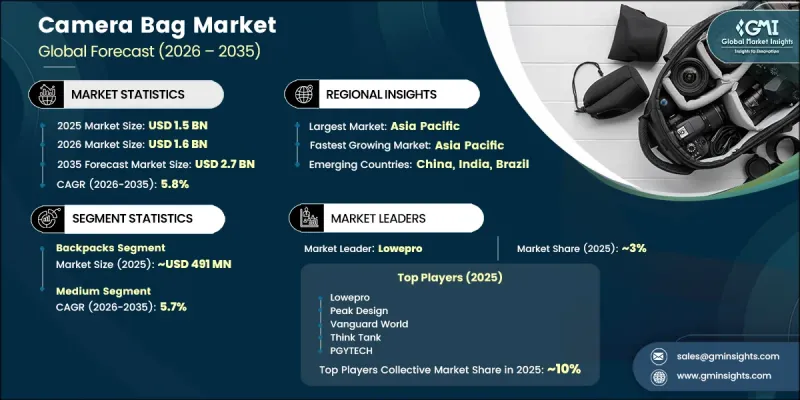
市場成長是由產業結構性變革共同驅動的,包括全球範圍內從單眼系統轉向無反相機平台的轉變、北美、歐洲和亞太地區數位內容創作者經濟日益成長的影響力,以及攝影配件的優質化。永續性因素在材料選擇和產品開發中也扮演著越來越重要的角色,人們越來越重視使用回收材料以及採用耐用且環保的結構。同時,銷售管道正在迅速擴張,使製造商能夠建立更牢固的客戶關係,改善利潤率結構,並建立數據驅動的行銷生態系統。 「數位優先」的銷售策略,輔以網紅合作、影片產品展示和創作者主導的內容,正成為品牌成長的核心。亞太和拉丁美洲等新興市場電子商務物流的改善,加上跨境貿易流量的增加和線上零售滲透率的不斷提高,進一步擴大了中低階相機包的供應範圍。
| 市場範圍 | |
|---|---|
| 開始年份 | 2025 |
| 預測期 | 2026-2035 |
| 初始市場規模 | 15億美元 |
| 預測金額 | 27億美元 |
| 複合年成長率 | 5.8% |
預計到2025年,背包市場銷售額將達到4.91億美元,並在2026年至2035年間以6.1%的複合年成長率成長。此市場成長的主要驅動力在於其能夠將整套相機設備(尤其是無反光鏡相機系統)收納於符合人體工學的便攜包中,並提供周全的保護。隨著全球相機用戶持續從傳統數位單眼(DSLR)配置轉向無反光鏡相機,消費者對專為無反光鏡相機生態系統最佳化設計的背包式背包的需求不斷成長,推動了該品類的成長。背包兼具儲存容量、便攜性和設備保護性,因此越來越受到消費者的青睞,成為專業攝影師和業餘攝影愛好者的首選。
預計到2025年,中端市場將佔據52.9%的市場佔有率,並在2035年之前以5.7%的複合年成長率成長。此品類主要針對攝影愛好者和半專業用戶,他們重視價格和性能之間的平衡。電商平台和專業零售通路為中階市場提供了強勁的需求,使消費者能夠廣泛購買來自知名品牌和新興品牌的中階產品。數位管道的普及極大地拓展了中階相機包的市場範圍,使世界各地的攝影愛好者都能從琳瑯滿目的功能性和時尚感產品中進行選擇。
美國相機包市場預計到2025年將達到3.818億美元,並在2035年之前以5.6%的複合年成長率成長。憑藉強大的本土品牌影響力以及高度發展的攝影配件數位化零售基礎設施,美國在該市場保持領先地位。美國市場受益於高電子商務滲透率、高品牌知名度以及大規模的專業和業餘攝影師用戶群。產品設計和數位行銷策略的持續創新進一步鞏固了美國在區域市場的主導地位。
目錄
第1章:調查方法
第2章執行摘要
第3章 行業洞察
- 產業生態系分析
- 供應商情況
- 製造商
- 中斷
- 零售商
- 利潤率分析
- 每個階段增加的價值
- 影響價值鏈的因素
- 影響產業的因素
- 促進因素
- 無反光鏡相機(如可換鏡頭相機)的普及速度迅速提升。
- 數位內容創作者經濟的擴張
- 優質化和生活方式定位
- 產業潛在風險與挑戰
- 智慧型手機的相機技術正在阻礙入門級可換鏡頭相機的銷售。
- 宏觀經濟敏感度和可自由支配支出的減少
- 機會
- 促進因素
- 成長潛力分析
- 技術與創新展望
- 最新科技趨勢
- 新興技術
- 價格分析
- 按產品類型分析歷史價格趨勢
- 依球員類型分類的定價策略(高級球員、超值球員、成本加成球員)
- 貿易數據分析
- 進出口量及進口額趨勢
- 主要貿易路線及關稅的影響
- 監理情勢
- 標準和合規要求
- 區域監理框架
- 認證標準
- 波特的分析
- PESTLE分析
- 人工智慧和生成式人工智慧對市場的影響
- 利用人工智慧改造現有經營模式
- 按細分市場分類的生成式人工智慧用例和部署藍圖
- 風險、限制和監管考量
第4章 競爭情勢
- 介紹
- 企業市佔率分析
- 按地區
- 企業矩陣分析
- 主要市場公司的競爭分析
- 競爭定位矩陣
- 主要進展
- 併購
- 夥伴關係和聯盟
- 新產品發布
- 業務拓展計劃
第5章 市場估算與預測:依產品類型分類,2022-2035年
- 背包
- 用於數位單眼相機的背包
- 無反相機背包
- 用於無人機和飛機設備的背包
- 探險戶外背包
- 肩背包/斜背包
- 斜背包
- 槍套包
- 相機包
- 拉桿箱/手推車箱
- 其他
第6章 市場估算與預測:依表面材料分類,2022-2035年
- 合成纖維
- 皮革
- 天然纖維
- 塑膠
- 其他
第7章 市場估計與預測:依價格分類,2022-2035年
- 經濟
- 中等的
- 優質的
第8章 市場估算與預測:依最終使用者分類,2022-2035年
- 專業攝影師、影像
- 嗜好和攝影愛好者
- 數位內容創作者
- 旅行和戶外愛好者
第9章 市場估價與預測:依通路分類,2022-2035年
- 線上
- 品牌官方網站
- 電子商務市場
- 離線
- 攝影器材及電子產品專賣店
- 大賣場
- 運動和戶外用品零售商
- 其他
第10章 市場估價與預測:依地區分類,2022-2035年
- 北美洲
- 美國
- 加拿大
- 歐洲
- 德國
- 英國
- 法國
- 義大利
- 西班牙
- 瑞典
- 荷蘭
- 亞太地區
- 中國
- 印度
- 日本
- 韓國
- 澳洲
- 印尼
- 拉丁美洲
- 巴西
- 墨西哥
- 阿根廷
- 中東和非洲
- 沙烏地阿拉伯
- UAE
- 南非
第11章:公司簡介
- 世界公司
- Lowepro
- Manfrotto
- Think Tank Photo
- Peak Design
- Vanguard World
- Tamrac
- Tenba
- 當地公司
- Billingham
- Crumpler
- PGYTECH
- Domke
- Thule Group
- ONA Bags
- Hama GmbH & Co KG
-
- WANDRD
- Shimoda Designs
- F-Stop Gear
- Gura Gear
- Brevite
- Atlas Packs
- Cotton Carrier
The Global Camera Bag Market was valued at USD 1.5 billion in 2025 and is estimated to grow at a CAGR of 5.8% to reach USD 2.7 billion by 2035.
Market growth is driven by a combination of structural industry shifts, including the global transition from DSLR systems to mirrorless camera platforms, the rising influence of the digital content creator economy across North America, Europe, and Asia Pacific, and the ongoing premiumization of photography accessories. The shift toward mirrorless systems is emerging as the most significant structural transformation, reshaping product design requirements and accelerating demand for lightweight, modular, and protective carrying solutions tailored to compact camera systems. Sustainability considerations are also playing a growing role in material selection and product development, with increasing emphasis on recycled fabrics and durable eco-friendly construction. At the same time, direct-to-consumer distribution channels are expanding rapidly, allowing manufacturers to build stronger customer relationships, improve margin structures, and develop data-driven marketing ecosystems. Digital-first sales strategies supported by influencer collaborations, video-based product demonstrations, and creator-led content are becoming central to brand growth. Improved e-commerce logistics across emerging markets in Asia Pacific and Latin America are further widening access to mid-range and budget camera bags, supported by rising cross-border trade flows and expanding online retail penetration.
| Market Scope | |
|---|---|
| Start Year | 2025 |
| Forecast Year | 2026-2035 |
| Start Value | $1.5 Billion |
| Forecast Value | $2.7 Billion |
| CAGR | 5.8% |
The backpacks segment generated USD 491 million in 2025 and is projected to grow at a CAGR of 6.1% between 2026 and 2035. This segment leads the market due to its ability to accommodate complete camera setups, particularly mirrorless systems, within a single ergonomic and protective carrying solution. Growth in this category is primarily driven by rising demand for backpack-style designs optimized for mirrorless camera ecosystems, as the global installed base continues to shift away from traditional DSLR configurations. Consumers increasingly favor backpacks due to their balance of storage capacity, portability, and equipment protection, making them the preferred choice among professional and enthusiast photographers.
The medium price segment accounted for 52.9% share in 2025 and is expected to grow at a CAGR of 5.7% through 2035. This category primarily serves photography enthusiasts and semi-professional users who prioritize a balance between affordability and performance. Demand is strongly supported by e-commerce platforms and specialty retail channels, which provide broad access to mid-tier offerings from both established and emerging brands. Growing digital accessibility has significantly expanded the reach of medium-priced camera bags, enabling hobbyist photographers to choose from a wider range of functional and design-oriented products across global markets.
United States Camera Bag Market captured USD 381.8 million in 2025, and is projected to grow at a CAGR of 5.6% through 2035. The country maintains its leadership position due to the strong presence of established domestic brands and a highly developed digital retail infrastructure for photography accessories. The U.S. market benefits from advanced e-commerce penetration, strong brand visibility, and a large base of professional and enthusiast photographers. Continued innovation in product design and digital marketing strategies further supports the country's dominant position within the regional market.
Major companies operating in the global camera bag industry include Lowepro, Manfrotto, Think Tank Photo, Peak Design, Vanguard World, Tamrac, Tenba, Billingham, Crumpler, PGYTECH, Domke, Thule Group, ONA Bags, Hama GmbH & Co KG, WANDRD, Shimoda Designs, F-Stop Gear, Gura Gear, Brevite, Atlas Packs, and Cotton Carrier. Companies in the camera bag market are adopting diversified growth strategies to strengthen their market position and enhance global competitiveness. Product innovation is a key focus area, with manufacturers developing lightweight, modular, and weather-resistant designs tailored to mirrorless and hybrid camera systems. Sustainability initiatives are gaining importance, with increased use of recycled and eco-conscious materials in product manufacturing. Expansion of direct-to-consumer channels is enabling brands to improve profit margins while building stronger customer relationships through personalized engagement. Influencer marketing, content creator partnerships, and social media-driven campaigns play a central role in brand visibility and consumer acquisition.
Table of Contents
Chapter 1 Research Methodology
- 1.1 Research approach
- 1.2 Quality Commitments
- 1.2.1 GMI AI policy & data integrity commitment
- 1.2.1.1 Source consistency protocol
- 1.2.1 GMI AI policy & data integrity commitment
- 1.3 Research trail & confidence scoring
- 1.3.1 Research trail components
- 1.3.2 Scoring components
- 1.4 Data Collection
- 1.4.1 Partial list of primary sources
- 1.5 Data mining sources
- 1.5.1 Paid sources
- 1.5.1.1 Sources, by region
- 1.5.1 Paid sources
- 1.6 Base estimates and calculations
- 1.6.1 Base year calculation
- 1.7 Forecast model
- 1.7.1 Quantified market impact analysis
- 1.7.1.1 Mathematical impact of growth parameters on forecast
- 1.7.1 Quantified market impact analysis
- 1.8 Research transparency addendum
- 1.8.1 Source attribution framework
- 1.8.2 Quality assurance metrics
- 1.8.3 Our commitment to trust
Chapter 2 Executive Summary
- 2.1 Industry 360° synopsis
- 2.2 Business trends
- 2.3 Regional
- 2.4 Product type
- 2.5 Surface material
- 2.6 Price
- 2.7 End-user
- 2.8 Distribution channel
Chapter 3 Industry Insights
- 3.1 Industry ecosystem analysis
- 3.1.1 Supplier landscape
- 3.1.2 Manufacturers
- 3.1.3 Distributors
- 3.1.4 Retailers
- 3.1.5 Profit margin analysis
- 3.1.6 Value addition at each stage
- 3.1.7 Factor affecting the value chain
- 3.2 Industry impact forces
- 3.2.1 Growth drivers
- 3.2.1.1 Mirrorless ILC Adoption Surge
- 3.2.1.2 Digital Content Creator Economy Expansion
- 3.2.1.3 Premiumization & Lifestyle Positioning
- 3.2.2 Industry pitfalls & challenges
- 3.2.2.1 Smartphone Camera Technology Moderating Entry-Level ILC Purchases
- 3.2.2.2 Macroeconomic Sensitivity and Discretionary Spending Compression
- 3.2.3 Opportunities
- 3.2.1 Growth drivers
- 3.3 Growth potential analysis
- 3.4 Technology and innovation landscape
- 3.4.1 Current technological trends
- 3.4.2 Emerging technologies
- 3.5 Pricing analysis (driven by primary research)
- 3.5.1 Historical price trend analysis by product category
- 3.5.2 Pricing strategy by player type (premium / value / cost-plus)
- 3.6 Trade data analysis (based on paid database)
- 3.6.1 Import/export volume & value trends
- 3.6.2 Key trade corridors & tariff impact
- 3.7 Regulatory landscape
- 3.7.1 Standards and compliance requirements
- 3.7.2 Regional regulatory frameworks
- 3.7.3 Certification standards
- 3.8 Porter's analysis
- 3.9 PESTEL analysis
- 3.10 Impact of AI & generative AI on the market
- 3.10.1 AI-driven disruption of existing business models
- 3.10.2 GenAI use cases & adoption roadmap by segment
- 3.10.3 Risks, limitations & regulatory considerations
Chapter 4 Competitive Landscape, 2025
- 4.1 Introduction
- 4.2 Company market share analysis
- 4.2.1 By Region
- 4.2.1.1 North America
- 4.2.1.2 Europe
- 4.2.1.3 Asia Pacific
- 4.2.1.4 Latin America
- 4.2.1.5 Middle East & Africa
- 4.2.1 By Region
- 4.3 Company matrix analysis
- 4.4 Competitive analysis of major market players
- 4.5 Competitive positioning matrix
- 4.6 Key developments
- 4.6.1 Mergers & acquisitions
- 4.6.2 Partnerships & collaborations
- 4.6.3 New product launches
- 4.6.4 Expansion plans
Chapter 5 Market Estimates & Forecast, By Product Type, 2022 - 2035, (USD Billion) (Units)
- 5.1 Key trends
- 5.2 Backpacks
- 5.2.1 DSLR camera backpacks
- 5.2.2 Mirrorless camera backpacks
- 5.2.3 Drone & aerial gear backpacks
- 5.2.4 Adventure & outdoor backpacks
- 5.3 Shoulder/messenger bags
- 5.4 Sling bags
- 5.5 Holster bags
- 5.6 Camera cases
- 5.7 Rolling/trolley bags
- 5.8 Others
Chapter 6 Market Estimates & Forecast, By Surface Material, 2022 - 2035, (USD Billion) (Units)
- 6.1 Key trends
- 6.2 Synthetic textile
- 6.3 Leather
- 6.4 Natural textile
- 6.5 Plastic
- 6.6 Others
Chapter 7 Market Estimates & Forecast, By Price, 2022 - 2035, (USD Billion) (Units)
- 7.1 Key trends
- 7.2 Economy
- 7.3 Medium
- 7.4 Premium
Chapter 8 Market Estimates & Forecast, By End-User, 2022 - 2035, (USD Billion) (Units)
- 8.1 Key trends
- 8.2 Professional photographers & videographers
- 8.3 Hobbyists & photography enthusiasts
- 8.4 Digital content creators
- 8.5 Travel & outdoor enthusiasts
Chapter 9 Market Estimates & Forecast, By Distribution Channel, 2022 - 2035, (USD Billion) (Units)
- 9.1 Key trends
- 9.2 Online
- 9.2.1 Brand websites
- 9.2.2 E-commerce marketplaces
- 9.3 Offline
- 9.3.1 Specialty photography & electronics stores
- 9.3.2 Hypermarkets
- 9.3.3 Sporting goods & outdoor retailers
- 9.3.4 Others
Chapter 10 Market Estimates & Forecast, By Region, 2022 - 2035, (USD Billion) (Units)
- 10.1 Key trends
- 10.2 North America
- 10.2.1 U.S
- 10.2.2 Canada
- 10.3 Europe
- 10.3.1 Germany
- 10.3.2 UK
- 10.3.3 France
- 10.3.4 Italy
- 10.3.5 Spain
- 10.3.6 Sweden
- 10.3.7 Netherlands
- 10.4 Asia Pacific
- 10.4.1 China
- 10.4.2 India
- 10.4.3 Japan
- 10.4.4 South Korea
- 10.4.5 Australia
- 10.4.6 Indonesia
- 10.5 Latin America
- 10.5.1 Brazil
- 10.5.2 Mexico
- 10.5.3 Argentina
- 10.6 Middle East and Africa
- 10.6.1 Saudi Arabia
- 10.6.2 UAE
- 10.6.3 South Africa
Chapter 11 Company Profiles
- 11.1 Global Players
- 11.1.1 Lowepro
- 11.1.2 Manfrotto
- 11.1.3 Think Tank Photo
- 11.1.4 Peak Design
- 11.1.5 Vanguard World
- 11.1.6 Tamrac
- 11.1.7 Tenba
- 11.2 Regional Players
- 11.2.1 Billingham
- 11.2.2 Crumpler
- 11.2.3 PGYTECH
- 11.2.4 Domke
- 11.2.5 Thule Group
- 11.2.6 ONA Bags
- 11.2.7 Hama GmbH & Co KG
- 11.3 Emerging Players & Innovators
- 11.3.1 WANDRD
- 11.3.2 Shimoda Designs
- 11.3.3 F-Stop Gear
- 11.3.4 Gura Gear
- 11.3.5 Brevite
- 11.3.6 Atlas Packs
- 11.3.7 Cotton Carrier

 智慧隨身行李箱市場-2026-2032年全球市場預測胸包市場-2026-2032年全球市場預測
 密封收納袋市場:按類型、應用和地區分類鋁箔袋市場:依產品類型、終端用戶產業、材料類型、密封類型、印刷類型和地區分類
 兒童拉桿箱市場報告:按類型、銷售管道和地區分類(2026-2034 年)
 全球胸包市場規模、佔有率、趨勢和成長分析報告(2026-2034年)礫石填充市場:2026-2032年全球市場預測(按產品類型、組件、井口類型、應用和最終用戶分類)黃麻袋市場:按材料類型、尺寸/容量、價格範圍、應用、最終用戶和分銷管道分類-2026-2032年全球預測
 箱包市場規模、佔有率及成長分析:按箱包類型、性別、價格範圍、材質、應用及地區分類-2026-2033年產業預測
 保溫袋市場機會、成長要素、產業趨勢分析及2026年至2035年預測。