


 |
市場調查報告書
商品編碼
2071332
獸醫腫瘤市場商機、成長要素、產業趨勢分析及2026-2035年預測Veterinary Oncology Market Opportunity, Growth Drivers, Industry Trend Analysis, and Forecast 2026 - 2035 |
||||||

全球獸醫腫瘤市場預計到 2025 年將達到 20 億美元,預計到 2035 年將以 10.3% 的複合年成長率成長至 54 億美元。
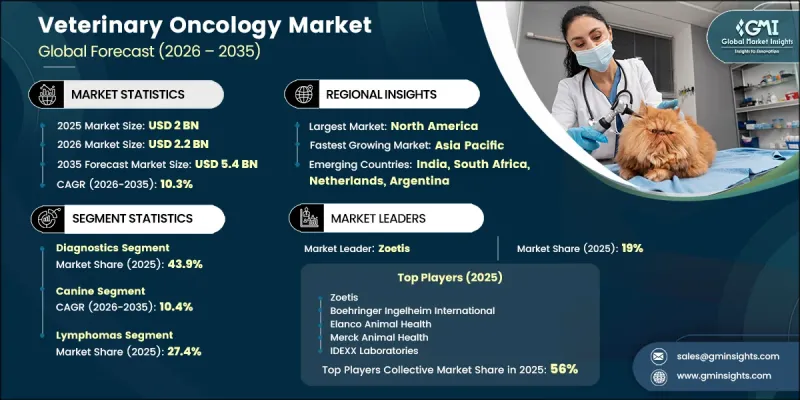
寵物飼養量的增加、動物醫療保健支出的成長以及獸醫腫瘤學領域藥物和診斷技術的穩步發展,共同推動了這一成長。預防性護理的改善延長了寵物的壽命,導致老齡化的發生率上升,並直接擴大了符合治療條件的患者群體。同時,寵物飼主對積極主動的癌症治療(而非僅針對症狀的治療)的需求日益成長,這正在改變人們對治療的預期。 CT、MRI 和數位 X 光等影像技術的進步,結合分子檢測和微創切片檢查工具,使得早期發現和更精準的治療方案製定成為可能。此外,設備成本的降低使得腫瘤篩檢能夠惠及一般獸醫診所,從而擴大了其應用範圍,不再局限於專業機構。
| 市場範圍 | |
|---|---|
| 開始年份 | 2025 |
| 預測期 | 2026-2035 |
| 初始市場規模 | 20億美元 |
| 預測金額 | 54億美元 |
| 複合年成長率 | 10.3% |
預計到2025年,診斷領域將佔據43.9%的市場佔有率,並在2035年之前以10.4%的複合年成長率成長。這一成長反映了先進影像和檢查室診斷工具在專科醫院和設備齊全的綜合獸醫診所中的應用日益廣泛。以CT、MRI、超音波和數位X光系統為代表的影像技術,用於腫瘤檢測、分期和治療方案製定,仍是主要的收入來源。微創手術,例如超音波引導切片檢查,透過提高診斷準確性並降低患者風險,也推動了該領域的成長。
預計到2025年,淋巴瘤市佔率將佔總市佔率的27.4%,並將在2035年之前以10.8%的複合年成長率成長。犬淋巴瘤仍是最常見的診斷類型,分為多中心型、胃腸道型、縱膈型和結外型,其中侵襲性極強的多中心型淋巴瘤最為常見。標準治療方法主要基於從人類腫瘤學中藉鏡的多藥化療方案,這些方案持續取得良好的緩解效果並延長接受治療動物的生存期。
北美獸醫腫瘤市場佔49.8%的市場佔有率,預計到2035年將以10.1%的複合年成長率成長。該地區的主導地位得益於高度發展的獸醫生態系統、眾多專業的腫瘤學家以及支持獸藥創新和核准的法律規範。美國仍然是該市場的核心,這得益於其領先的學術機構和轉診中心,這些機構為臨床研究、治療方法創新和腫瘤治療標準的提升做出了重大貢獻。
目錄
第1章:調查方法和範圍
第2章執行摘要
第3章 行業洞察
- 產業生態系分析
- 影響產業的因素
- 促進因素
- 動物癌症盛行率和發生率增加
- 寵物癌症診斷的技術進步
- 加大寵物癌症治療的研究與投資
- 寵物保險投保率上升
- 產業潛在風險與挑戰
- 癌症治療和手術高成本
- 寵物癌症治療藥物的副作用
- 市場機遇
- 開發個人化和標靶癌症治療方法
- 擴大獸醫腫瘤基礎設施和專科診所
- 促進因素
- 成長潛力分析
- 技術與創新展望
- 最新科技趨勢
- 新興技術
- 價格趨勢分析
- 監理情勢
- 波特的分析
- PESTLE分析
- 專利分析
- 未來市場趨勢
- 人工智慧和生成式人工智慧對市場的影響
- 投資與資金籌措分析
- 寵物數量統計數據
第4章 競爭情勢
- 介紹
- 企業市佔率分析
- 北美洲
- 歐洲
- 亞太地區
- 企業矩陣分析
- 主要市場公司的競爭分析
- 競爭定位矩陣
- 主要進展
- 併購
- 夥伴關係和聯盟
- 新產品發布
- 業務拓展計劃
第5章 市場估計與預測:依癌症診斷與治療分類,2022-2035年
- 診斷
- 按類型
- 診斷影像
- 切片檢查
- 內視鏡檢查
- 其他診斷方法
- 按最終用途
- 獸醫醫院和診所
- 診斷中心
- 其他最終用戶
- 按類型
- 過程
- 按類型
- 外科手術
- 放射治療
- 化療
- 免疫療法
- 其他治療方法
- 按最終用途
- 動物醫院
- 動物診所
- 其他最終用戶
- 按類型
第6章 市場估計與預測:依動物類型分類,2022-2035年
- 狗
- 貓
- 馬
- 其他動物類型
第7章 市場估計與預測:依癌症類型分類,2022-2035年
- 肥大細胞瘤
- 乳腺腫瘤
- 淋巴瘤
- 黑色素瘤
- 其他癌症
第8章 市場估計與預測:依地區分類,2022-2035年
- 北美洲
- 美國
- 加拿大
- 歐洲
- 德國
- 法國
- 英國
- 西班牙
- 義大利
- 荷蘭
- 亞太地區
- 中國
- 日本
- 印度
- 澳洲
- 韓國
- 拉丁美洲
- 巴西
- 墨西哥
- 阿根廷
- 中東和非洲
- 沙烏地阿拉伯
- 南非
- UAE
第9章:公司簡介
- Zoetis Inc.
- AB Science SA
- Elanco Animal Health Incorporated
- Boehringer Ingelheim International GmbH
- Merck Animal Health(Merck &Co., Inc.)
- IDEXX Laboratories, Inc.
- Siemens Healthineers(Varian Medical Systems)
- Accuray Incorporated
- Elekta AB
- PetCure Oncology
- Virbac SA
- Dechra Pharmaceuticals PLC
- Nippon Zenyaku Kogyo Co., Ltd.(ZENOAQ)
The Global Veterinary Oncology Market was valued at USD 2 billion in 2025 and is estimated to grow at a CAGR of 10.3% to reach USD 5.4 billion by 2035.
Growth is reinforced by expanding pet ownership, higher spending on animal healthcare, and a steadily broadening pipeline of veterinary oncology drugs and diagnostics. As pets live longer due to improved preventive care, the incidence of age-related cancers is also rising, directly expanding the treated patient pool. At the same time, growing willingness among pet owners to pursue active cancer therapies rather than purely supportive care is reshaping treatment expectations. Advances in diagnostic imaging, such as CT, MRI, and digital radiography, combined with molecular testing and minimally invasive biopsy tools, are enabling earlier detection and more precise treatment planning. Lower equipment costs are also allowing general veterinary clinics to adopt oncology screening capabilities, widening access beyond specialized centers.
| Market Scope | |
|---|---|
| Start Year | 2025 |
| Forecast Year | 2026-2035 |
| Start Value | $2 Billion |
| Forecast Value | $5.4 Billion |
| CAGR | 10.3% |
The diagnostics segment accounted for 43.9% share in 2025 and is projected to grow at a CAGR of 10.4% through 2035. Its expansion reflects the increasing use of advanced imaging and laboratory-based diagnostic tools across both specialty hospitals and well-equipped general veterinary practices. Imaging technologies remain the primary revenue contributor, supported by CT, MRI, ultrasound, and digital radiography systems used for tumor detection, staging, and treatment planning. Minimally invasive procedures such as ultrasound-guided sampling are also improving diagnostic accuracy while reducing patient risk, further supporting segment growth.
The lymphoma segment held a 27.4% share in 2025 and will grow at a CAGR of 10.8% through 2035. Canine lymphoma remains the most diagnosed form and is categorized into multicentric, alimentary, mediastinal, and extranodal types, with aggressive multicentric cases being the most frequently observed. Standard treatment practices are largely based on multi-agent chemotherapy protocols adapted from human oncology, which continue to deliver strong remission outcomes and extended survival periods in treated animals.
North America Veterinary Oncology Market held a 49.8% share and is projected to grow at a CAGR of 10.1% through 2035. The region's leadership is supported by a highly developed veterinary healthcare ecosystem, strong availability of specialist oncologists, and a regulatory framework that supports veterinary drug innovation and approvals. The United States remains the central market, backed by leading academic and referral institutions that contribute significantly to clinical research, treatment innovation, and the advancement of oncology care standards.
Major players operating in the global veterinary oncology market include Zoetis Inc., Boehringer Ingelheim International GmbH, Elanco Animal Health Incorporated, Merck Animal Health, AB Science S.A., IDEXX Laboratories, Inc., Siemens Healthineers (Varian Medical Systems), Accuray Incorporated, Elekta AB, PetCure Oncology, Virbac S.A., Dechra Pharmaceuticals PLC, and Nippon Zenyaku Kogyo Co., Ltd. (ZENOAQ). Companies in the veterinary oncology market are strengthening their position through expanded investment in drug development pipelines focused on targeted and immuno-oncology therapies designed specifically for companion animals. Strategic collaborations between pharmaceutical firms and veterinary research institutions are accelerating clinical validation and product approvals. Players are also enhancing diagnostic-treatment integration by combining imaging, molecular testing, and therapeutic solutions into unified oncology care pathways. Geographic expansion through specialty clinics and referral networks is improving treatment accessibility across emerging urban markets. Digital health platforms and tele-oncology services are being deployed to support remote consultation and treatment monitoring.
Table of Contents
Chapter 1 Methodology & Scope
- 1.1 Research approach
- 1.2 Quality commitments
- 1.2.1 GMI AI policy & data integrity commitment
- 1.2.1.1 Source consistency protocol
- 1.2.1 GMI AI policy & data integrity commitment
- 1.3 Research trail & confidence scoring
- 1.3.1 Research trail components
- 1.3.2 Scoring components
- 1.4 Data collection
- 1.4.1 Partial list of primary sources
- 1.5 Data mining sources
- 1.5.1 Paid sources
- 1.5.1.1 Sources, by region
- 1.5.1 Paid sources
- 1.6 Base estimates and calculations
- 1.6.1 Base year calculation for any one approach
- 1.7 Market estimates & forecasts parameters
- 1.8 Forecast model
- 1.8.1 Quantified market impact analysis
- 1.8.1.1 Mathematical impact of growth parameters on forecast
- 1.8.1 Quantified market impact analysis
- 1.9 Research transparency addendum
- 1.9.1 Source attribution framework
- 1.9.2 Quality assurance metrics
- 1.9.3 Our commitment to trust
Chapter 2 Executive Summary
- 2.1 Industry 3600 synopsis
- 2.1.1 Business trends
- 2.1.2 Cancer diagnostics & treatment trends
- 2.1.3 Animal type trends
- 2.1.4 Cancer type trends
- 2.1.5 Regional trends
- 2.2 CXO perspectives: Strategic imperatives
Chapter 3 Industry Insights
- 3.1 Industry ecosystem analysis
- 3.2 Industry impact forces
- 3.2.1 Growth drivers
- 3.2.1.1 Rising prevalence and incidence of cancer in animals
- 3.2.1.2 Technological advancements in pet cancer diagnosis
- 3.2.1.3 Growing research and investments in pet cancer therapy
- 3.2.1.4 Increasing pet insurance adoption
- 3.2.2 Industry pitfalls and challenges
- 3.2.2.1 High cost of cancer treatment and procedures
- 3.2.2.2 Adverse effects of drugs used for pet cancer treatment
- 3.2.3 Market opportunities
- 3.2.3.1 Development of personalized and targeted oncology therapies
- 3.2.3.2 Expansion of veterinary oncology infrastructure and specialty clinics
- 3.2.1 Growth drivers
- 3.3 Growth potential analysis
- 3.4 Technology and innovation landscape
- 3.4.1 Current technological trends
- 3.4.2 Emerging technologies
- 3.5 Pricing trend analysis (Driven by primary research)
- 3.6 Regulatory landscape (Driven by primary research)
- 3.6.1 North America
- 3.6.2 Europe
- 3.6.3 Asia Pacific
- 3.6.4 Latin America
- 3.6.5 MEA
- 3.7 Porter's analysis
- 3.8 PESTEL analysis
- 3.9 Patent analysis
- 3.10 Future market trends
- 3.11 Impact of AI and Generative AI on the market (Driven by primary research)
- 3.12 Investment & funding analysis (Driven by primary research)
- 3.13 Pet population statistics (Driven by primary research)
Chapter 4 Competitive Landscape, 2025
- 4.1 Introduction
- 4.2 Company market share analysis
- 4.2.1 North America
- 4.2.2 Europe
- 4.2.3 Asia Pacific
- 4.3 Company matrix analysis
- 4.4 Competitive analysis of major market players
- 4.5 Competitive positioning matrix
- 4.6 Key developments
- 4.6.1 Merger and acquisition
- 4.6.2 Partnership and collaboration
- 4.6.3 New product launches
- 4.6.4 Expansion plans
Chapter 5 Market Estimates and Forecast, By Cancer Diagnostics & Treatment, 2022 - 2035 ($ Mn)
- 5.1 Key trends
- 5.2 Diagnostics
- 5.2.1 By Type
- 5.2.1.1 Imaging
- 5.2.1.2 Biopsy
- 5.2.1.3 Endoscopy
- 5.2.1.4 Other diagnostics
- 5.2.2 By End Use
- 5.2.2.1 Veterinary hospitals & clinics
- 5.2.2.2 Diagnostics centers
- 5.2.2.3 Other end users
- 5.2.1 By Type
- 5.3 Treatment
- 5.3.1 By Type
- 5.3.1.1 Surgery
- 5.3.1.2 Radiotherapy
- 5.3.1.3 Chemotherapy
- 5.3.1.4 Immunotherapy
- 5.3.1.5 Other treatments
- 5.3.2 By End Use
- 5.3.2.1 Veterinary hospitals
- 5.3.2.2 Veterinary clinics
- 5.3.2.3 Other end users
- 5.3.1 By Type
Chapter 6 Market Estimates and Forecast, By Animal Type, 2022 - 2035 ($ Mn)
- 6.1 Key trends
- 6.2 Canine
- 6.3 Feline
- 6.4 Equine
- 6.5 Other animal types
Chapter 7 Market Estimates and Forecast, By Cancer Type, 2022 - 2035 ($ Mn)
- 7.1 Key trends
- 7.2 Mast cell tumors
- 7.3 Mammary tumors
- 7.4 Lymphomas
- 7.5 Melanoma
- 7.6 Other cancer types
Chapter 8 Market Estimates and Forecast, By Region, 2022 - 2035 ($ Mn)
- 8.1 Key trends
- 8.2 North America
- 8.2.1 U.S.
- 8.2.2 Canada
- 8.3 Europe
- 8.3.1 Germany
- 8.3.2 France
- 8.3.3 UK
- 8.3.4 Spain
- 8.3.5 Italy
- 8.3.6 Netherlands
- 8.4 Asia Pacific
- 8.4.1 China
- 8.4.2 Japan
- 8.4.3 India
- 8.4.4 Australia
- 8.4.5 South Korea
- 8.5 Latin America
- 8.5.1 Brazil
- 8.5.2 Mexico
- 8.5.3 Argentina
- 8.6 Middle East & Africa
- 8.6.1 Saudi Arabia
- 8.6.2 South Africa
- 8.6.3 UAE
Chapter 9 Company Profiles
- 9.1 Zoetis Inc.
- 9.2 AB Science S.A.
- 9.3 Elanco Animal Health Incorporated
- 9.4 Boehringer Ingelheim International GmbH
- 9.5 Merck Animal Health (Merck & Co., Inc.)
- 9.6 IDEXX Laboratories, Inc.
- 9.7 Siemens Healthineers (Varian Medical Systems)
- 9.8 Accuray Incorporated
- 9.9 Elekta AB
- 9.10 PetCure Oncology
- 9.11 Virbac S.A.
- 9.12 Dechra Pharmaceuticals PLC
- 9.13 Nippon Zenyaku Kogyo Co., Ltd. (ZENOAQ)

 2034年獸醫腫瘤市場預測-全球分析(依動物種類、癌症類型、診斷方法、治療手段、給藥途徑、治療方案、最終使用者、通路和地區分類)
 獸醫腫瘤市場:按動物類型、治療方法、癌症類型、給藥途徑和最終用戶分類-2026-2032年全球市場預測
 獸醫腫瘤市場:依動物種類、治療方法、給藥途徑、應用、通路及地區分類
 獸醫腫瘤市場分析及預測(至2035年):依類型、產品、服務、技術、應用、最終使用者、設備、功能及階段分類
 全球獸醫腫瘤市場規模、佔有率、趨勢和成長分析報告(2026-2034)
 獸醫腫瘤市場-全球產業規模、佔有率、趨勢、機會、預測:按動物類型、治療類型、癌症類型、地區和競爭格局分類,2021-2031年
 獸醫腫瘤市場規模、佔有率和成長分析(按治療類型、動物類型、癌症類型、最終用戶和地區分類)—產業預測(2026-2033 年)
 全球獸醫腫瘤市場評估:依動物類型、療法、癌症類型、地區、機會和預測(2018-2032)
 美國獸醫腫瘤市場規模、佔有率、趨勢分析報告:按動物、治療方法、癌症類型和細分市場分類,預測(2025-2030 年)美國獸醫癌症診斷市場規模、佔有率、趨勢分析報告(按動物類型、檢測類型、癌症類型、最終用途、國家/地區、細分市場預測),2025 年至 2030 年