

 |
市場調查報告書
商品編碼
2071321
2026 年至 2035 年窗簾市場的機會、成長要素、產業趨勢和預測。Window Coverings Market Opportunity, Growth Drivers, Industry Trend Analysis, and Forecast 2026 - 2035 |
||||||

全球窗簾市場預計到 2025 年價值 176 億美元,年複合成長率為 7.7%,到 2035 年將達到 369 億美元。
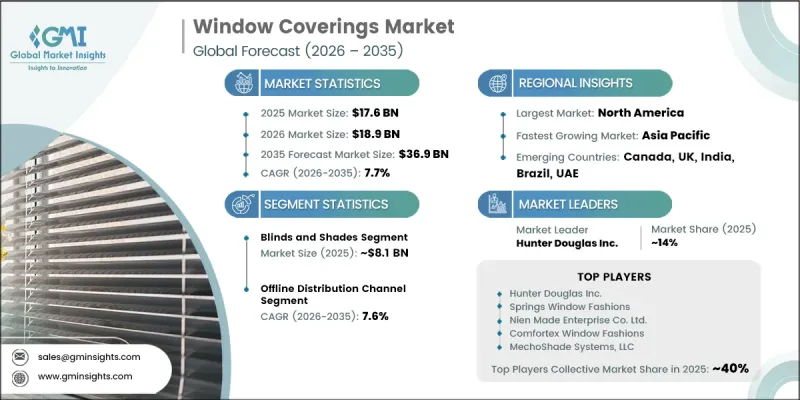
智慧家庭技術的普及是推動該市場成長的主要動力,消費者擴大採用自動化系統來控制住宅中的照明、安防和溫度。這種轉變顯著提升了電動百葉窗和智慧簾子的需求,這些產品可透過智慧型手機、遙控器或語音控制平台(例如亞馬遜 Alexa、Google Home 和連網家庭Siri)進行控制。這些解決方案之所以廣受歡迎,是因為它們能夠與自動化照明控制和智慧家庭生態系統無縫整合,從而提供更高的便利性、能源效率和更強的住宅安全性。在都市區和高所得家庭中,對技術先進的住宅解決方案的偏好尤其明顯。此外,住宅建設活動的活性化、都市區住宅需求的擴大以及持續的房屋維修和改造趨勢也進一步促進了市場的擴張。消費者正逐漸從傳統窗簾轉向兼具美觀性和功能性的現代窗飾解決方案,支撐了該行業在已開發市場和新興市場的持續成長。
| 市場範圍 | |
|---|---|
| 開始年份 | 2025 |
| 預測期 | 2026-2035 |
| 上市時的市場規模 | 176億美元 |
| 預測金額 | 369億美元 |
| 複合年成長率 | 7.7% |
預計到2025年,百葉窗和簾子市場規模將達到81億美元,並在2026年至2035年間以7.8%的複合年成長率成長。由於百葉窗和簾子具有現代化的設計、緊湊的結構和卓越的光線控制能力,消費者越來越傾向於選擇它們而非傳統窗簾,因此該領域正成為市場成長的主要驅動力。這些產品具有可調節的隱私性、更好的隔熱性和節能性等優點,使其適用於住宅和商業環境。與智慧家庭系統的日益融合進一步加速了對電動和自動化產品的需求,這些產品能夠提升用戶便利性並支援能源管理。
預計到2025年,線下分銷管道將佔據75.8%的市場佔有率,並預計在2035年之前以7.6%的複合年成長率成長。由於窗簾需要精確測量、客製化和安裝,線下零售仍佔據主導地位,消費者更傾向於光顧實體店、專賣店和展示室。這些銷售管道讓買家能夠親身感受材質、顏色和紋理,並獲得專家建議,這在室內設計決策中尤其重要,因為美觀和功能性都至關重要。
美國窗簾市場預計到2025年將達到40億美元,並在2026年至2035年間以7.6%的複合年成長率成長。智慧家庭系統在美國的日益普及,正推動著消費者對整合互聯生態系統的自動化窗簾的需求,這主要得益於其對舒適性、能源效率和安全性的提升。此外,強勁的住宅市場,在持續的建設活動和濃厚的翻新改造文化的支撐下,也持續推動對現代窗簾解決方案的穩定需求。
目錄
第1章:調查方法和範圍
第2章執行摘要
第3章 行業洞察
- 產業生態系分析
- 供應商情況
- 利潤率
- 每個階段增加的價值
- 影響價值鏈的因素
- 影響產業的因素
- 促進因素
- 智慧家庭的需求日益成長
- 擴大住宅建設和翻新
- 材料和設計創新方面的進步
- 產業潛在風險與挑戰
- 激烈的市場競爭與價格壓力
- 原物料價格波動
- 機會
- 智慧自動窗簾的興起
- 客製化和個人化趨勢
- 促進因素
- 成長潛力分析
- 未來市場趨勢
- 技術與創新展望
- 最新科技趨勢
- 新興技術
- 監理情勢
- 標準和合規要求
- 區域監理框架
- 認證標準
- 貿易數據分析
- 進出口量及進口額趨勢
- 主要貿易路線及關稅的影響
- 價格分析
- 對過去價格趨勢的分析
- 按業務類型(高階/低階/大眾市場)分類的定價策略
- 人工智慧和生成式人工智慧對市場的影響
- 利用人工智慧改造現有經營模式
- 按細分市場分類的生成式人工智慧用例和部署藍圖
- 風險、限制和監管考量
- 波特的分析
- PESTLE分析
- 消費者購買行為分析
- 人口趨勢
- 影響購買決策的因素
- 消費者產品採納
- 首選分銷管道
第4章 競爭情勢
- 介紹
- 企業市佔率分析
- 按地區
- 企業矩陣分析
- 主要市場公司的競爭分析
- 競爭定位矩陣
- 主要進展
- 併購
- 夥伴關係和聯盟
- 新產品發布
- 業務拓展計劃
第5章 市場估算與預測:依產品類型分類,2022-2035年
- 百葉窗和簾子
- 卷簾
- 百葉窗
- 垂直百葉窗
- 蜂巢簾/百褶簾子
- 羅馬簾子
- 簾子
- 木質編織簾子
- 紗簾
- 面板軌道百葉窗
- 窗簾和帷幔
- 遮光窗簾
- 薄紗窗簾
- 隔熱窗簾
- 訂製窗簾
- 百葉窗
- 木百葉窗
- 複合百葉窗
- 乙烯基/聚酯緞面百葉窗
- 其他物品(窗簾桿及配件、帷幔配件等)
第6章 市場估計與預測:依材料分類,2022-2035年
- 自然的
- 合成
第7章 市場估計與預測:依技術分類,2022-2035年
- 手冊封面
- 智慧保護套/自動保護套
第8章 市場估計與預測:依陰影度分類,2022-2035年
- 完全遮光
- 遮光
- 透光性
- 透明/輕薄
第9章 市場估計與預測:依價格分類,2022-2035年
- 低價
- 中價位
- 優質的
第10章 市場估價與預測:依最終用途分類,2022-2035年
- 住宅
- 商業
第11章 市場估價與預測:依通路分類,2022-2035年
- 線上
- 電子商務
- 企業網站
- 離線
- 專賣店
- 零售店
- 其他
第12章 市場估計與預測:依地區分類,2022-2035年
- 北美洲
- 美國
- 加拿大
- 歐洲
- 德國
- 英國
- 法國
- 義大利
- 西班牙
- 亞太地區
- 中國
- 印度
- 日本
- 韓國
- 澳洲
- 印尼
- 馬來西亞
- 拉丁美洲
- 巴西
- 墨西哥
- 阿根廷
- 中東和非洲
- 沙烏地阿拉伯
- UAE
- 南非
第13章:公司簡介
- 世界頂尖公司
- Hunter Douglas NV
- Springs Window Fashions
- Levolor Inc.
- Luxaflex
- Somfy
- Norman Window Fashions
- Griesser AG
- 該地區的領先企業
- Toso Co., Ltd.
- Warema Renkhoff SE
- Rollease Acmeda
- The Shade Store
- Hillarys
- Kresta Holdings Limited
- Louvolite Group
- 新興企業
- Smith & Noble
- Blinds.com
- 3 Day Blinds
- Coulisse BV
- WinLux Asia
- Graber Window Treatments
- QMotion Shades
The Global Window Coverings Market was valued at USD 17.6 billion in 2025 and is estimated to grow at a CAGR of 7.7% to reach USD 36.9 billion by 2035.
The market growth is strongly supported by the rising adoption of smart home technologies, where consumers are increasingly integrating automated systems for lighting, security, and climate control within residential spaces. This transition is significantly increasing demand for motorized blinds and smart shades that can be controlled through smartphones, remote devices, or voice-enabled platforms such as Amazon Alexa, Google Home, and Apple Siri. These solutions are gaining popularity due to their ability to improve convenience, enhance energy efficiency, and strengthen home security through automated light regulation and seamless integration with connected home ecosystems. Growing preference for technologically advanced home solutions is particularly strong among urban and high-income households. In addition, rising residential construction activities, expanding urban housing demand, and continuous renovation and remodeling trends are further contributing to market expansion. Consumers are increasingly shifting from traditional curtains toward modern window treatment solutions that combine aesthetics with functionality, supporting sustained industry growth across both developed and emerging regions.
| Market Scope | |
|---|---|
| Start Year | 2025 |
| Forecast Year | 2026-2035 |
| Start Value | $17.6 Billion |
| Forecast Value | $36.9 Billion |
| CAGR | 7.7% |
The blinds and shades segment generated USD 8.1 billion in 2025 and is anticipated to grow at a CAGR of 7.8% from 2026 to 2035. This segment leads the market as consumers increasingly prefer blinds and shades over conventional curtains due to their modern design, compact structure, and superior light control capabilities. These products offer adjustable privacy, improved insulation, and energy-saving benefits, making them suitable for both residential and commercial environments. Growing integration with smart home systems has further accelerated demand for motorized and automated variants that enhance user convenience and support energy management.
The offline distribution channel accounted for 75.8% share in 2025 and is expected to grow at a CAGR of 7.6% through 2035. Offline retail continues to dominate as window coverings require precise measurement, customization, and fitting, encouraging consumers to rely on physical stores, specialty outlets, and showrooms. These channels allow buyers to evaluate materials, colors, and textures firsthand while receiving expert consultation, which is particularly important for interior design decisions where aesthetics and functionality must align.
U.S. Window Coverings Market captured USD 4 billion in 2025 and is projected to grow at a CAGR of 7.6% from 2026 to 2035. Strong penetration of smart home systems in the country is accelerating demand for automated window coverings integrated with connected ecosystems, improving comfort, energy efficiency, and security. In addition, a strong housing sector supported by ongoing construction activity and a robust culture of renovation and interior upgrading continues to sustain steady demand for modern window treatment solutions.
Major players operating in the global window coverings industry include Hunter Douglas N.V., Springs Window Fashions, Levolor Inc., Luxaflex, Somfy, Norman Window Fashions, Griesser AG, Toso Co., Ltd., Warema Renkhoff SE, Rollease Acmeda, The Shade Store, Hillarys, Kresta Holdings Limited, Louvolite Group, Smith & Noble, Blinds.com, 3 Day Blinds, Coulisse B.V., WinLux Asia, Graber Window Treatments, and QMotion Shades. Companies in the window coverings market are focusing on expanding smart and motorized product portfolios to align with rising demand for home automation. Many players are investing in IoT-enabled solutions that integrate seamlessly with voice assistants and connected home systems. Strategic partnerships with interior designers, real estate developers, and home automation providers are helping expand market reach. Manufacturers are also emphasizing customization capabilities, offering made-to-measure solutions to meet diverse consumer preferences. Strengthening omnichannel distribution networks, particularly by combining offline showrooms with digital platforms, is improving customer accessibility.
Table of Contents
Chapter 1 Methodology & Scope
- 1.1 Market scope and definition
- 1.2 Research design
- 1.2.1 Research approach
- 1.2.2 Data collection methods
- 1.3 Data mining sources
- 1.3.1 Global
- 1.3.2 Regional/Country
- 1.4 Base estimates and calculations
- 1.4.1 Base year calculation
- 1.4.2 Key trends for market estimation
- 1.5 Primary research and validation
- 1.5.1 Primary sources
- 1.6 Forecast model
- 1.7 Research assumptions and limitations
Chapter 2 Executive Summary
- 2.1 Industry 360° synopsis
- 2.2 Key market trends
- 2.2.1 Regional
- 2.2.2 Product type
- 2.2.3 Material
- 2.2.4 Technology
- 2.2.5 Price range
- 2.2.6 Opacity level
- 2.2.7 End use
- 2.2.8 Distribution channel
Chapter 3 Industry Insights
- 3.1 Industry ecosystem analysis
- 3.1.1 Supplier landscape
- 3.1.2 Profit margin
- 3.1.3 Value addition at each stage
- 3.1.4 Factor affecting the value chain
- 3.2 Industry impact forces
- 3.2.1 Growth drivers
- 3.2.1.1 Rising demand for smart homes
- 3.2.1.2 Expansion of residential construction & renovation
- 3.2.1.3 Advancements in materials & design innovation
- 3.2.2 Industry pitfalls & challenges
- 3.2.2.1 Intense market competition & price pressure
- 3.2.2.2 Fluctuating raw material prices
- 3.2.3 Opportunities
- 3.2.3.1 Growth in smart & automated window coverings
- 3.2.3.2 Customization & personalization trends
- 3.2.1 Growth drivers
- 3.3 Growth potential analysis
- 3.4 Future market trends
- 3.5 Technology and innovation landscape
- 3.5.1 Current technological trends
- 3.5.2 Emerging technologies
- 3.6 Regulatory landscape
- 3.6.1 Standards and compliance requirements
- 3.6.2 Regional regulatory frameworks
- 3.6.3 Certification standards
- 3.7 Trade data analysis (HS Code 6303)
- 3.7.1 Import/export volume & value trends
- 3.7.2 Key trade corridors & tariff impact
- 3.8 Pricing analysis
- 3.8.1 Historical price trend analysis (driven by primary research)
- 3.8.2 Pricing strategy by player type (premium / value / mass market)
- 3.9 Impact of AI & generative AI on the market
- 3.9.1 AI-driven disruption of existing business models
- 3.9.2 GenAI use cases & adoption roadmap by segment
- 3.9.3 Risks, limitations & regulatory considerations
- 3.10 Porter's analysis
- 3.11 PESTEL analysis
- 3.12 Consumer buying behavior analysis
- 3.12.1 Demographic trends
- 3.12.2 Factors affecting buying decisions
- 3.12.3 Consumer product adoption
- 3.12.4 Preferred distribution channel
Chapter 4 Competitive Landscape, 2025
- 4.1 Introduction
- 4.2 Company market share analysis
- 4.2.1 By Region
- 4.2.1.1 North America
- 4.2.1.2 Europe
- 4.2.1.3 Asia Pacific
- 4.2.1.4 Latin America
- 4.2.1.5 Middle East & Africa
- 4.2.1 By Region
- 4.3 Company matrix analysis
- 4.4 Competitive analysis of major market players
- 4.5 Competitive positioning matrix
- 4.6 Key developments
- 4.6.1 Mergers & acquisitions
- 4.6.2 Partnerships & collaborations
- 4.6.3 New product launches
- 4.6.4 Expansion plans
Chapter 5 Market Estimates & Forecast, By Product Type, 2022 - 2035, (USD Billion) (Million Units)
- 5.1 Key trends
- 5.2 Blinds and shades
- 5.2.1 Roller blinds
- 5.2.2 Venetian blinds
- 5.2.3 Vertical blinds
- 5.2.4 Cellular/honeycomb shades
- 5.2.5 Roman shades
- 5.2.6 Solar shades
- 5.2.7 Woven wood shades
- 5.3 Sheer shades
- 5.3.1 Panel track blinds
- 5.3.2 Curtains and drapes
- 5.3.3 Blackout curtains
- 5.3.4 Sheer curtains
- 5.3.5 Thermal curtains
- 5.3.6 Custom drapes
- 5.4 Shutters
- 5.4.1 Wood shutters
- 5.4.2 Composite shutters
- 5.4.3 Vinyl/Poly satin shutters
- 5.5 Others (curtain rods & hardware, drapery fixtures etc.)
Chapter 6 Market Estimates & Forecast, By Material, 2022 - 2035, (USD Billion) (Million Units)
- 6.1 Key trends
- 6.2 Natural
- 6.3 Synthetic
Chapter 7 Market Estimates & Forecast, By Technology, 2022 - 2035, (USD Billion) (Million Units)
- 7.1 Key trends
- 7.2 Manual covers
- 7.3 Smart covers/automatic covers
Chapter 8 Market Estimates & Forecast, By Opacity level, 2022 - 2035, (USD Billion) (Million Units)
- 8.1 Key trends
- 8.2 Blackout
- 8.3 Room darkening
- 8.4 Light filtering
- 8.5 Sheer/transparent
Chapter 9 Market Estimates & Forecast, By Price, 2022 - 2035, (USD Billion) (Million Units)
- 9.1 Key trends
- 9.2 Economy
- 9.3 Mid-range
- 9.4 Premium
Chapter 10 Market Estimates & Forecast, By End Use, 2022 - 2035, (USD Billion) (Million Units)
- 10.1 Key trends
- 10.2 Residential
- 10.3 Commercial
Chapter 11 Market Estimates & Forecast, By Distribution Channel, 2022 - 2035, (USD Billion) (Million Units)
- 11.1 Key trends
- 11.2 Online
- 11.2.1 E-commerce
- 11.2.2 Company websites
- 11.3 Offline
- 11.3.1 Specialty stores
- 11.3.2 Retail stores
- 11.3.3 Others
Chapter 12 Market Estimates & Forecast, By Region, 2022 - 2035, (USD Billion) (Million Units)
- 12.1 Key trends
- 12.2 North America
- 12.2.1 U.S.
- 12.2.2 Canada
- 12.3 Europe
- 12.3.1 Germany
- 12.3.2 UK
- 12.3.3 France
- 12.3.4 Italy
- 12.3.5 Spain
- 12.4 Asia Pacific
- 12.4.1 China
- 12.4.2 India
- 12.4.3 Japan
- 12.4.4 South Korea
- 12.4.5 Australia
- 12.4.6 Indonesia
- 12.4.7 Malaysia
- 12.5 Latin America
- 12.5.1 Brazil
- 12.5.2 Mexico
- 12.5.3 Argentina
- 12.6 MEA
- 12.6.1 Saudi Arabia
- 12.6.2 UAE
- 12.6.3 South Africa
Chapter 13 Company Profiles
- 13.1 Top Global Players
- 13.1.1 Hunter Douglas N.V.
- 13.1.2 Springs Window Fashions
- 13.1.3 Levolor Inc.
- 13.1.4 Luxaflex
- 13.1.5 Somfy
- 13.1.6 Norman Window Fashions
- 13.1.7 Griesser AG
- 13.2 Regional Champions
- 13.2.1 Toso Co., Ltd.
- 13.2.2 Warema Renkhoff SE
- 13.2.3 Rollease Acmeda
- 13.2.4 The Shade Store
- 13.2.5 Hillarys
- 13.2.6 Kresta Holdings Limited
- 13.2.7 Louvolite Group
- 13.3 Emerging Players
- 13.3.1 Smith & Noble
- 13.3.2 Blinds.com
- 13.3.3 3 Day Blinds
- 13.3.4 Coulisse B.V.
- 13.3.5 WinLux Asia
- 13.3.6 Graber Window Treatments
- 13.3.7 QMotion Shades

 窗簾市場-全球市場預測(2026-2032年)
 窗簾市場預測至2034年-按產品類型、材料、操作機制、安裝方式、通路、最終用戶和地區分類的全球分析
 窗簾市場:全球產業規模、市場佔有率、趨勢、機會和預測(按類型、應用、分銷管道和地區分類)、競爭格局(2021-2031 年)窗飾市場預測至2034年-按產品、材料、操作機制、價格範圍、通路、應用和地區分類的全球分析
 窗簾市場分析及預測(至2035年):依類型、產品類型、材料類型、技術、應用、服務、最終用戶、安裝類型分類
 全球窗簾市場規模、佔有率、趨勢和成長分析報告(2026-2034)窗簾市場規模、佔有率、成長及全球產業分析:按類型、應用和地區分類的洞察,2026-2034 年預測
 窗簾市場規模、佔有率及成長分析(按類型、材料、技術、最終用戶、通路和地區分類)-2026-2033年產業預測
 全球窗簾市場