


 |
市場調查報告書
商品編碼
2071302
圓柱門鎖市場:市場機會、成長促進因素、產業趨勢分析及未來預測(2026-2035)Cylindrical Door Lock Market Opportunity, Growth Drivers, Industry Trend Analysis, and Forecast 2026 - 2035 |
||||||

全球圓柱門鎖市場預計到 2025 年價值 67 億美元,年複合成長率為 7.3%,到 2035 年將達到 135 億美元。
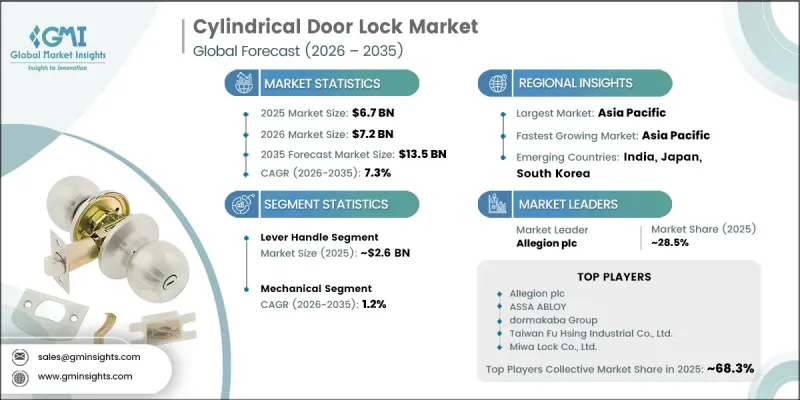
受住宅、商業和公共領域建設活動活性化的推動,該市場正經歷穩步擴張。這帶動了對安全可靠的鎖具解決方案的需求。快速的都市化和持續的基礎設施建設進一步加速了圓柱形門鎖在新建築項目中的安裝。同時,維修和改造項目帶來的更換需求依然強勁,支撐著市場的持續成長。製造商正日益專注於開發耐用、美觀且高性能的鎖系統,以滿足現代建築的需求。人們對資產安全和門禁控制意識的提高也推動了終端用戶對鎖具的採用。圓柱形門鎖因其可靠性、易於安裝和適用於各種應用場景而廣受歡迎。此外,智慧鎖具系統和電子門禁技術的整合正在擴展產品功能,為使用者提供更便利的操作、遠端控制和增強的安全功能。
| 市場範圍 | |
|---|---|
| 開始年份 | 2025 |
| 預測期 | 2026-2035 |
| 初始市場規模 | 67億美元 |
| 市場規模預測 | 135億美元 |
| 複合年成長率 | 7.3% |
預計到2025年,槓桿式把手市場規模將達到26億美元,並在2026年至2035年間以9.5%的複合年成長率成長。該細分市場憑藉其符合人體工學的設計、便捷的操作以及對各種住宅和商業環境的廣泛適應性而佔據主導地位。與傳統產品相比,槓桿式把手使用起來更加省力,因此非常適合兒童、老人和殘疾人士使用。槓桿式把手在包括住宅、辦公室、教育機構、醫療機構和酒店等在內的各種場所的廣泛應用,進一步鞏固了其市場主導地位。
預計到2025年,住宅領域將佔據全球市場最大佔有率,並在整個預測期內保持強勁成長。這一主導地位歸功於住宅建設的增加、人們對家庭安全的日益關注以及對經濟實惠且可靠的鎖具解決方案不斷成長的需求。圓柱形門鎖因其價格實惠、易於安裝且安全性能可靠,在住宅中已廣泛應用。都市區成長、公寓開發項目的擴張以及持續的住宅翻新活動進一步推動了該領域的需求。
中國圓柱門鎖市場預計到2025年將達到11億美元,並在2026年至2035年間以8.3%的複合年成長率成長。大規模的住宅建設活動和城市基礎設施的快速擴張支撐了中國市場強勁的發展勢頭。包括住宅小區、商業設施、住宿設施和公共基礎設施項目在內的所有需要可靠鎖具系統的領域,對可靠鎖具系統的需求都在不斷成長。本土製造商透過提供具競爭力的價格,並不斷提升產品設計品質和性能標準,維持穩固的市場地位。
圓柱形門鎖產業的主要參與者包括 ASSA ABLOY、Allegion plc、dormakaba Group、Salto Systems、Hafele Group、Miwa Lock Co., Ltd.、ISEO Ultimate Access Technologies、Godrej & Boyce Manufacturing Company Ltd.、EVVA Security Technology GmbH、BURG-WACH-Telot. GmbH、The Eastern Company、台灣復興實業股份有限公司、ZKTeco Co., Ltd.、Aqara(Lumi United Technology Co., Ltd.)、Lockly(Pin Genie)、iLOQ Ltd.、Anviz Global(Xthings Inc.)、U-tec Group Inc.(Ultraloq, & DessAnviz Global(Xthings Inc.)、U-tec Group Inc.(Ultraloq., & DessAnviz Global, Machines Inc.)。這些公司致力於透過持續的產品創新來鞏固其市場地位,特別是透過整合智慧鎖技術、生物識別系統和電子門禁解決方案。製造商正投資先進材料和精密工程技術,以提升產品的耐用性、安全性和設計吸引力。與建設公司、房地產開發商和智慧家庭生態系統供應商建立策略合作夥伴關係,有助於拓展銷售網路。各公司也優先投入研發,開發兼具機械可靠性和數位連接性的新一代鎖具系統。擴大產能和本地化策略有助於提高成本效益並滲透本地市場。此外,各公司也持續豐富產品系列,提供可客製化的、以設計為中心的解決方案,以滿足建築需求。
目錄
第1章:分析方法和範圍
第2章執行摘要
第3章業界考察
- 產業生態系分析
- 供應商情況
- 利潤率
- 每個階段增加的價值
- 影響價值鏈的因素
- 影響產業的因素
- 促進因素
- 全球住宅和商業建築活動增加
- 人們對安全和門禁控制解決方案的興趣日益濃厚。
- 擴大飯店、辦公大樓和公共設施的基礎設施
- 潛在風險和挑戰
- 與智慧鎖和先進電子安防系統的激烈競爭。
- 低價假冒仿冒品產品和無品牌產品的供應情況
- 市場機遇
- 圓柱鎖與智慧門禁技術的整合
- 市場對設計精良的高品質硬體產品的需求日益成長。
- 促進因素
- 成長潛力分析
- 未來市場趨勢
- 技術與創新展望
- 最新科技趨勢
- 新興技術
- 監理情勢
- 標準和合規要求
- 區域監理框架
- 認證標準
- 波特五力分析
- PESTLE分析
- 貿易數據分析
- 進出口趨勢:按地區以金額為準)
- 分析關稅對主要貿易路線的影響
- 確定貿易差額和淨出口/進口國
- 人工智慧和生成式人工智慧對市場的影響
- 利用人工智慧改造現有經營模式
- 按細分市場分類的生成式人工智慧用例和部署藍圖
- 預測性維護和異常檢測
- 個人化存取控制和行為學習
- 人工智慧驅動的安全威脅偵測
- 語音辨識和自然語言介面
- 風險、限制和監管考量
- 人工智慧鎖具的網路安全漏洞
- 對資料隱私和演算法偏見的擔憂
- 人工智慧在實體安全領域的監管格局
- 生產能力和生產情況
- 設備生產能力:按地區和主要生產國分類
- 運轉率和擴張計劃
第4章 競爭情勢
- 介紹
- 公司市佔率分析
- 北美洲
- 歐洲
- 亞太地區
- 拉丁美洲
- 中東和非洲
- 企業矩陣分析
- 主要公司的競爭分析
- 競爭定位矩陣
- 主要趨勢
- 企業合併(M&A)
- 商業夥伴關係與合作
- 新產品發布
- 擴張計劃
第5章 市場估算與預測:依鎖定機制類型分類(2022-2035 年)
- 門栓
- 槓桿手柄
- 克諾布洛赫
- 掛鎖式
- 其他
第6章 市場估算與預測:依技術水準分類(2022-2035 年)
- 機械的
- 電子智慧鎖
- 已連線 Wi-Fi
- 藍牙連接
- ZigBee 連接
- 其他
第7章 市場估計與預測:依價格區間分類(2022-2035 年)
- 低價位
- 中價位
- 高價位範圍
第8章 市場估算與預測:依應用領域分類(2022-2035 年)
- 家用
- 商業的
- 政府和公共機構
- 零售和購物中心
- 飯店業(飯店、度假村)
- 辦公大樓
- 醫療設施
- 教育機構
- 其他
第9章 市場估計與預測:依通路分類(2022-2035 年)
- 離線
- 金屬製品和家居裝修商店
- 安防商品專賣店
- 批發商(B2B)
- 其他零售店
- 線上
- 第三方電子商務平台
- 製造商官方網站
第10章 市場估價與預測:按地區分類(2022-2035 年)
- 北美洲
- 美國
- 加拿大
- 歐洲
- 德國
- 英國
- 法國
- 義大利
- 西班牙
- 亞太地區
- 中國
- 印度
- 日本
- 韓國
- 澳洲
- 拉丁美洲
- 巴西
- 墨西哥
- 阿根廷
- 中東和非洲
- 沙烏地阿拉伯
- UAE
- 南非
第11章:公司簡介
- 世界頂尖公司
- Allegion plc
- ASSA ABLOY
- dormakaba Group
- Hafele Group
- ISEO Ultimate Access Technologies
- Miwa Lock Co., Ltd.
- Salto Systems
- 該地區的領先企業
- BURG-WACHTER GmbH & Co. KG
- EVVA Security Technology GmbH
- Godrej & Boyce Manufacturing Company Ltd.
- Kaadas Intelligent Technology Co., Ltd.
- Nuki Home Solutions GmbH
- Taiwan Fu Hsing Industrial Co., Ltd.
- The Eastern Company
- 新興企業和專業公司
- Anviz Global(Xthings Inc.)
- Aqara(Lumi United Technology Co., Ltd.)
- Dessmann(China)Machinery & Electronic Co., Ltd.
- iLOQ Ltd.
- Lockly(Pin Genie)
- U-tec Group Inc.(Ultraloq)
- ZKTeco Co., Ltd.
The Global Cylindrical Door Lock Market was valued at USD 6.7 billion in 2025 and is estimated to grow at a CAGR of 7.3% to reach USD 13.5 billion by 2035.
The market is witnessing steady expansion driven by rising construction activity across residential, commercial, and institutional sectors, which is increasing the demand for secure and reliable locking solutions. Rapid urbanization and ongoing infrastructure development are further accelerating the installation of cylindrical door locks in new building projects. At the same time, renovation and remodeling activities are sustaining replacement demand, ensuring continuous market growth. Manufacturers are increasingly focusing on developing durable, aesthetically refined, and high-performance lock systems to align with modern architectural requirements. Rising awareness regarding property security and access control is also strengthening adoption across end users. Cylindrical door locks continue to be widely preferred due to their reliability, ease of installation, and versatility across multiple applications. Additionally, the integration of smart locking systems and electronic access technologies is expanding product capabilities, offering users enhanced convenience, remote access, and improved security functionality.
| Market Scope | |
|---|---|
| Start Year | 2025 |
| Forecast Year | 2026-2035 |
| Start Value | $6.7 Billion |
| Forecast Value | $13.5 Billion |
| CAGR | 7.3% |
The lever handle segment generated USD 2.6 billion in 2025 and is anticipated to grow at a CAGR of 9.5% from 2026 to 2035. This segment leads the market due to its ergonomic design, user-friendly operation, and suitability across a wide range of residential and commercial environments. Lever handles require minimal physical effort compared to traditional alternatives, making them ideal for children, elderly users, and individuals with limited mobility. Their widespread installation across housing units, offices, educational facilities, healthcare centers, and hospitality spaces further supports segment dominance.
The residential segment accounted for the largest share of the global market in 2025 and is expected to record strong growth throughout the forecast period. This dominance is attributed to rising housing construction, increasing emphasis on household safety, and growing demand for cost-effective and dependable locking solutions. Cylindrical door locks are extensively used in residential buildings due to their affordability, ease of installation, and dependable security performance. Expanding urban populations, rising apartment developments, and ongoing home renovation activities are further reinforcing demand across this segment.
China Cylindrical Door Lock Market generated USD 1.1 billion in 2025 and is projected to grow at a CAGR of 8.3% from 2026 to 2035. The country's strong position is supported by large-scale residential construction activity and the rapid expansion of urban infrastructure. Demand is high across housing complexes, commercial properties, hospitality establishments, and public infrastructure projects, all of which require reliable locking systems. Local manufacturers maintain a strong presence by offering competitively priced products while continuously improving design quality and performance standards.
The leading companies operating in the Cylindrical Door Lock Industry include ASSA ABLOY, Allegion plc, dormakaba Group, Salto Systems, Hafele Group, Miwa Lock Co., Ltd., and ISEO Ultimate Access Technologies, Godrej & Boyce Manufacturing Company Ltd., EVVA Security Technology GmbH, BURG-WACHTER GmbH & Co. KG, Kaadas Intelligent Technology Co., Ltd., Nuki Home Solutions GmbH, The Eastern Company, and Taiwan Fu Hsing Industrial Co., Ltd., ZKTeco Co., Ltd., Aqara (Lumi United Technology Co., Ltd.), Lockly (Pin Genie), iLOQ Ltd., Anviz Global (Xthings Inc.), U-tec Group Inc. (Ultraloq), and Dessmann (China) Machinery & Electronic Co., Ltd. Companies operating in the cylindrical door lock market are focusing on strengthening their market position through continuous product innovation, particularly by integrating smart locking technologies, biometric systems, and electronic access solutions. Manufacturers are investing in advanced materials and precision engineering to improve durability, security, and design appeal. Strategic partnerships with construction firms, real estate developers, and smart home ecosystem providers are helping expand distribution reach. Firms are also prioritizing R&D to develop next-generation locking systems that combine mechanical reliability with digital connectivity. Expansion of production capabilities and localization strategies is enabling cost efficiency and better regional penetration. In addition, companies are enhancing product portfolios with customizable and design-focused solutions to meet architectural requirements.
Table of Contents
Chapter 1 Methodology & Scope
- 1.1 Market scope and definition
- 1.2 Research design
- 1.2.1 Research approach
- 1.2.2 Data collection methods
- 1.3 Data mining sources
- 1.3.1 Global
- 1.3.2 Regional/Country
- 1.4 Base estimates and calculations
- 1.4.1 Base year calculation
- 1.4.2 Key trends for market estimation
- 1.5 Primary research and validation
- 1.5.1 Primary sources
- 1.6 Forecast model
- 1.7 Research assumptions and limitations
Chapter 2 Executive Summary
- 2.1 Industry 360° synopsis
- 2.2 Key market trends
- 2.2.1 Regional
- 2.2.2 Lock Mechanism Type
- 2.2.3 Technology Level
- 2.2.4 Price Range
- 2.2.5 Application
- 2.2.6 Distribution channel
Chapter 3 Industry Insights
- 3.1 Industry ecosystem analysis
- 3.1.1 Supplier landscape
- 3.1.2 Profit margin
- 3.1.3 Value addition at each stage
- 3.1.4 Factor affecting the value chain
- 3.2 Industry impact forces
- 3.2.1 Growth drivers
- 3.2.1.1 Rising residential and commercial construction activities globally
- 3.2.1.2 Growing focus on security and access control solutions
- 3.2.1.3 Expansion of hospitality, office, and institutional infrastructure
- 3.2.2 Pitfalls & Challenges
- 3.2.2.1 High competition from smart locks and advanced electronic security systems
- 3.2.2.2 Availability of low-cost counterfeit and unbranded products
- 3.2.3 Opportunities
- 3.2.3.1 Integration of cylindrical locks with smart access technologies
- 3.2.3.2 Growing demand for aesthetically designed and premium hardware products
- 3.2.1 Growth drivers
- 3.3 Growth potential analysis
- 3.4 Future market trends
- 3.5 Technology and innovation landscape
- 3.5.1 Current technological trends
- 3.5.2 Emerging technologies
- 3.6 Regulatory landscape
- 3.6.1 Standards and compliance requirements
- 3.6.2 Regional regulatory frameworks
- 3.6.3 Certification standards
- 3.7 Porter's analysis
- 3.8 PESTEL analysis
- 3.8.1 Pricing analysis (driven by primary research)
- 3.8.1.1 Historical price trend analysis (2019-2024) (driven by primary research)
- 3.8.1.2 Pricing strategy by player type (premium / value / cost-plus) (driven by primary research)
- 3.8.1.3 Price band distribution by lock type and technology level (driven by primary research)
- 3.8.1.4 Regional price variance and import/export impact (driven by primary research)
- 3.8.2 Trade data analysis (driven by paid database)
- 3.8.2.1 Import/export volume and value trends by region (driven by paid database)
- 3.8.2.2 Key trade corridors and tariff impact analysis (driven by paid database)
- 3.8.2.3 Trade balance and net exporter/importer identification (driven by paid database)
- 3.8.3 Impact of AI and generative AI on the market
- 3.8.3.1 AI-driven disruption of existing business models
- 3.8.3.2 GenAI use cases and adoption roadmap by segment
- 3.8.3.3 Predictive maintenance and anomaly detection
- 3.8.3.4 Personalized access control and behavioral learning
- 3.8.3.5 AI-enhanced security threat recognition
- 3.8.3.6 Voice-activated and natural language interface
- 3.8.3.7 Risks, limitations and regulatory considerations
- 3.8.3.8 Cybersecurity vulnerabilities in AI-enabled locks
- 3.8.3.9 Data privacy and algorithmic bias concerns
- 3.8.3.10 Regulatory landscape for AI in physical security
- 3.8.4 Capacity and production landscape (driven by primary research)
- 3.8.4.1 Installed manufacturing capacity by region and key producer (driven by primary research)
- 3.8.4.2 Capacity utilization rates and expansion pipelines (driven by primary research)
- 3.8.1 Pricing analysis (driven by primary research)
Chapter 4 Competitive Landscape, 2025
- 4.1 Introduction
- 4.2 Company market share analysis
- 4.2.1 By Region
- 4.2.1.1 North America
- 4.2.1.2 Europe
- 4.2.1.3 Asia Pacific
- 4.2.1.4 Latin America
- 4.2.1.5 Middle East & Africa
- 4.2.1 By Region
- 4.3 Company matrix analysis
- 4.4 Competitive analysis of major market players
- 4.5 Competitive positioning matrix
- 4.6 Key developments
- 4.6.1 Mergers & acquisitions
- 4.6.2 Partnerships & collaborations
- 4.6.3 New product launches
- 4.6.4 Expansion plans
Chapter 5 Market Estimates & Forecast, By Lock Mechanism Type, 2022 - 2035, (USD Billion) (Thousand Units)
- 5.1 Key trends
- 5.2 Deadbolt
- 5.3 Lever Handle
- 5.4 Knob Lock
- 5.5 Padlock Style
- 5.6 Others
Chapter 6 Market Estimates & Forecast, By Technology Level, 2022 - 2035, (USD Billion) (Thousand Units)
- 6.1 Key trends
- 6.2 Mechanical
- 6.3 Electronic Smart Locks
- 6.3.1 Wi-Fi Connected
- 6.3.2 Bluetooth Connected
- 6.3.3 ZigBee Connected
- 6.3.4 Others
Chapter 7 Market Estimates & Forecast, By Price Range, 2022 - 2035, (USD Billion) (Thousand Units)
- 7.1 Key trends
- 7.2 Low
- 7.3 Medium
- 7.4 High
Chapter 8 Market Estimates & Forecast, By Application, 2022 - 2035, (USD Billion) (Thousand Units)
- 8.1 Key trends
- 8.2 Residential
- 8.3 Commercial
- 8.3.1 Government & Institutional
- 8.3.2 Retail & Shopping Centers
- 8.3.3 Hospitality (Hotels, resorts)
- 8.3.4 Office Buildings
- 8.3.5 Healthcare Facilities
- 8.3.6 Educational Institutions
- 8.3.7 Others
Chapter 9 Market Estimates & Forecast, By Distribution Channel, 2022 - 2035, (USD Billion) (Thousand Units)
- 9.1 Key trends
- 9.2 Offline
- 9.2.1 Hardware & Home Improvement Stores
- 9.2.2 Specialized Security Equipment Stores
- 9.2.3 Wholesale Distributors (B2B)
- 9.2.4 Other Retail Outlets
- 9.3 Online
- 9.3.1 Third-Party E-Commerce Platforms
- 9.3.2 Manufacturer Direct Websites
Chapter 10 Market Estimates & Forecast, By Region, 2022 - 2035, (USD Billion) (Thousand Units)
- 10.1 Key trends
- 10.2 North America
- 10.2.1 U.S.
- 10.2.2 Canada
- 10.3 Europe
- 10.3.1 Germany
- 10.3.2 UK
- 10.3.3 France
- 10.3.4 Italy
- 10.3.5 Spain
- 10.4 Asia Pacific
- 10.4.1 China
- 10.4.2 India
- 10.4.3 Japan
- 10.4.4 South Korea
- 10.4.5 Australia
- 10.5 Latin America
- 10.5.1 Brazil
- 10.5.2 Mexico
- 10.5.3 Argentina
- 10.6 MEA
- 10.6.1 Saudi Arabia
- 10.6.2 UAE
- 10.6.3 South Africa
Chapter 11 Company Profiles
- 11.1 Top Global Players
- 11.1.1 Allegion plc
- 11.1.2 ASSA ABLOY
- 11.1.3 dormakaba Group
- 11.1.4 Hafele Group
- 11.1.5 ISEO Ultimate Access Technologies
- 11.1.6 Miwa Lock Co., Ltd.
- 11.1.7 Salto Systems
- 11.2 Regional Champions
- 11.2.1 BURG-WACHTER GmbH & Co. KG
- 11.2.2 EVVA Security Technology GmbH
- 11.2.3 Godrej & Boyce Manufacturing Company Ltd.
- 11.2.4 Kaadas Intelligent Technology Co., Ltd.
- 11.2.5 Nuki Home Solutions GmbH
- 11.2.6 Taiwan Fu Hsing Industrial Co., Ltd.
- 11.2.7 The Eastern Company
- 11.3 Emerging & Specialized Players
- 11.3.1 Anviz Global (Xthings Inc.)
- 11.3.2 Aqara (Lumi United Technology Co., Ltd.)
- 11.3.3 Dessmann (China) Machinery & Electronic Co., Ltd.
- 11.3.4 iLOQ Ltd.
- 11.3.5 Lockly (Pin Genie)
- 11.3.6 U-tec Group Inc. (Ultraloq)
- 11.3.7 ZKTeco Co., Ltd.

 數位門鎖系統市場:依認證方式、連接方式、鎖類型、安裝方式、最終用途和銷售管道分類-2026-2032年全球市場預測
 數位門鎖系統市場:按產品類型、最終用戶和地區分類
 2026年全球帶鎖把手門市場報告
 全球智慧門鎖市場規模、佔有率、趨勢和成長分析報告(2026-2034)智慧門鎖市場:依產品類型、解鎖方式和地區分類電動鎖栓市場:按連接方式、電源、類型、操作方式、材料、應用、分銷管道和最終用戶分類,全球預測(2026-2032)
 數位門鎖系統市場規模、佔有率和成長分析:按產品類型、最終用途、分銷管道、地區和產業預測,2026-2033年智慧門鎖市場規模、佔有率、成長及全球產業分析:依類型、應用和地區劃分的洞察與預測(2026-2034)
 智慧門鎖市場規模、佔有率和成長分析(按類型、應用、通訊協定、方法和地區分類)-2026-2033年產業預測
 數位門鎖系統市場 - 全球產業規模、佔有率、趨勢、機會和預測,按產品、應用、地區和競爭格局分類,2020-2030 年預測