


 |
市場調查報告書
商品編碼
2071301
船用柴油引擎市場:商業機會、成長要素、產業趨勢分析及2026-2035年預測Marine Diesel Engines Market Opportunity, Growth Drivers, Industry Trend Analysis, and Forecast 2026 - 2035 |
||||||

全球船用柴油引擎市場預計到 2025 年將達到 51 億美元,年複合成長率為 3.2%,到 2035 年將達到 68 億美元。
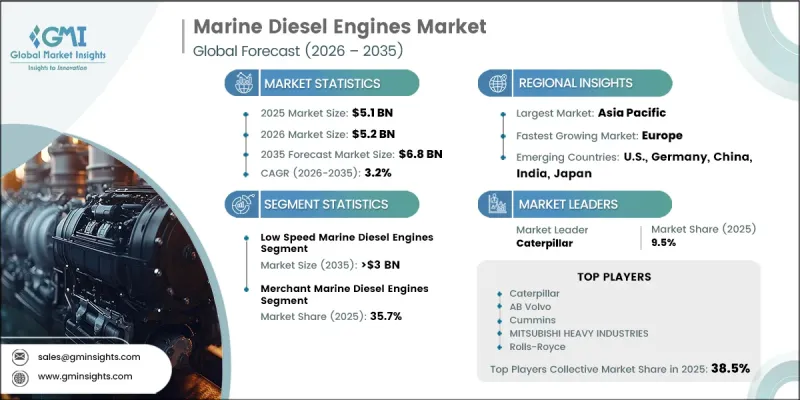
隨著航運業加大減排排放氣體、遵守日益嚴格的環境法規並滿足相關人員不斷變化的期望,船用柴油引擎市場正經歷重大變革。這些變化促使船東、營運商和引擎製造商投資於能夠提高營運效率並降低環境影響的推進技術。船用柴油引擎在全球航運業中繼續發揮至關重要的作用,既提供推進動力,也提供船上發電。國際貿易量的成長、海上運輸網路的擴展以及新航線的開發持續支撐著市場成長。同時,產業相關人員正尋求在提高燃油效率的同時,採用新一代推進解決方案。引擎技術的不斷進步正在推動性能提升,並加速向更清潔的船舶運營模式轉型。此外,海洋能源探勘的增加以及全球對溫室氣體減排日益成長的關注,預計將在預測期內為船用柴油引擎市場創造持續成長的機會。
| 市場範圍 | |
|---|---|
| 開始年份 | 2025 |
| 預測期 | 2026-2035 |
| 上市時的市場規模 | 51億美元 |
| 預測金額 | 68億美元 |
| 複合年成長率 | 3.2% |
預計到2035年,低速船用柴油引擎市場規模將達30億美元。由於其卓越的熱效率和可運作多種燃料的特性,這些引擎仍然是大型商用船舶的最佳選擇。製造商正積極改進這些系統,以適應替代燃料並提升環保性能。持續的技術創新著重於最佳化燃燒過程、提高燃料利用率和減少排放氣體。此外,先進感測器技術、即時監控系統和預測性維護平台的整合有望加速該領域的需求成長。
預計到2025年,商船運輸領域將佔據35.7%的市場。市場擴張主要得益於旨在加強國家海事能力和實現商船隊現代化的投資增加。全球貿易活動的活性化持續推動對配備先進推進系統的商船的需求。此外,可支配收入的增加和人們對海上旅遊日益成長的興趣也支撐著對郵輪和客船的需求。隨著消費者越來越傾向於高階旅行體驗,營運商正在投資技術先進的船舶解決方案,從而進一步促進了該領域的成長。
預計到2025年,美國船用柴油引擎市場規模將達到4.805億美元。憑藉卓越的製造能力、關鍵原料的供應以及成本效益高的生產環境,美國在該領域保持強大的競爭優勢。造船廠正在進行的船舶現代化改造和維修項目,為採用更清潔、更節能的推進技術創造了巨大的機會。隨著航運公司不斷升級船隊以滿足環保和營運要求,預計在整個預測期內,對先進船用柴油引擎的需求將保持強勁。
目錄
第1章:調查方法和範圍
第2章執行摘要
第3章 行業洞察
- 產業生態系分析
- 原物料供應及採購分析
- 生產能力評估
- 供應鏈韌性與風險因素
- 配電網路分析
- 影響產業的因素
- 促進因素
- 產業潛在風險與挑戰
- 監理情勢
- 成長潛力分析
- 波特的分析
- PESTLE分析
- 成本結構分析:船用柴油引擎
- 新機會和趨勢
- 數位化和物聯網整合
- 未開發市場和應用領域的成長
- 投資分析及未來展望
- 價格趨勢分析
- 按地區
- 透過技術
- 貿易數據分析
- 進出口額趨勢
- 主要貿易路線及關稅的影響
- 人工智慧和生成式人工智慧對市場的影響
- 利用人工智慧最佳化生產
- 預測性維護和故障檢測
第4章 競爭情勢
- 介紹
- 企業市佔率分析:按地區分類
- 北美洲
- 歐洲
- 亞太地區
- 中東和非洲
- 拉丁美洲
- 主要市場公司的競爭分析
- 競爭定位矩陣
- 主要進展
- 併購
- 夥伴關係和聯盟
- 新產品發布
- 業務拓展計劃及資金籌措
- 按公司規模進行基準測試
- 排名分類標準與選擇標準
- 按銷售額、地區和創新能力分類的層級定位矩陣。
第5章 市場規模及預測:依技術分類,2022-2035年
- 慢速
- 中速
- 高速
第6章 市場規模/預測:依電力分類,2022-2035年
- 不足1000馬力
- 1,000~5,000 HP
- 5,001~10,000 HP
- 10,001~20,000 HP
- >20,000 HP
第7章 市場規模及預測:依應用領域分類,2022-2035年
- Merchant
- 貨櫃船
- 油船
- 散貨船
- 氣體裝運船隻
- RO-RO
- 其他
- 離岸
- 鑽井鑽機和鑽井船
- 錨作作業船
- 海上支援船
- 浮體式生產設備
- 平台供應船
- 遊輪渡輪
- 郵輪
- 客船
- 客船和貨船
- 其他
- 海軍
- 其他
第8章 市場規模及預測:依地區分類,2022-2035年
- 北美洲
- 美國
- 加拿大
- 歐洲
- 德國
- 英國
- 法國
- 義大利
- 挪威
- 俄羅斯
- 丹麥
- 亞太地區
- 中國
- 日本
- 韓國
- 印度
- 澳洲
- 越南
- 中東和非洲
- UAE
- 沙烏地阿拉伯
- 伊朗
- 安哥拉
- 埃及
- 南非
- 拉丁美洲
- 巴西
- 阿根廷
- 墨西哥
第9章:公司簡介
- AB Volvo
- Anglo Belgian
- Caterpillar
- Cummins
- Daihatsu Diesel
- Deere &Company
- DEUTZ
- Everllence
- HD Hyundai Heavy Industries Engine &Machinery
- IHI Corporation
- Kawasaki Heavy Industries
- MITSUBISHI HEAVY INDUSTRIES
- Rolls-Royce
- Scania
- STX Heavy Industries
- Wabtec Corporation
- Wartsila
- Weichai India
- Yanmar
- Yuchai International
The Global Marine Diesel Engines Market was valued at USD 5.1 billion in 2025 and is estimated to grow at a CAGR of 3.2% to reach USD 6.8 billion by 2035.
The marine diesel engines market is experiencing significant transformation as the maritime industry intensifies efforts to reduce emissions, comply with increasingly stringent environmental regulations, and meet evolving stakeholder expectations. These changes are encouraging shipowners, vessel operators, and engine manufacturers to invest in propulsion technologies that deliver greater operational efficiency while lowering environmental impact. Marine diesel engines continue to serve as a vital component of global shipping operations by providing both propulsion and onboard power generation. Growing international trade volumes, expanding maritime transportation networks, and the development of new shipping corridors continue to support market growth. At the same time, industry participants are pursuing a balance between enhanced fuel efficiency and the adoption of next-generation propulsion solutions. Continuous advancements in engine technologies are improving performance while supporting the transition toward cleaner marine operations. In addition, increasing offshore energy exploration activities and a stronger global focus on greenhouse gas reduction initiatives are expected to create sustained growth opportunities for the marine diesel engines market throughout the forecast period.
| Market Scope | |
|---|---|
| Start Year | 2025 |
| Forecast Year | 2026-2035 |
| Start Value | $5.1 Billion |
| Forecast Value | $6.8 Billion |
| CAGR | 3.2% |
The low-speed marine diesel engines segment is anticipated to reach USD 3 billion by 2035. These engines remain the preferred choice for large commercial vessels due to their superior thermal efficiency and capability to operate on a variety of fuel types. Manufacturers are increasingly redesigning these systems to accommodate alternative fuel options while enhancing environmental performance. Ongoing technological innovation is focused on optimizing combustion processes, improving fuel utilization, and lowering emissions output. Furthermore, the integration of advanced sensor technologies, real-time monitoring systems, and predictive maintenance platforms is expected to accelerate demand across this segment.
The merchant vessel segment accounted for 35.7% share in 2025. Market expansion is supported by rising investments aimed at strengthening national maritime capabilities and modernizing commercial shipping fleets. Increased global trade activity continues to drive demand for merchant vessels equipped with advanced propulsion systems. Additionally, growing disposable incomes and rising interest in marine tourism are supporting demand for cruise and passenger vessels. Consumer preference for premium travel experiences has encouraged operators to invest in technologically advanced marine solutions, contributing further to segment growth.
U.S. Marine Diesel Engines Market was valued at USD 480.5 million in 2025. The country maintains a strong competitive position due to favorable manufacturing capabilities, access to key raw materials, and cost-efficient production environments. Ongoing vessel modernization and retrofit programs across shipyards are creating significant opportunities for the installation of cleaner and more fuel-efficient propulsion technologies. As maritime operators continue upgrading fleets to meet environmental and operational requirements, demand for advanced marine diesel engines is expected to remain strong throughout the forecast period.
Key participants operating in the global marine diesel engines market include AB Volvo, Cummins, Kawasaki Heavy Industries, Wartsila, Caterpillar, Rolls-Royce, HD Hyundai Heavy Industries Engine & Machinery, DEUTZ, Yanmar, Mitsubishi Heavy Industries, Scania, Anglo Belgian, Wabtec Corporation, Daihatsu Diesel, IHI Corporation, Deere & Company, STX Heavy Industries, Weichai India, Everllence, and Yuchai International. Companies operating in the marine diesel engines market are implementing a range of strategic initiatives to strengthen their market position and expand their competitive footprint. A primary focus area is investment in research and development to improve fuel efficiency, reduce emissions, and support compatibility with alternative fuels. Manufacturers are also incorporating digital technologies such as predictive maintenance, remote monitoring, and intelligent engine management systems to enhance operational performance and customer value. Strategic partnerships with shipbuilders, fleet operators, and technology providers are helping companies accelerate product deployment and market penetration.
Table of Contents
Chapter 1 Methodology & Scope
- 1.1 Research approach
- 1.2 Quality commitments
- 1.2.1 GMI AI policy & data integrity commitment
- 1.2.1.1 Source consistency protocol
- 1.2.1 GMI AI policy & data integrity commitment
- 1.3 Research trail & confidence scoring
- 1.3.1 Research trail components
- 1.3.2 Scoring components
- 1.4 Data collection
- 1.4.1 Partial list of primary sources
- 1.5 Data mining sources
- 1.5.1 Paid sources
- 1.5.1.1 Sources, by region
- 1.5.1 Paid sources
- 1.6 Base estimates and calculations
- 1.6.1 Base year calculation for any one approach
- 1.7 Market estimates & forecasts parameters
- 1.8 Forecast model
- 1.8.1 Quantified market impact analysis
- 1.8.1.1 Mathematical impact of growth parameters on forecast
- 1.8.1 Quantified market impact analysis
- 1.9 Research transparency addendum
- 1.9.1 Source attribution framework
- 1.9.2 Quality assurance metrics
- 1.9.3 Our commitment to trust
- 1.10 Market definitions
Chapter 2 Executive Summary
- 2.1 Industry synopsis, 2022 - 2035
- 2.1.1 Business trends
- 2.1.2 Technology trends
- 2.1.3 Power trends
- 2.1.4 Application trends
- 2.1.5 Regional trends
Chapter 3 Industry Insights
- 3.1 Industry ecosystem analysis
- 3.1.1 Raw material availability & sourcing analysis
- 3.1.2 Manufacturing capacity assessment
- 3.1.3 Supply chain resilience & risk factors
- 3.1.4 Distribution network analysis
- 3.2 Industry impact forces
- 3.2.1 Growth drivers
- 3.2.2 Industry pitfalls & challenges
- 3.3 Regulatory landscape
- 3.4 Growth potential analysis
- 3.5 Porter's analysis
- 3.5.1 Bargaining power of suppliers
- 3.5.2 Bargaining power of buyers
- 3.5.3 Threat of new entrants
- 3.5.4 Threat of substitutes
- 3.6 PESTEL analysis
- 3.6.1 Political factors
- 3.6.2 Economic factors
- 3.6.3 Social factors
- 3.6.4 Technological factors
- 3.6.5 Legal factors
- 3.6.6 Environmental factors
- 3.7 Cost structure analysis of marine diesel engines
- 3.8 Emerging opportunities & trends
- 3.9 Digitalization & IoT integration
- 3.10 Growth in untapped markets & applications
- 3.11 Investment analysis & future prospects
- 3.12 Price trend analysis (USD/Unit) (Driven by Primary Research)
- 3.12.1 By region (Driven by Primary Research)
- 3.12.2 By technology (Driven by Primary Research)
- 3.13 Trade data analysis (Driven by Primary Research)
- 3.13.1 Import/export value trends (Driven by Primary Research)
- 3.13.2 Key trade corridors & tariff impact (Driven by Primary Research)
- 3.14 Impact of AI & Generative AI on the market (Driven by Primary Research)
- 3.14.1 AI-Driven production optimization (Driven by Primary Research)
- 3.14.2 Predictive maintenance & fault detection (Driven by Primary Research)
Chapter 4 Competitive Landscape, 2026
- 4.1 Introduction
- 4.2 Company market share analysis, by region, 2025
- 4.2.1 North America
- 4.2.2 Europe
- 4.2.3 Asia Pacific
- 4.2.4 Middle East & Africa
- 4.2.5 Latin America
- 4.3 Competitive analysis of major market players
- 4.4 Competitive positioning matrix
- 4.5 Key developments
- 4.5.1 Mergers & acquisitions
- 4.5.2 Partnerships & collaborations
- 4.5.3 New product launches
- 4.5.4 Expansion plans & funding
- 4.6 Company tier benchmarking
- 4.6.1 Tier classification criteria & qualifying thresholds
- 4.6.2 Tier positioning matrix by revenue, geography & innovation
Chapter 5 Market Size and Forecast, By Technology, 2022 - 2035 (USD Million & Units)
- 5.1 Key trends
- 5.2 Low speed
- 5.3 Medium speed
- 5.4 High speed
Chapter 6 Market Size and Forecast, By Power, 2022 - 2035 (USD Million & Units)
- 6.1 Key trends
- 6.2 < 1,000 HP
- 6.3 1,000 - 5,000 HP
- 6.4 5,001 - 10,000 HP
- 6.5 10,001 - 20,000 HP
- 6.6 > 20,000 HP
Chapter 7 Market Size and Forecast, By Application, 2022 - 2035 (USD Million & Units)
- 7.1 Key trends
- 7.2 Merchant
- 7.2.1 Container vessels
- 7.2.2 Tankers
- 7.2.3 Bulk carriers
- 7.2.4 Gas carriers
- 7.2.5 RO-RO
- 7.2.6 Others
- 7.3 Offshore
- 7.3.1 Drilling rigs & ships
- 7.3.2 Anchor handling vessels
- 7.3.3 Offshore support vessels
- 7.3.4 Floating production units
- 7.3.5 Platform supply vessels
- 7.4 Cruise & ferry
- 7.4.1 Cruise vessels
- 7.4.2 Passenger vessels
- 7.4.3 Passenger/cargo vessels
- 7.4.4 Others
- 7.5 Navy
- 7.6 Others
Chapter 8 Market Size and Forecast, By Region, 2022 - 2035 (USD Million & Units)
- 8.1 Key trends
- 8.2 North America
- 8.2.1 U.S.
- 8.2.2 Canada
- 8.3 Europe
- 8.3.1 Germany
- 8.3.2 UK
- 8.3.3 France
- 8.3.4 Italy
- 8.3.5 Norway
- 8.3.6 Russia
- 8.3.7 Denmark
- 8.4 Asia Pacific
- 8.4.1 China
- 8.4.2 Japan
- 8.4.3 South Korea
- 8.4.4 India
- 8.4.5 Australia
- 8.4.6 Vietnam
- 8.5 Middle East & Africa
- 8.5.1 UAE
- 8.5.2 Saudi Arabia
- 8.5.3 Iran
- 8.5.4 Angola
- 8.5.5 Egypt
- 8.5.6 South Africa
- 8.6 Latin America
- 8.6.1 Brazil
- 8.6.2 Argentina
- 8.6.3 Mexico
Chapter 9 Company Profiles
- 9.1 AB Volvo
- 9.2 Anglo Belgian
- 9.3 Caterpillar
- 9.4 Cummins
- 9.5 Daihatsu Diesel
- 9.6 Deere & Company
- 9.7 DEUTZ
- 9.8 Everllence
- 9.9 HD Hyundai Heavy Industries Engine & Machinery
- 9.10 IHI Corporation
- 9.11 Kawasaki Heavy Industries
- 9.12 MITSUBISHI HEAVY INDUSTRIES
- 9.13 Rolls-Royce
- 9.14 Scania
- 9.15 STX Heavy Industries
- 9.16 Wabtec Corporation
- 9.17 Wartsila
- 9.18 Weichai India
- 9.19 Yanmar
- 9.20 Yuchai International


