

 |
市場調查報告書
商品編碼
2071292
智慧背包市場機會、成長要素、產業趨勢分析及2026-2035年預測Smart Backpack Market Opportunity, Growth Drivers, Industry Trend Analysis, and Forecast 2026 - 2035 |
||||||

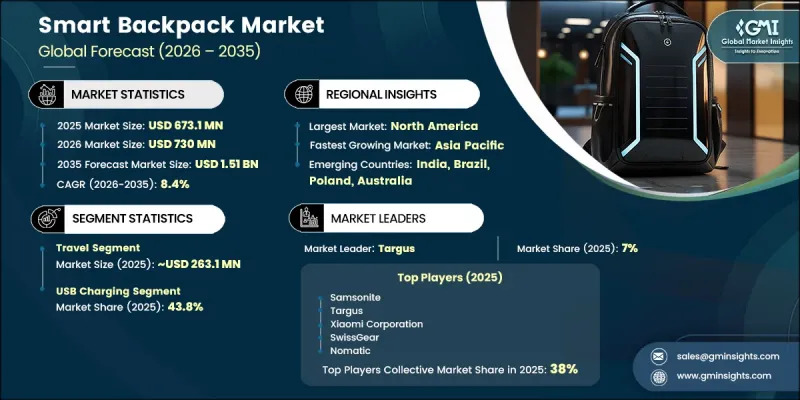
全球智慧背包市場預計到 2025 年將達到 6.731 億美元,年複合成長率為 8.4%,到 2035 年將達到 15.1 億美元。
市場成長的驅動力來自於生活方式的結構性轉變,包括混合辦公模式的建立、全球旅行活動的復甦以及智慧紡織品整合和嵌入式電子系統的快速發展。在輕量化材料、模組化設計和嵌入式電子元件的持續創新推動下,智慧背包正從單純的實用產品轉向技術驅動的生活方式配件。對耐用性和永續性的日益重視進一步改變了產品開發策略,尤其是在製造商將再生布料與剛性面板和防護框架系統等增強結構組件相結合的情況下。對材料透明度和永續性法規的日益關注也影響著競爭格局,要求品牌證明其原料來源的可追溯性和環保生產。隨著消費者對多功能、技術整合的生活風格產品的期望不斷提高,智慧背包正成為更廣泛的穿戴式和可攜式電子產品生態系統中的關鍵細分市場。
| 市場範圍 | |
|---|---|
| 開始年份 | 2025 |
| 預測期 | 2026-2035 |
| 上市時的市場規模 | 6.731億美元 |
| 預測金額 | 15.1億美元 |
| 複合年成長率 | 8.4% |
預計到2025年,旅行應用市佔率將達到39.1%,市場規模將達2.631億美元。推動這一領域需求成長的因素包括日益成長的行動出行趨勢以及消費者對旅行配件高級功能的期望不斷提高。使用者越來越重視整合充電解決方案、有序的電子設備收納、防盜功能以及更符合人體工學的設計。隨著全球旅行行為的持續復甦,對技術增強型便攜解決方案的需求預計將保持強勁,尤其是在經常出差旅行的人士和需要在旅途中獲得可靠設備支援的專業人士中。
預計到2025年,智慧鎖市場佔有率將達到17.9%,並在2035年之前以9.1%的複合年成長率成長。在消費者對增強型個人安全功能的偏好日益成長的推動下,智慧鎖正成為產品創新的核心領域。人們越來越關注旅行和日常通勤期間設備的安全性和防盜問題,這促進了智慧鎖的普及。配備智慧鎖的背包整合了數位鎖定機制和增強型安全技術,有助於提升用戶安心感,並增強產品吸引力。嵌入式安全系統的持續進步預計將進一步提升高階和中階產品類型對智慧鎖的需求。
預計到2025年,北美智慧背包市場規模將達到2.501億美元,市佔率將達37.1%。在消費者對高階生活方式配件的強勁支出以及科技整合產品的高滲透率的支撐下,該地區預計將在整個預測期內保持穩定成長。美國憑藉其完善的數位零售基礎設施、較高的消費性電子產品滲透率以及都市區強大的購買力,繼續引領區域需求。商務人士、學生和經常出差的人士對多功能攜帶解決方案的偏好日益成長,進一步鞏固了該地區在全球市場的主導地位。
目錄
第1章:調查方法
第2章執行摘要
第3章 行業洞察
- 產業生態系分析
- 影響價值鏈的因素
- 利潤率分析
- 中斷
- 前景
- 製造商
- 中斷
- 供應商情況
- 主要新聞和舉措
- 技術與創新展望
- 監理情勢
- 影響因素
- 促進因素
- 產業潛在風險與挑戰
- 機會
- 2025年價格分析
- 2022-2025年歷史價格趨勢分析
- 依球員類型分類的定價策略(高級球員、超值球員、成本加成球員)
- 區域價格波動分析
- 成長潛力分析
- 波特的分析
- PESTLE分析
- 貿易數據分析
- 進出口量及進口額趨勢
- 主要貿易路線及關稅的影響
- 人工智慧和生成式人工智慧對市場的影響
- 利用人工智慧改造現有經營模式
- 按細分市場分類的生成式人工智慧用例和部署藍圖
- 風險、限制和監管考量
- 生產能力和生產情況
- 設備產能:按地區和主要生產商分類
- 運轉率和擴張計劃
第4章 競爭情勢
- 介紹
- 企業市佔率分析
- 競爭定位矩陣
- 戰略展望矩陣
- 主要市場公司的競爭分析
- 主要進展
- 併購
- 夥伴關係和聯盟
- 新產品發布
- 業務拓展計劃
第5章 市場估計與預測:依類型分類,2022-2035年
- 旅行背包
- 休閒背包
- 筆記型電腦背包
- 其他
第6章 市場估計與預測:依技術分類,2022-2035年
- USB充電
- 太陽能
- 相容物聯網
- 智慧鎖系統
- 感應器
- 其他
第7章 市場估計與預測:依產能分類,2022-2035年
- 少於30公升
- 30-40升
- 40公升或以上
第8章 市場估算與預測:依材料分類,2022-2035年
- 聚酯纖維
- 尼龍
- 皮革
- 其他
第9章 市場估計與預測:依殼類型分類,2022-2035年
- 硬殼
- 軟殼
第10章 市場估價與預測:依價格分類,2022-2035年
- 低的
- 中等的
- 高的
第11章 市場估價與預測:依通路分類,2022-2035年
- 線上
- 電子商務網站
- 企業網站
- 離線
- 專賣店
- 超級市場和大賣場
- 其他
第12章 市場估計與預測:依地區分類,2022-2035年
- 北美洲
- 美國
- 加拿大
- 歐洲
- 德國
- 英國
- 法國
- 義大利
- 西班牙
- 亞太地區
- 中國
- 印度
- 日本
- 韓國
- 澳洲
- 拉丁美洲
- 巴西
- 墨西哥
- 阿根廷
- 中東和非洲
- UAE
- 沙烏地阿拉伯
- 南非
第13章:公司簡介
- 世界公司
- Targus
- Samsonite
- Xiaomi Corporation
- SwissGear
- Nomatic
- Nordace
- Osprey
- 當地公司
- Timbuk2
- Korin Design
- XD Design
- Pacsafe
- Matein
- Herschel Supply Co.
- Peak Design
- 新興企業
- Bopai
- Modoker
- Kopack
- Mancro
- Bagsmart
- Voltaic Systems
- Incase
The Global Smart Backpack Market was valued at USD 673.1 million in 2025 and is estimated to grow at a CAGR of 8.4% to reach USD 1.51 billion by 2035.
Market growth is driven by structural lifestyle shifts, including the normalization of hybrid working models, the recovery of global travel activity, and rapid advancements in smart textile integration and embedded electronic systems. The category is transitioning from a standard utility product into a technology-enabled lifestyle accessory, supported by continuous innovation in lightweight materials, modular design architecture, and embedded electronic components. Rising emphasis on durability and sustainability is further reshaping product development strategies, particularly as manufacturers integrate recycled fabrics with reinforced structural components such as rigid panels and protective framing systems. Increasing regulatory focus on material transparency and sustainability compliance is also influencing competitive dynamics, with brands increasingly required to demonstrate traceable sourcing and environmentally responsible production. As consumer expectations evolve toward multifunctional, tech-integrated lifestyle goods, smart backpacks are becoming a key segment within the broader wearable and portable electronics ecosystem.
| Market Scope | |
|---|---|
| Start Year | 2025 |
| Forecast Year | 2026-2035 |
| Start Value | $673.1 Million |
| Forecast Value | $1.51 Billion |
| CAGR | 8.4% |
The travel application segment held a 39.1% share, valued at USD 263.1 million in 2025. Demand in this category is being driven by increased mobility trends and rising consumer expectations for advanced functionality in travel accessories. Users are increasingly prioritizing integrated charging solutions, organized storage for electronic devices, anti-theft protection features, and improved ergonomic design. As travel behavior continues to recover globally, the demand for technologically enhanced carry solutions is expected to remain strong, particularly among frequent travelers and digital professionals who require reliable device support on the move.
The smart locks segment accounted for 17.9% share in 2025 and is projected to grow at a CAGR of 9.1% through 2035. This segment occupies a growing mid-tier position within product innovation, driven by increasing consumer preference for enhanced personal security features. Adoption is being supported by rising concerns around device safety and theft prevention during travel and daily commuting. Smart lock-enabled backpacks integrate digital locking mechanisms and security reinforcement technologies that improve user confidence and product appeal. Continued advancements in embedded security systems are expected to further strengthen demand for this segment across both premium and mid-range product categories.
North America Smart Backpack Market generated USD 250.1 million in 2025 accounting for 37.1% share. The region is expected to maintain steady growth throughout the forecast period, supported by strong consumer spending on premium lifestyle accessories and high adoption of technology-integrated products. The United States continues to lead regional demand due to its well-established digital retail infrastructure, strong penetration of consumer electronics, and high purchasing power among urban populations. Growing preference for multifunctional carry solutions among professionals, students, and frequent travelers continues to reinforce the region's dominant position in the global market.
Major companies operating in the Global Smart Backpack Market include Peak Design, Nomatic, Samsonite, Targus, Osprey, Herschel Supply Co., XD Design, Pacsafe, Xiaomi Corporation, Incase, Timbuk2, SwissGear, Voltaic Systems, Nordace, Bagsmart, Kopack, Korin Design, Bopai, Mancro, Matein, and Modoker. Companies in the smart backpack market are focusing on innovation-driven strategies to strengthen their competitive position and expand global reach. Product differentiation through integrated technology features such as charging systems, GPS tracking, and advanced security mechanisms is a key priority. Manufacturers are also investing in lightweight, durable, and sustainable materials to align with evolving consumer expectations and regulatory requirements. Expansion of direct-to-consumer sales channels and digital retail platforms is enabling brands to improve accessibility and strengthen customer engagement. Strategic collaborations with technology providers are supporting the integration of smarter electronic components and enhancing product functionality.
Table of Contents
Chapter 1 Research Methodology
- 1.1 Research approach
- 1.2 Quality Commitments
- 1.2.1 GMI AI policy & data integrity commitment
- 1.2.1.1 Source consistency protocol
- 1.2.1 GMI AI policy & data integrity commitment
- 1.3 Research Trail & Confidence Scoring
- 1.3.1 Research Trail Components
- 1.3.2 Scoring Components
- 1.4 Data Collection
- 1.4.1 Partial list of primary sources
- 1.5 Data mining sources
- 1.5.1 Paid sources
- 1.5.1.1 Sources, by region
- 1.5.1 Paid sources
- 1.6 Base estimates and calculations
- 1.6.1 Base year calculation for any one approach
- 1.7 Forecast model
- 1.7.1 Quantified market impact analysis
- 1.7.1.1 Mathematical impact of growth parameters on forecast
- 1.7.1 Quantified market impact analysis
- 1.8 Research transparency addendum
- 1.8.1 Source attribution framework
- 1.8.2 Quality assurance metrics
- 1.8.3 Our commitment to trust
Chapter 2 Executive Summary
- 2.1 Industry 360° synopsis, 2022 - 2035
- 2.2 Key market trends
- 2.2.1 Regional
- 2.2.2 Type
- 2.2.3 Technology
- 2.2.4 Capacity
- 2.2.5 Shell Type
- 2.2.6 Material
- 2.2.7 Price
- 2.2.8 Product
- 2.2.9 Distribution Channel
Chapter 3 Industry Insights
- 3.1 Industry ecosystem analysis
- 3.1.1 Factor affecting the value chain
- 3.1.2 Profit margin analysis
- 3.1.3 Disruptions
- 3.1.4 Future outlook
- 3.1.5 Manufacturers
- 3.1.6 Distributors
- 3.2 Supplier landscape
- 3.3 Key news & initiatives
- 3.4 Technology & Innovation Landscape
- 3.5 Regulatory landscape
- 3.6 Impact on forces
- 3.6.1 Growth drivers
- 3.6.2 Industry pitfalls & challenges
- 3.6.3 Opportunities
- 3.7 Pricing analysis, 2025 (driven by primary research)
- 3.7.1 Historical price trend analysis (2022-2025)
- 3.7.2 Pricing strategy by player type (premium/value/cost-plus)
- 3.7.3 Regional price variation analysis
- 3.8 Growth potential analysis
- 3.9 Porter's analysis
- 3.10 PESTEL analysis
- 3.11 Trade data analysis (driven by paid database)
- 3.11.1 Import/export volume & value trends (Driven by Primary Research)
- 3.11.2 Key trade corridors & tariff impact (Driven by Primary Research)
- 3.12 Impact of AI & generative AI on the market
- 3.12.1 AI-driven disruption of existing business models
- 3.12.2 GenAI use cases & adoption roadmap by segment
- 3.12.3 Risks, limitations & regulatory considerations
- 3.13 Capacity & Production Landscape (Driven by Primary Research)
- 3.13.1 Installed Capacity by Region & Key Producer (Driven by Primary Research)
- 3.13.2 Capacity Utilization Rates & Expansion Pipelines (Driven by Primary Research)
Chapter 4 Competitive Landscape, 2025
- 4.1 Introduction
- 4.2 Company market share analysis
- 4.3 Competitive positioning matrix
- 4.4 Strategic outlook matrix
- 4.5 Competitive analysis of major market players
- 4.6 Key developments
- 4.6.1 Mergers & acquisitions
- 4.6.2 Partnerships & collaborations
- 4.6.3 New product launches
- 4.6.4 Expansion plans
Chapter 5 Market Estimates & Forecast, By Type, 2022-2035 (USD Million) (Million Units)
- 5.1 Key trends
- 5.2 Travel backpack
- 5.3 Casual backpack
- 5.4 Laptop backpack
- 5.5 Others
Chapter 6 Market Estimates & Forecast, By Technology, 2022-2035 (USD Million) (Million Units)
- 6.1 Key trends
- 6.2 USB charging
- 6.3 Solar-powered
- 6.4 IoT-enabled
- 6.5 Smart locking systems
- 6.6 Sensors
- 6.7 Others
Chapter 7 Market Estimates & Forecast, By Capacity, 2022-2035 (USD Million) (Million Units)
- 7.1 Key trends
- 7.2 Below 30 Liters
- 7.3 30-40 Liters
- 7.4 Above 40 Liters
Chapter 8 Market Estimates & Forecast, By Material, 2022-2035 (USD Million) (Million Units)
- 8.1 Key trends
- 8.2 Polyester
- 8.3 Nylon
- 8.4 Leather
- 8.5 Others
Chapter 9 Market Estimates & Forecast, By Shell Type, 2022-2035 (USD Million) (Million Units)
- 9.1 Key trends
- 9.2 Hard shell
- 9.3 Soft shell
Chapter 10 Market Estimates & Forecast, By Price, 2022-2035 (USD Million) (Million Units)
- 10.1 Key trends
- 10.2 Low
- 10.3 Medium
- 10.4 High
Chapter 11 Market Estimates & Forecast, By Distribution Channel, 2022-2035 (USD Billion) (Million Units)
- 11.1 Key trends
- 11.2 Online
- 11.2.1 E-commerce site
- 11.2.2 Company website
- 11.3 Offline
- 11.3.1 Specialty stores
- 11.3.2 Supermarkets/Hypermarkets
- 11.3.3 Others
Chapter 12 Market Estimates & Forecast, By Region, 2022 - 2035, (USD Million) (Million Units)
- 12.1 Key trends
- 12.2 North America
- 12.2.1 U.S.
- 12.2.2 Canada
- 12.3 Europe
- 12.3.1 Germany
- 12.3.2 U.K.
- 12.3.3 France
- 12.3.4 Italy
- 12.3.5 Spain
- 12.4 Asia Pacific
- 12.4.1 China
- 12.4.2 India
- 12.4.3 Japan
- 12.4.4 South Korea
- 12.4.5 Australia
- 12.5 Latin America
- 12.5.1 Brazil
- 12.5.2 Mexico
- 12.5.3 Argentina
- 12.6 MEA
- 12.6.1 UAE
- 12.6.2 Saudi Arabia
- 12.6.3 South Africa
Chapter 13 Company Profiles (Business Overview, Financial Data, Product Landscape, Strategic Outlook, SWOT Analysis)
- 13.1 Global players
- 13.1.1 Targus
- 13.1.2 Samsonite
- 13.1.3 Xiaomi Corporation
- 13.1.4 SwissGear
- 13.1.5 Nomatic
- 13.1.6 Nordace
- 13.1.7 Osprey
- 13.2 Regional players
- 13.2.1 Timbuk2
- 13.2.2 Korin Design
- 13.2.3 XD Design
- 13.2.4 Pacsafe
- 13.2.5 Matein
- 13.2.6 Herschel Supply Co.
- 13.2.7 Peak Design
- 13.3 Emerging players
- 13.3.1 Bopai
- 13.3.2 Modoker
- 13.3.3 Kopack
- 13.3.4 Mancro
- 13.3.5 Bagsmart
- 13.3.6 Voltaic Systems
- 13.3.7 Incase

 太陽能背包市場規模、佔有率和成長分析:按產品類型、電池容量、應用、最終用戶、分銷管道和地區分類 - 產業預測,2026-2033年
 背包市場報告:趨勢、預測和競爭分析(至2035年)
 環保背包市場機會、成長要素、產業趨勢分析及2026-2035年預測
 背包市場:依材質、容量範圍、銷售管道、應用程式和最終用戶分類-2026-2032年全球市場預測
 全球相機背包市場規模、佔有率、趨勢和成長分析報告(2026-2034年)全球智慧背包市場規模、佔有率、趨勢和成長分析報告(2026-2034年)背包市場規模、佔有率、成長及全球產業分析:按類型、應用和地區分類的洞察,2026-2034 年預測
 時尚背包市場-全球產業規模、佔有率、趨勢、機會、預測:按類型、應用、地區和競爭格局分類,2021-2031年環保背包市場-全球產業規模、佔有率、趨勢、機會、預測:按產品類型、材料、地區和競爭格局分類,2021-2031年狗背包市場按產品類型、材質、價格範圍和尺寸分類-2026-2032年全球預測